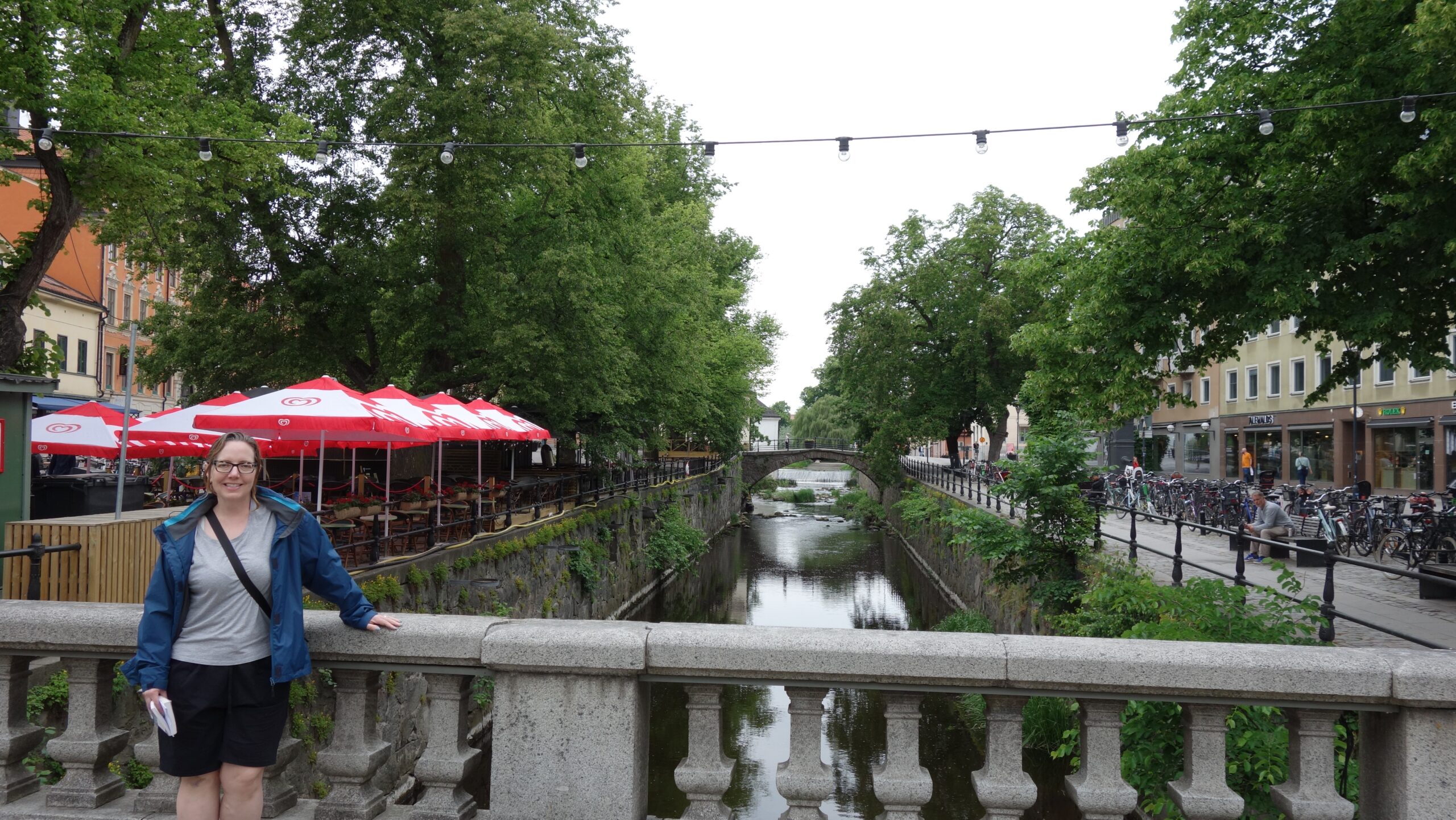
 Students are convinced that teachers spend all summer thinking about school and maybe even living at school and counting the days down until school starts. That’s obvious nonsense, as this vacation gives testimony to. For instance, today we went to Uppsala, home of Sweden’s oldest, um, school (university).
Meredith has been good to me this front end of the vacation by letting me be car-free. We took a boat two days ago, a train yesterday, and another train today to get to places outside of Stockholm. It probably would have been more efficient and more or less a wash on cost if we’d had a car, but then I’d have to keep dealing with Stockholm traffic and parking. I’m grateful for the peaceful transportation options we’ve been using.
We arrived at Uppsala right around 10:00 and set off walking into the town from the train station. We very quickly hit a pedestrian-only street that led to a large main square area. The town was a bit larger than I had anticipated, but the walk through the center of town was pleasant. We kept going, and suddenly a huge church hove into view. I said, “Whoa!” and Mer replied, “That ‘whoa!” is what we’re here to see.”
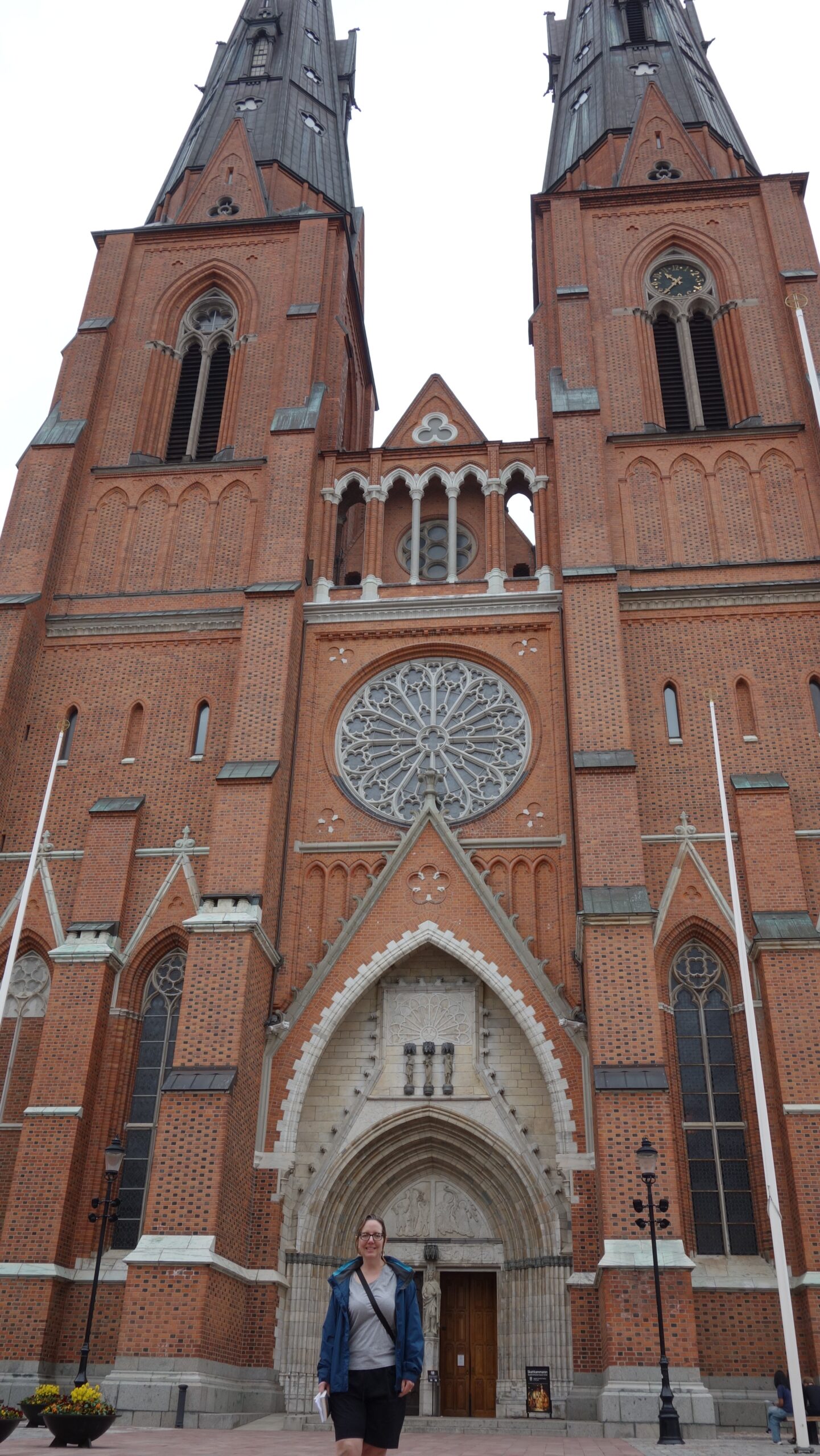 We were looking at the towering red-brick Uppsala Cathedral, tallest church in the Nordic countries, which was started a little before 1300. It has two front spires that are each over thirty feet tall, reaching over 380 feet in the sky. The spire over the transept of the church isn’t much smaller, which makes it a “whoa!” sight to see.
Happily, the cathedral is free to enter, even on a weekday. It does cost a fee to go see the treasury, which we did later, but I have no issue with that if it helps with the maintenance of the church. The interior is decorated, especially the pulpit, which is wildly ornate with Biblical stories and various cherubs about.
There are side chapels along both walls. One has the tomb of an early Swedish queen, and one has the tomb of the Swedish botanist Carl Linnaeus. There was a chapel used as a children’s teaching area, and one was set up as a comfortable office for drop-by counseling. My favorite was an installation of a simple representation of Jesus surrounded by several children and some parents. It was clearly from the “Bring the little children to me and hinder them not” passage of the Bible. It was cheerful and colorful and well done. And there was a barricade across the entrance. These things make me smile.
One chapel was set up to display a video from a video artist. The church had bought the piece, and I had never thought about video art being sold before. It was a moving video of two women, out of focus and filmed in black and white, crossing through a sheet of water. Once through the water, they were in color and in sharp focus. They were both joyful and then started looking sad, and then went back through the water to the grey. Mer and I thought it represented moments of being very close to God but then having to come back to being in this world every day to keep doing God’s work. As Paul said, “For to me, to live is Christ and to die is gain” – serving Jesus here is important, but being with Jesus after death is actually a gain (is better). It was a thoughtful exhibit, and I love that churches are still buying art.
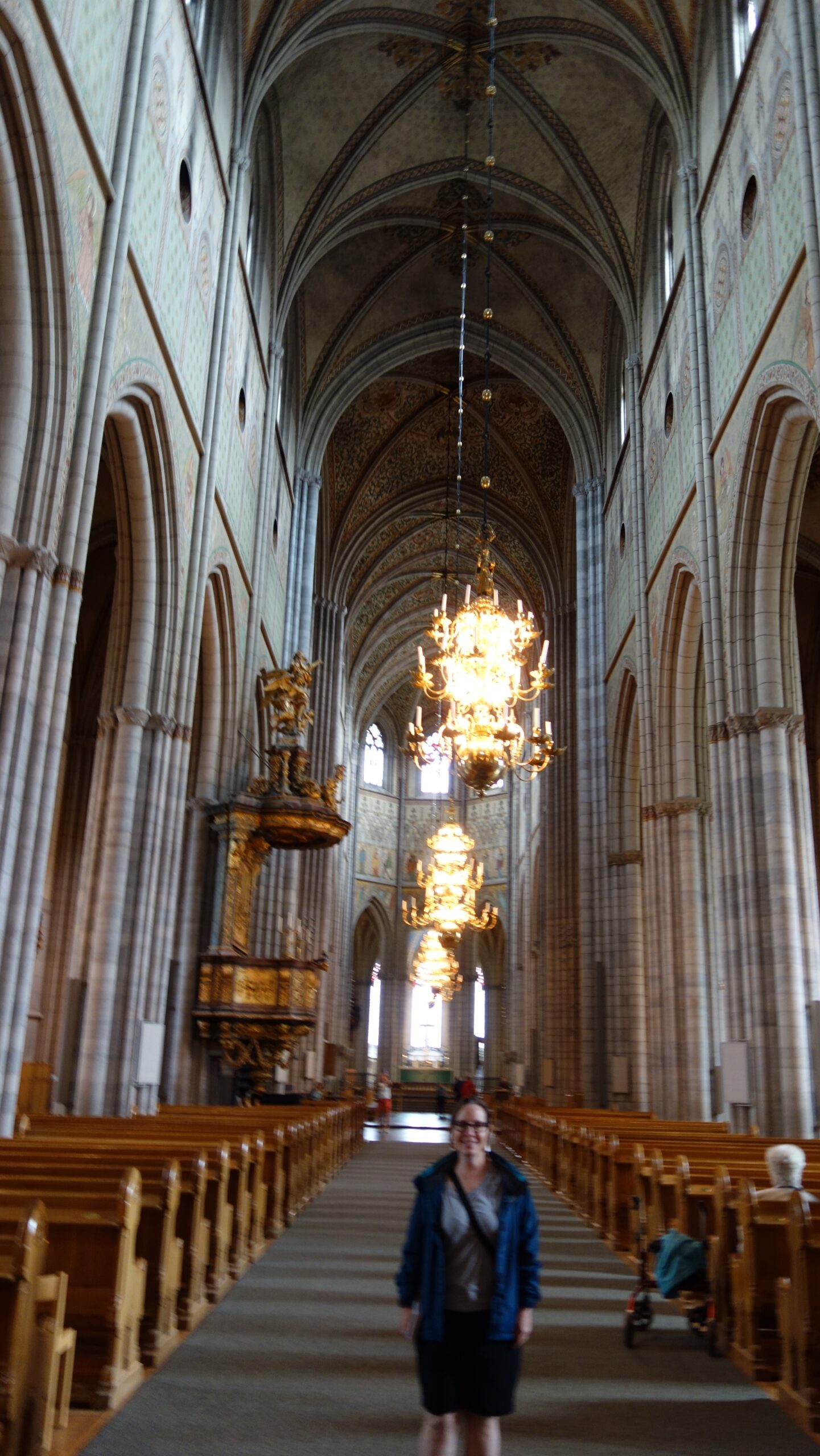 Toward the back of the church was a tomb of one of the kings of Sweden, buried along with his two wives (the first one died relatively young). Outside the tomb was a representation of a normal-looking woman who looked a bit worn and sad. This was a work by an artist who wanted to show Mary looking in on a chapel after seeing her son die. Again, a very effective work. No crown of heaven or being borne on angels to heaven – just a woman who was in pain.
Having wrapped up seeing the church, we paid to see the treasury, which was in one of the spire towers, seven floors up, and then coming down to the six and then fifth floor. We took the elevator up, and we were given flashlights so we could see the artifacts more closely in the dim light.
Most of the objects were fabric – old church vestments, mostly. But they were incredibly elaborate and decorated with gold and silver thread and sometimes pearls. It had to have held poor illiterate peasants in awe to see a bishop come out in these clothes. Almost all had some story from the Bible woven in to them, so they could be used to remind people of the important messages of the Bible.
There were also some standard church objects – crosses, chalices (including the most heavily decorated chalice I’ve ever seen), swords and crowns from royal tombs, and so on.
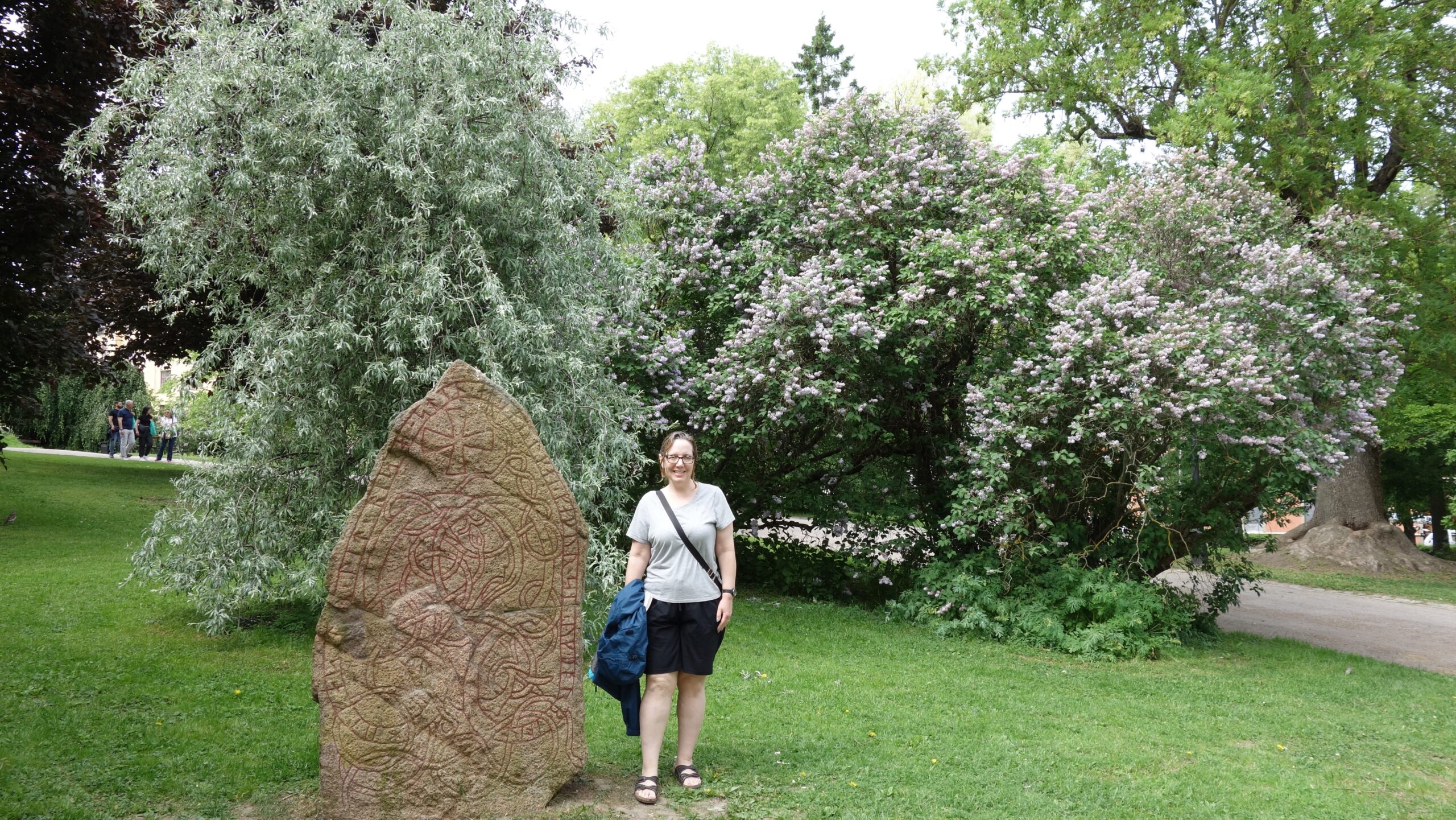 After the church, we crossed the street to go look at the university museum, the Gustavianum. But we got distracted at looking at five rune stones in the park in front. And then we discovered there was an English-language tour in forty-five minutes at 1:00, so we beat a hasty retreat back to the cathedral cafeteria for lunch.
After lunch, we still had twenty minutes before the tour began, so we looked in on the museum’s pre-Viking exhibit on the Vendel culture that lasted a couple of hundred years before the Vikings (from about 500 to 800). The most important objects were for us four Vendel helmets recovered from graves. Vikings didn’t bury helmets, so they are quite rare, with only five known. We saw four today, and the fifth is in the British Museum, and we’ve seen it too, so we collected them all. The British Museum one is pictured in Meredith’s British literature book for her classes for when she teaches Beowulf. Now we’ve seen them all.
There were only four of us on the tour – us and a British couple who now live in New Zealand. That was a fun-sized group. We were taken around by Sara, who is studying Museum Studies at the university. She took us to a case of banned hazing tools from the 1600s and told us about the history of the school (and how it was founded two years before the rival Danes’ school in Copenhagen). From there, she took us up a floor to the art wings.
 The Gustavianum has the second-largest art collection in Sweden, after only the national museum. They can only have about five percent on display at any time. One piece that is always on display is a huge curiosity cabinet that had been used to store thousands of items from nature and cultures around the world. It’s about ten feet high and weighs almost two thousand pounds. Most of the items that had been in it are on display, except for some of the natural specimens that eighteenth-century scientists lost track of. Oooops.
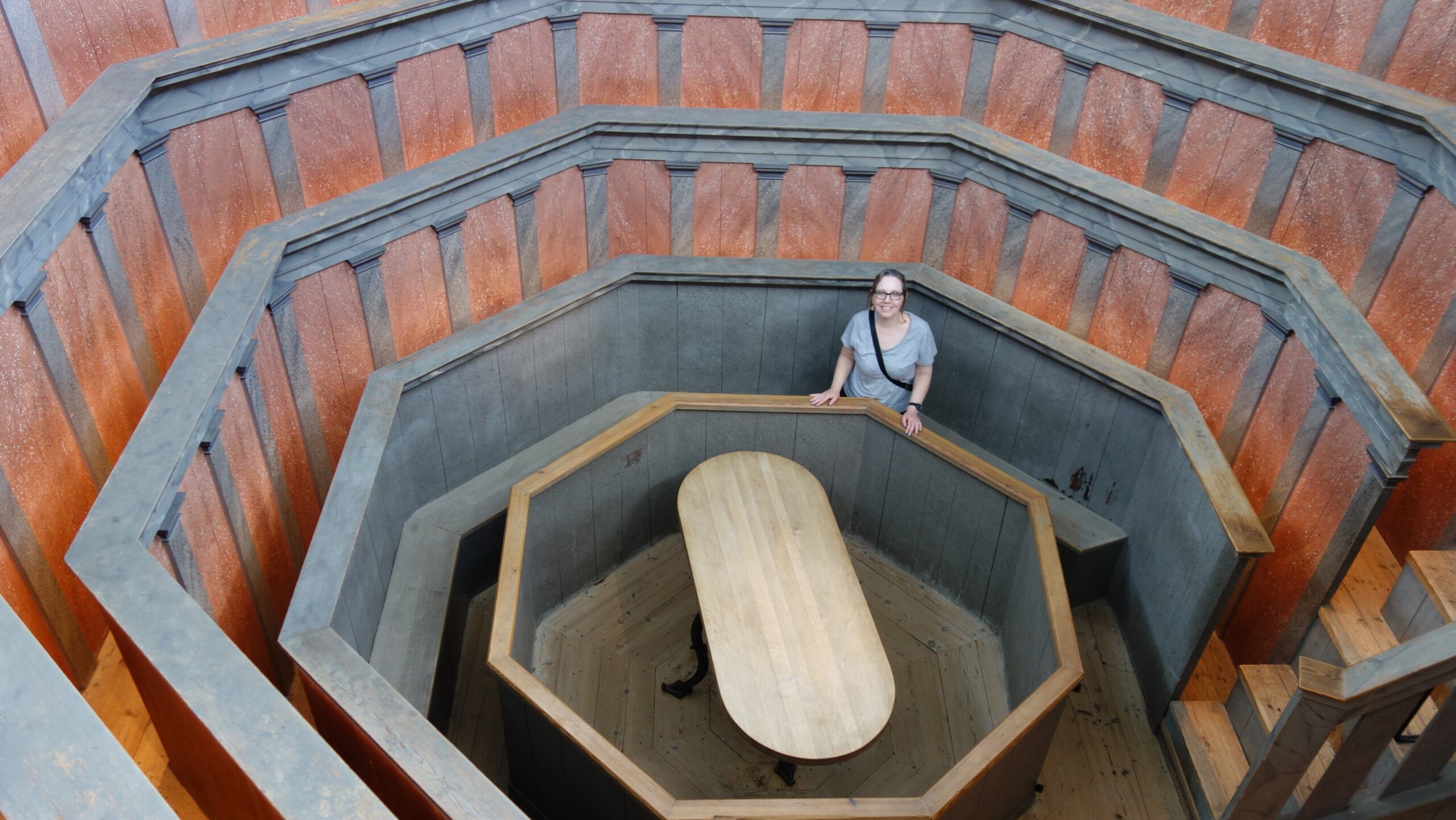
From there, we went to the operating theater. This was a reconstruction (in place) of a 1600s lecture hall dedicated to dissection of human corpses to teach medicine. Mostly. It seems some tickets were also sold to the public to help defray costs. Because cutting up human bodies was controversial, the university and church agreed that they could only dissect criminals, suicides, and bastards. The university did give the body a proper burial on university grounds when they were finished with each dissection.
After our tour, we went back and finished all the rooms we had skipped. The university has Celsius’ first thermometer, which oddly had zero degrees as the temperature of boiling water and one hundred degrees as the temperature of freezing water. I’m not sure of the reasoning there, but it got fixed at some point. There were many other scientific instruments in that wing, including early telescopes and microscopes, and various early instruments to study electricity. I quite liked it.
We finished up with the two art wings. A Swedish playwright that Meredith knows of also turned out to be a pretty decent painter, and Carl III was a very good painter of landscapes himself. The museum had one small Rodin work, and an eclectic collection of landscapes, still lifes, and portraits.
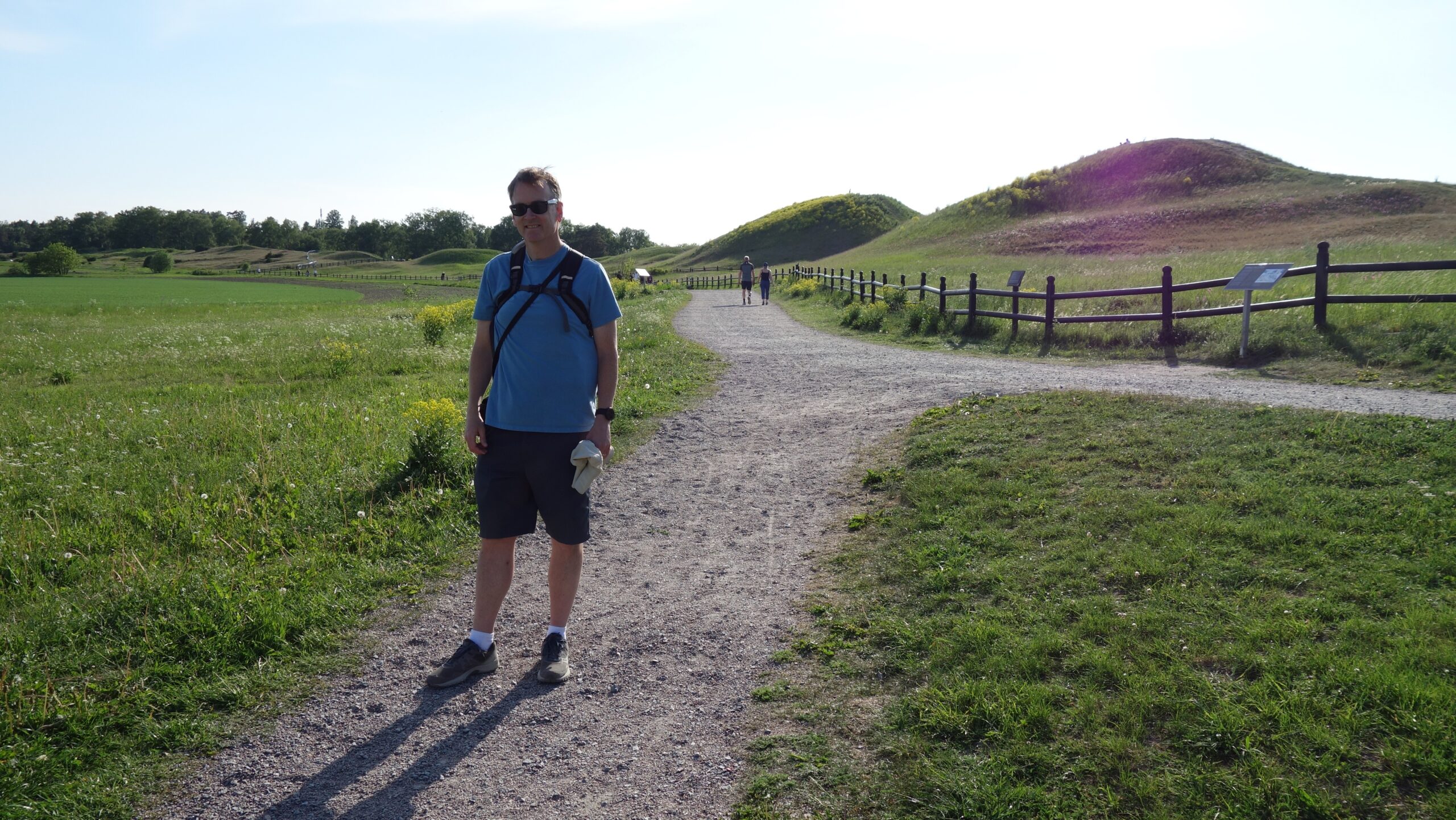 From the museum, after a false start on finding where to buy tickets, we got on the bus out to the very edge of town, to go to Gamla Uppsala. We got out, and I saw a large hill, and Mer said that that was where we were going. The large hill was joined by two other hills and several smaller ones as we came up to them. These were all ancient burial mounds, from around 600. With enough money and influence, local leaders could have seventy or more serfs pile up a hill over the gravesite. Since these were visible from all over the area, it was a display of wealth and power. These hills also became the site for the local sort-of parliament (“Thing”) to gather once a year to make decisions and give out justice, during festivals. We walked around all the hills and read all of the info placards.
 The placards kept cracking us up. They would make unsubstantiated claims, and then put a question mark at the end to over their bases – “Could it be this flat area was used for horse races?” and so on. It amused us.
And so we headed back into Uppsala, then to the train station, and back to Stockholm, where we got a late supper around 8:00. We learned a bunch of things to day. The students wouldn’t be shocked.
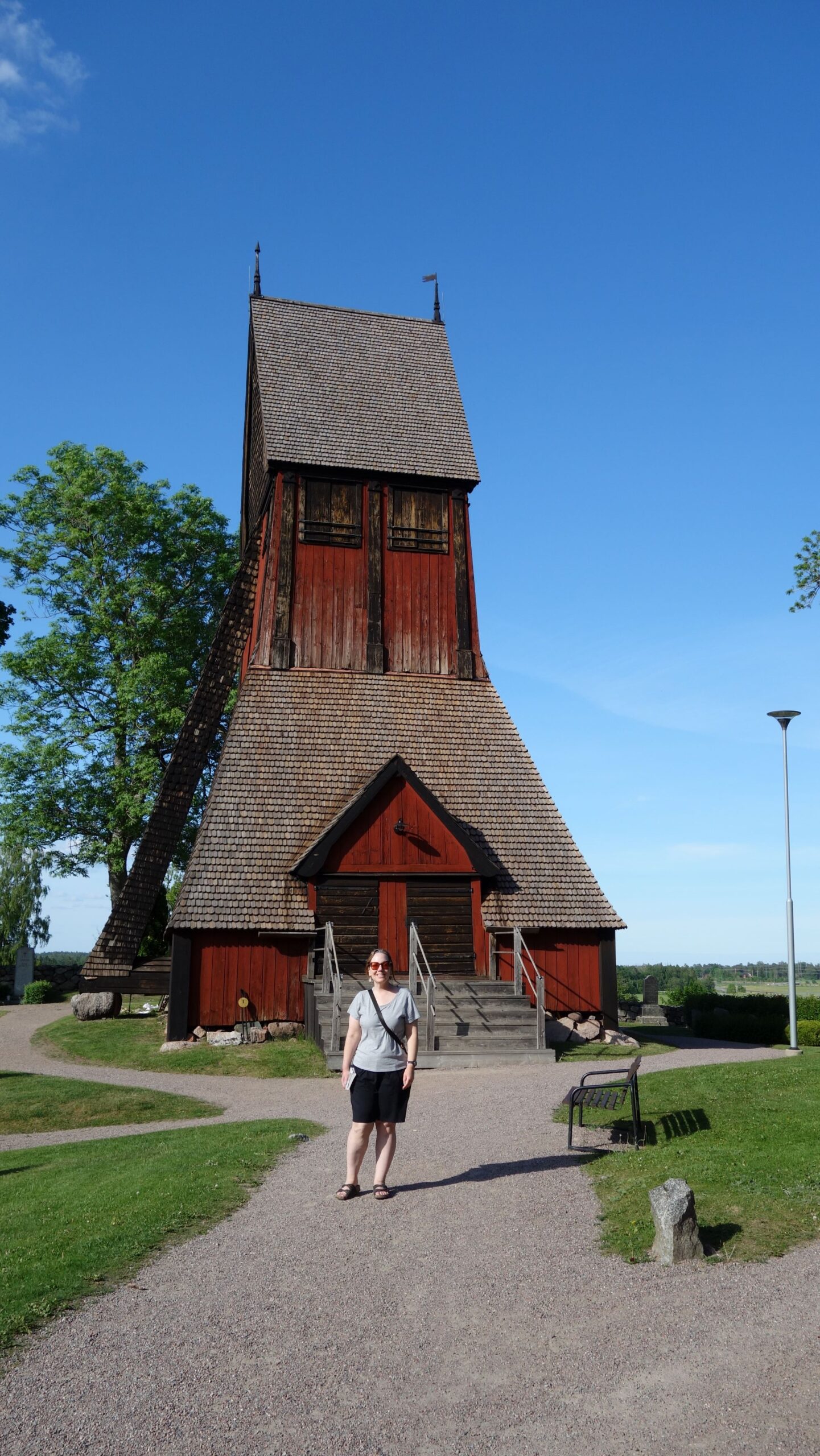
What is the last building where Meredith is standing? It’s sad that children of unwed mothers were discriminated against as bastards; they didn’t do anything wrong. I think as a youngster, I probably thought that teachers (at least the ones whom I liked) just had fun all summer; I don’t think I would have thought they studied all summer.
She’s standing in front of a detached bell tower; this one was in Gamma Uppsala, but we saw one like it at the folk museum.