 About a week ago I started looking at the weather for this trip, and it was supposed to rain all week starting today. That was going to be challenging, especially when I looked up the weather in southern Portugal (where we were last year) and it was partly sunny and 67 degrees every day. Let’s say it’s good that I have a tourisitcally … focused wife who wanted to do the north, and we also had a couple of paid-for hotels.
Given that, I was very pleased when the forecast for our destination city of Coimbra said that the rain would end around 10:00 am and then maybe have a sprinkle around 2:00. Otherwise, dry. Huzzah! Touring is much more pleasant when not getting wet.
 It turns out the forecast was somewhat optimistic. We ended up with a weird weather day of rain and then sprinkles and then light rain and then sun and then light rain while the sun was out, and so on. Still, the real rain never lasted more than a few minutes, and so we were able to tour on today pretty effectively.
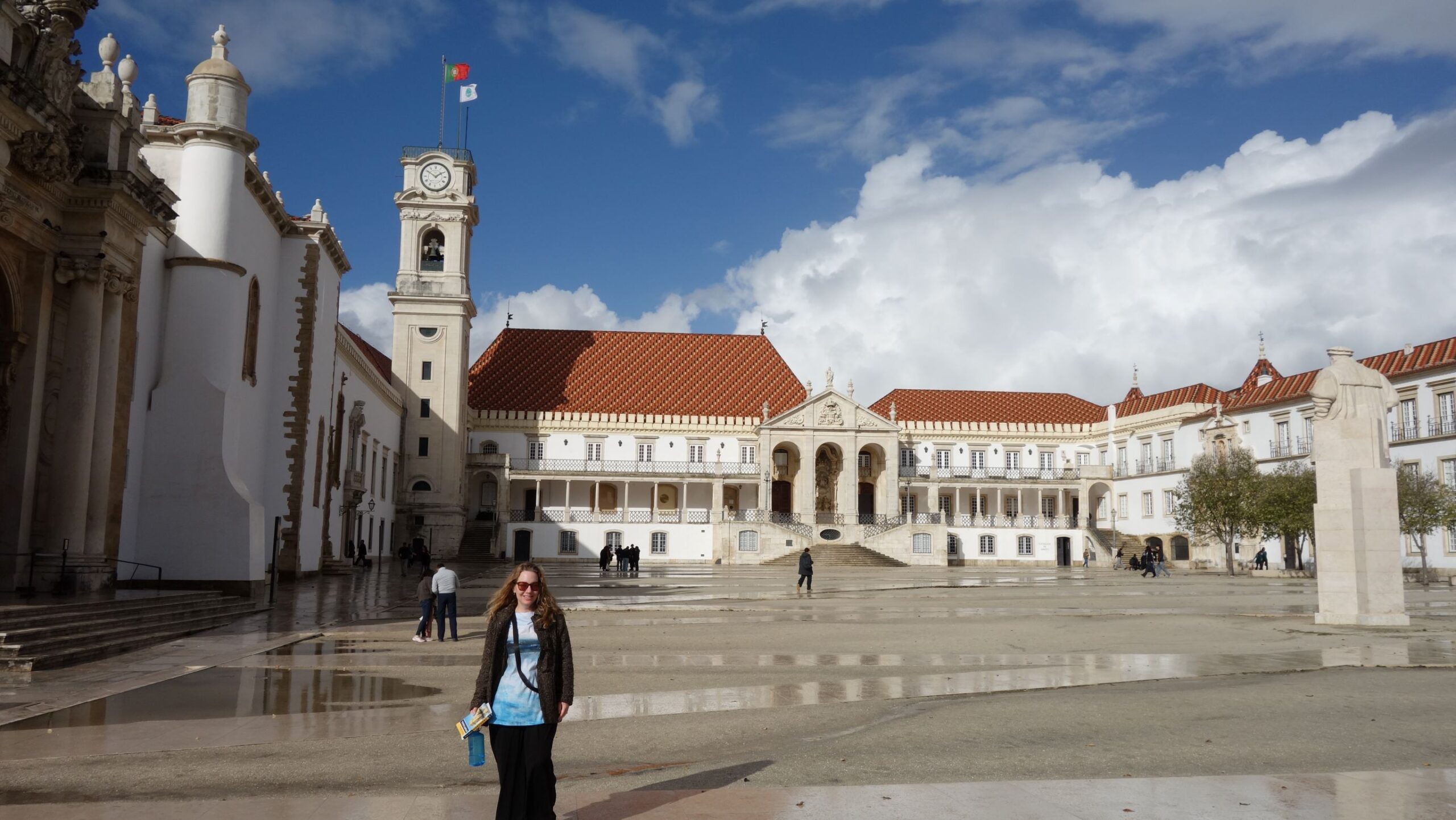
Coimbra is a city of 140,000 people with the oldest university in Portugal, dating back to 1290. Fun fact we learned today – it was the ONLY university in all of Portugal and its colonies (including Brazil) until 1910. The university is smaller than the one in Lisbon, but still has thirty thousand students. The original college is housed in a king’s former palace. It seems the university students and locals didn’t get along well, and so after the university bounced between Coimbra and Lisbon five times, the king finally decreed that it would be housed at Coimbra. After the students and locals still had issues, he gave the university his palace in Coimbra, which was way, way up a hill, so the students and locals would be separated. That stuck.
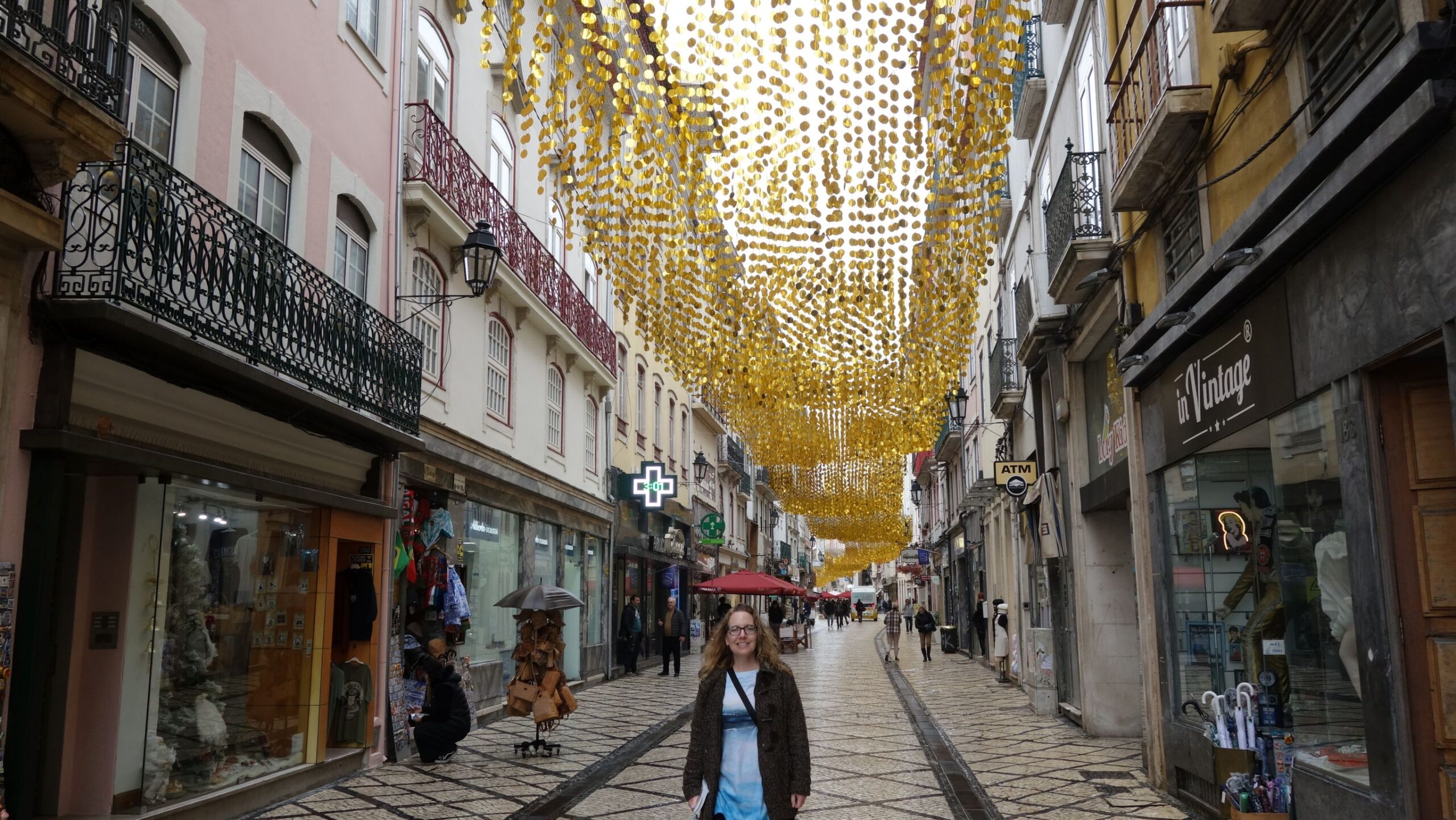
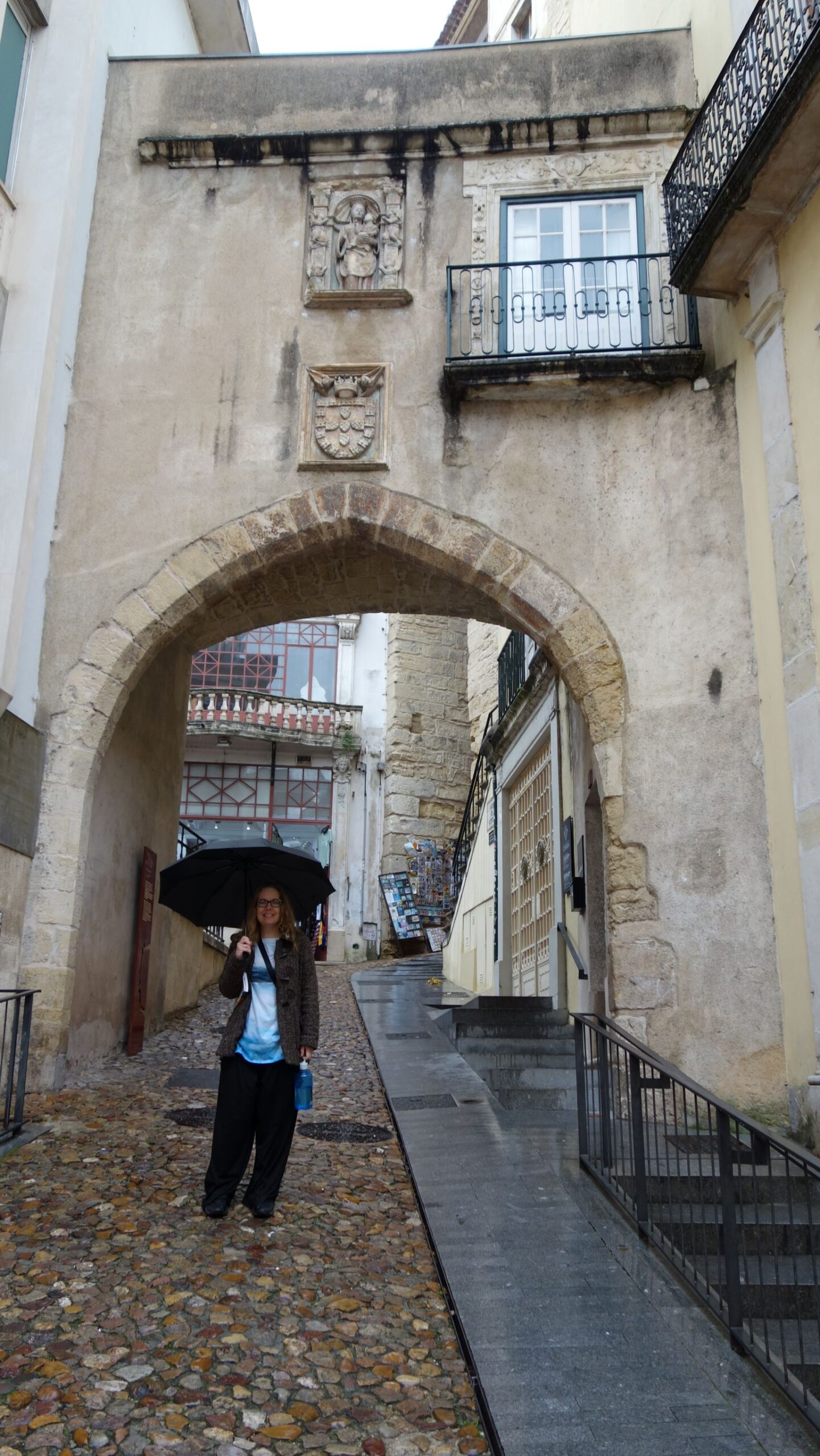
 We dumped our stuff in our hotel room, which was ready early, and we headed into the old part of town. We got to a small square that led to the pedestrian shopping street, which we followed for a bit until we got to the old wall gate, where we started going up. Up, always up. My lands, the topography of northern Portugal wants to whip you into shape. We climbed up cobblestone and stairs, past shops and the fortress-looking cathedral, and up and up, until we finally got up to the university. Mer took us to the old Jesuit college that now houses some small exhibits about the academic life of the university, a minerals collection, and a collection of curiosities and oddities. She asked the woman at the desk if we could get an English tour, and we were told there was one at 3:00, but we had to go four blocks away to get tickets.
Off we went. We walked to a square with a large statue of the king who ordered the university to be founded, and we were surrounded by unfortunate Brutalist architecture dating from the 1940s to the 1970s. Portugal was ruled by a dictator during that time, and he admired Mussolini and so had an Italian architect build squat concrete buildings to house the university, while at the same time leveling much of the old heart of the old town to make room. Our guide told us the goal was to strike fear into the students so they would obey authority, but it just engendered disgust in me – I’m not a fan of the style at all.
 We found the ticket booth and got our 3:00 tour tickets. The tour included self-guided tours of a few collections, including the ones we had just come from. So back we tromped through the on-again showers. The first exhibit in the building was on academic life and a little on the living conditions for students. As we saw in Sweden last summer, students live in communal living based on some common ground, such as the towns they come from. The university also offers about twenty sports (among which they count chess). Upon graduation, students load up on floats and parade through the town, and it seems that some festive beverages are consumed. We learned from our guide later that master’s degree folks go to the main gate after dark (so as to avoid the university security), where their families cut up their academic robes, leaving the new scholars in their underwear and a cape. Ah, tradition!
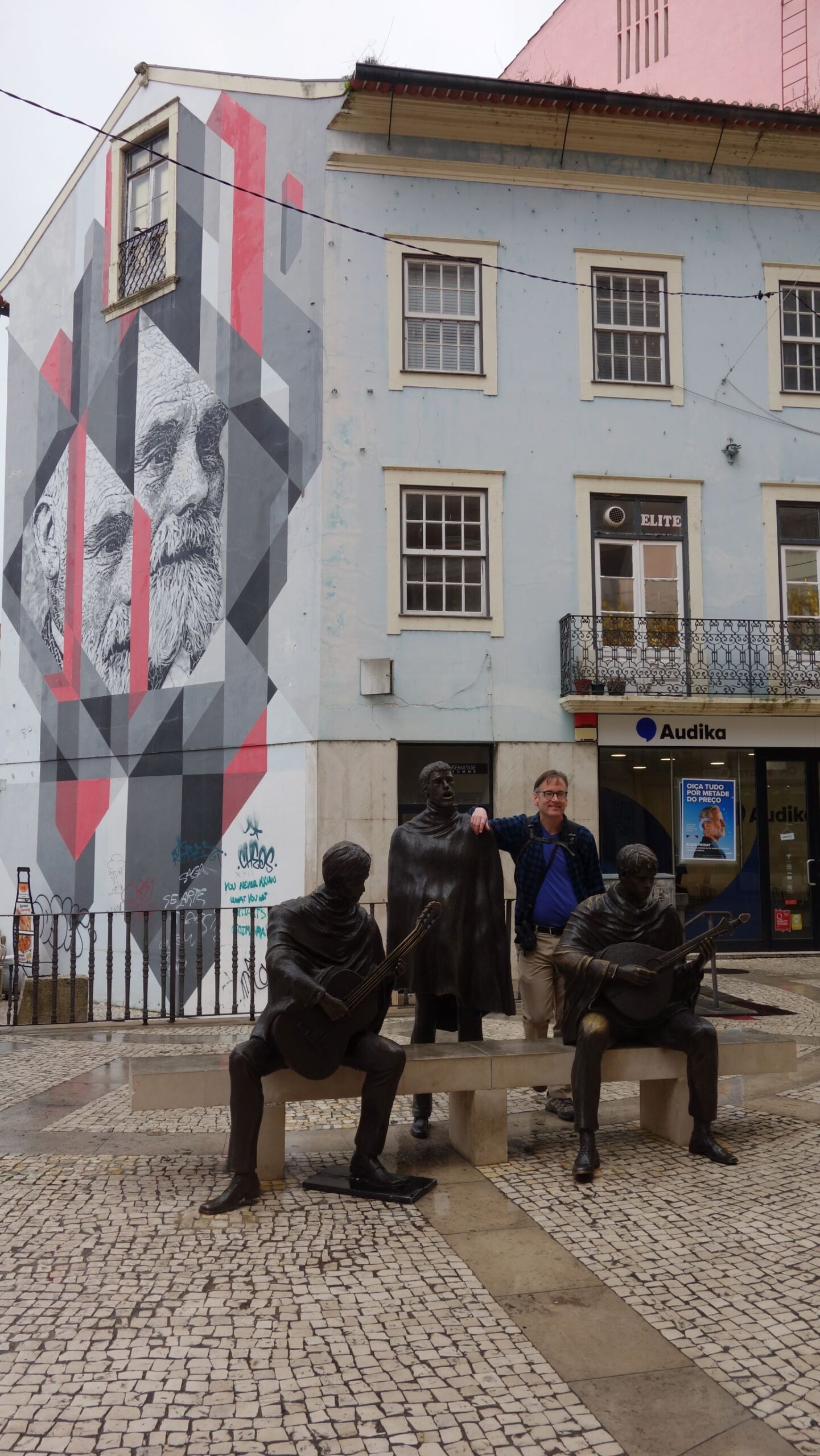
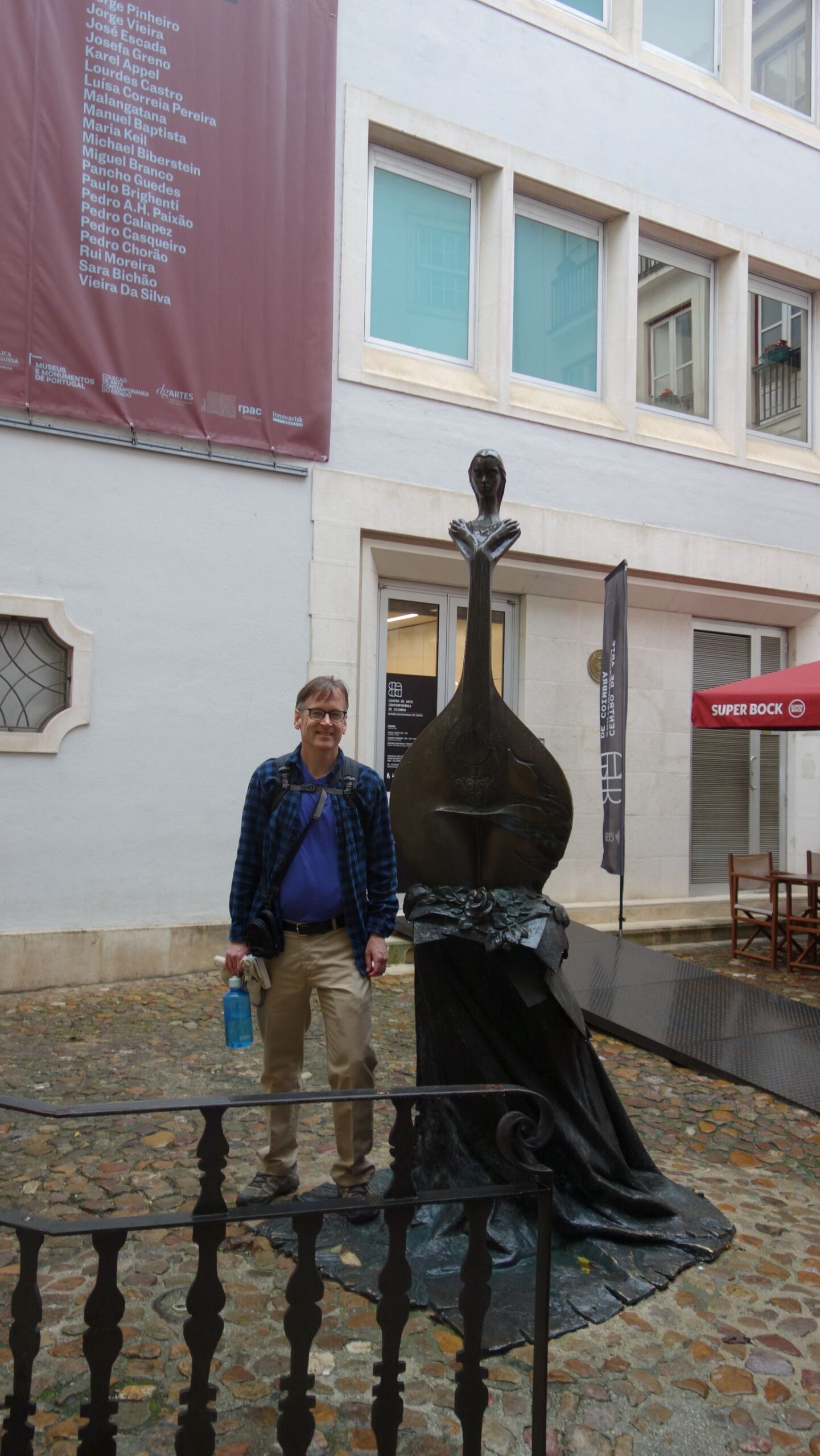
We saw a very brief display on fado music and how Coimbra has a distinctive version of the Portuguese music. While most fado is sad, usually sung by a woman whose man has sailed away, Coimbra fado is usually sung by men, and is about wooing women and also the sadness of leaving school life for a job.
 We popped upstairs to see a very extensive minerals collection. Most were just rock-like, but some were very pretty with unusual colors or textures. There must have been pretty close to a thousand samples.
We finished the building by going into a lovely room decked out in wooden cabinets that contained the oddities and curiosities collection. They were odd, and we were curious. There were bugs (some of which are WAY too large) and too many snakes. They had a manatee and a dugout canoe. There were lots of skeletons of various critters and multiple stuffed versions too. There were manmade objects like instruments and tools and such, but it was mostly oddities from the natural world.
To finish off our self-guided tour, we crossed the street to the chemistry building, where only one room was open. It was an old teaching lab, and they had giant pestles and some old equipment, like two hemispheres where the air could be evacuated and then hooked to horses to try to pull them apart, to demonstrate the force of air pressure. There was a glass ball used to demonstrate that hydrogen and oxygen could be used to make water. We read that the lab made gunpowder to help resist Napoleon, and they also gave out free caustic solutions to help fight the plague.
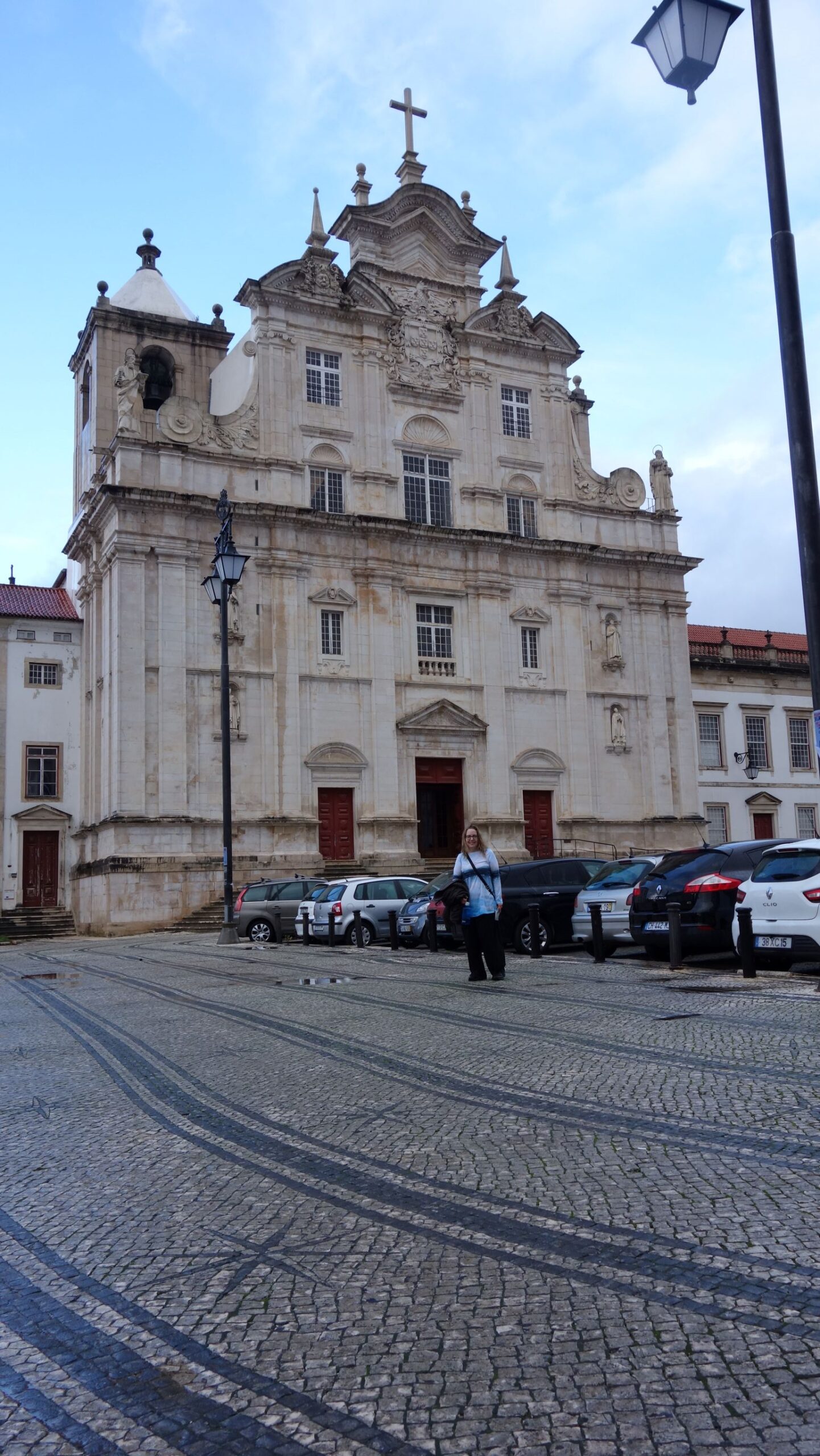
 By then it was 1:00, so we went to the very crowded and small cafeteria, where we got lunch. We finished up about 1:45, so we had an hour to keep touring. We walked back down into the old city part of Coimbra, where we picked up a Rick Steves guidebook walk. It took us past the cathedral, but we didn’t have time to do more than look in the door. We looked around the old town a bit and then went back up the hill to catch our tour. Along the way, we saw a row of young men doing pushups and then singing/yelling, so we think we got to see some of the light hazing that first-year students have to do.
Our tour was just four of us and our guide – me and Mer and a couple from England (although she was originally from Lithuania). That was nice. Our guide was a fast-talking and enthusiastic graduated history major, and while his English was very good, he did require that I pay attention or I would lose his meaning because of his accent and speed of talking.
 He told us the history of the university and some of the student traditions and took us over to the palace part of the original university. By the late 1700s, the church was seen as an obstacle to the progressive movement the king wanted, so one of his ministers kicked the Jesuits out of the university, and the school stopped teaching theology (which is still not taught in state-owned schools). They installed chemistry and physics as schools. Law and medicine were still taught, and the law school is still in part of the palace.
We got to go in and see the very fancy room that had been the throne room of the palace. It used to be used for doctoral defenses, but is now only used for special occasions. In the same way, there are rooms dedicated to the major schools of the university where the departments used to meet to discuss things, but that is all done in the department buildings, and the fancy rooms are only used for special occations.
We saw the king’s former bedchamber, where there are now portraits of the rectors of the university hanging (at least some of the ones from the seventeenth and eighteenth centuries). The room also had a model of what the king probably looked like, based on scanning his skull and looking at his DNA. He was blond because his ancestors came from southern France.
 We got to see the chapel, which is ornately decorated and has a huge organ (two thousand pipes) that is too big for the space. It was meant for a cathedral that was never built, and so the king had it installed in the school chapel. Our guide told us that if the organist ever played the organ at full volume, it would easily blow out all the windows of the chapel. Fun fact – the Mary in the chapel is wearing a crown that was given to her by a king of Portugal after a victory. No king from that point was ever painted wearing a crown.
We got to see the school jail where students were punished for being late to class or falling asleep in class, and they even had solitary confinement cells if students should speak against the king or the church. Students in the ordinary jail were still escorted to and from class so that they wouldn’t miss classes.
 We finished the tour with the library, and the top floor was the second prettiest library I’ve ever seen, second only to Trinity University’s library in Dublin. The ceilings were painted with allegories of virtues, the bookcase were oak and gilded over, the tables were dark exotic woods from Brazil, and the place was pretty amazing. They used to have a cat to hunt mice, but the cat was replaced by very small native bats that eat mice and bugs and help keep the books safe. They put out leather over the tables at night to protect against droppings.
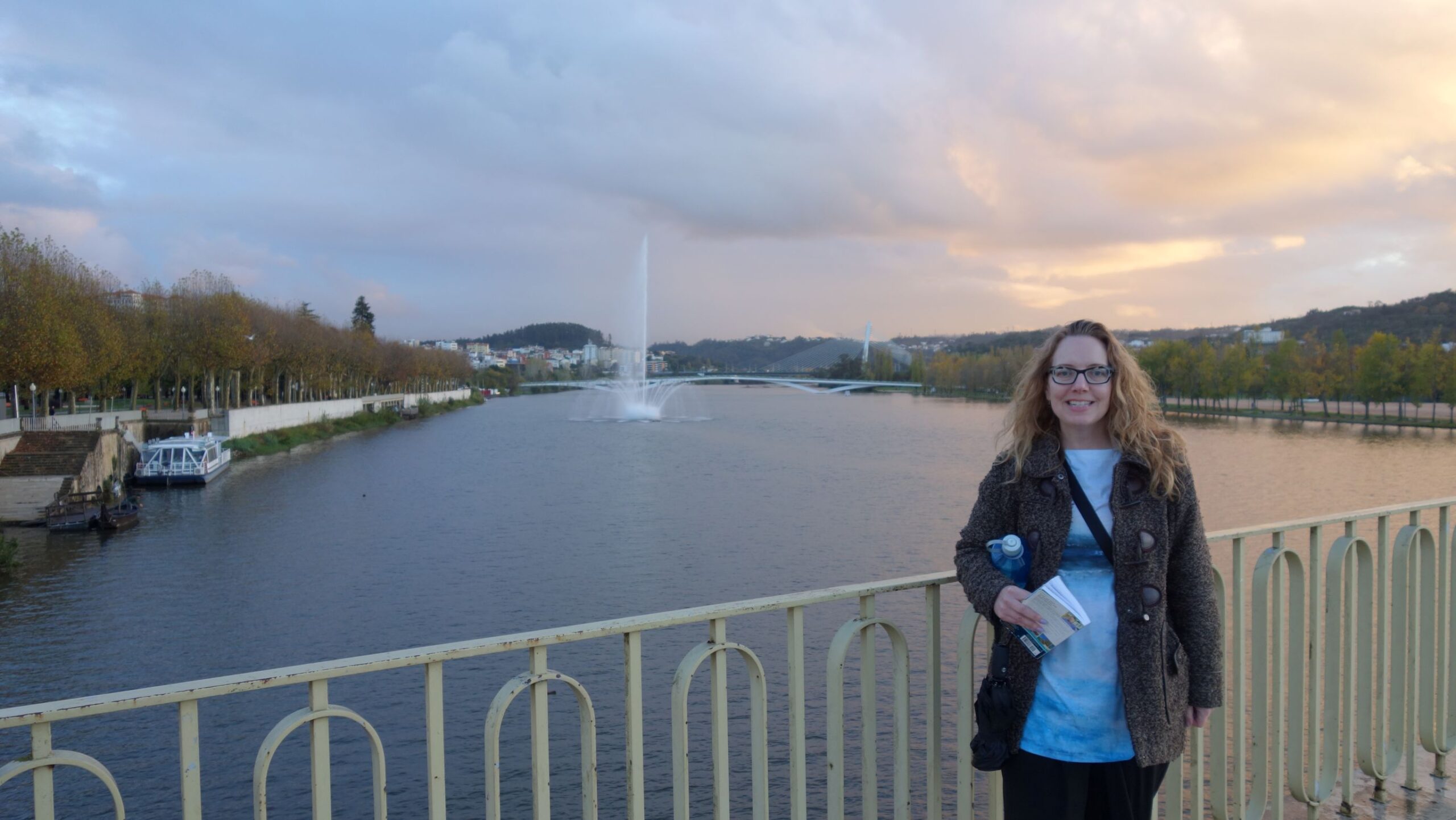
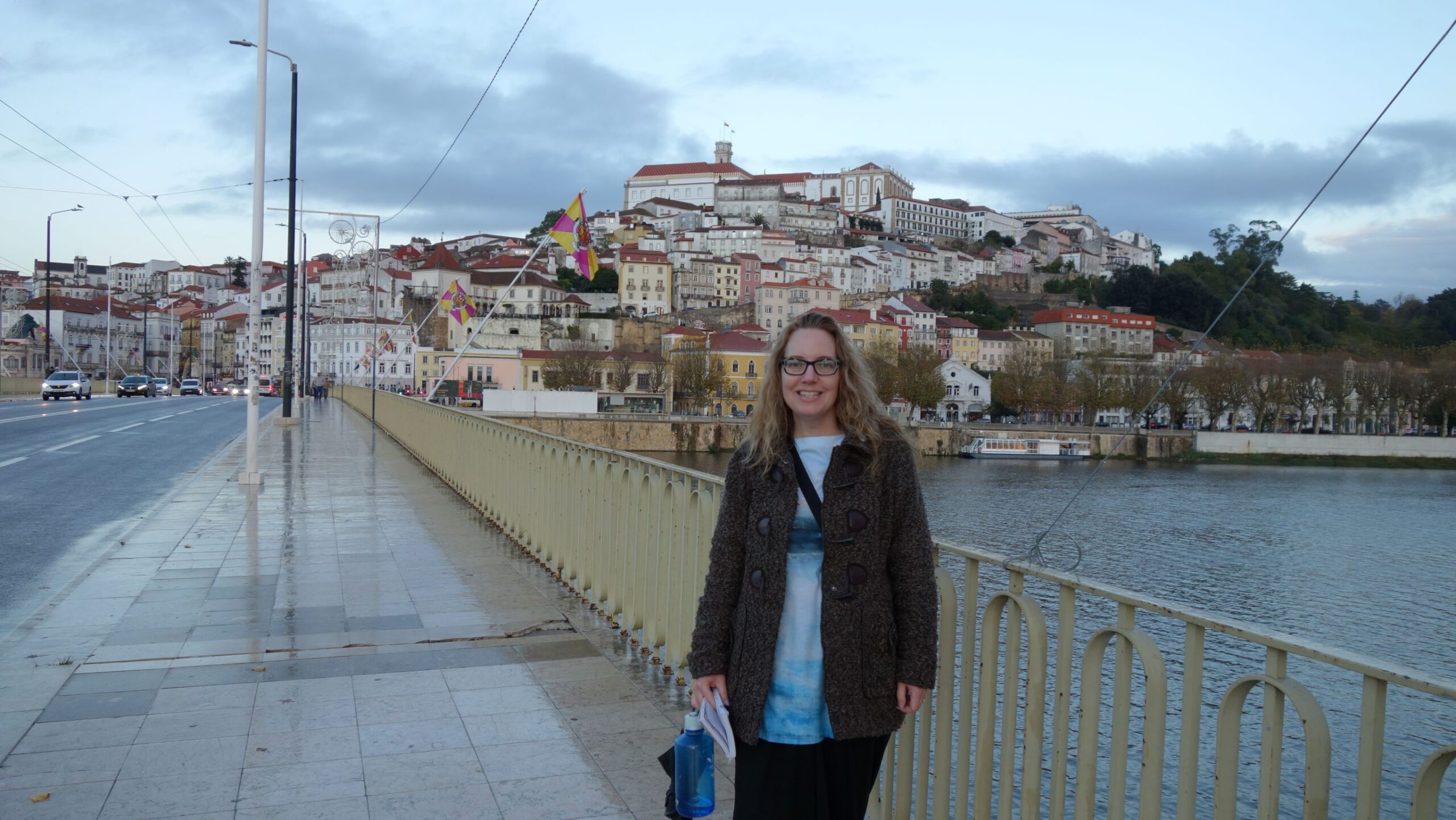
That ended the tour of the school, and so we headed back into town to finish up the Rick Steves walk. We went all the way down to the river to cross the bridge so we could see the old town from a good vantage point. As a bonus, we were at the river when a river fountain was going full-out, which we guessed was on the hour (it was about 5:00). We grabbed a town-specialty pastry from a shop, and then walked up along the pedestrian way to the gates again, where we went up to a small room to listen to a fado concert.
I loved it. It consisted of two men singing, one man playing the twelve-stringed Portuguese guitar, and one man playing classical guitar. The guitar-work was fun for me to watch, and I enjoyed the men singing very much. Some fado I’ve heard on videos or walking by places seemed to be about women using lots of vibrato and being high in their ranges, which I don’t like much. The men sang things well in their range and didn’t ornament their singing. It was a fun hour.
After the concert, we finished the pedestrian street and went to look at a huge fountain, and we then finished the night with a light supper. Or so we thought. As we were walking home, a young male student stopped us and asked if we would be in a picture with him – he said it was tradition. He was with two young women, and all three were in the law school, so we posed with him, and then we chatted with all three for about twenty minutes. They were tipsy, but were friendly and not stupid-drunk, so it was amusing to talk with them. I did finally have to beg leave to go so I could shower and go to bed.
So even if a little rain fell on our sightseeing today, it didn’t dampen our spirits. We leave Coimbra tomorrow morning, as such is the way with these one-week trips. On to the next town!