Monthly Archives: June 2026

Sweden 2026 – Day 9, Sunday, Kalmar and Oland

Mer let us sleep in this morning until 8:30 since we’d had such a long day yesterday. That was a welcome decision. I’ve been having trouble sleeping this vacation (oddly, usually because our rooms have been too hot when it’s been fifty degrees outside), and getting a decent sleep was needed.

After a rather extensive breakfast where we also got to sit outside on a sunny day (but in the shade, of course), we headed off to church. Meredith had found another Pentecostal church that had live English translations, and it was about a fifteen-minute walk away. It was called Lorensberg Church, and we found it with about four minutes to spare.

It was a lovely service. The entire thing, including the songs, was all in Swedish, which, to me, is how it should be for any church that isn’t trying to minister to international people. Our translator did a fantastic job, and he even translated the lyrics of the songs for us. The sermon was given by an elder since the pastor was out of town, and he spoke on what baptism and “living in your baptism” means. It was a solid sermon.
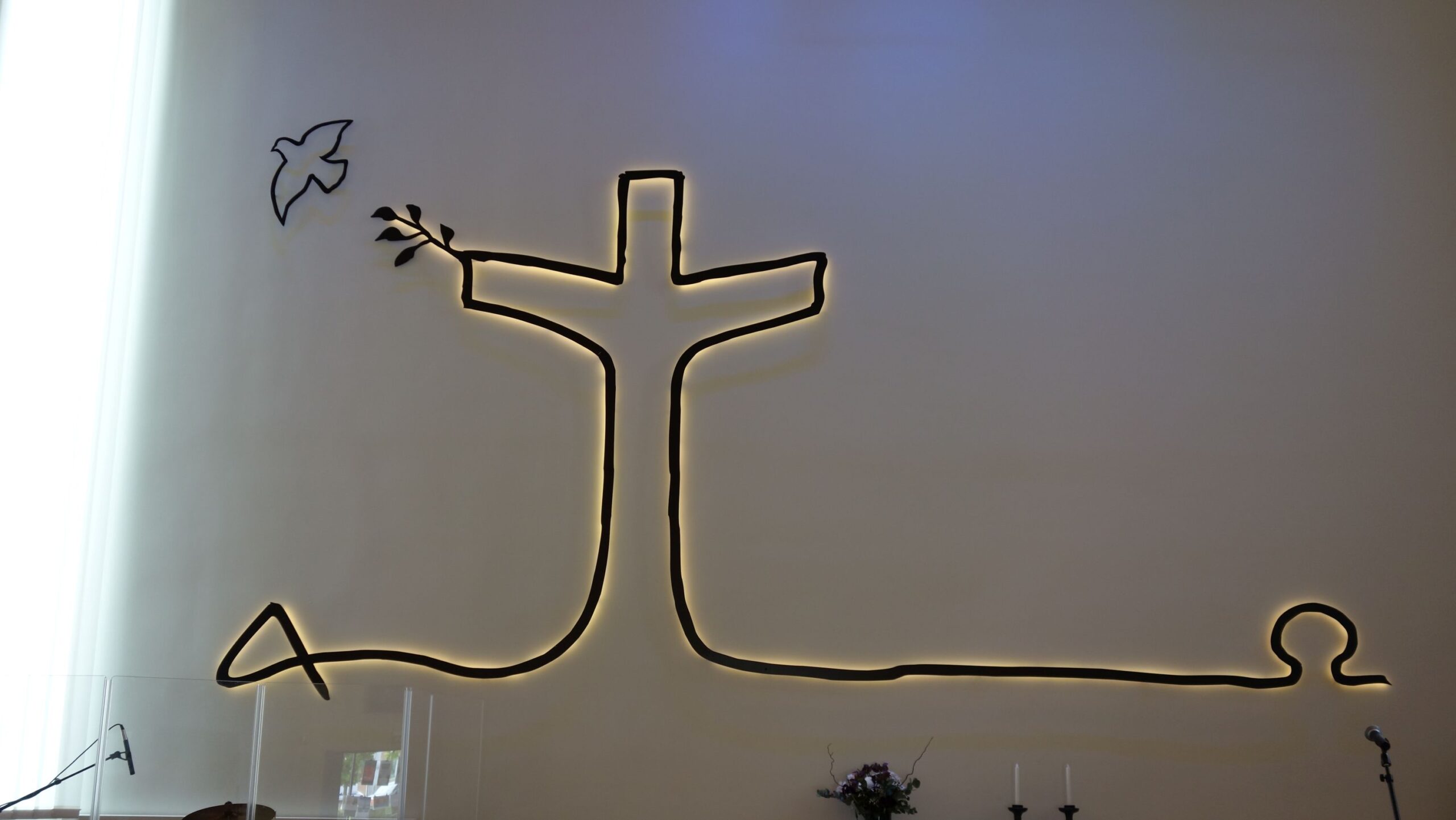
Sometimes Pentecostal churches can be a little wild for outsiders – they can be very emotional, and interactive, with lots of raising of hands and verbal affirmations from the congregation. Lorensberg Church was very much on the “tame” end of the spectrum and was pretty much what we’re used to back home. There was a lot of speaking in tongues, but I’m pretty sure it was all Swedish.

I did crack myself up. During one song, I saw some English cognates in the song, so I was excited to follow along with, “You are my hope, You are my life, You are my filbblegibbit.” There was a disconnect there toward the end.  Some Swedish words are similar to their English equivalents, but others, not so much.
After the service, a retired man came up to speak to us, and he used very solid English. He invited us to stay for “fika,” which is the Swedish term for coffee and light food. We were happy to stick around, and he pointed out a man sitting outside who had lived in Dallas for a couple of years, and he had been the guitar player for the church service today. Mer and I went up to him and introduced ourselves, and we chatted for a long time. A couple of other English speakers joined us and chatted with Meredith, but I kept talking to Par (the guitar player) about guitars and his line of work. He and his son spent six months building a guitar from wood sourced from family property, which is very cool. He was a quality control engineer for Ericsson, which had a factory in Dallas, which is why he lived there for a couple of years. Meredith and I had a great time getting to talk to locals. We finally thanked everyone and left around 1:30.
We got changed and organized back in the room, and then headed out, driving to the island of Oland. Oland was connected to the mainland by a nearly four-mile-long bridge back in 1972, so it makes for an easy drive. We were aiming for the largest town, Borgholm, about forty-five minutes away.

It was a pleasant drive, except for the unsettlingly tall bridge we had to cross. The island does have dozens of old-style wooden windmills scattered all over, and even a few modern ones as well. The old ones no longer turn in the wind since the arms aren’t covered in cloth.

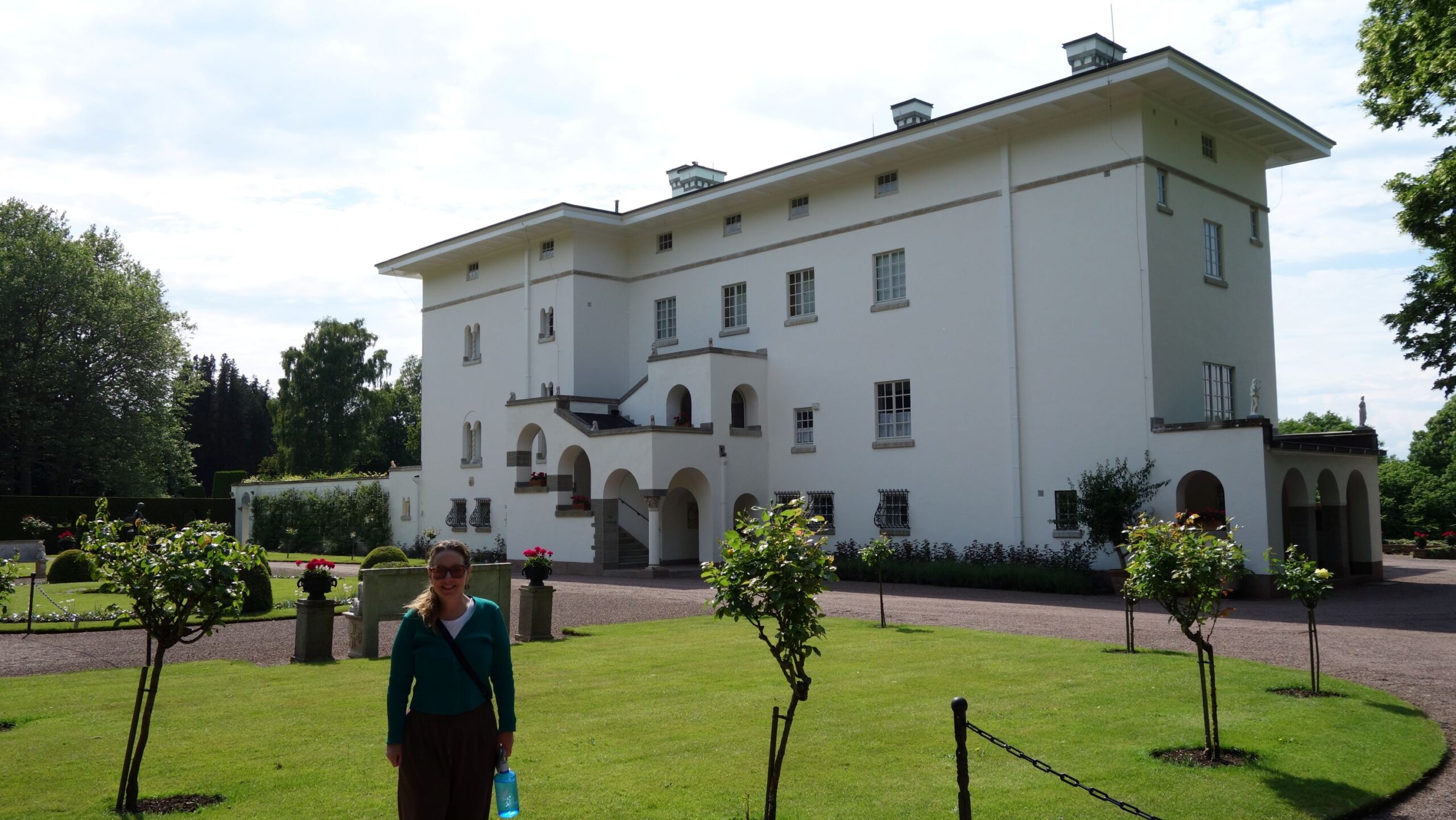
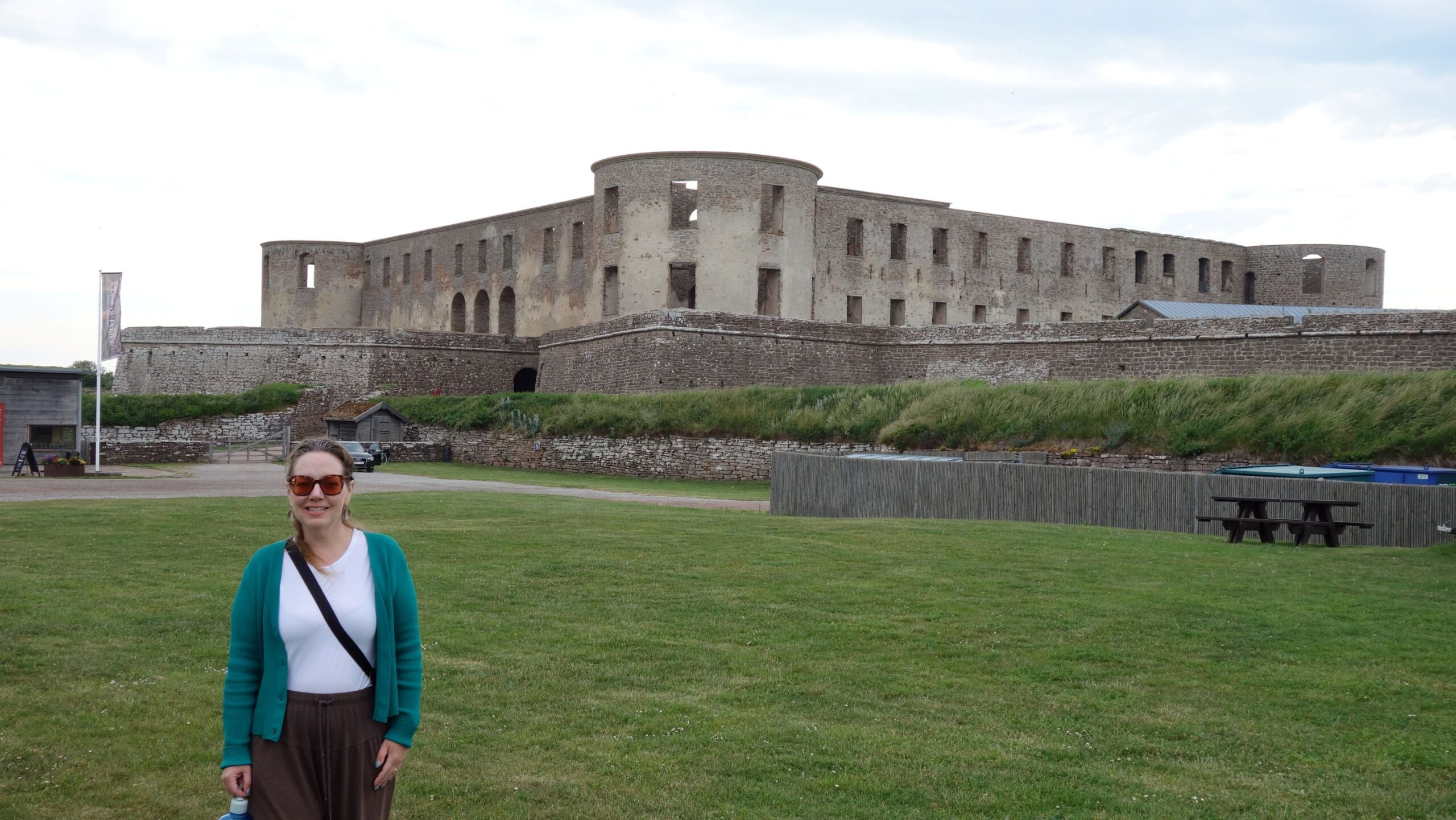
Just before the town, an old semi-ruined castle broods on a cliff overlooking the sea. It’s very weird in that the roof is completely gone, but the rest of the stone structure is intact. Usually at least a wall or two is damaged, but not in this case. We turned off at the castle drive, but kept going past it and on to Solliden Palace, the summer escape home for the royal family. The home is closed to the public, but the gardens are open.
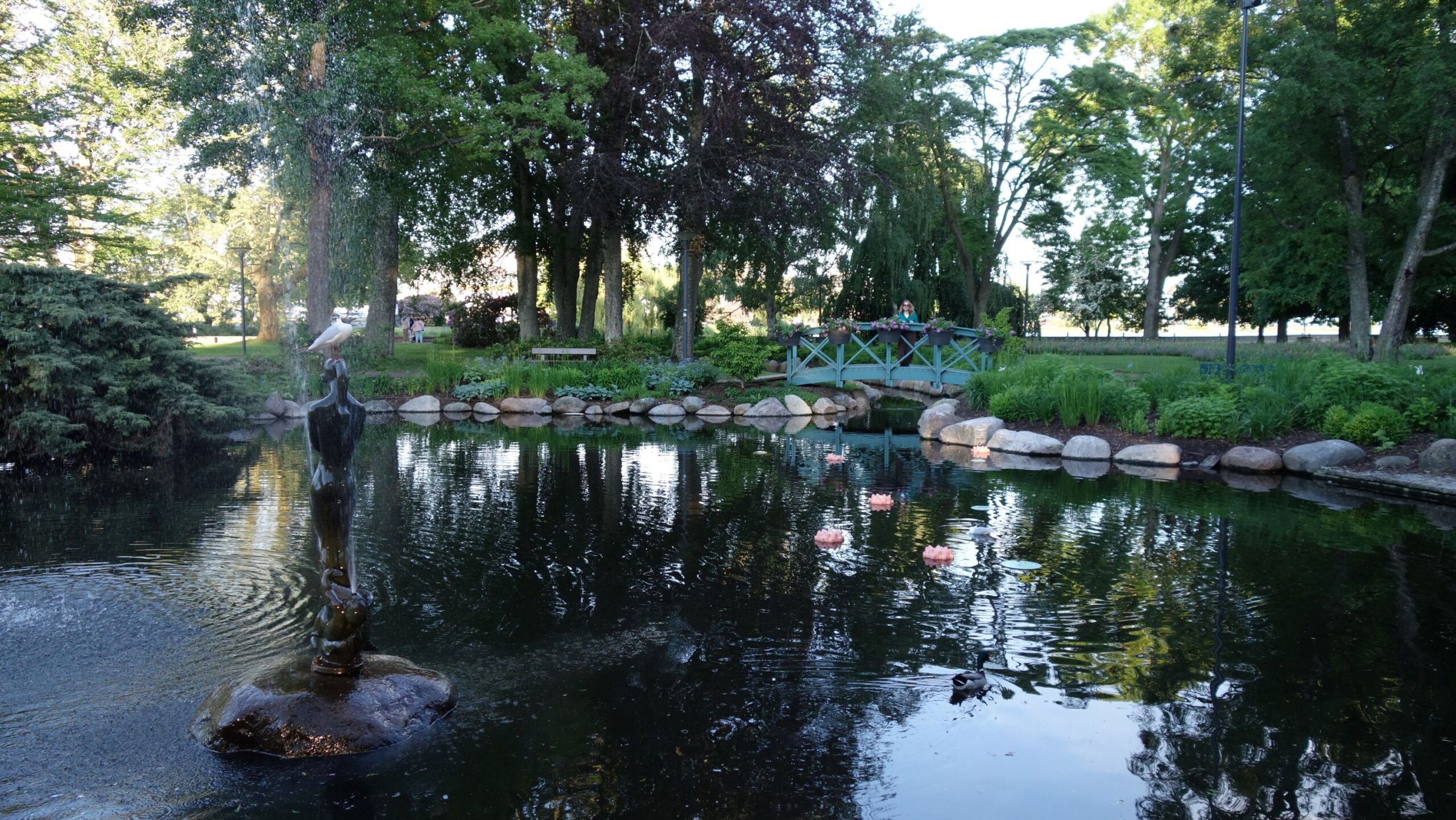
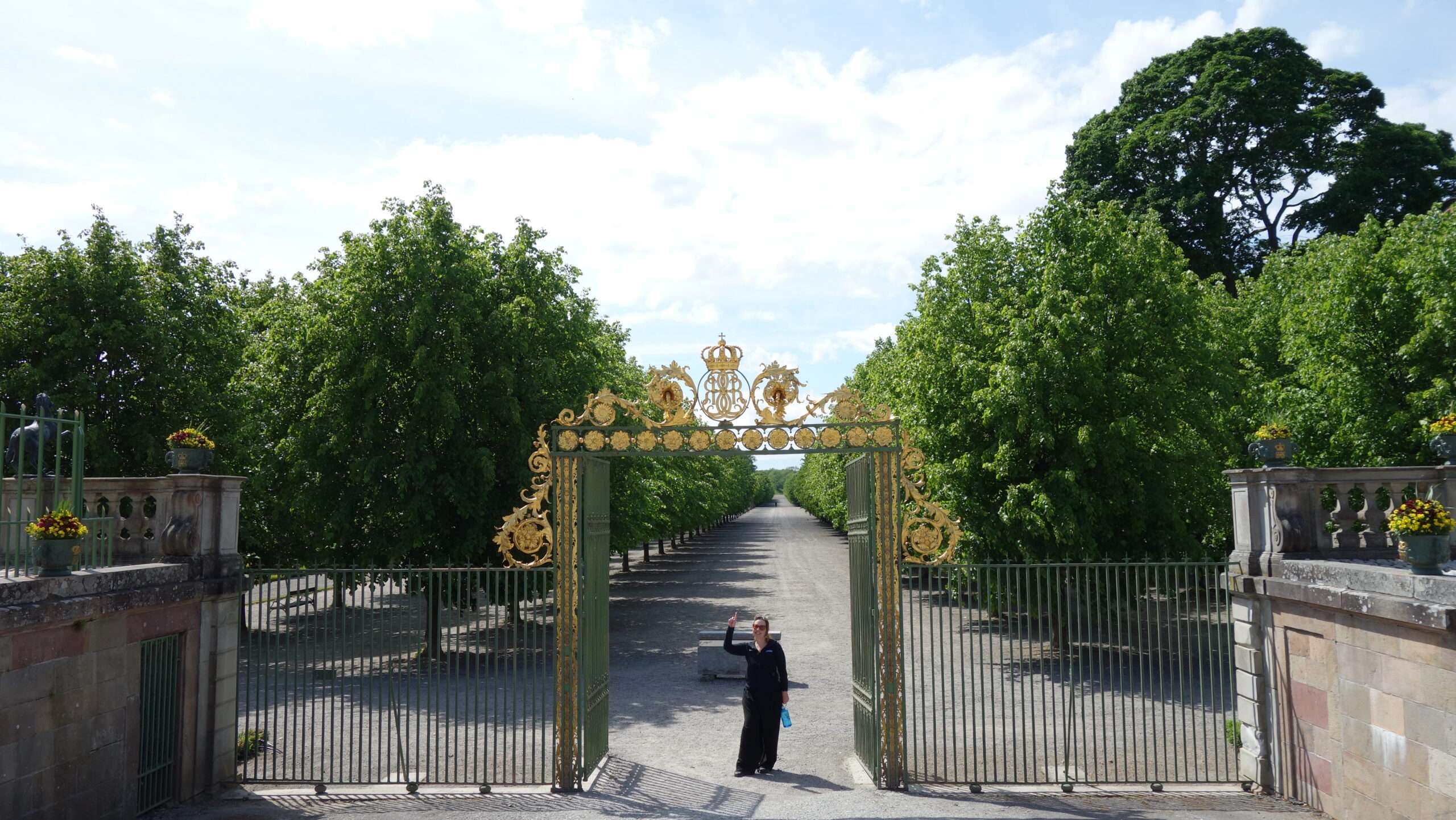
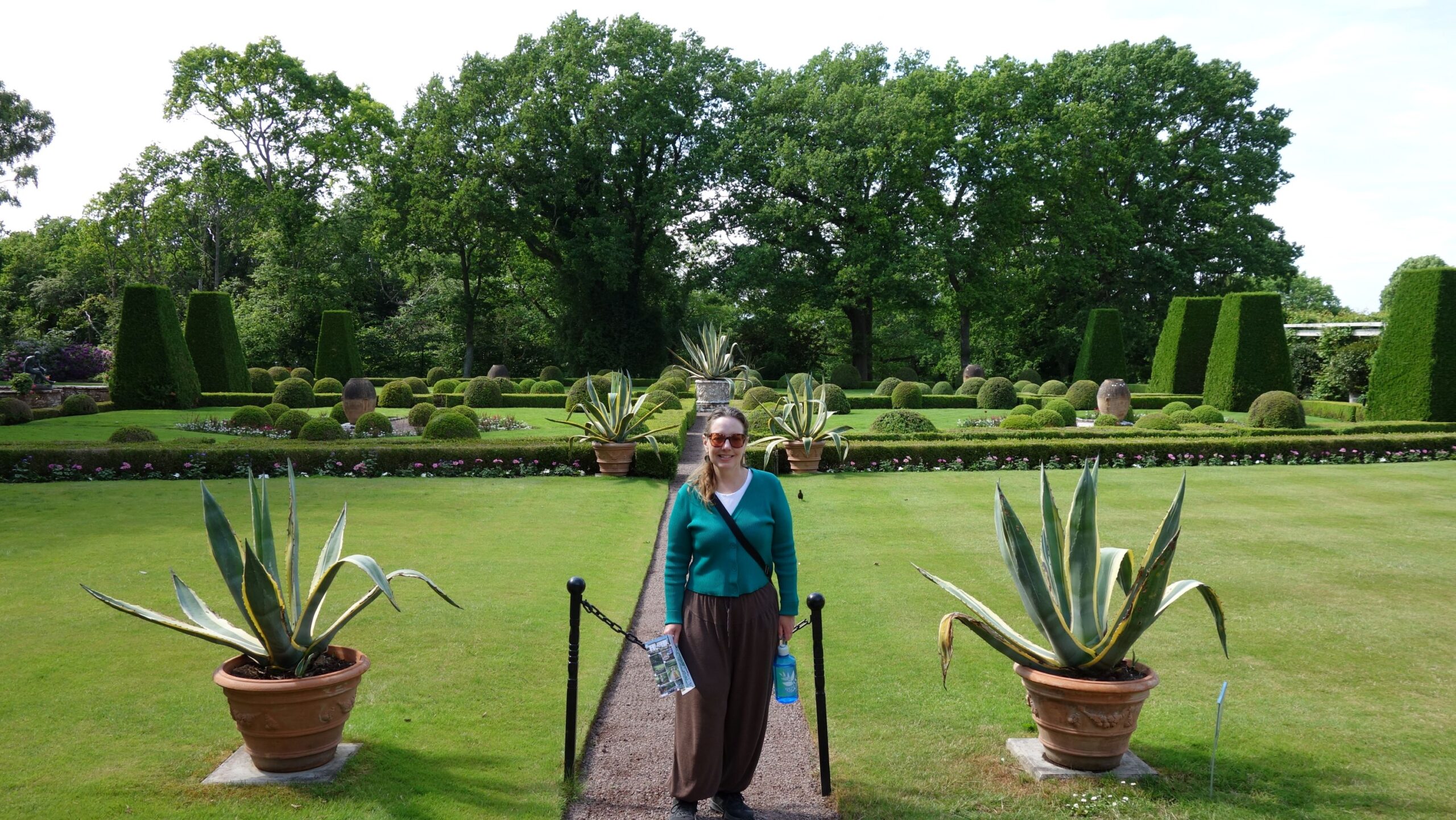
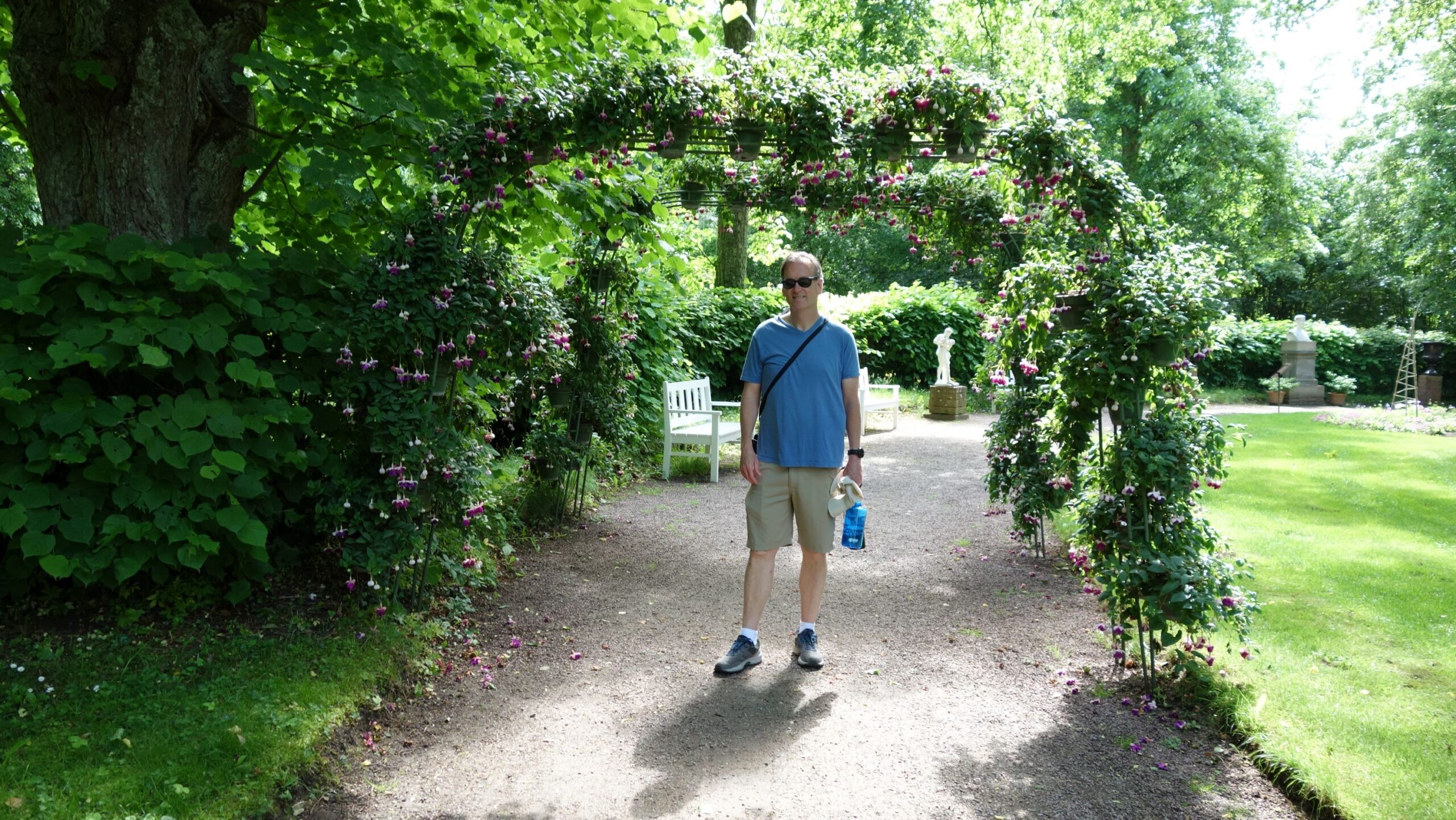
We only had two hours to closing time, but while the grounds weren’t tiny, they weren’t extensive. We saw everything in about an hour and fifteen minutes. The gardens were quite lovely, and everything was heavily shaded. The garden had a very cool three-tier fountain waterfall, and there were classical statues scattered around, and some modern sculpture as well. There was a large art installation in one part of the grounds that celebrated a husband-and-wife team of artists who are well known in Sweden. The wife passed away in 2018, but the husband is still making art at age eighty-eight.

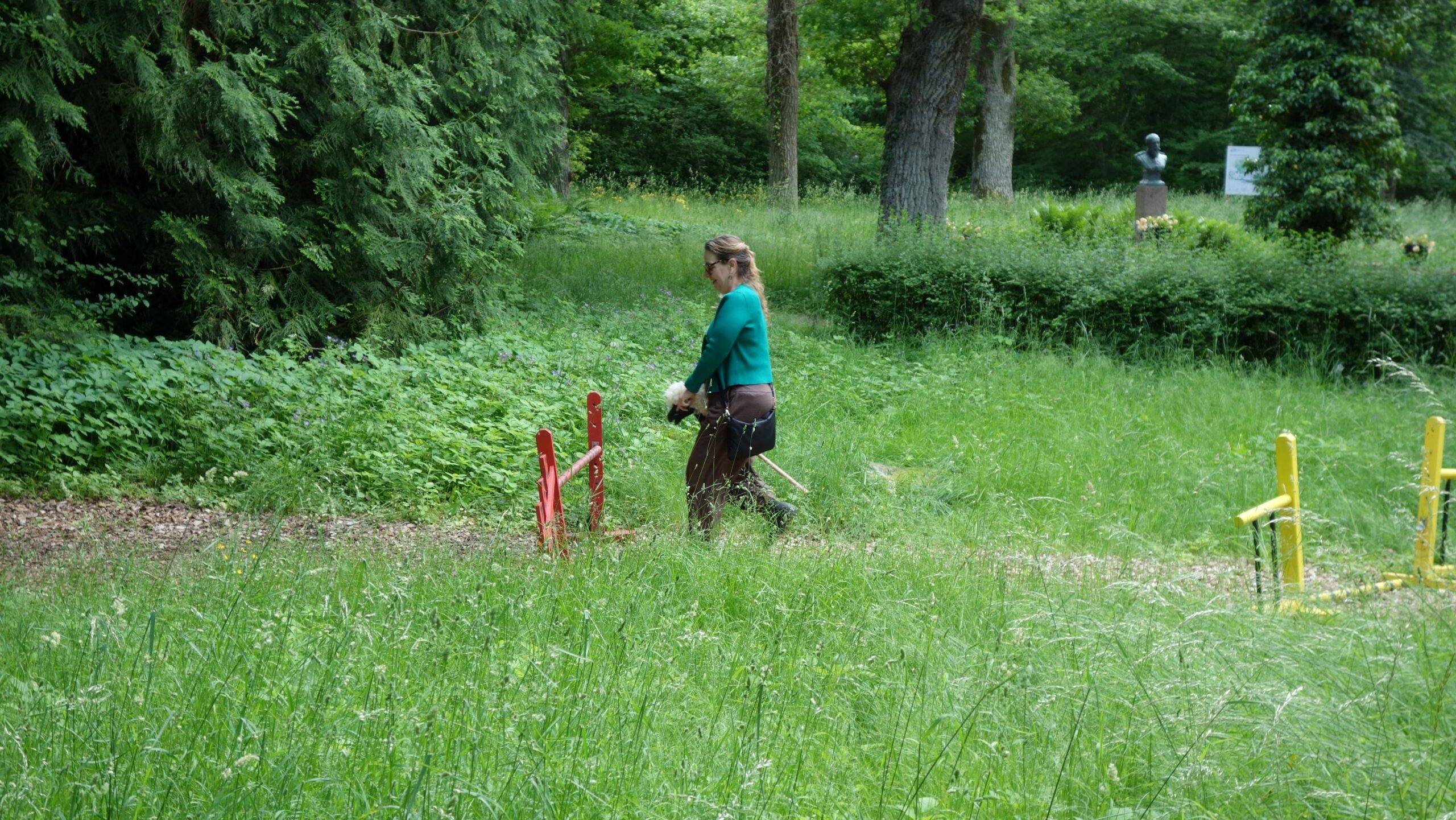
One of the more random features of the garden was encountered as we came along a road on the back of the public area:  we saw some small gates set up in a circle that looked like a mini show-jumping ring, like in the Olympics. I joked that it was for horses, and then we saw that there was a rack of hobby horses for little kids. The course was for them, so of course we tried it, stepping over the taller gates so as not to fall over ourselves. Mer decided that the hardest thing was keeping the horse stick between her knees.
The last major exhibit in the garden was a series of photos of the royal family, mostly at Solliden. The king and queen have been married for fifty years and the king turns eighty this year, so it was a celebration of the family. Many of the photos were taken by the family or even the king himself. From an outsider’s perspective, the family seems to be fairly normal, if a bit richer than your average Riordan.

After the gardens, we went back to the car and drove back to the ruined castle. It was now almost 4:30, so there wasn’t any point in paying for admission, but we did get closer to the walls, and also looked out to sea some. We investigated a huge cairn that was put up as a memorial to a king from the 1800s by his hunting buddies. We then drove on to town.
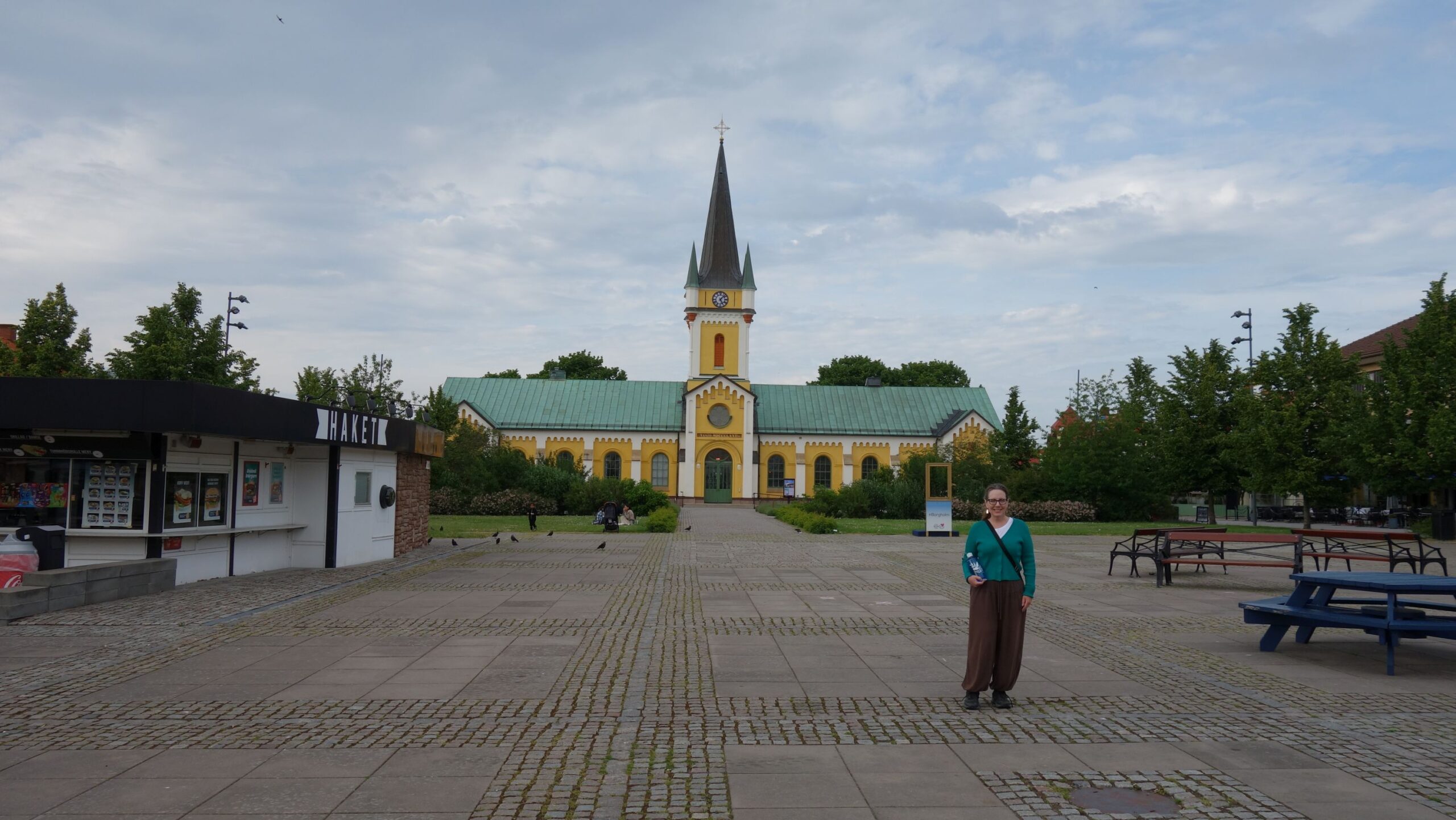
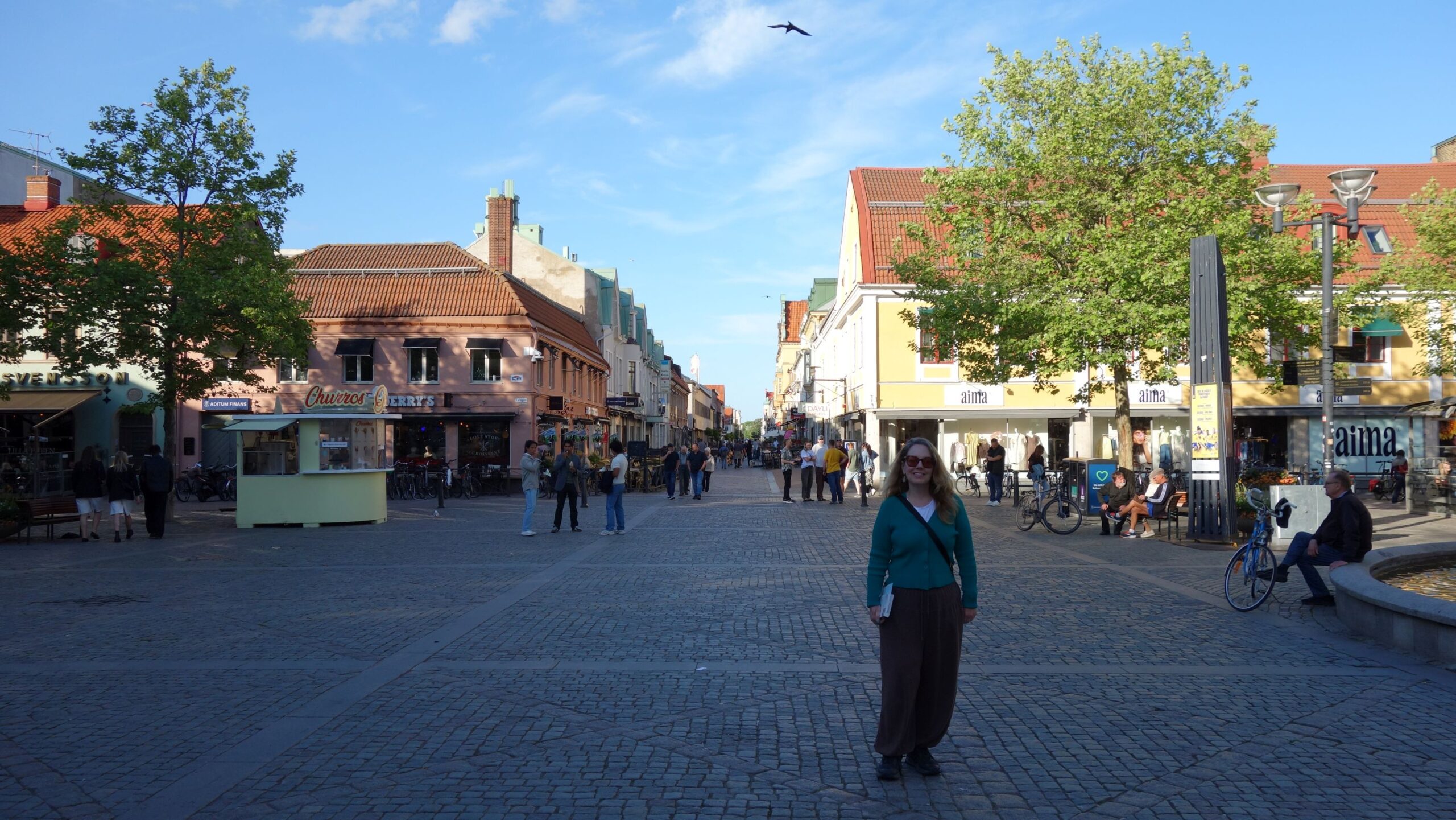
It turns out that Borgholm is a very quiet town of a Sunday. We parked by the sea and then walked up to the four-block-long main pedestrian street. There were a few restaurants open, but that was it; no shops were open. There was only a handful of people about. It was a cute street, and the city hall was a cheerful bright yellow. We liked the walk, but it was strange to see a European shopping area so nearly deserted.

Sadly, toward the end of the walk, I started having stomach cramps. I have no idea what I ate today that made me sick, but I found a pay-for bathroom and was in there long enough that Meredith came over to the door to ask if I was okay. Once I was fit for traveling, we drove the forty-five minutes back to the hotel, where I was cramped up again for a time. And then again after supper while still at the restaurant. It wasn’t food poisoning, which I had last year, but it was a reaction to something I ate, or possibly dehydration (I probably didn’t drink so much as I normally do today). It was a bit frustrating, because I’d wanted to wander around in Borgholm or at least back here in Kalmar, but I felt I needed to stay near a bathroom. And the worst of it is is that I don’t know what caused it, so I could end up doing it again tomorrow when I have the same breakfast options.

Still, a rough ending of a day doesn’t negate the good of the rest of the day. Church was excellent ,and we got to meet some locals, and then the gardens on Oland were a happy place to wander around in. Tomorrow I take over again for the next several days, and we head further south in Sweden.
Sweden 2026 – Day 8, Saturday, Stockholm archipelago, Stockholm, and Kalmar

When Meredith and I tour a country, we like to see as much of the country as we can efficiently manage while still actually seeing sights – no pulling up and taking a photo and driving on to the next place. But when you have large countries, say, like Sweden, you sometimes have days made up largely of travel. Especially when you pin yourself out on an island two-and-a-half hours from Stockholm, where the rental car is. Today was a fairly long in-motion day, but we managed to interspace some touring into the boat, bus, foot, and car travel.

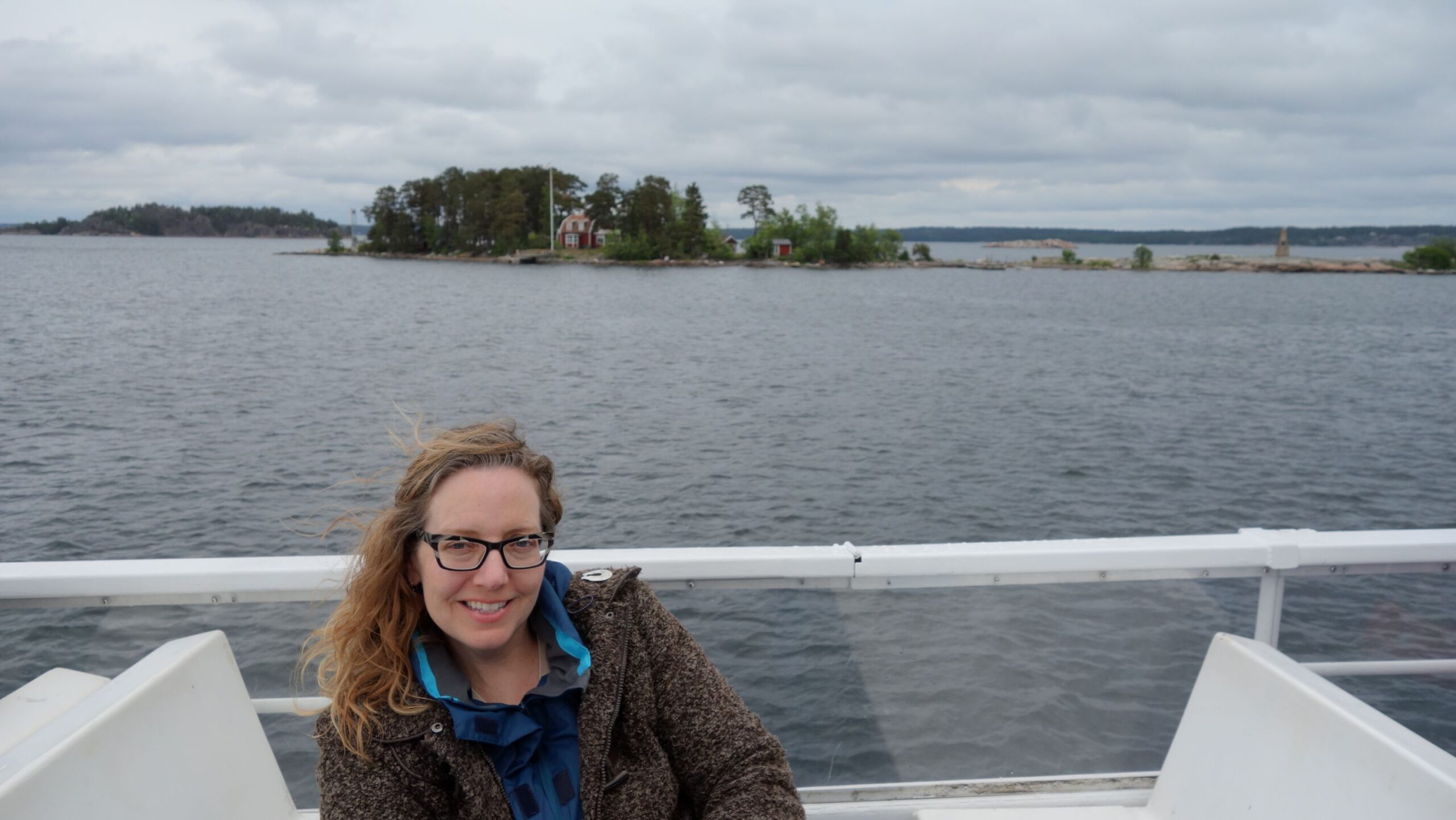
We got up early at Sandhamn to catch the first ferry out, which left at 8:40. The only ferry that goes all the way to Stockholm leaves at 3:00 p.m., so we couldn’t wait for that. We took the fifty-minute ferry to an island that had bridge connections all the way back to Stockholm so that we could take a bus back, getting to the city about 11:00. It was raining in the archipelago, but only lightly. Mer found that the back of the boat had a very small outside deck that was covered by an open upper deck, and that there were two dry chairs back there. So we sat out on the deck and watched the islands and the sea roll by. Even with the rain, the water was calm, and the trip was still beautiful. That counted as some tourism on a travel day.

We caught the bus and rode fifty minutes into the city. The bus was really hot, and I had awakened with a stiff neck that sometimes can trigger stomachaches and migraines. I treated the neck, but was left feeling fragile, healthwise. Between the bus’s heat and its swaying, my stomach got really upset. Mer saw that and suggested we ride an extra stop to get close to Gamla Stan, where we could walk outside rather than take another bus to the train station to the car rental building. I quickly agreed.

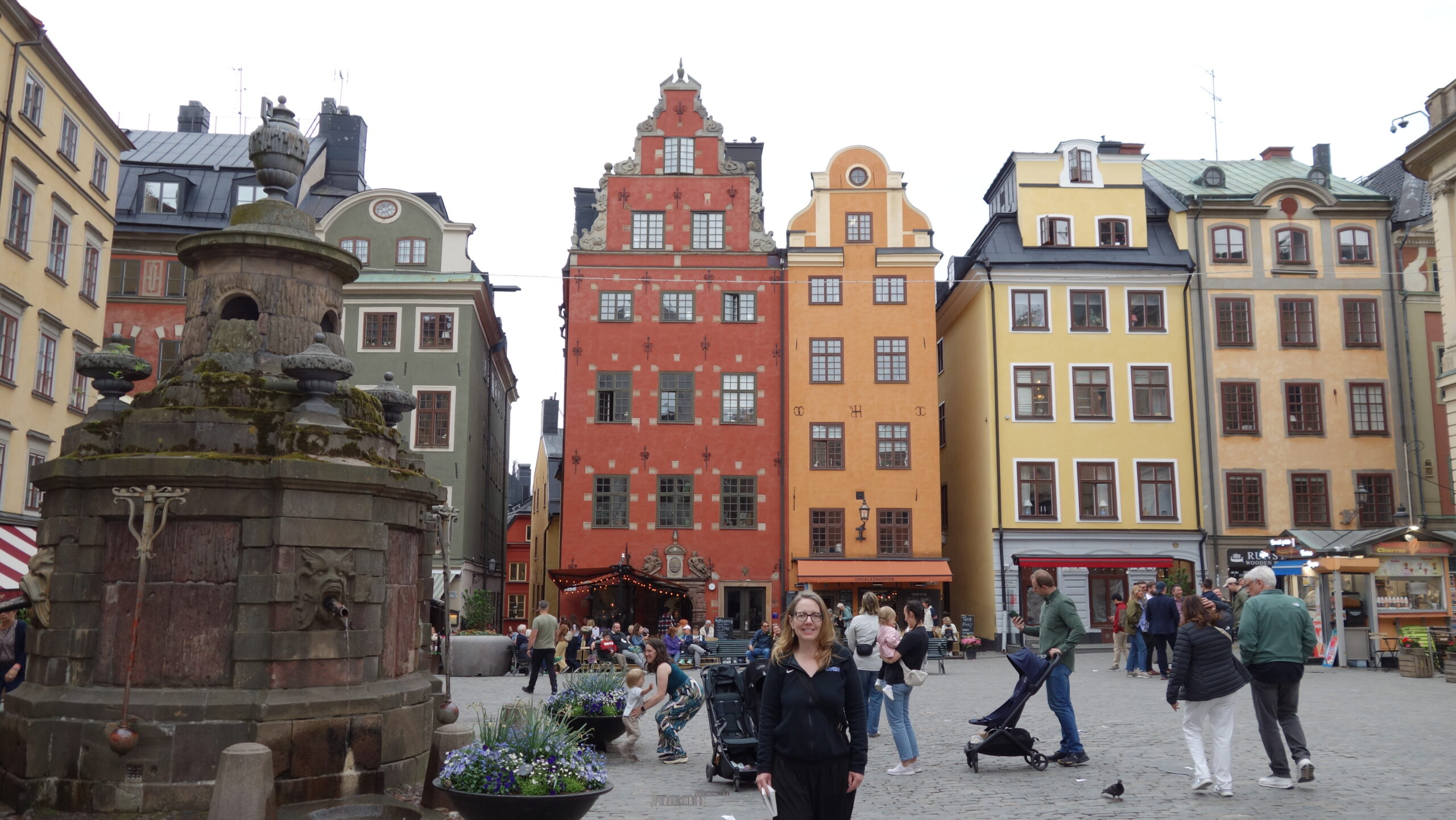
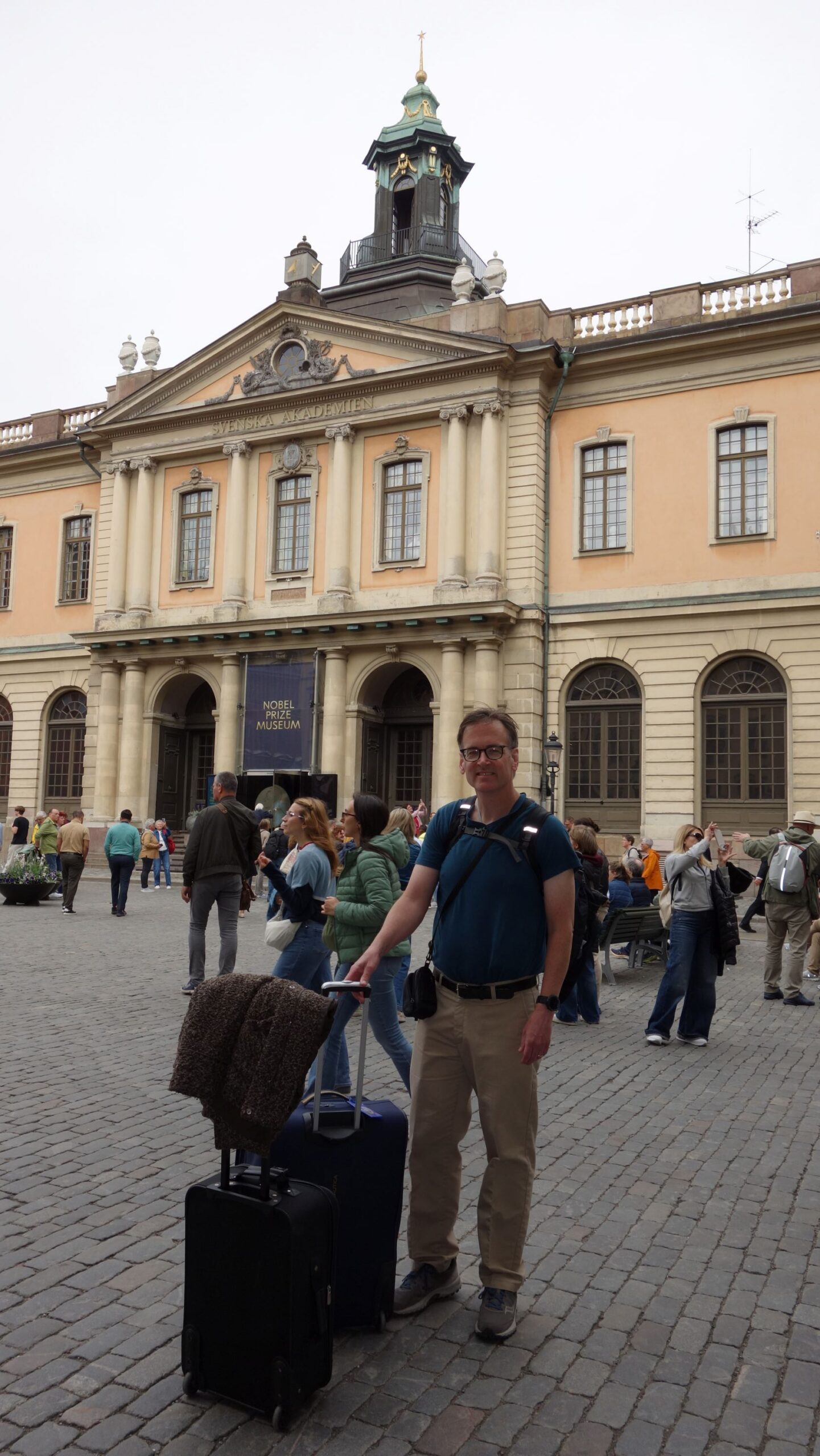
So, even though we were schlepping luggage with us, we walked back into the old town of Stockholm. That was some touring in itself, but we got a light lunch outside of a bakery on the main square, where we sat across from the Swedish Academy, which awards the Nobel Prizes. That was fun. As we left the bakery, we heard music and investigated, and saw some helmet plumes over the heads of a huge crowd; it was the ceremonial changing of the guard at the in-town palace. We didn’t stick around, since we couldn’t see very well, but that was cool to almost see.

The walk to the car rental place wasn’t too exciting, but we did manage to see a small square near the main square that we hadn’t seen before. We had left the rain back on the outer islands, and the day was a pretty one for walking. The food and walk cleared up my head and stomach nicely.

It took about thirty or forty minutes to get our car (there was a line of people being helped by only one worker for a long time), but we got the car and got underway. It wasn’t a terribly scenic drive, but it went smoothly, and we finally pulled up to our hotel in Kalmar, about five hours south of Stockholm, at 6:30.

You would assume that at 6:30, after about eleven hours of our being in motion, we would get some food and go to bed. But, as readers know by now, I travel with Meredith, and it doesn’t get dark here until about 10:15 p.m. We did get some fantastic food, at a restaurant in the city center called Symposium, but then we toured another two-and-a-half hours. Make hay while the sun shines.

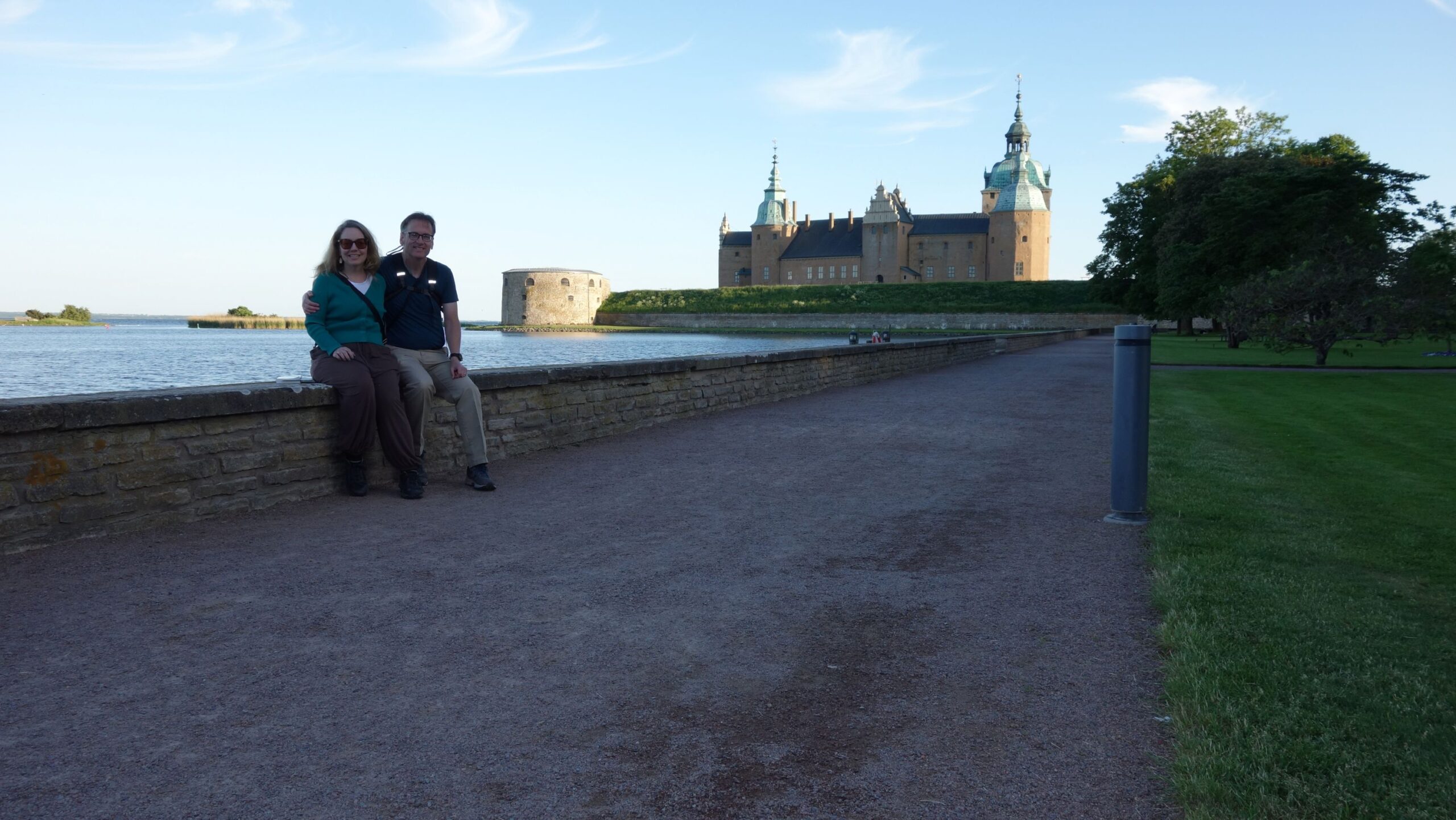
It was a perfect evening – cool and with a few puffy clouds. Kalmar is right on the Baltic Sea, and so there are water views from all along the park on the eastern side of town. The town also has a castle, with a dry moat and a water-filled moat, so this is a fun place to wander. Which we did. We saw a small glassed-in gazebo operating as a small art museum showing the works of an artist who worked on the nearby large island, Oland. We popped over to the castle and looked in, but decided not to crash the very swanky-looking wedding reception going on. We did walk up on the outer walls and look out over the sea, which was quite pretty.

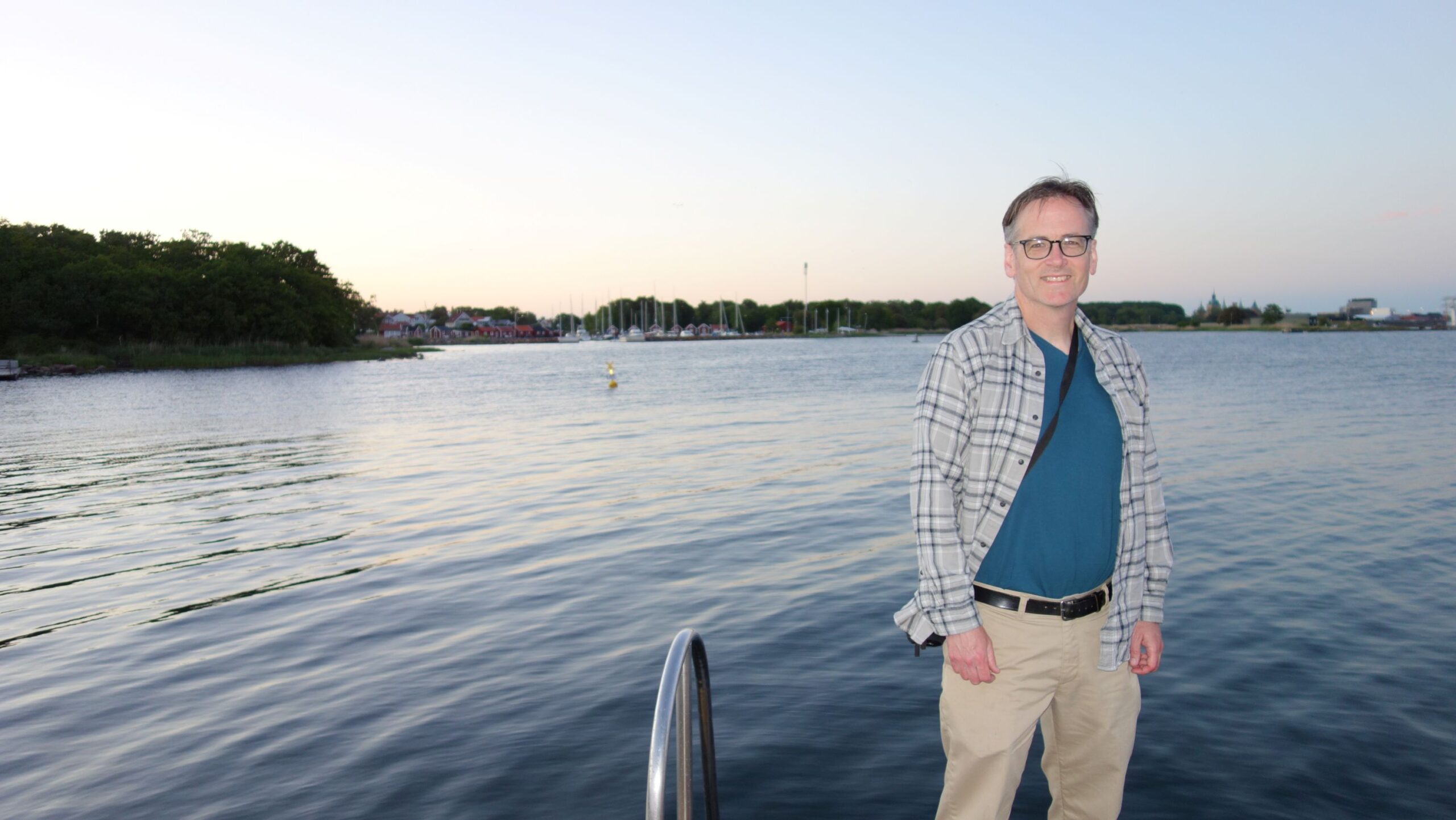
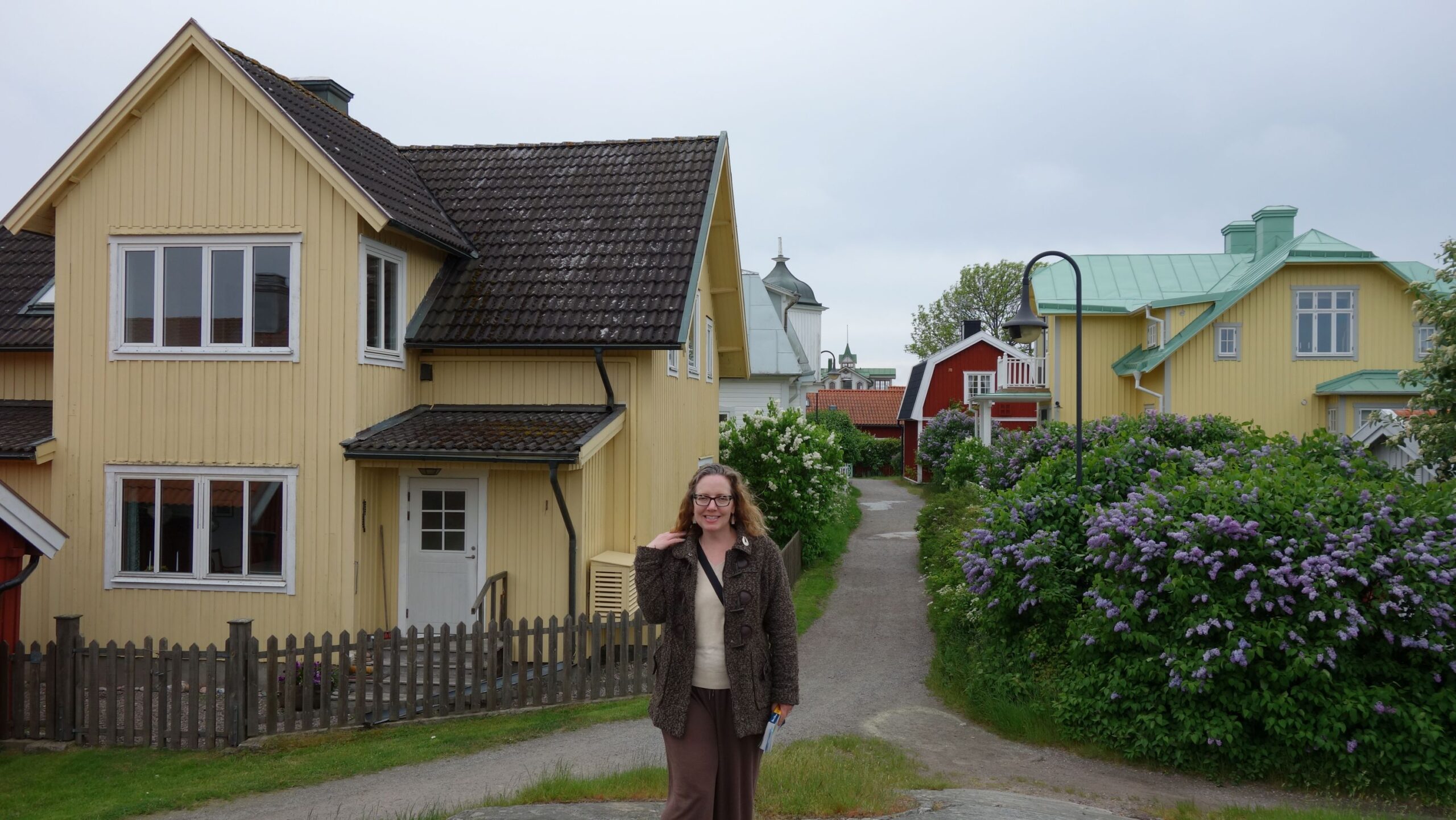
From there, we trekked out to the pier, where we were surprised to find several teen boys swimming in the sea on this sixty-degree day. Carpe swimming – swim while you can, I guess. We then wrapped up the touring of the day with a long stroll through a park out to the island park of Stenso. Between the sea on one side and the park on the other with the cool evening, it was a pretty wonderful stroll. On the way back to the hotel, we went through the town instead of going along the shore, and we admired the red and yellow homes, the well-kept yards, and the flowering trees and shrubs.

On a day of about seven-and-a-half hours of travel, we managed to do some five hours of touring, That’s not something I’d want to do every day of any trip, but it does get us to see more of the country. Welcome to the far south of Sweden!

Sweden 2026 – Day 7, Friday, Sandhamn

When we tour, sometimes the journey is a large chunk of the touring . Such was today as we headed out to the far eastern end of the Stockholm archipelago, to the small village of Sandhamn.

We checked out of our hotel in Stockholm and started walking to the ferry landing. The forecast had shown it was raining, and it was, but it was only a light sprinkle, and by the time we got to the boat, it had stopped raining. That was a huge blessing for us, since we wanted to sit outside on the boat (for two and a half hours) and walk (outside) all around Sandhamn.

The ferry is on a main street in Stockholm, and walking in, I had noticed that the police were blocking intersections onto the street. While we were waiting in the line for the boat, the traffic dried up on the road, and some police cars went slowly by. They were followed by fifty or so horses ridden by (presumably) soldiers in golden helmets and with drawn swords. They were followed by two horse-drawn carriages with some people in them, and then three black sedans, a large van full of soldiers, and then more police cars. I have no idea who or what this show was for, but it was clearly important and sure snarled up traffic.

On to the boat! Mer and I sat in the small open section of the back, and we got underway. The boat took us past several places we had been, but it also got us our best look at Grona Lund, the city’s amusement park (fun fact – the local people who live near the park get a subsidy to make up for the noise from the park). They’ve managed to squeeze four or five roller coasters onto a small plot of land, and even have a spinning ride floating on a barge.

We headed out into the not-really-open water as we started navigating the islands. There are 30,000 islands in the archipelago (counting even the tiny ones), but only 150 are inhabited year-round. It takes a long time to get to open water from Stockholm.

On the whole, the landscape reminded me strongly of the Maine coast. It’s rocky and forested in many places, but it still has differences. Here there are more mini-islands than Maine has, and a surprising number of them have a few houses built on them. The houses seem to be painted in cheerful colors, and, not surprisingly, many of them are really nice. There are also fewer pine trees here than along the Maine coast – still tons of trees, but fewer of them are pines.

And so we had a pleasant and scenic, if increasingly chilly, ride out to Sandhamn. The temperature dropped as we kept going east, and with the wind on the boat, it was cool (probably in the fifties).

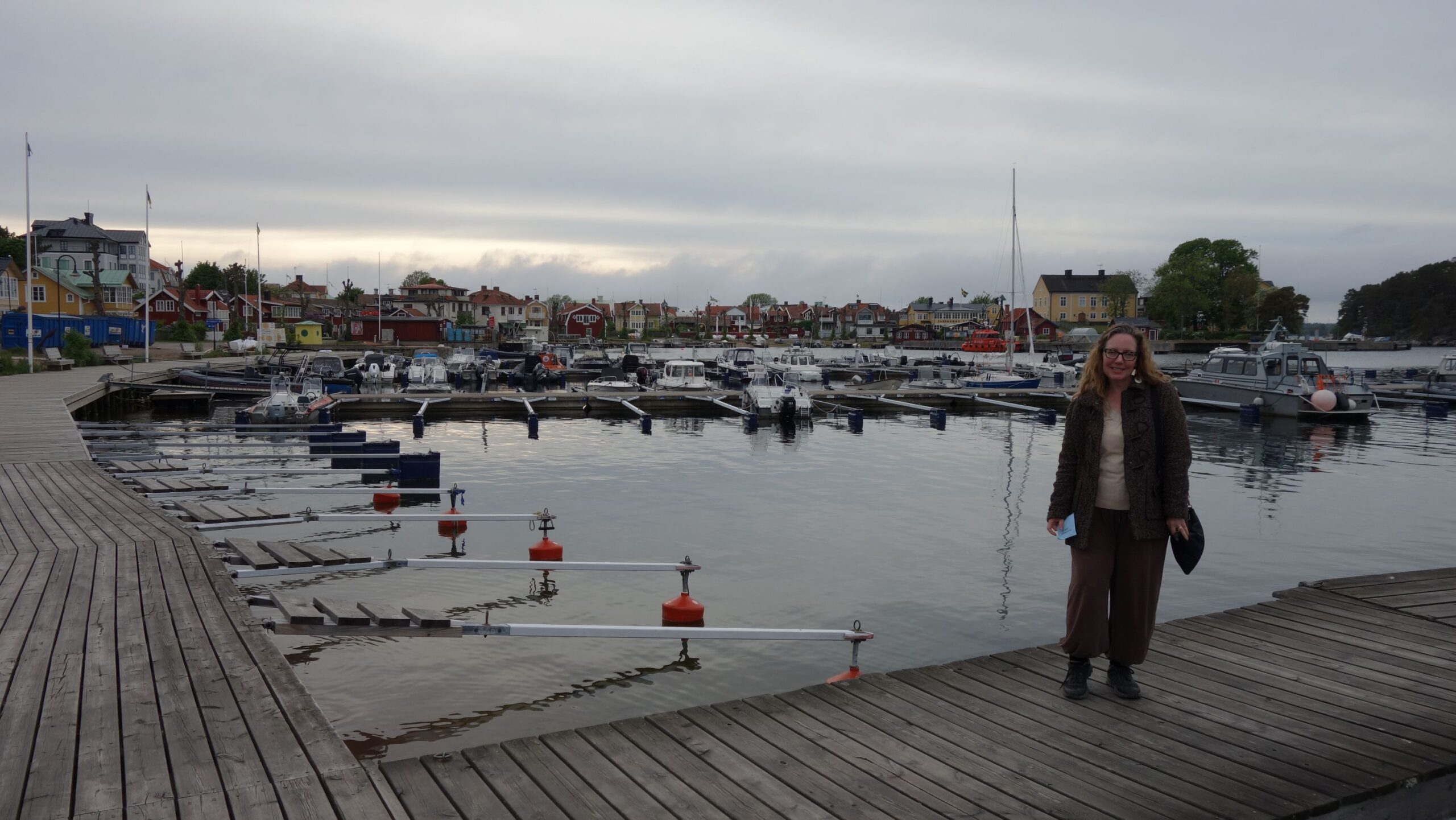
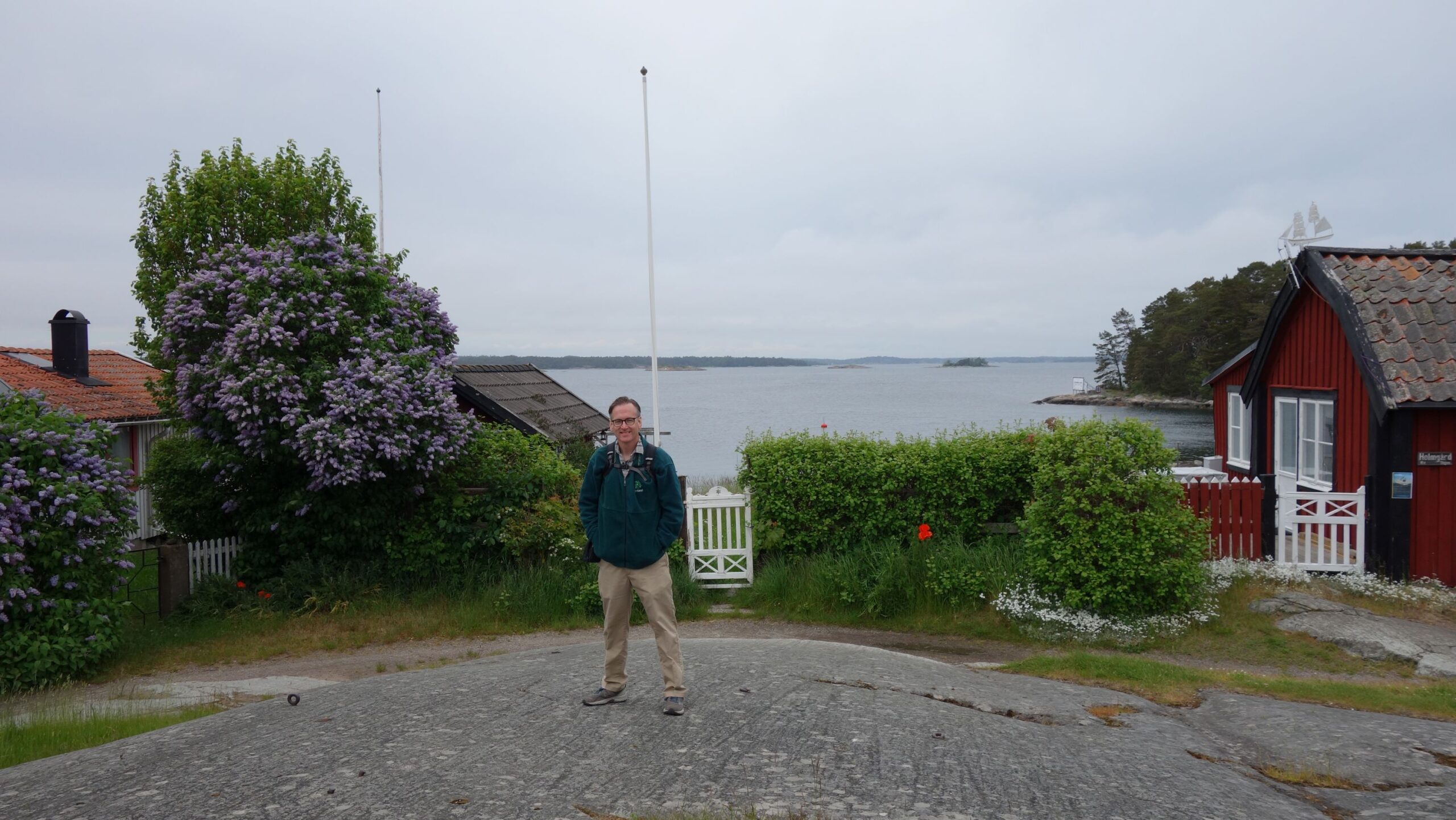
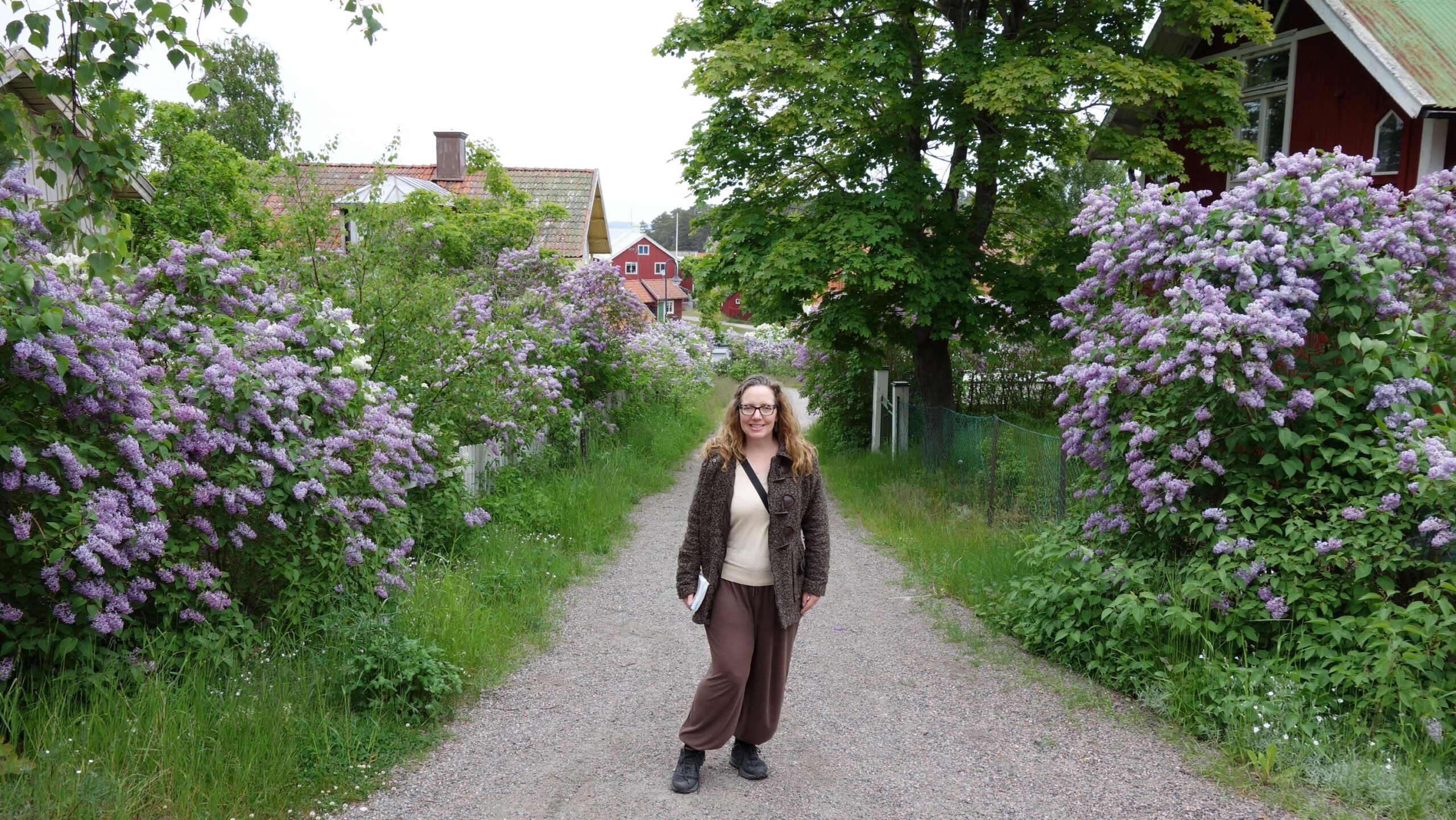
Sandhamn is a very cute village. There are only about 450 homes in the village, and only about 50 of those have people who stay the winter. There are no cars and only one paved street (a hill is paved, probably to prevent erosion). People here do use four-wheelers and electric carts to move people and good in, but no cars. Most of the “roads” are really just large paths between houses. The houses are brightly painted, and there are lilacs everywhere, and they’re still in bloom. I’ve never seen anywhere with so many lilacs, which I love, since it’s my favorite flower.

We got off the boat and dumped our luggage at the hotel (our room wasn’t ready at 12:30), and we walked across the village to the local bakery, which is still only open Friday to Sunday; it opens every day once the school holidays start on June 15th. We ate lunch there, sitting outside, and then we wandered around the village. We found a large outcropping of rock overlooking the sea that used to have a windmill on it. We found the local beach and then the chapel on the island, which is on a rise of land with good sea views. We stopped to smell lilacs all over town, and took back lanes as we wanted until we ended back on the waterfront.

It was 2:30, so we checked into our room, and then went back out on the island. Across the island, about a mile away, is the other small settlement here. Back in the mid-twentieth century, a developer built a bunch of small cabins (about 170 square feet) so that middle-class people could have a summer cabin on the beach. We walked out to it. A few of the small cabins remain, but most of the places with sea views are no longer 170 square feet. We were the only ones on the beach – it’s on the Baltic Sea side of the island, and the breeze was quite strong, making for a cool day to be swimming, We sat and watched the sea for awhile, and then walked back to Sandhamn, going back a different way that was longer but wound more around houses. They were pretty nice with lots of large windows.

That got us back to town and our hotel. We swung by a local bar to order bar food, and then decided to call it an early night. We’ve been touring pretty hard for a week, so an early night is quite welcome. This is certainly a great place to slow down.

Sweden 2026 – Day 6, Thursday, Stockholm

Today was my one and only day to plan things in Stockholm (by my own choice, since I wanted my additional time spent elsewhere). So I was a little sad that the forecast called for rain showers and full-on rain in the afternoon, but the morning was beautiful. I wanted to take full advantage of that.

Usually, I’m a last-minute-planning kind of tourist. I like to get in the city and see what’s around before I start planning too many things. As I did my research this time, I found a bunch of things I wanted to do, so I actually reserved ahead. For four different things. Busy day today.

We walked down to the old-town island of Gamla Stan, past the in-town palace and along the harbor. We got to a small open square, where we met up with Max, a Ukrainian who has been living here for two years, and he was our street-legal golf cart  driver today, to take us on a two-hour tour of Stockholm.

It was a fun tour. Max took us all over the areas around Gamla Stan, crossing something like eight of the fourteen islands that Stockholm is built on. Max showed us (not exhaustively) –
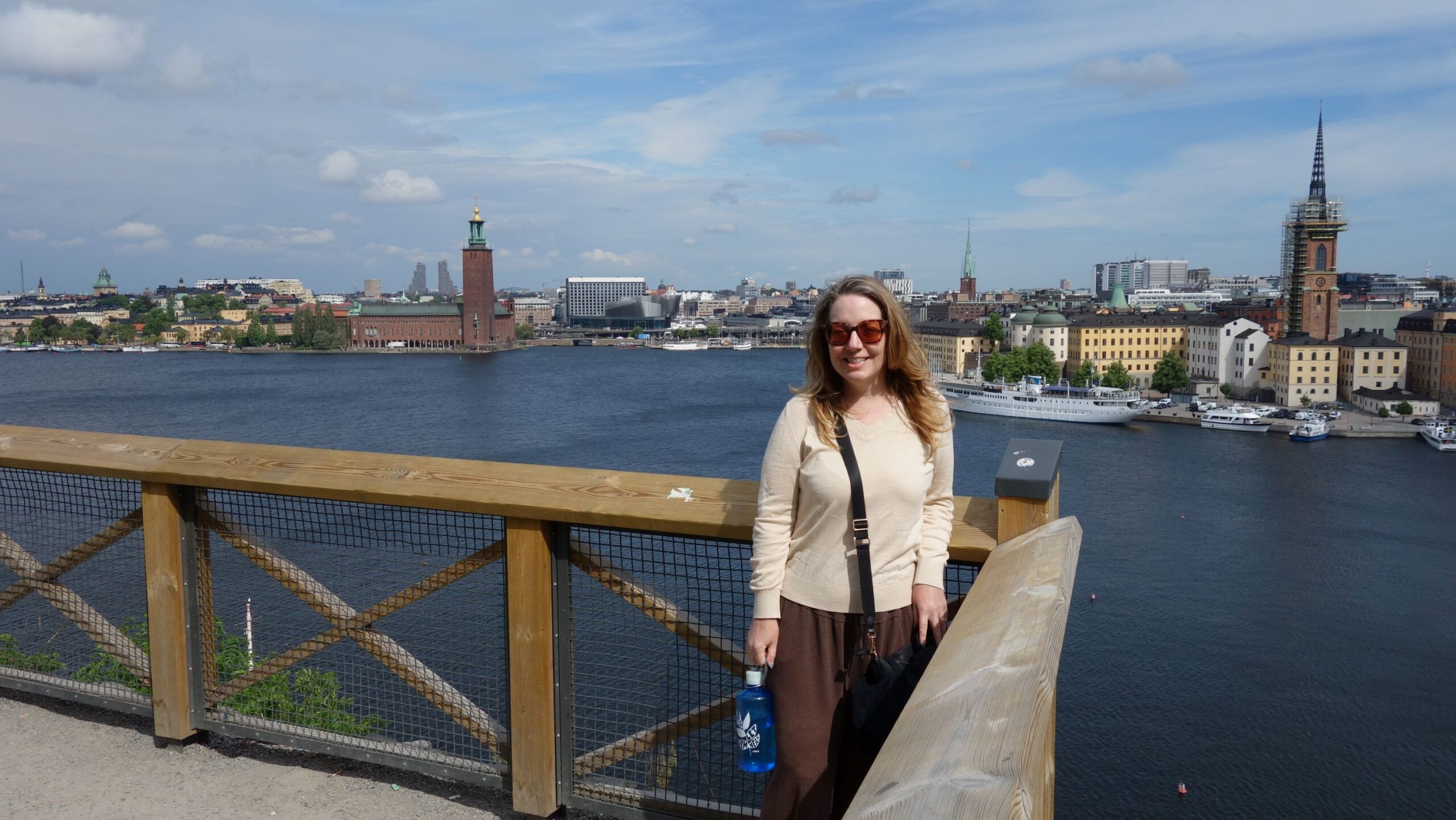
– Several high points to see the city from, including a clifftop park.
– How you can see one neighborhood where it straddled the before and after of dynamite; one side was built on visible rocks, and on the other side, the rock had been blasted out of the way.
– A very pretty building that was actually an elevator built to bring supplies up to a wealthy noble’s house on the cliff.
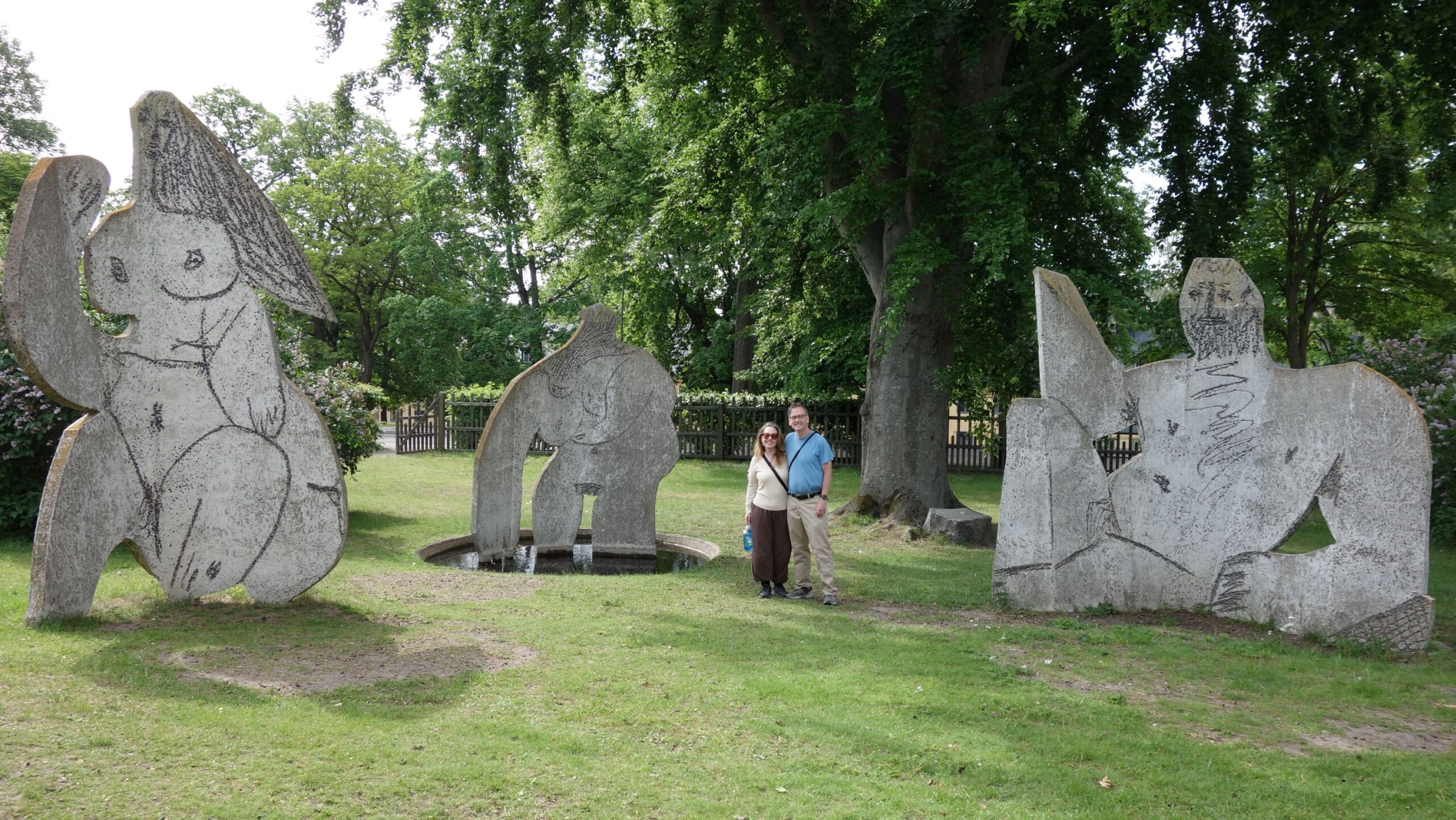
– An easy-to-miss grouping of Picasso sculptures.
– A statue of an actress that is heated to body temperature, since the actress had complained that statues were cold. People warm their hands on the statue during the winter.
– Where the ship the Vasa was built and roughly where it sank.
– He also told us that between private and public museums, Stockholm has over 350 museums.

The tour lasted two hours, and the weather was still very fine, so I decided to press my luck to go to a fairly far-flung attraction that I had flexible tickets for. It was 11:00, and we had 1:00 tickets for another sight, so I knew that it was going to be tight, but the weather was good, so off we went.

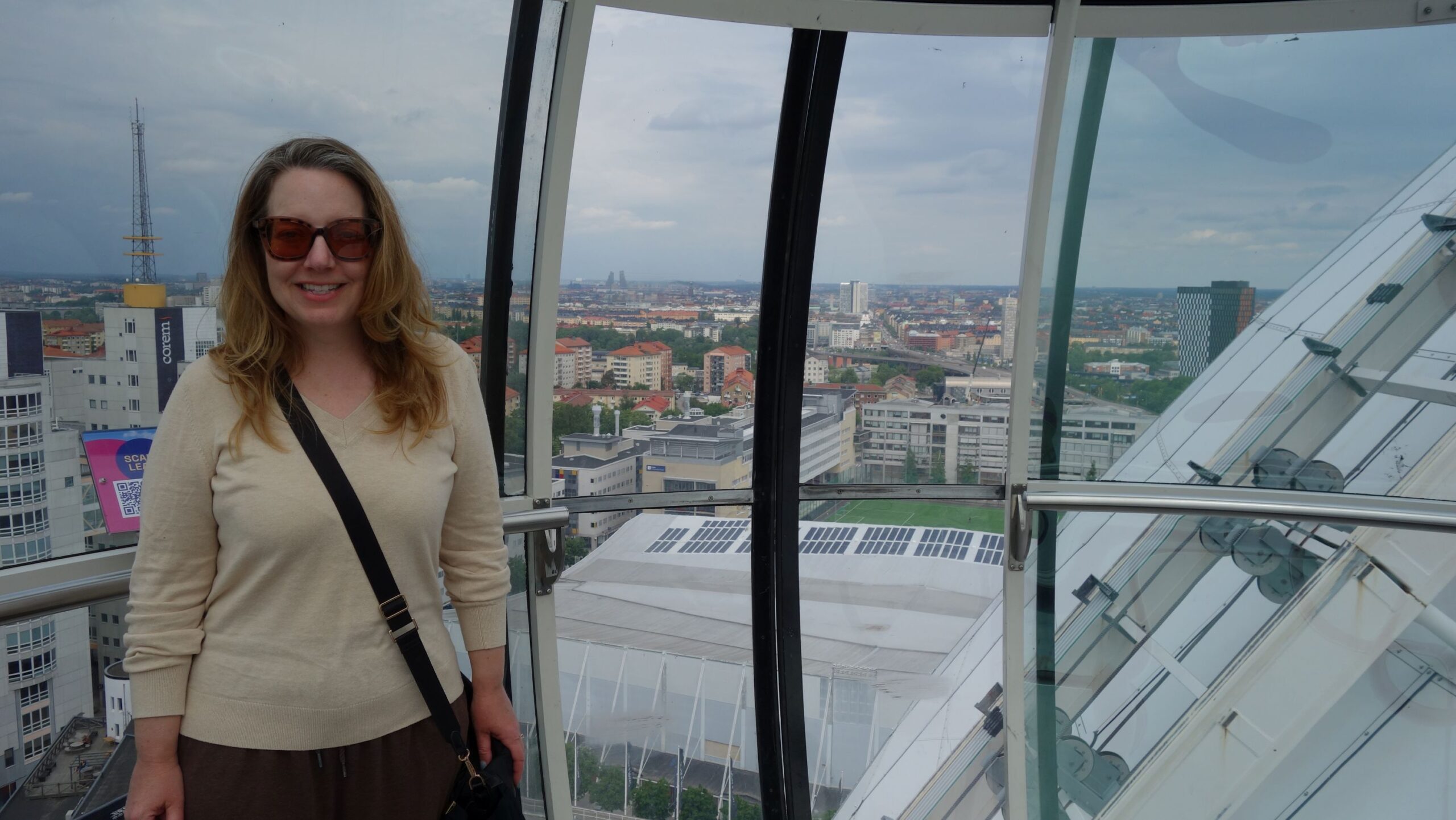
We took the subway south about four miles, emerging in a random tower-housing area. Meredith was a bit confused, and I was really trusting my phone-given directions. It didn’t look promising. But then a large golf-ball structure came into view, and we were good. We were here to do the SkyView at Avicii Arena. The arena is used for large events, like concerts, but about fifteen years ago, glass compartments were added on the outside of the sphere, and you can ride it up to the top of the arena at 280 feet for views of the greater Stockholm area.

We had a few-minute wait, which made me think I was going to miss my 1:00 entry at the next sight, but we were here. We watched a movie on how extreme construction workers used helicopters to build the ride, and then we got to get on the gondola. The ride up follows the curve of the surface of the arena, and goes at a moderate pace. We sat at the top for several minutes, which gave us a chance to look around some. I had a couple of height-related moments of fear, but generally, if I was sitting and looking out, I was okay.

We got off the SkyView about 12:15 or so, and I began to think we had a chance. We walked purposefully back to the subway, took it to the central train station (north of Gamla Stan), and walked over to city hall, which is on the water facing Gamla Stan. We made it with about fifteen minutes to spare for our 1:00 entry time to climb the 365-step tower to the viewing platform on top.

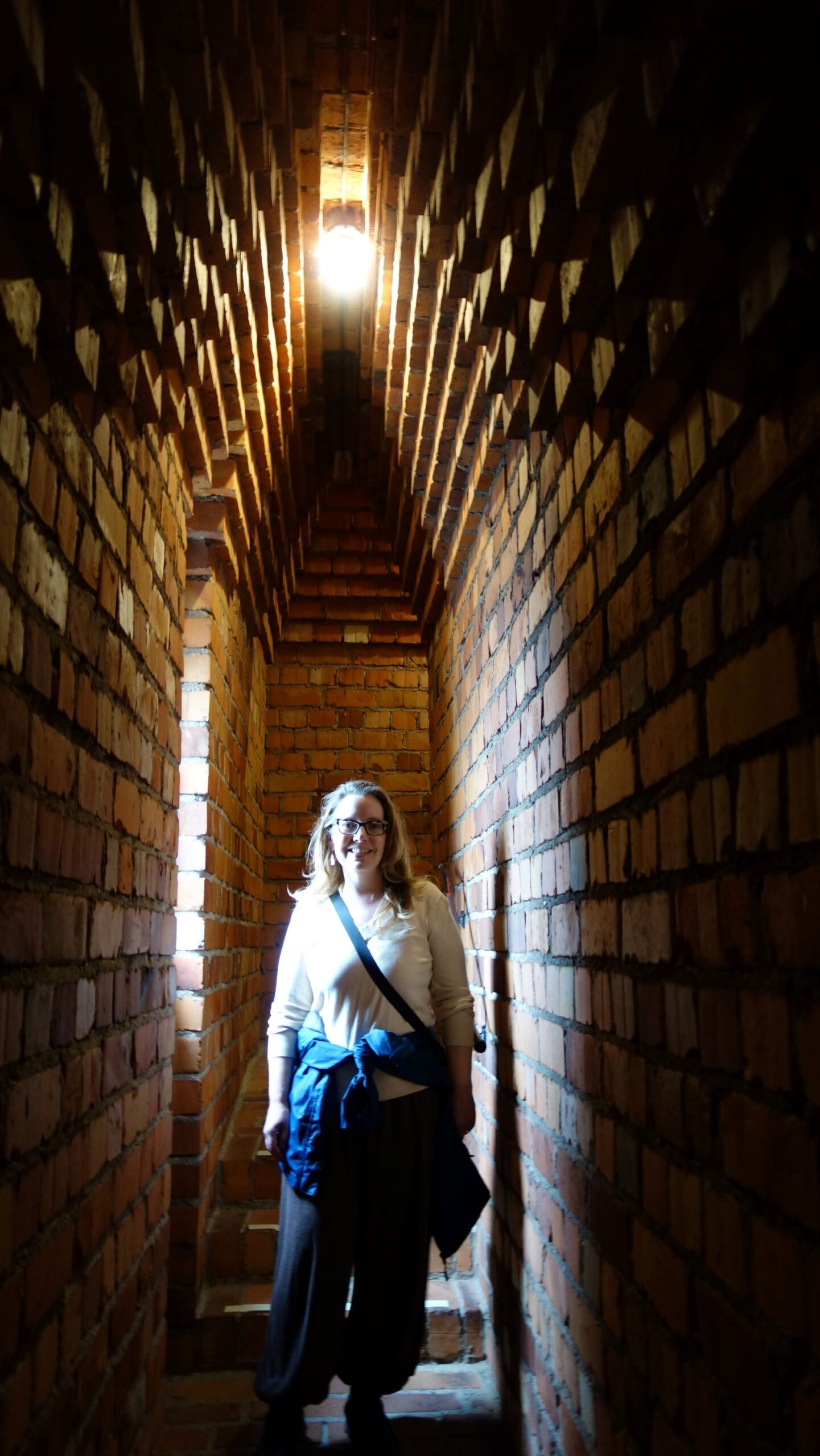
There is an elevator that will take visitors half of the way. Mer asked me if I was going to take it. She’s so droll! My patient wife joined me on the climb up. I loved it. The interior of the tower is almost all red brick, and at the half-way point is an open area for the interior dome for city hall. The space has been made into a small museum of busts of various people, including some of ordinary workers who helped build city hall. From there, the passageway wound around the tower, going up on slightly sloping ramps that had some steps along the way. The overhead brickwork was artistically done.

We made it to the top in about fifteen minutes, and the views in all directions were great. The view down to and over Gamla Stan was especially magnificent. And while I’m terrified of heights, the wise folks of Stockholm put up a cage all around the platform, even over the top. That somehow made me feel better, and I was able to stay up on top the full allowed fifteen minutes, albeit with my sitting as far back as I could manage. Usually, I leave Meredith on towers like this one, so she was happy I was able to be companionable.

That wrapped up my pre-arranged plans, except for a 7:00 supper reservation. We grabbed a light snack in the city hall cafe, and I checked the weather. It did seem as if rain was moving in very soon, so I decided to go to my backup indoor plan, to go see the Vasa Museum.

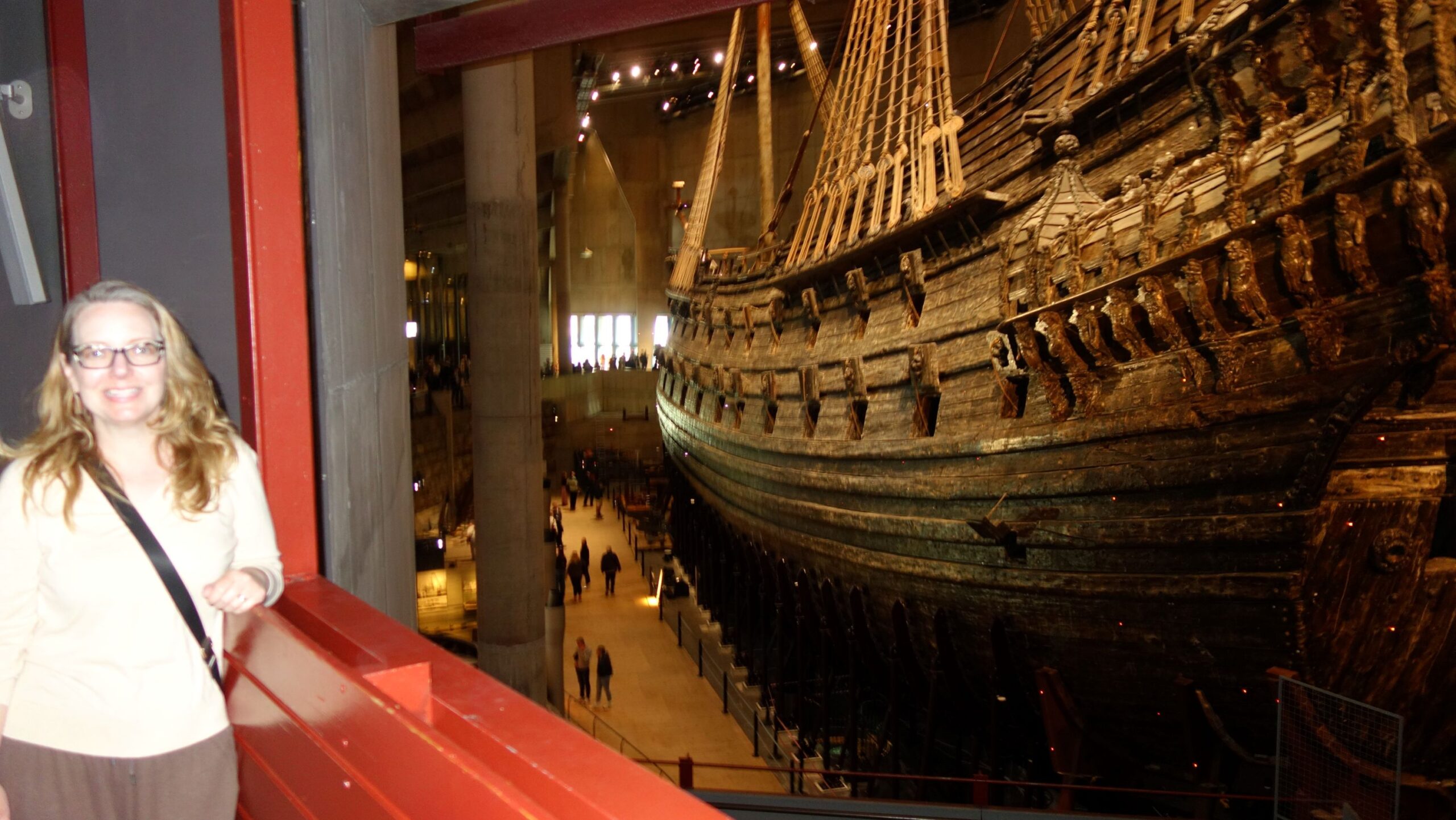
The Vasa Museum is dedicated to a ship that sank in 1628 on the day it launched. I thought the museum would show the ship and tell a little about it and we’d be there an hour or so. It turns out that the museum is one of the best museums I’ve been in anywhere. When you walk in, you are confronted with the entire Vasa sitting in front of you. It was a ship built to impress enemies of Sweden, and it still impressed me and Mer.

The museum has a film on how the Vasa sank, was found, was floated again, and was preserved. Then there are four viewing floors at different levels that highlight parts of the ship. One floor has a recreation of one of the two gun decks of the ship so you could feel how cramped the space was, and this was where the regular sailors and soldiers slept, as well.

The quick story – the king of Sweden wanted to get control of the Baltic Sea from Poland, and so ordered a huge ship to be built to go fight the Poles. He insisted that the Vasa have two gun levels, which the ship builder had never done before. The final product put the lower gun level only three feet above the waterline, and the second-level guns were higher up than normal, making the Vasa top-heavy. The Vasa was also a fairly narrow ship. Being top-heavy and narrow is bad for a ship. When the Vasa was launched (under pressure from the king), it got broadsided by a breeze and tilted over enough for the lower gun ports to start to take on water, which made the ship list more. It eventually sank after only twenty minutes of sailing, killing thirty to forty people who couldn’t get off.

The navy tried to raise the ship out of the ninety feet of water it sank in, but didn’t succeed, so the Vasa sat on the bottom of the harbor for over three hundred years, until the late 1950s, when a man who dreamed of finding the ship did actually find it, using a weighted, pointed metal cone to bring up samples from the sea floor. When he found a sample of oak (not native to Sweden), he guessed correctly that he had found the ship.

It took years to raise the ship and treat the wood so that it wouldn’t dry out and split. The Vasa was wharfed and opened to the public in 1961, and was moved to the new dedicated building in 1990, which was renovated in 2013.

Meredith and I spent almost three hours at the museum, admiring the ship from multiple angles and heights. We managed to catch an English-language tour, which showed some of the decorative touches on the ship and described the sinking in more detail. The ship cost about two percent of the national budget, so it was a severe loss.

The builders learned from the mistake – the sister ship was torn apart and made three feet wider than the Vasa had been. The other ship sailed for over thirty years. What a difference a few feet can make!

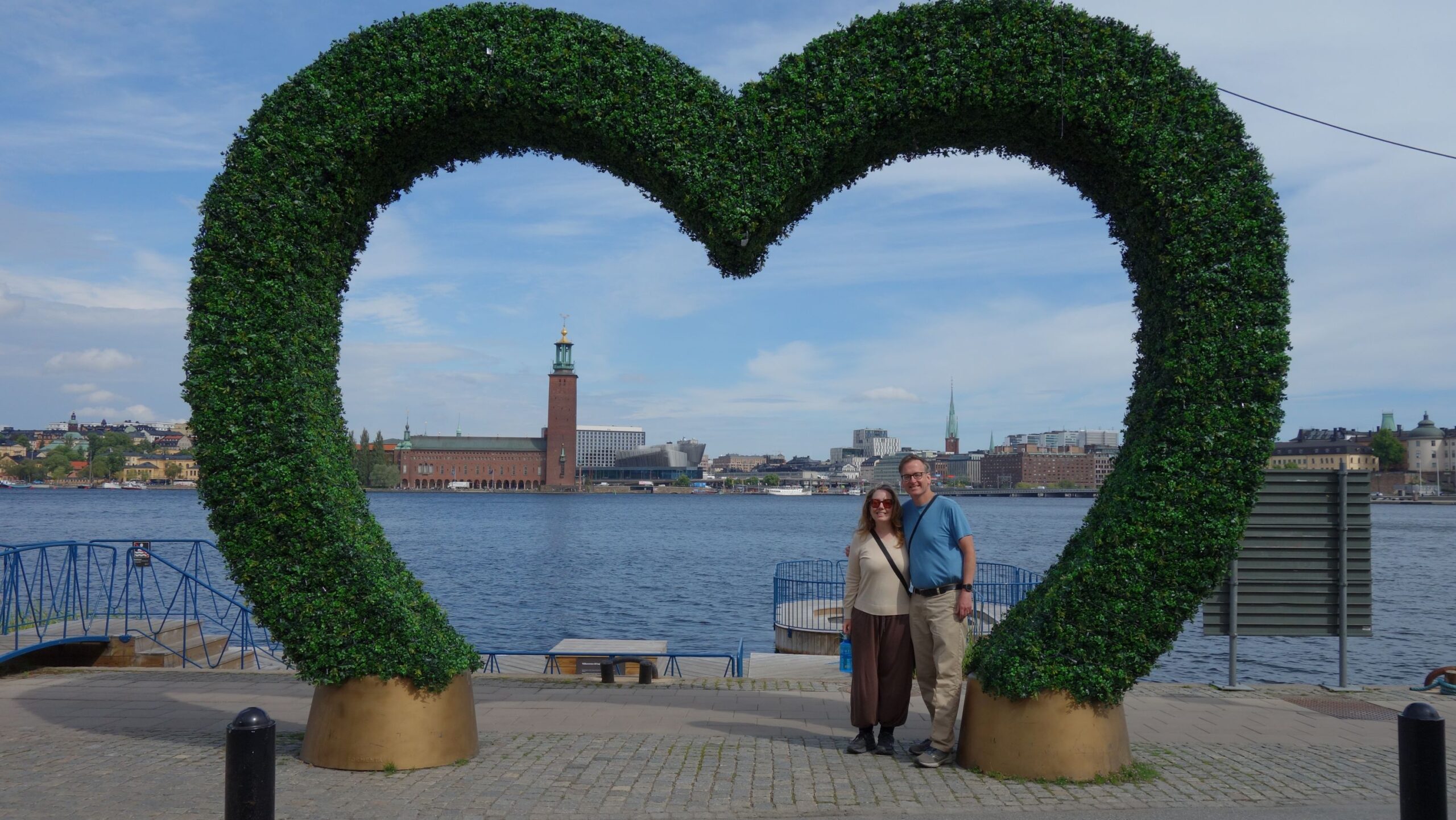
That wrapped up the museum, so we went back to Gamla Stan, where we wandered around for half an hour to see the sights, and especially the views across the bay to the city hall. We then went to our restaurant for the evening, Aifur.

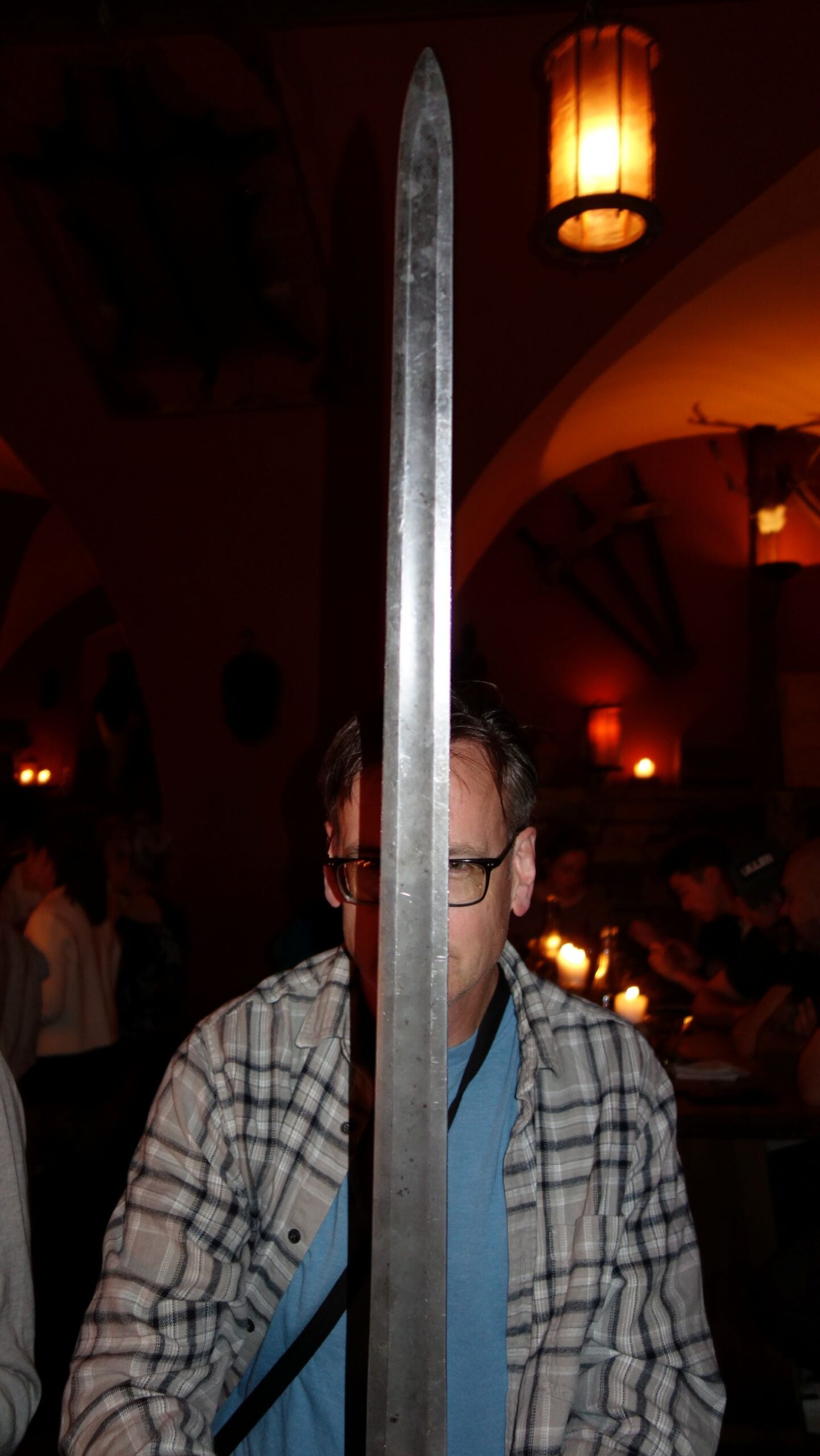
Aifur is a restaurant that serves food that is the best guess of what Vikings ate, and it’s Viking-themed. You are publicly announced to applause and hearty shouts from the other diners, and you are seated at a long common table. There is live music (a lute-like instrument and a bagpipe for our evening), and there is an extensive list of meads you can buy. I got a Sprite, but it was served in an earthenware glass. The place was joyfully loud and chaotic, and we had a good time. The food was good, and the experience was even better.

That finally wrapped up my day in Stockholm and ends our touring of the city for this trip. The rain was good enough to be heaviest while we were in the museum, and the slight drizzle we walked home in was warded off by our just wearing hats. Stockholm has been good to us, and we’re looking forward to the next part of our trip.

Sweden 2026 – Day 5, Wednesday, Uppsala

Students are convinced that teachers spend all summer thinking about school and maybe even living at school and counting the days down until school starts. That’s obvious nonsense, as this vacation gives testimony to. For instance, today we went to Uppsala, home of Sweden’s oldest, um, school (university).

Meredith has been good to me this front end of the vacation by letting me be car-free. We took a boat two days ago, a train yesterday, and another train today to get to places outside of Stockholm. It probably would have been more efficient and more or less a wash on cost if we’d had a car, but then I’d have to keep dealing with Stockholm traffic and parking. I’m grateful for the peaceful transportation options we’ve been using.

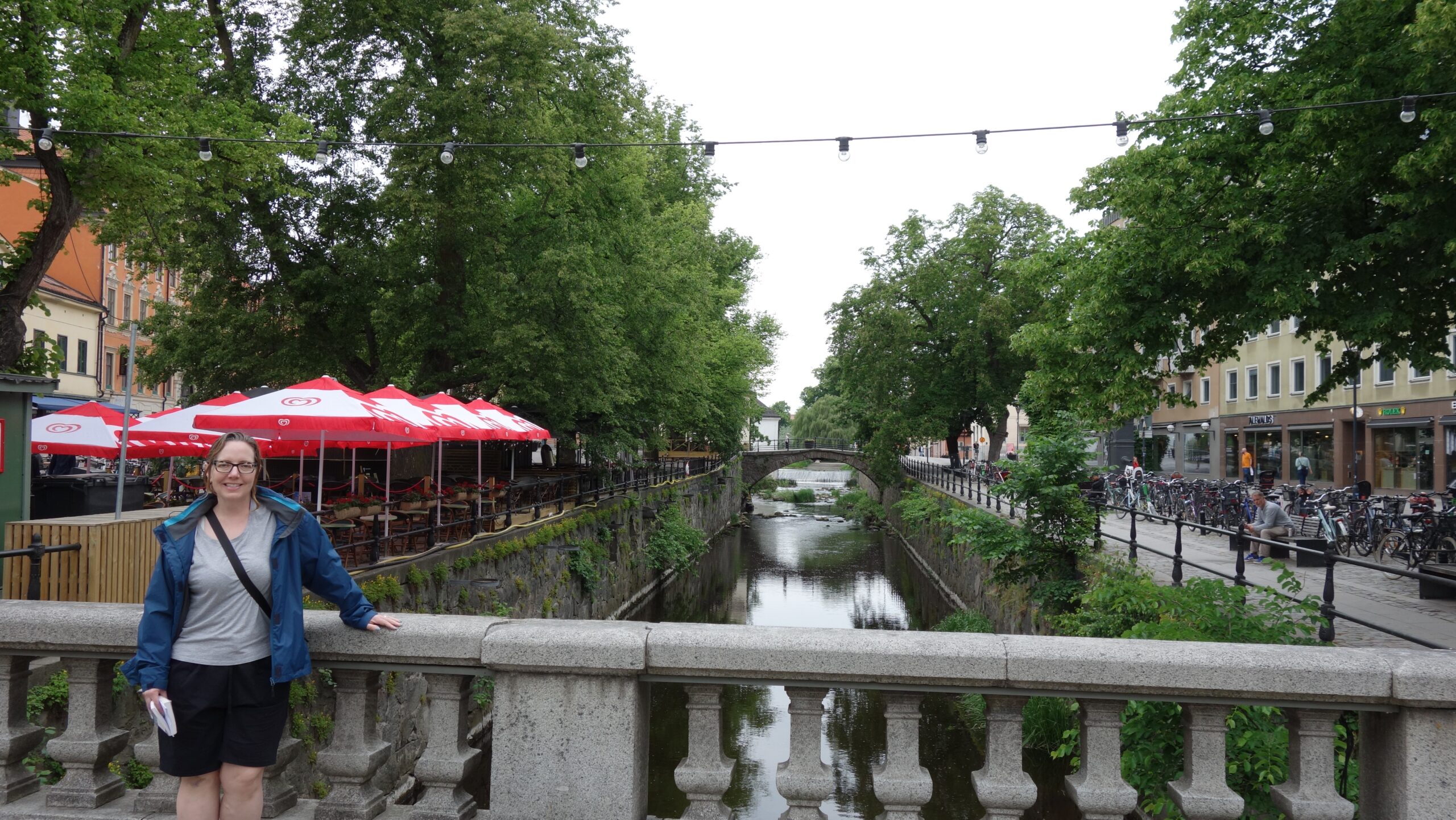
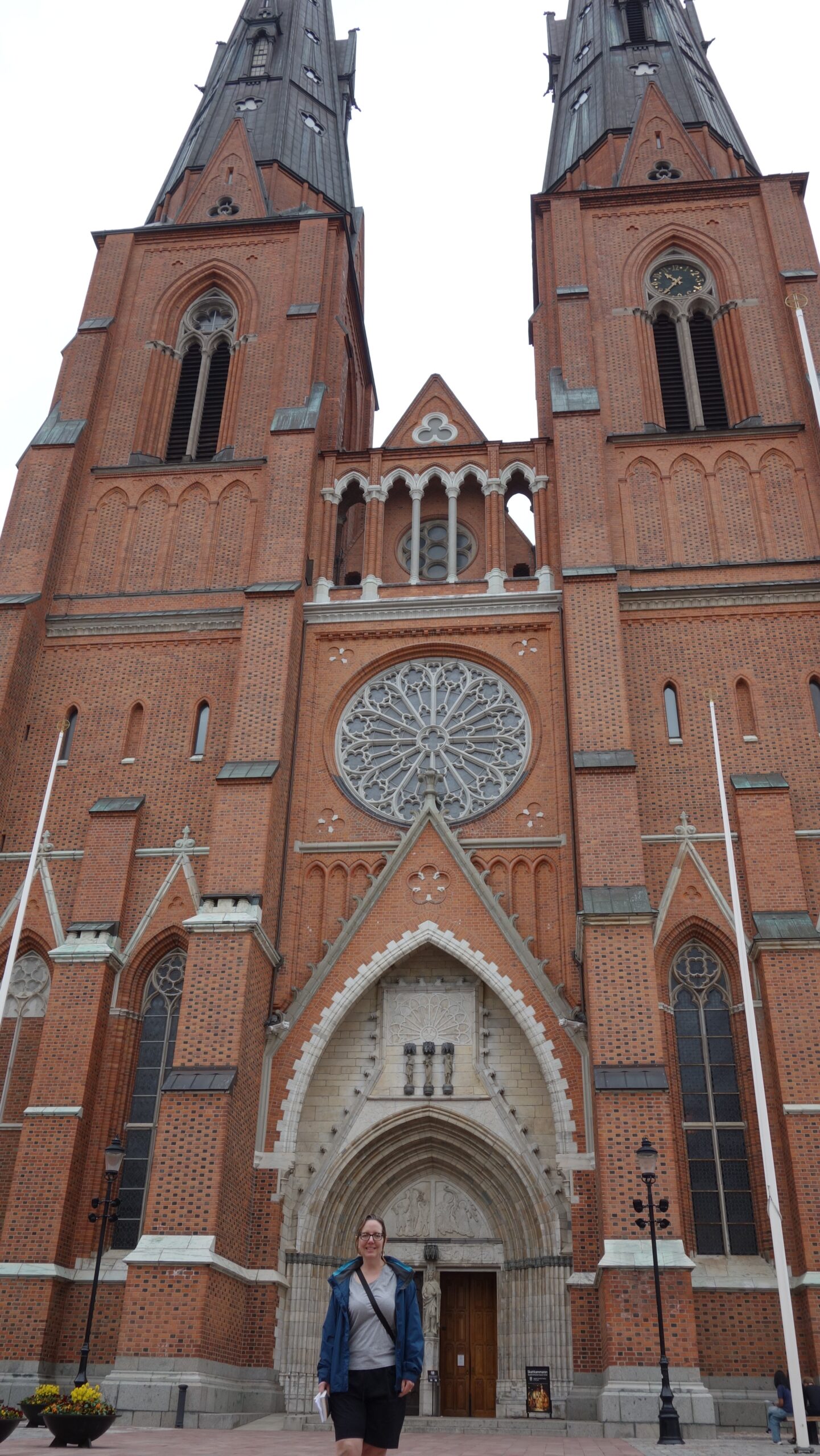
We arrived at Uppsala right around 10:00 and set off walking into the town from the train station. We very quickly hit a pedestrian-only street that led to a large main square area. The town was a bit larger than I had anticipated, but the walk through the center of town was pleasant. We kept going, and suddenly a huge church hove into view. I said, “Whoa!” and Mer replied, “That ‘whoa!” is what we’re here to see.”

We were looking at the towering red-brick Uppsala Cathedral, tallest church in the Nordic countries, which was started a little before 1300. It has two front spires that are each over thirty feet tall, reaching over 380 feet in the sky. The spire over the transept of the church isn’t much smaller, which makes it a “whoa!” sight to see.

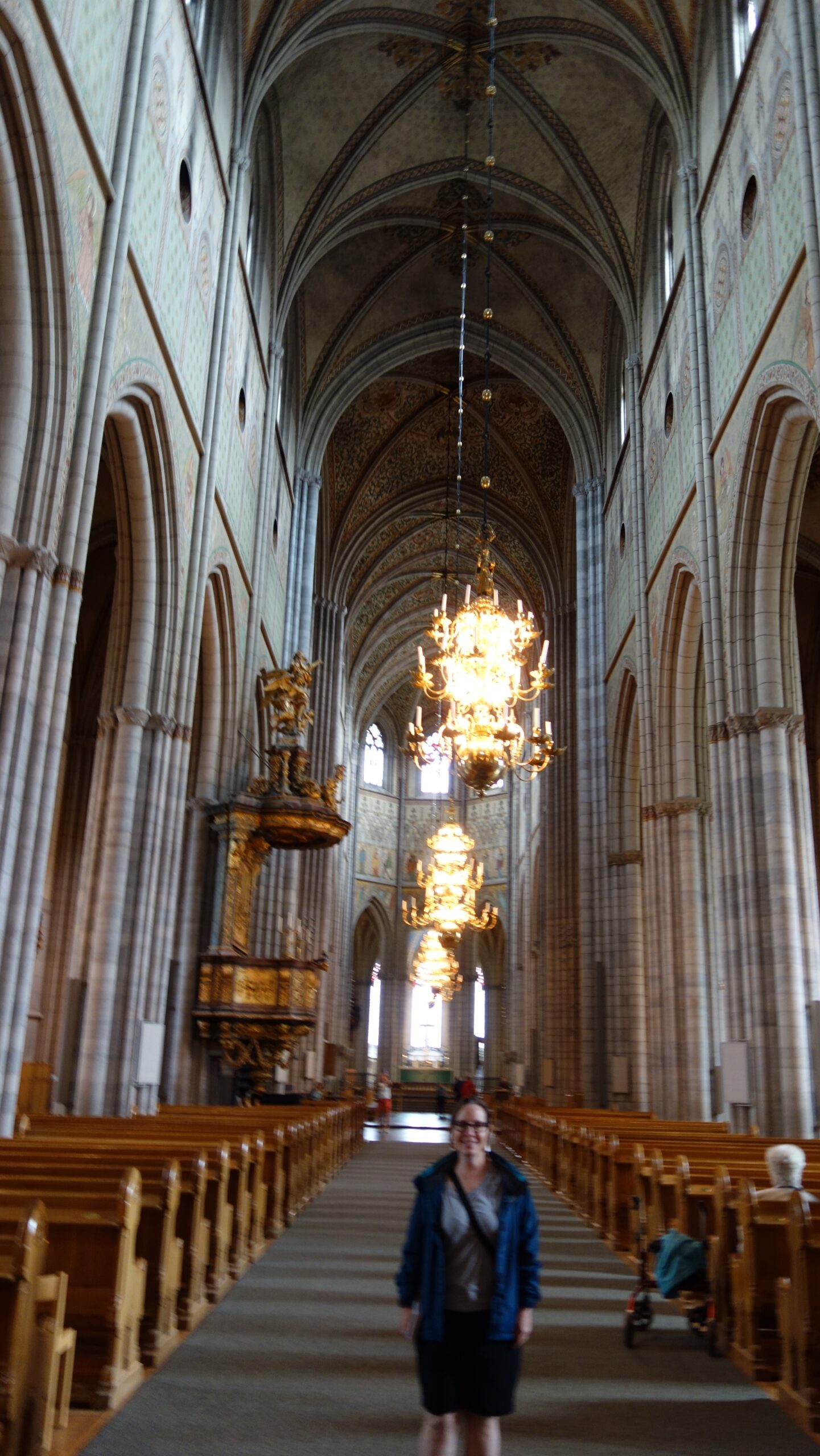
Happily, the cathedral is free to enter, even on a weekday. It does cost a fee to go see the treasury, which we did later, but I have no issue with that if it helps with the maintenance of the church. The interior is decorated, especially the pulpit, which is wildly ornate with Biblical stories and various cherubs about.

There are side chapels along both walls. One has the tomb of an early Swedish queen, and one has the tomb of the Swedish botanist Carl Linnaeus. There was a chapel used as a children’s teaching area, and one was set up as a comfortable office for drop-by counseling. My favorite was an installation of a simple representation of Jesus surrounded by several children and some parents. It was clearly from the “Bring the little children to me and hinder them not” passage of the Bible. It was cheerful and colorful and well done. And there was a barricade across the entrance. These things make me smile.

One chapel was set up to display a video from a video artist. The church had bought the piece, and I had never thought about video art being sold before. It was a moving video of two women, out of focus and filmed in black and white, crossing through a sheet of water. Once through the water, they were in color and in sharp focus. They were both joyful and then started looking sad, and then went back through the water to the grey. Mer and I thought it represented moments of being very close to God but then having to come back to being in this world every day to keep doing God’s work. As Paul said, “For to me, to live is Christ and to die is gain” – serving Jesus here is important, but being with Jesus after death is actually a gain (is better). It was a thoughtful exhibit, and I love that churches are still buying art.

Toward the back of the church was a tomb of one of the kings of Sweden, buried along with his two wives (the first one died relatively young). Outside the tomb was a representation of a normal-looking woman who looked a bit worn and sad. This was a work by an artist who wanted to show Mary looking in on a chapel after seeing her son die. Again, a very effective work. No crown of heaven or being borne on angels to heaven – just a woman who was in pain.

Having wrapped up seeing the church, we paid to see the treasury, which was in one of the spire towers, seven floors up, and then coming down to the six and then fifth floor. We took the elevator up, and we were given flashlights so we could see the artifacts more closely in the dim light.

Most of the objects were fabric – old church vestments, mostly. But they were incredibly elaborate and decorated with gold and silver thread and sometimes pearls. It had to have held poor illiterate peasants in awe to see a bishop come out in these clothes. Almost all had some story from the Bible woven in to them, so they could be used to remind people of the important messages of the Bible.

There were also some standard church objects – crosses, chalices (including the most heavily decorated chalice I’ve ever seen), swords and crowns from royal tombs, and so on.

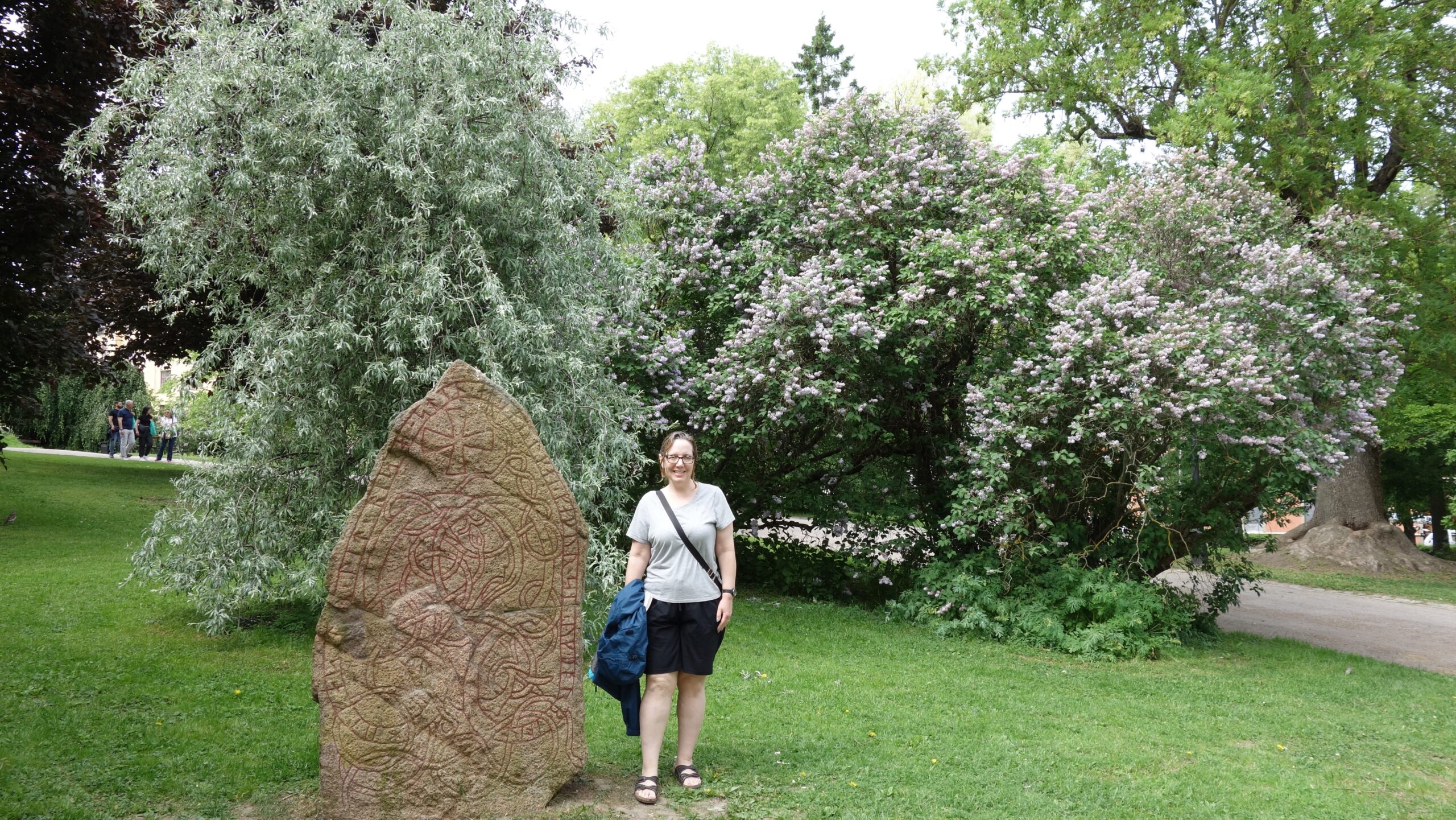
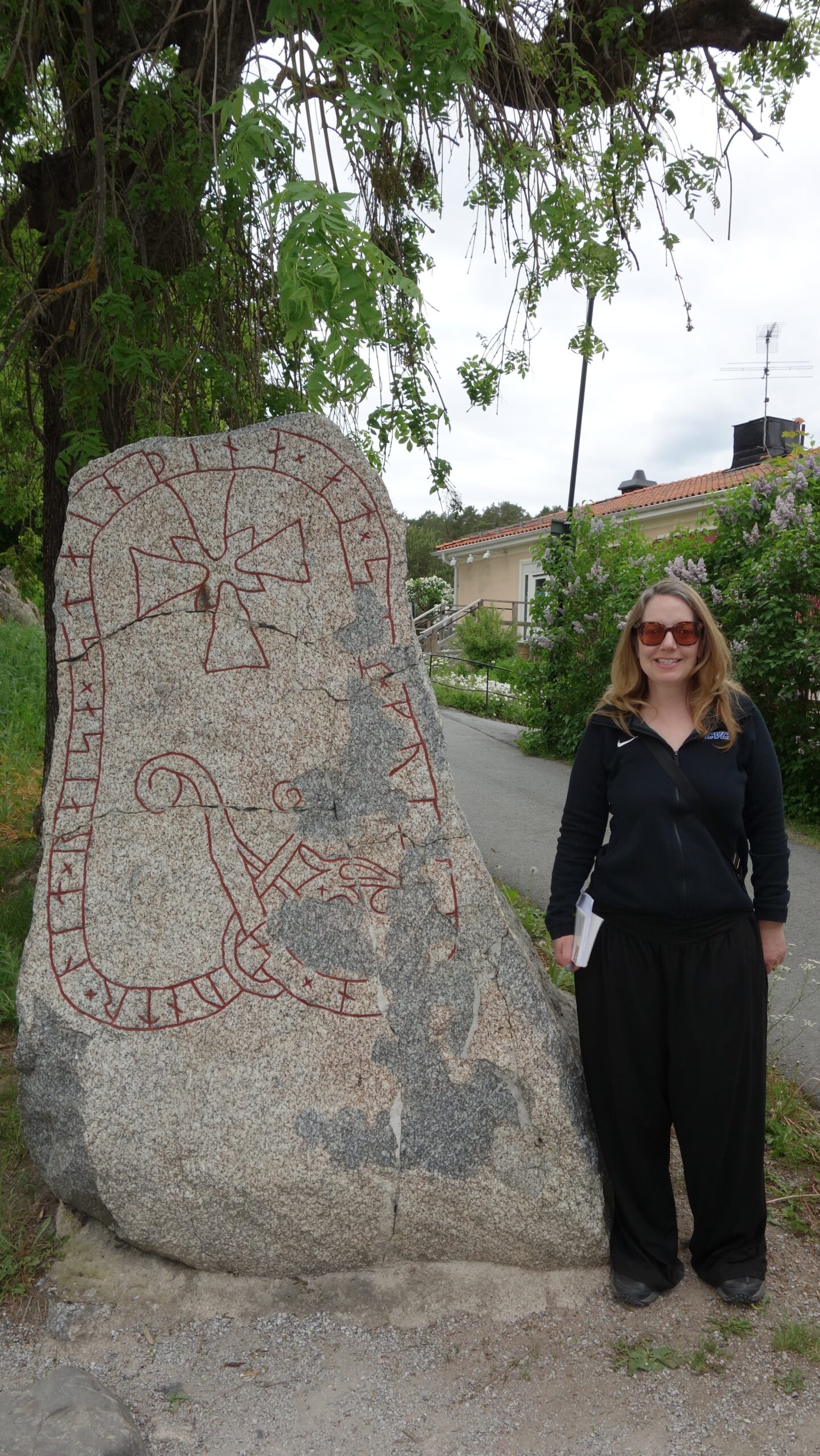
After the church, we crossed the street to go look at the university museum, the Gustavianum. But we got distracted at looking at five rune stones in the park in front. And then we discovered there was an English-language tour in forty-five minutes at 1:00, so we beat a hasty retreat back to the cathedral cafeteria for lunch.

After lunch, we still had twenty minutes before the tour began, so we looked in on the museum’s pre-Viking exhibit on the Vendel culture that lasted a couple of hundred years before the Vikings (from about 500 to 800). The most important objects were for us four Vendel helmets recovered from graves. Vikings didn’t bury helmets, so they are quite rare, with only five known. We saw four today, and the fifth is in the British Museum, and we’ve seen it too, so we collected them all. The British Museum one is pictured in Meredith’s British literature book for her classes for when she teaches Beowulf. Now we’ve seen them all.

There were only four of us on the tour – us and a British couple who now live in New Zealand. That was a fun-sized group. We were taken around by Sara, who is studying Museum Studies at the university. She took us to a case of banned hazing tools from the 1600s and told us about the history of the school (and how it was founded two years before the rival Danes’ school in Copenhagen). From there, she took us up a floor to the art wings.

The Gustavianum has the second-largest art collection in Sweden, after only the national museum. They can only have about five percent on display at any time. One piece that is always on display is a huge curiosity cabinet that had been used to store thousands of items from nature and cultures around the world. It’s about ten feet high and weighs almost two thousand pounds. Most of the items that had been in it are on display, except for some of the natural specimens that eighteenth-century scientists lost track of. Oooops.

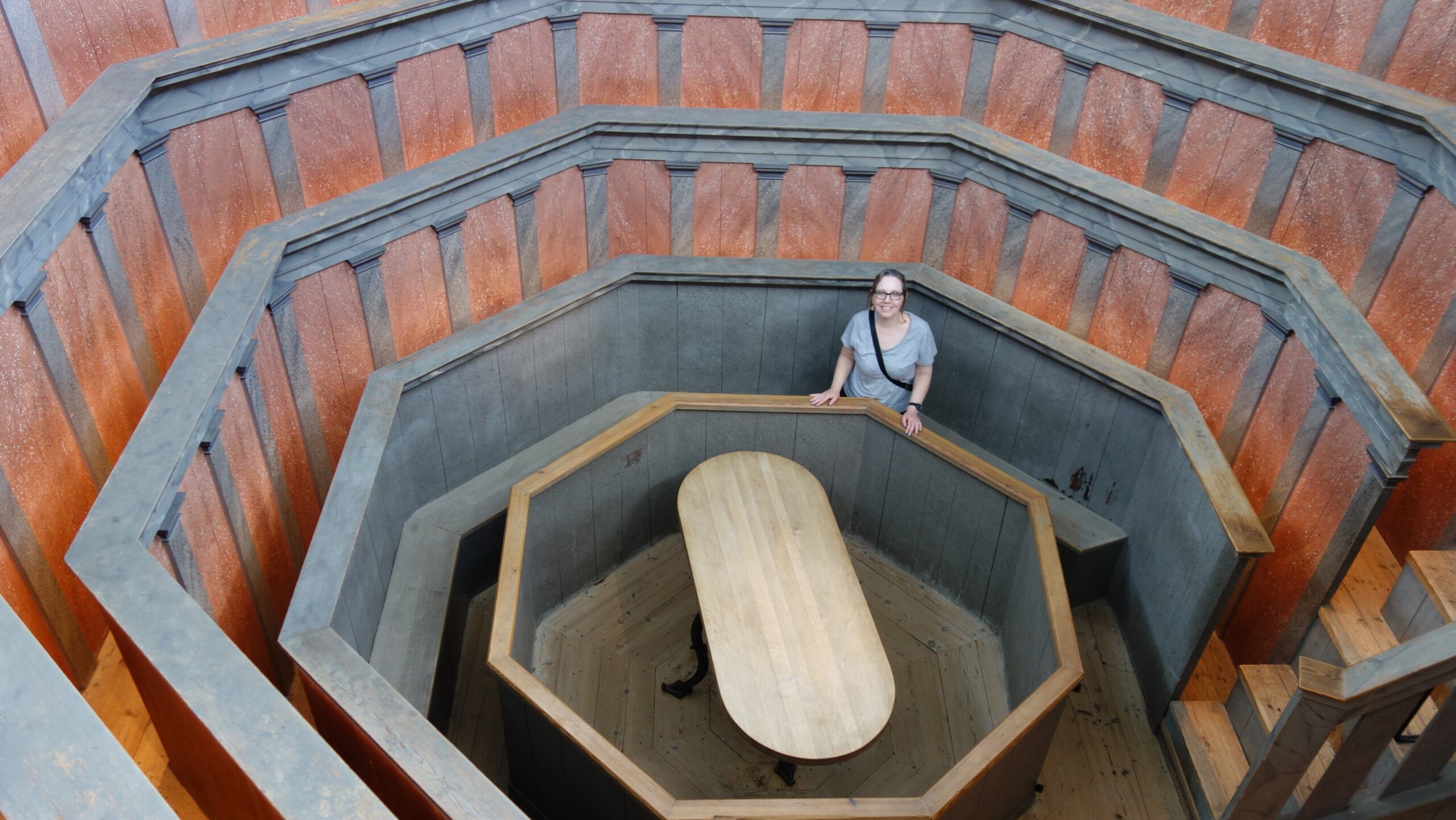
From there, we went to the operating theater. This was a reconstruction (in place) of a 1600s lecture hall dedicated to dissection of human corpses to teach medicine. Mostly. It seems some tickets were also sold to the public to help defray costs. Because cutting up human bodies was controversial, the university and church agreed that they could only dissect criminals, suicides, and bastards. The university did give the body a proper burial on university grounds when they were finished with each dissection.

After our tour, we went back and finished all the rooms we had skipped. The university has Celsius’ first thermometer, which oddly had zero degrees as the temperature of boiling water and one hundred degrees as the temperature of freezing water. I’m not sure of the reasoning there, but it got fixed at some point. There were many other scientific instruments in that wing, including early telescopes and microscopes, and various early instruments to study electricity. I quite liked it.

We finished up with the two art wings. A Swedish playwright that Meredith knows of also turned out to be a pretty decent painter, and Carl III was a very good painter of landscapes himself. The museum had one small Rodin work, and an eclectic collection of landscapes, still lifes, and portraits.

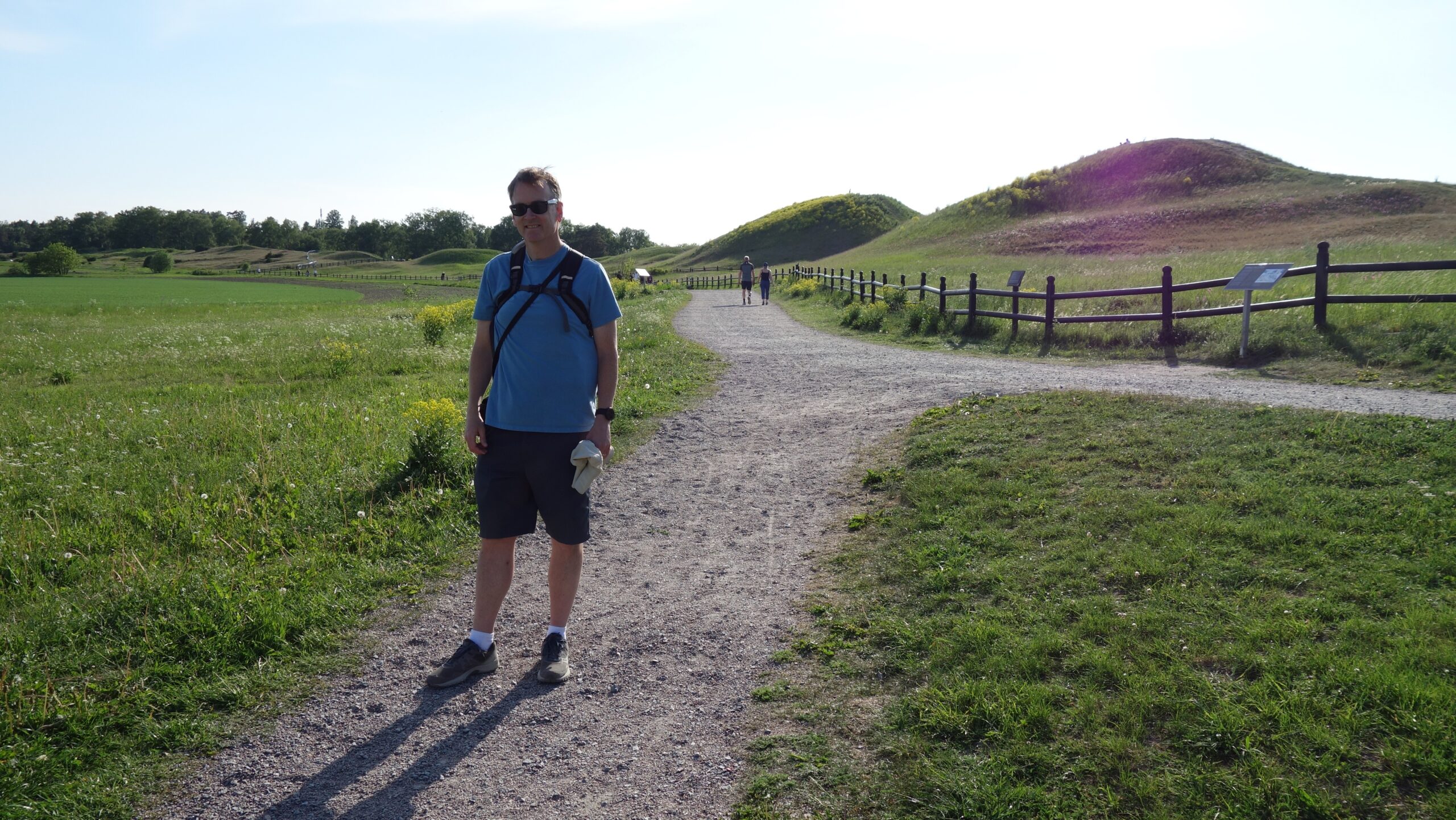
From the museum, after a false start on finding where to buy tickets, we got on the bus out to the very edge of town, to go to Gamla Uppsala. We got out, and I saw a large hill, and Mer said that that was where we were going. The large hill was joined by two other hills and several smaller ones as we came up to them. These were all ancient burial mounds, from around 600. With enough money and influence, local leaders could have seventy or more serfs pile up a hill over the gravesite. Since these were visible from all over the area, it was a display of wealth and power. These hills also became the site for the local sort-of parliament (“Thing”) to gather once a year to make decisions and give out justice, during festivals. We walked around all the hills and read all of the info placards.

The placards kept cracking us up. They would make unsubstantiated claims, and then put a question mark at the end to over their bases – “Could it be this flat area was used for horse races?” and so on. It amused us.

And so we headed back into Uppsala, then to the train station, and back to Stockholm, where we got a late supper around 8:00. We learned a bunch of things to day. The students wouldn’t be shocked.


Sweden 2026 – Day 4, Tuesday, Sigtuna and Stockholm

Even when you have a printed guidebook AND a worldwide database of extensive knowledge, you can still end up staring out of a bus window at a small housing development with the sinking feeling that maybe this isn’t the main street of Sweden’s oldest town.

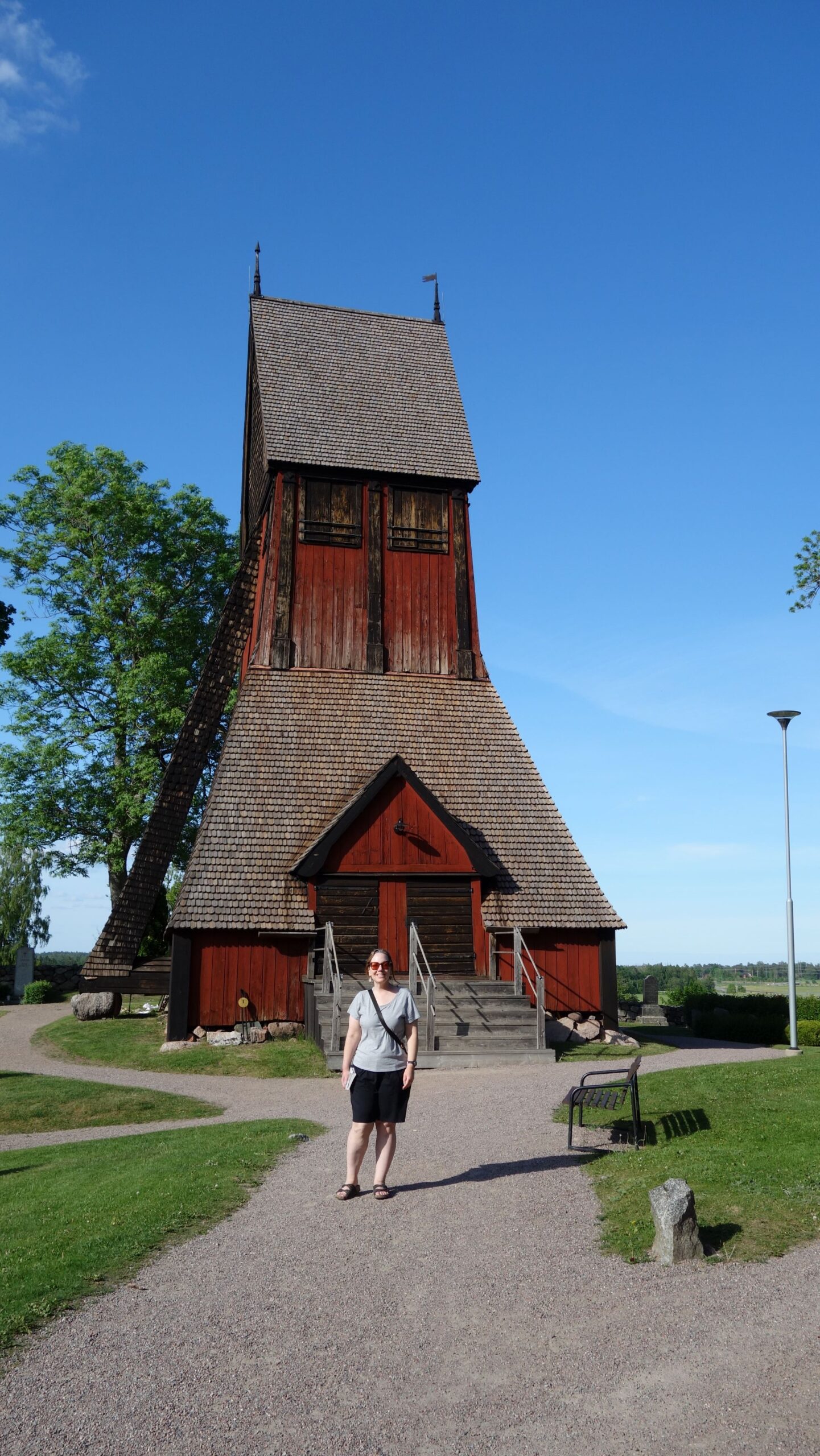
After a later breakfast today (after yesterday’s long day), we got moving a little before 10:00, heading to the subway, where we took a line to another subway line to a suburban train to a bus. The bus was headed to Sigtuna, Sweden’s oldest town, which was historic and supposed to be really cute. According to Google, the bus line ended at Sigtuna, so we sat back and relaxed all the way to the end of the line, to a view of the small housing development. We asked the driver about our destination, and he told us we should have gotten off at Sigtuna bus station (which is really just a small building next to a pull-off in town). To be fair, Mer had started to wonder about what we were doing as we drove past signs for the Sigtuna museum. She had thought it would be odd to have the museum away from the town center. It’s not – it’s on the end of the main street. We rode the same bus back, and the driver was kind enough to motion us to the front of the bus to tell us what to see – that was very kind. We got off the bus, ready to tour, around noon.

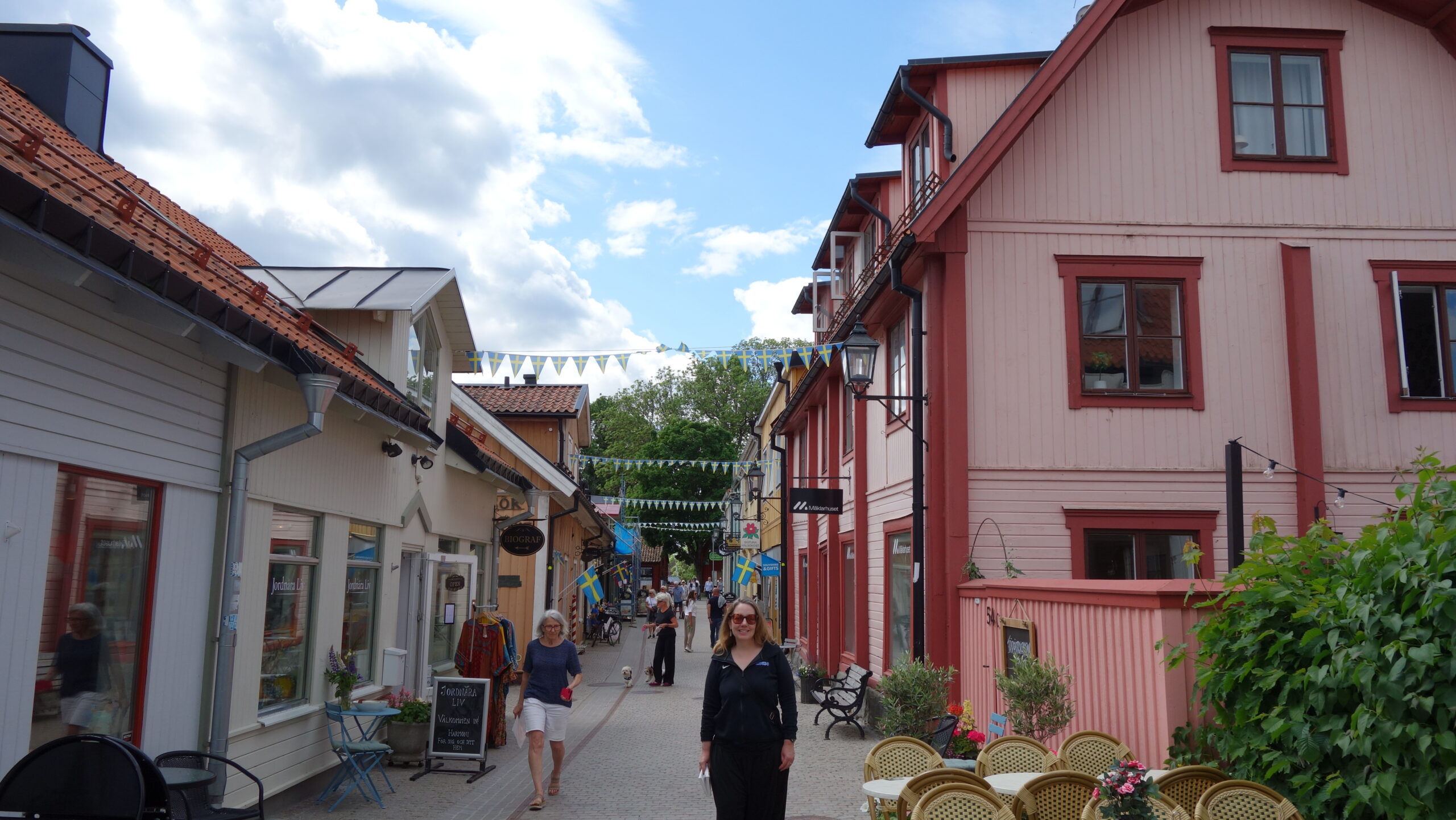
The main part of old Sigtuna is mostly one long main street, which is pedestrian-only. There are shops on either side, and most buildings are painted red or yellow, which makes for a cheery downtown. We strolled along the four or five blocks of the street, ending in the Sigtuna museum, of road-sign fame.

The museum was also the tourist information center, so we picked up a map of the town. We also paid a small fee to visit the museum. It had two main sections – Viking-era Sigtuna (1000-ish), and twentieth-century Sigtuna. Some highlights:
– The Vikings traded heavily with Islamic countries using the Volga River and land routes to get to the Middle East.
– This led to huge numbers of silver Islamic coins coming to Sweden. Sweden has more circa-1000 Islamic coins in museums than the original countries do.
– There were two hoards of coins found in town, including one under a floorboard of a house.
– Sweden’s climate used to be temperate, allowing for animals to be outside year-round. It cooled over time.
– A volcanic eruption in the Americas in the middle ages threw up so much ash that the sun was veiled and winter in Sigtuna lasted for several years.
– Crosses and charms of Thor’s hammer were found together, showing that it took some time for Christianity to spread and truly replace pagan beliefs.
– Sigtuna had seven churches at the time of the Reformation because it was the home of the archbishop. Six of the churches were left to fall into ruin, with three still visible.
– In 1945, the town of fourteen hundred people received six hundred (mostly female) survivors of the Holocaust. The survivors and caretakers all had to quarantine for eight months.
– The airport being built nearby caused the town’s population to go from about 6,000 people to about 53,000 in the municipal area (about 10,000 in the historic town).

After the museum, we had a late lunch, eating outside in a small courtyard.

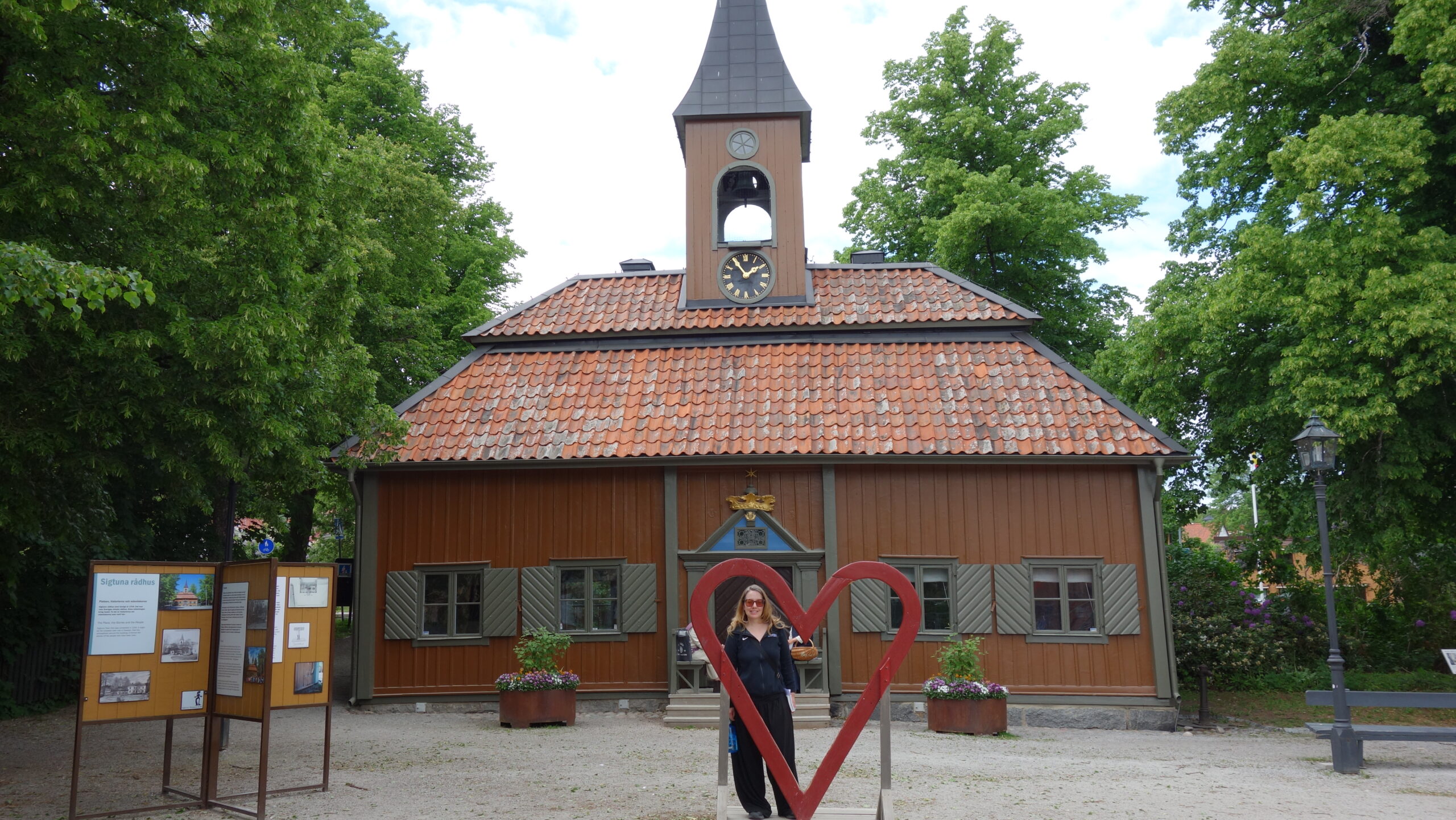
We then walked off the main street to walk past the small town hall, and up to the remaining church of the original seven. It was open, so we went inside, and several parts of the church, including one entire section, still had the pre-Reformation murals on the wall, which is unheard of in my experience; most formerly Catholic churches got the murals painted over. I’m not sure how these survived, but I liked them. They weren’t the height of artistic endeavor, but they gave a great idea of what the church might have looked like at the time.

Mer then wanted us to use the map to find several rune stones. These stones were covered in Nordic runes, usually as memorial stones put up by family members. Sigtuna has the most rune stones of any town in Sweden, so we went to “collect them all.” I said we were on the road to rune. Meredith pointed out that “ruin” and “rune” aren’t said the same, but I thought it was funny.

We did find all the rune stones, including one about thirty feet up the side of an old ruined church. I think there were eight in all. It was a fun way to see some of the rest of the town.

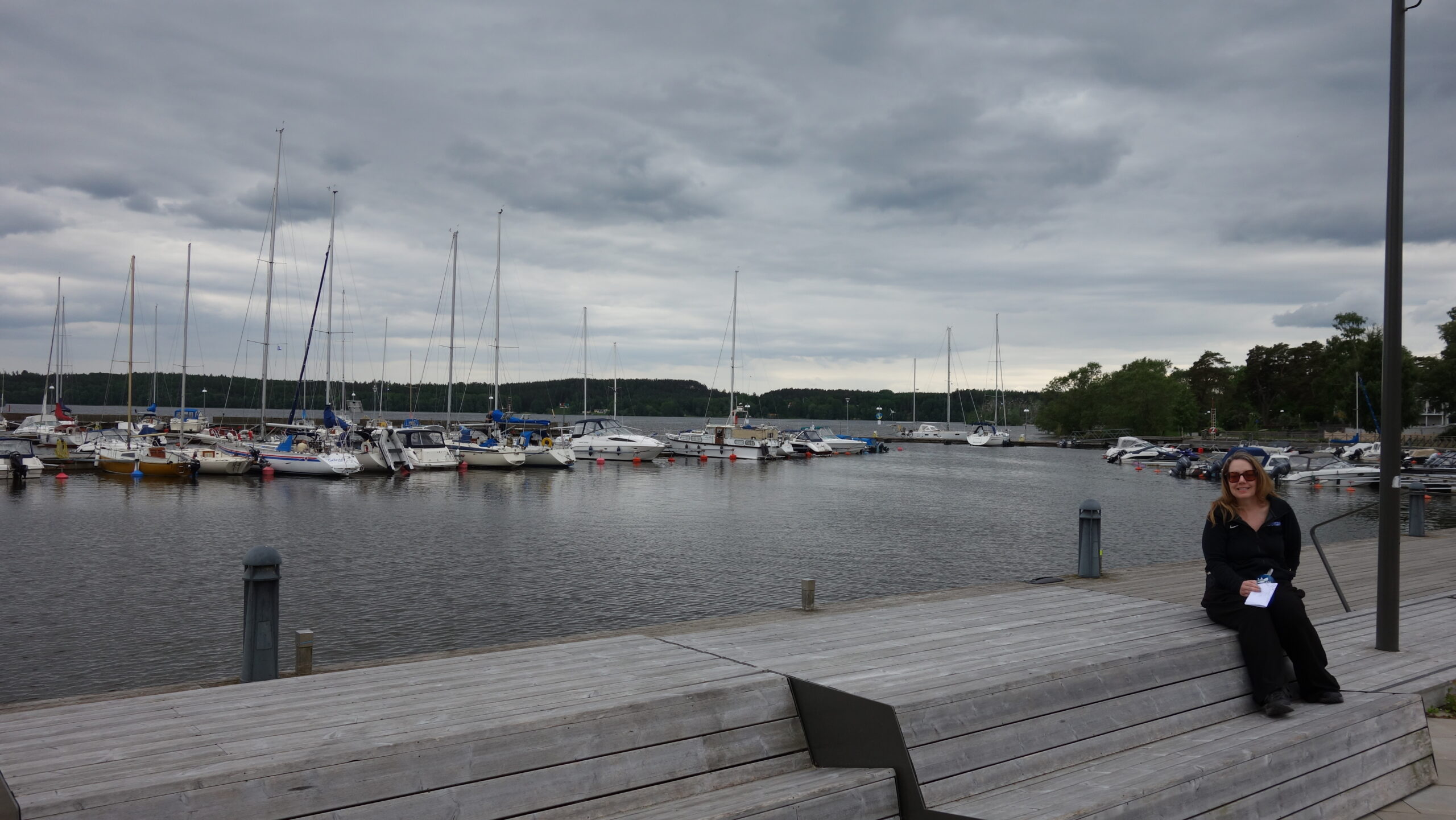
After rune quest, we did a quick stop at the tourist information building/museum for a bathroom break, and then we walked down to Lake Malaren, which is a huge lake, and is the same one that Drottningholm Palace is on. The lake is surrounded by fir trees and very much felt like a Maine lake. We sat and looked at the water and then walked along the shore for a bit, before heading back to the bus station to catch the bus/train/subway back home.

Getting back to Stockholm a little before 6:00 sounds like a full day. Surely, we had supper and called it an early evening. Ha! Not when Rick Steves has TWO Stockholm walks and we had only done one. Rick’s second walk covered much of Gamla Stan, the oldest part of the city, located on an island, and home of the palace and parliament building.

We got off the subway on Gamla Stan, and walked to the other side of the island, next to the king’s palace, to start the walk. We went up the hill in front of the palace to admire the views across the harbor, then went behind the Finnish Church (the Finns and Germans built their own churches once Latin worship went out and vernacular worship came in). There we saw the smallest of over six hundred statues of the town. Women of the area knit hats for the little boy.

We then wandered off into the wonderfully scenic lanes of the old city. They’re all too small for cars, and they meander delightfully. We went though quiet areas that used to be merchant housing (and still had the block-and-tackle posts near the roofline), and small squares with people hanging out, and one large main square that was full of life and happened to be next to the Swedish Academy, home of the Nobel Prize.

All told, we spent over an hour on the walk, and I was very pleased with Gamla Stan. It’s a gem of an island in Stockholm. And this time, our map held true.


Sweden 2026 – Day 3, Monday, Drottningholm Palace, Stockholm

We didn’t manage to get planes in today, but we did do boats, buses, and trains/subways. And we threw in fifteen miles of walking and a reunion as well. Good, if busy, day.

After breakfast, we headed out around 9:00, heading toward (wait for it…) the water, but this time the water near the town hall, which is further west than we’ve done yet. We were there to get the very scenic boat for the fifty-minute ride to Drottningholm Palace, home to the royal family (their part of the palace isn’t open to the public, oddly). The boat took us east along a sort-of-river, sort-of-lake (I’m not sure where the boundary between narrow lake and lazy river comes into play), and it was a very beautiful day. Mer and I were in the front of the boat (known as the “bow”) and we were happy to be out of the sun (known as “in the shade”). The surroundings looked a lot like coastal Maine, with heavily forested areas and lots of small islands, except that the islands had more exposed rock than Maine islands typically have.

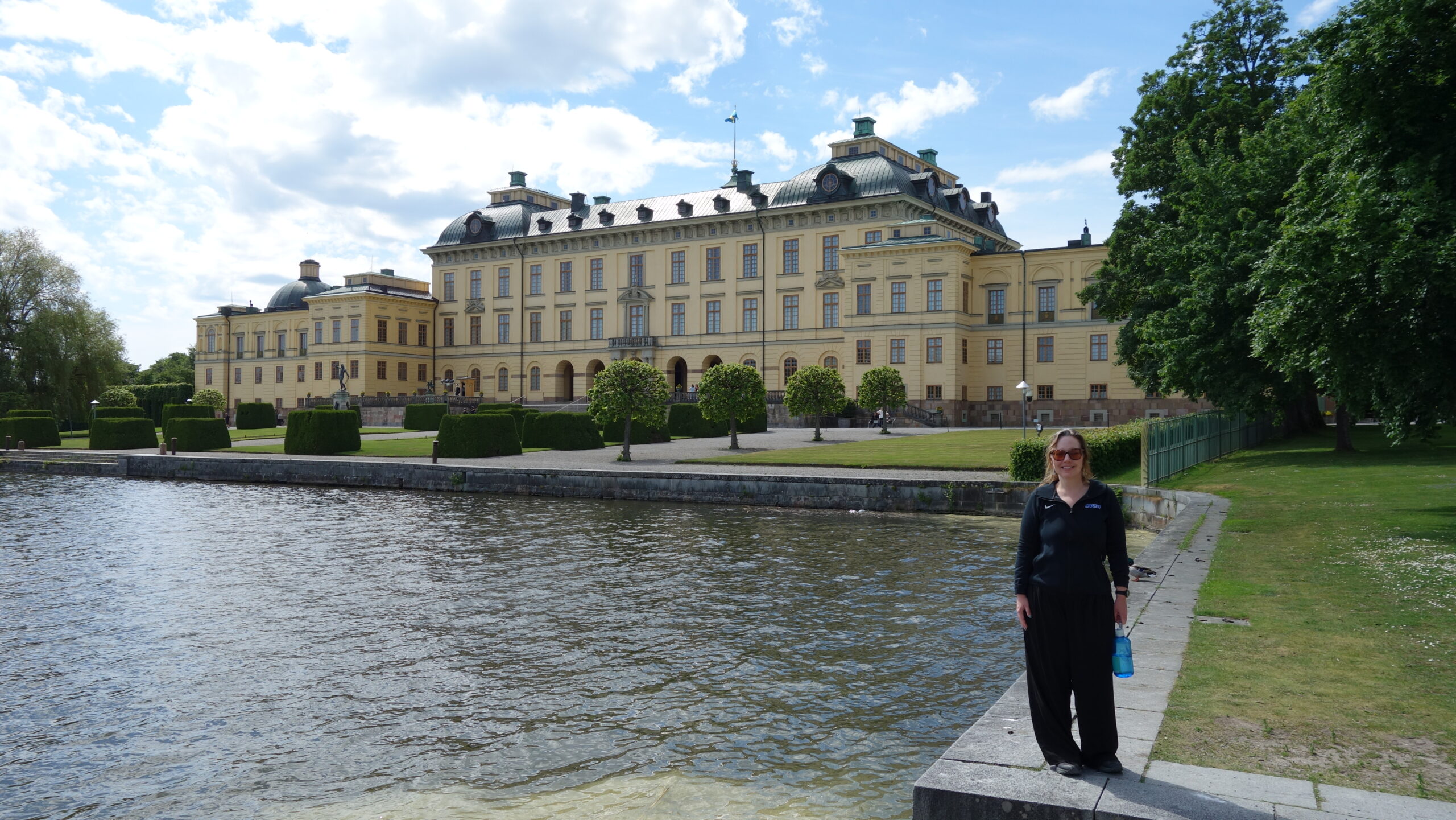
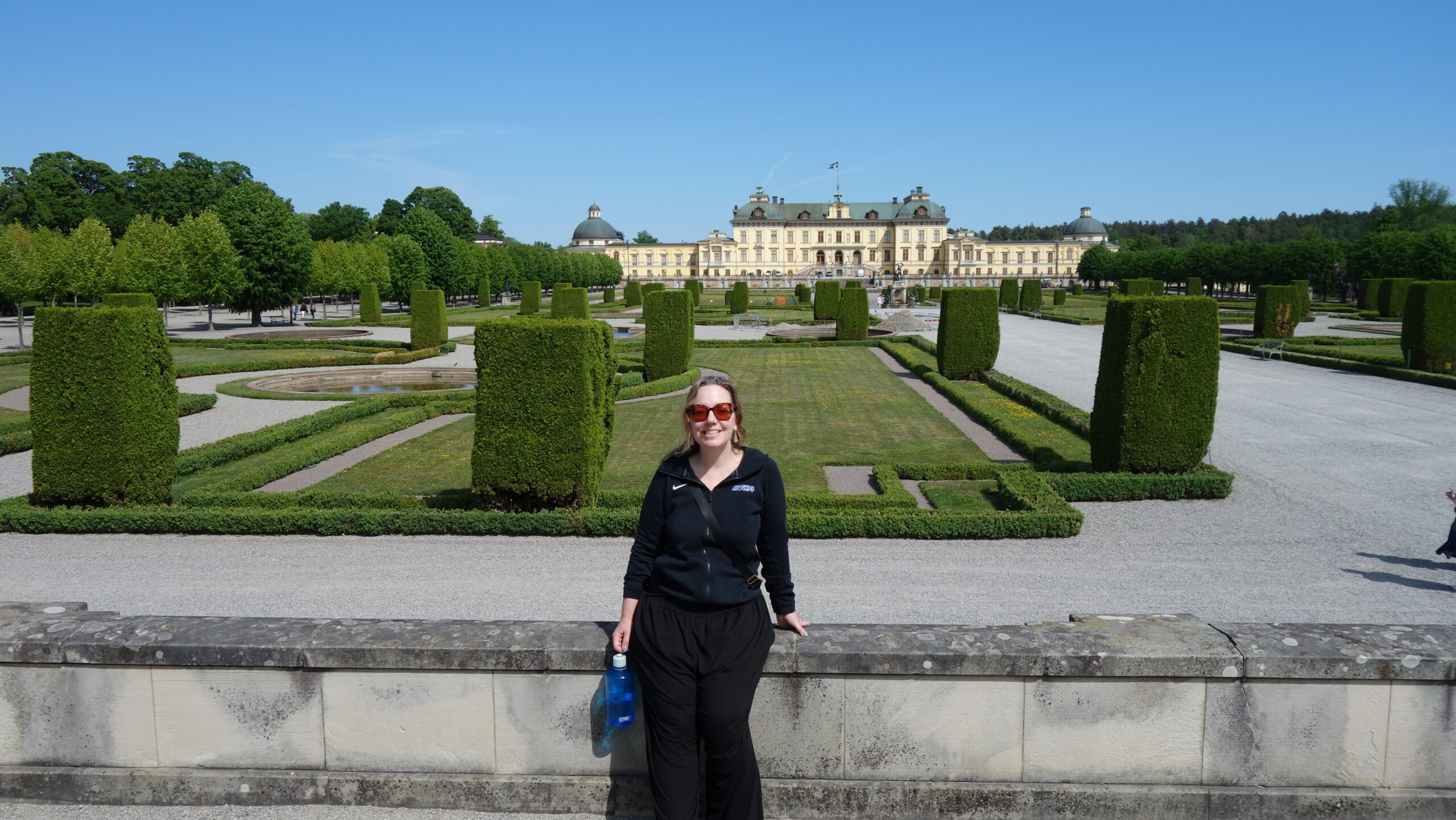
The palace hove into view, which was the first inkling I had that we were going to a palatial home. Mer had planned today, so I was just going along for the very pleasant ride. The palace is right on the water and makes a fine “whoa” sight across the lake as you round the last island in the way. The house is painted a cheerful yellow, is large but not overwhelming, and is classically symmetrical and set in lush (but oddly flowerless) grounds. I was very fond of the place immediately.

We got ashore as efficiently as possible so that Mer could check to see if we could get on an English-language tour of the house. We could, and we got tickets for 11:30. We then found the theater building on the grounds to see if we could get tickets for an English-language tour later. We could, but didn’t need to reserve, so we could come back later.

So we went back to the palace to join our tour. We were two of about twenty or so, and the guide spoke good English and at a volume loud enough to fill whatever room we were in. She took us through some highlights of the public part of the palace. It was developed into a fine building by Queen Hedvig, who was a widow queen holding the throne for her son until he came of age. She rebuilt the palace into the current form after the previous one burned down. It was originally used as a summer and fall retreat for the royal family, but the current king and queen have lived there since the early eighties.

The interior of the palace is grand, with paintings and carvings and statues all resplendently on display. I didn’t find even the most decorated rooms (and there were some) to be over the top or tacky. The queen’s bedroom was probably the most elaborate decorated, but it was done in simple colors that made all the plaster work be more harmonious.

We toured the main level and then went up a very grand staircase with a dozen full-sized statues looking down on us, and through multiple rooms on the second floor, finishing up in a large room used for festivals and state functions. The walls were all lined with full-sized portraits of the king and queen heads of state of nineteenth-century Europe. Since Sweden was neutral, the king could display many heads of state in his room since Sweden wasn’t at war with any of them.

After the house tour, we walked over to the separate building of the palace theater, built around 1766 by a queen who had been brought up in Berlin and thought that Sweden needed more modern culture. The theater is very large, with a stage about sixty feet deep. The queen’s son, Gustav III, carried on her love of theater, and even had Swedish-language plays performed for the first time. He also gave free tickets to common people to come see the plays, but they sat in the back behind a curtain that went up just as the performance started so as not to see the nobles at the front of the theater.

Gustav III was assassinated in 1792, and the theater was used for storage until the early 1920s when a scholar found the theater to be still intact and worked to get the stage open again. Since the place had been untouched for over 125 years, all of the stage machinery from the late 1700s was still intact. The ropes had to be replaced, but everything still worked, which makes the theater the only one in Europe to put on performances that still use the original Baroque stage methods. It’s impressive – the stagehands can change all the backdrop scenery in just six seconds using muscle power.

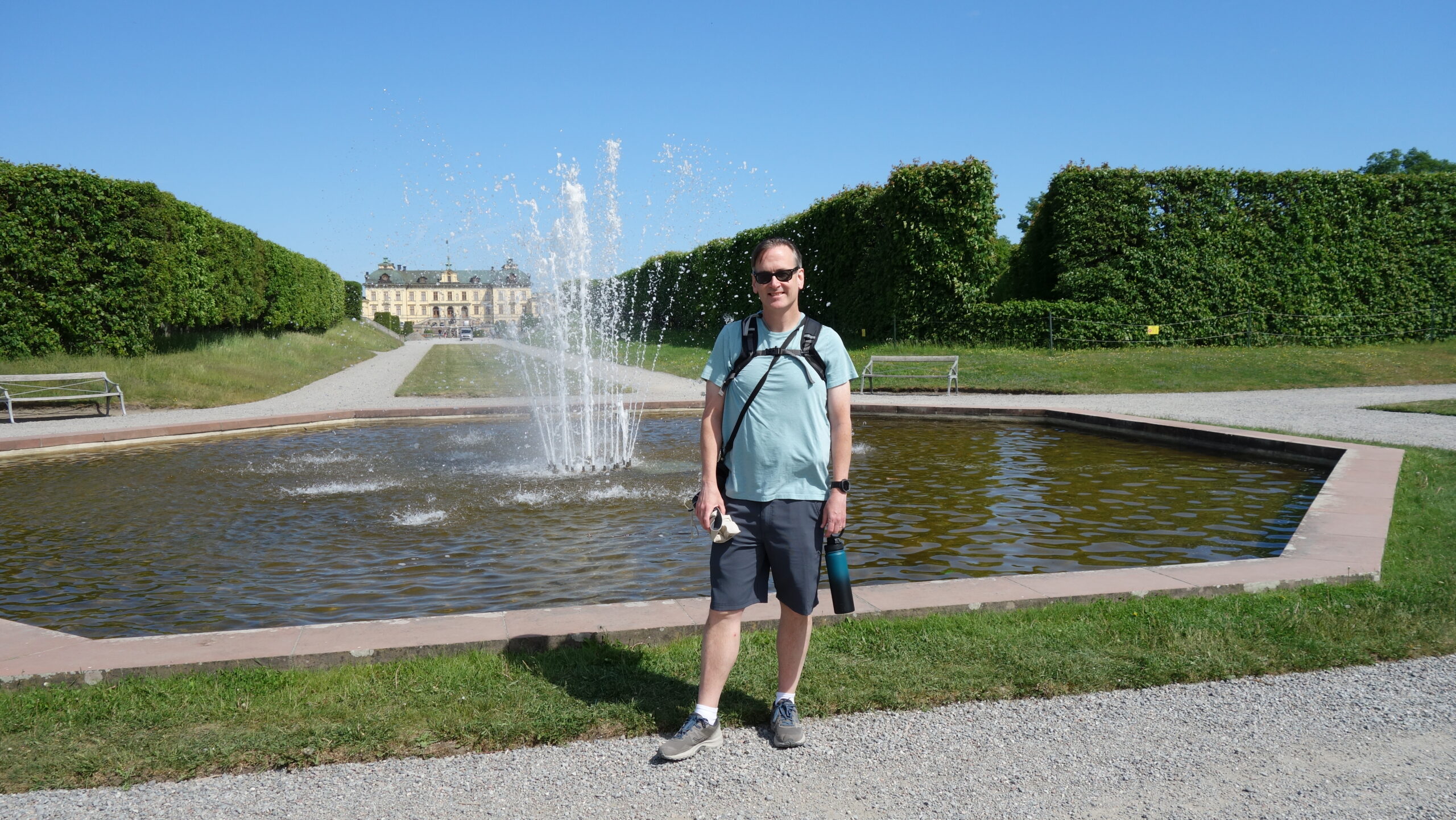
That wrapped up the theater tour, so we set off to walk though the large formal gardens, strolling our way to the Chinese pavilion, where there’s a cafe where we got lunch. We got to tour the pavilion on our own. It’s the largest Chinese pavilion of its kind in Europe – most royals who caught the Eastern bug only had a room or two decked out in (perceived) Chinese fashion. The pavilion had more than fifteen rooms (depending on how you count large connecting hallways), and also had a couple of outbuildings used by the royal family as well. According to what we read, the pavilion was where the family went to get away from the pressure of the court, to where they could garden or read or talk.

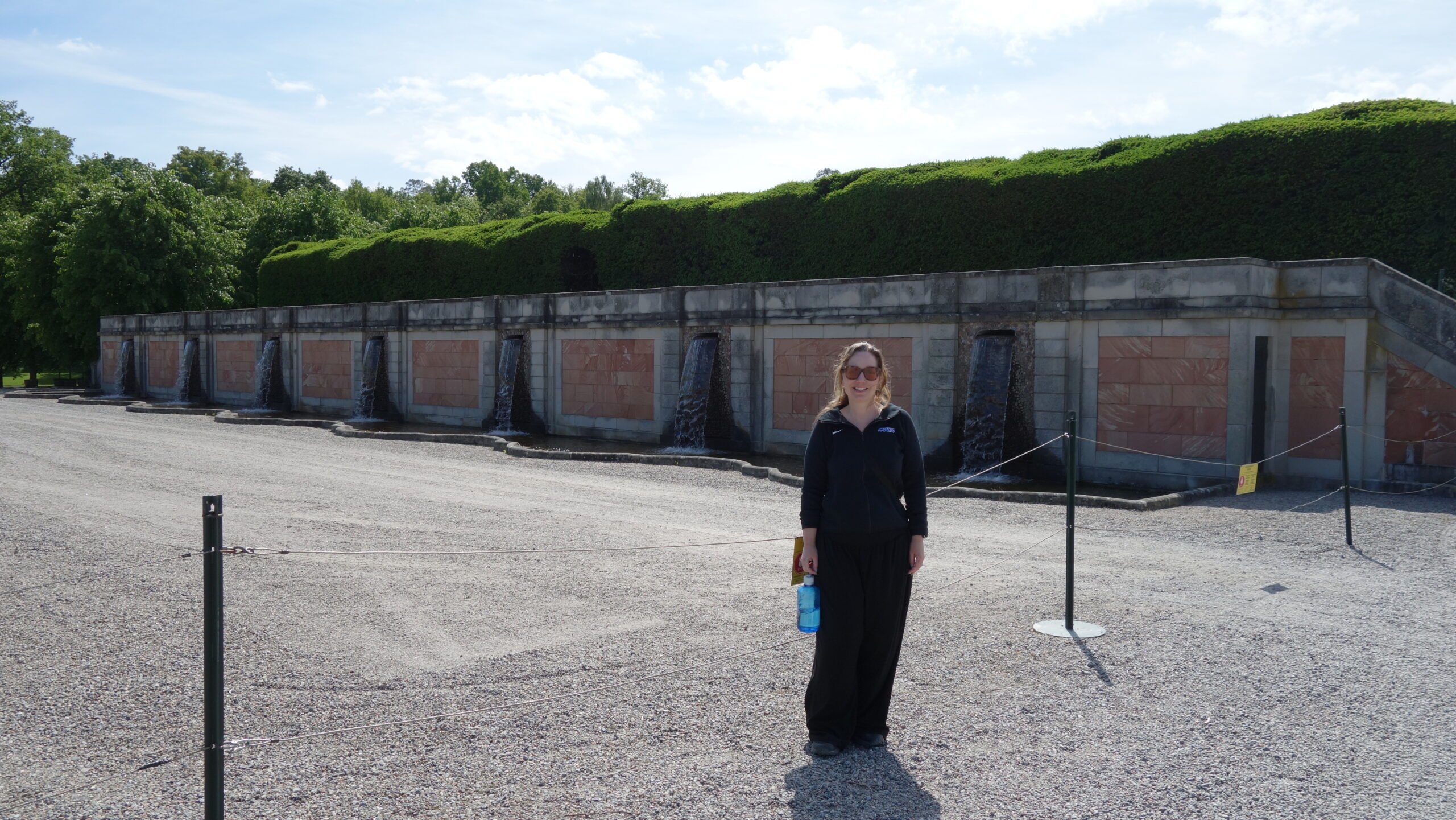
After that, we walked back along the canal features of the grounds, accidently getting stuck on an island and having to go back the way we came. The grounds around the canals were in a more wild English garden style, which was mostly trees growing in less manicured positions and open grassy fields.

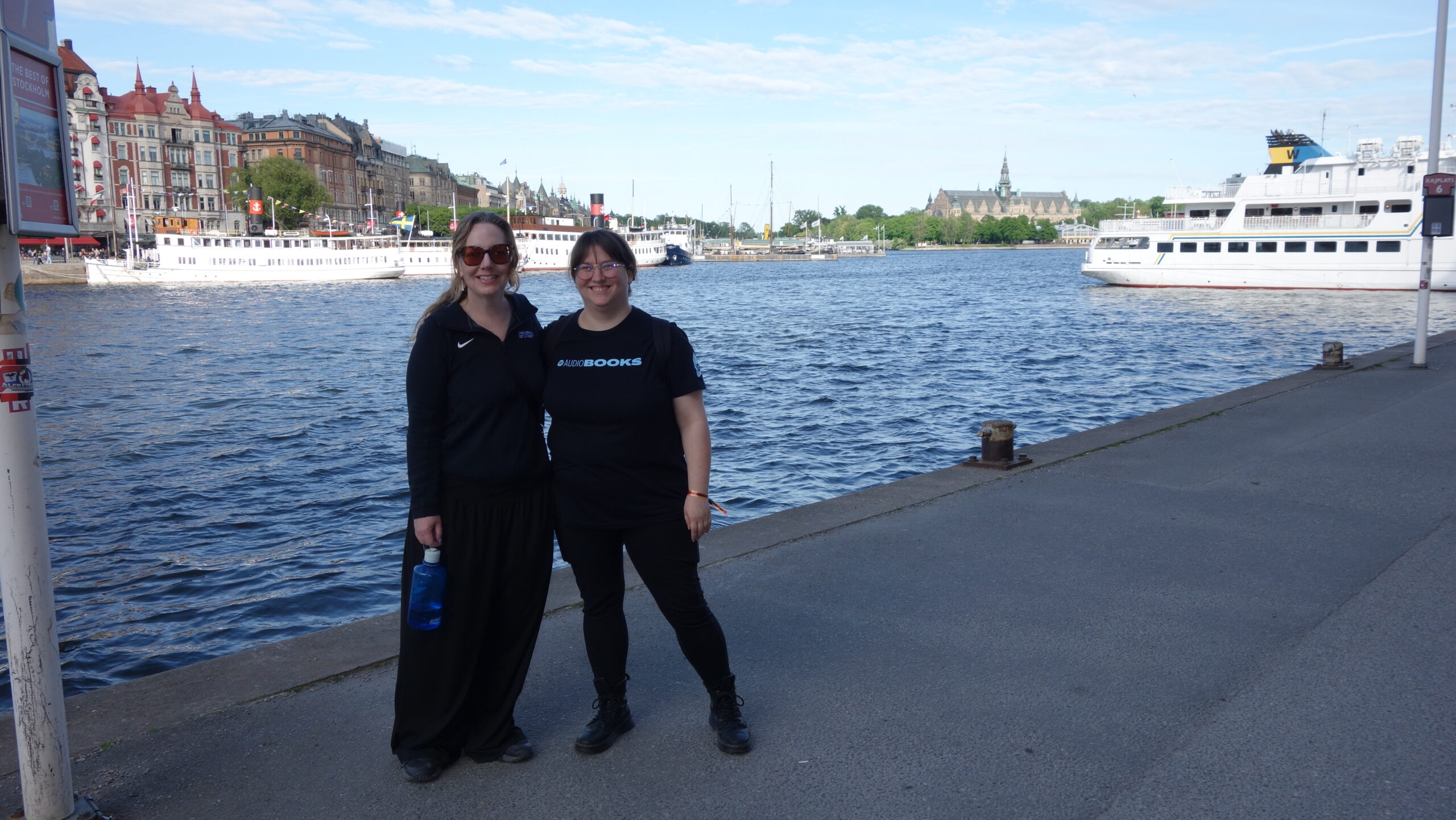
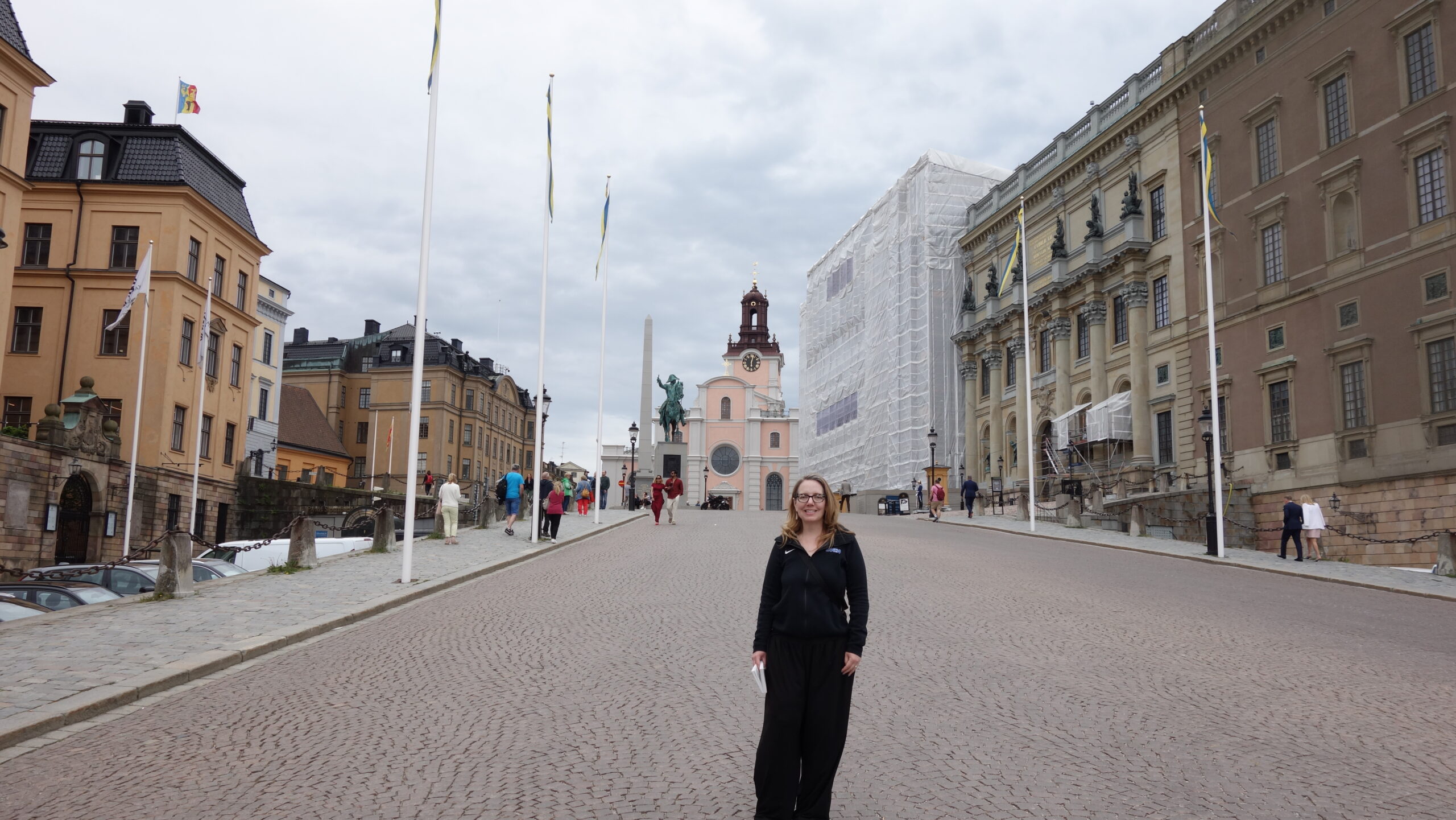
By then, it was after 4:15, so we quickly tried to find a museum of sculpture from the grounds, but it was closed. So we started the bus-to-train-to-subway journey back into downtown Stockholm, where we met up with our friend and former student Kim. Kim just got to Stockholm today. She works in the audiobook division of Spotify, which is a Swedish company, and they flew a bunch of people in to celebrate the company’s birthday. Since she was here and we were here, we met up at her hotel down by the water, and we walked to the main central island of Gamla Stan to go get dinner. Mer and I hadn’t been on Gamla Stan yet, and we crossed the bridge to the island right in front of the king’s in-town palace, so we got to see two palaces on the same day (I liked Drottningholm better – from the outside, at any rate).

Supper was a fun time of catching up with Kim, and then we walked about three quarters of a mile to find a store where Kim could buy plug adapters for her electronics; she had brought ones that work in the UK, which don’t work in Sweden. We got to the store just a few minutes before closing, and celebrated that small victory by going to get dessert from a stand on the pedestrian street Mer and I had walked down the other day.
We walked Kim back to her hotel, where we visited for another fifteen minutes or so, while relaxing in the lobby, where we could look out to the harbor. We then said goodbye, and Mer and I walked back home, finishing up the day with fifteen miles of walking.

It’s no Drottningholm palace, but I was still plenty happy to see my temporary home. Even good days can be tiring days.