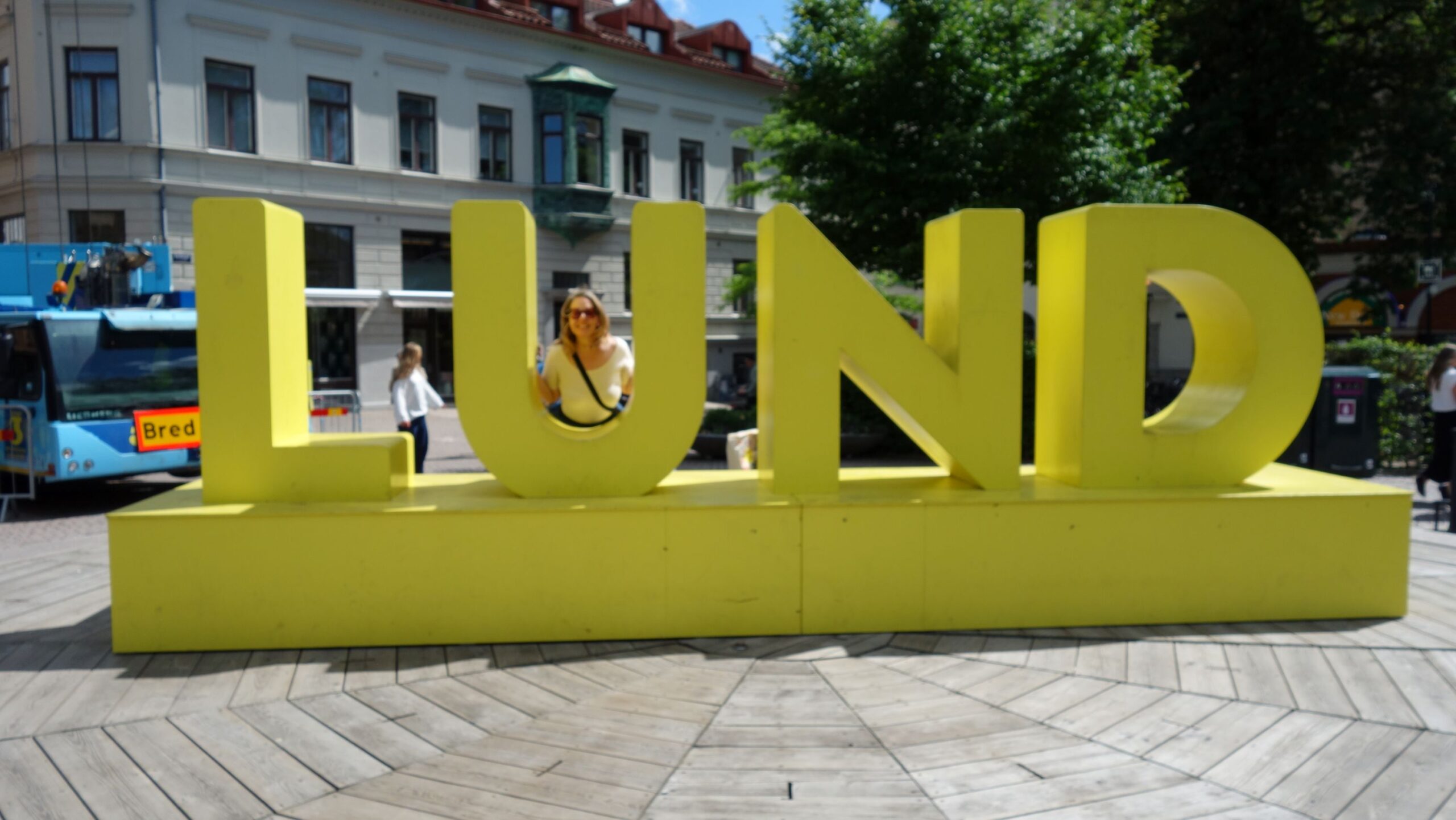
 Today I had to drive a bit into the unknown. I wanted to go to the cathedral town of Lund, about an hour northwest of Ystad. We had a B and B booked, with parking, but it was a fifteen-minute drive outside of town. My usual plan of dump-the-car-and-walk wasn’t going to work. I knew I wanted to get close to the old town without actually having to drive in it, so I programmed my GPS for the center of the city and then started looking for parking signs as we got close. The end result was okay – a large parking lot, but further from the cathedral than I might have wanted at a fifteen-minute walk. That got us to the church at 9:57 for our 10:00 tour with…
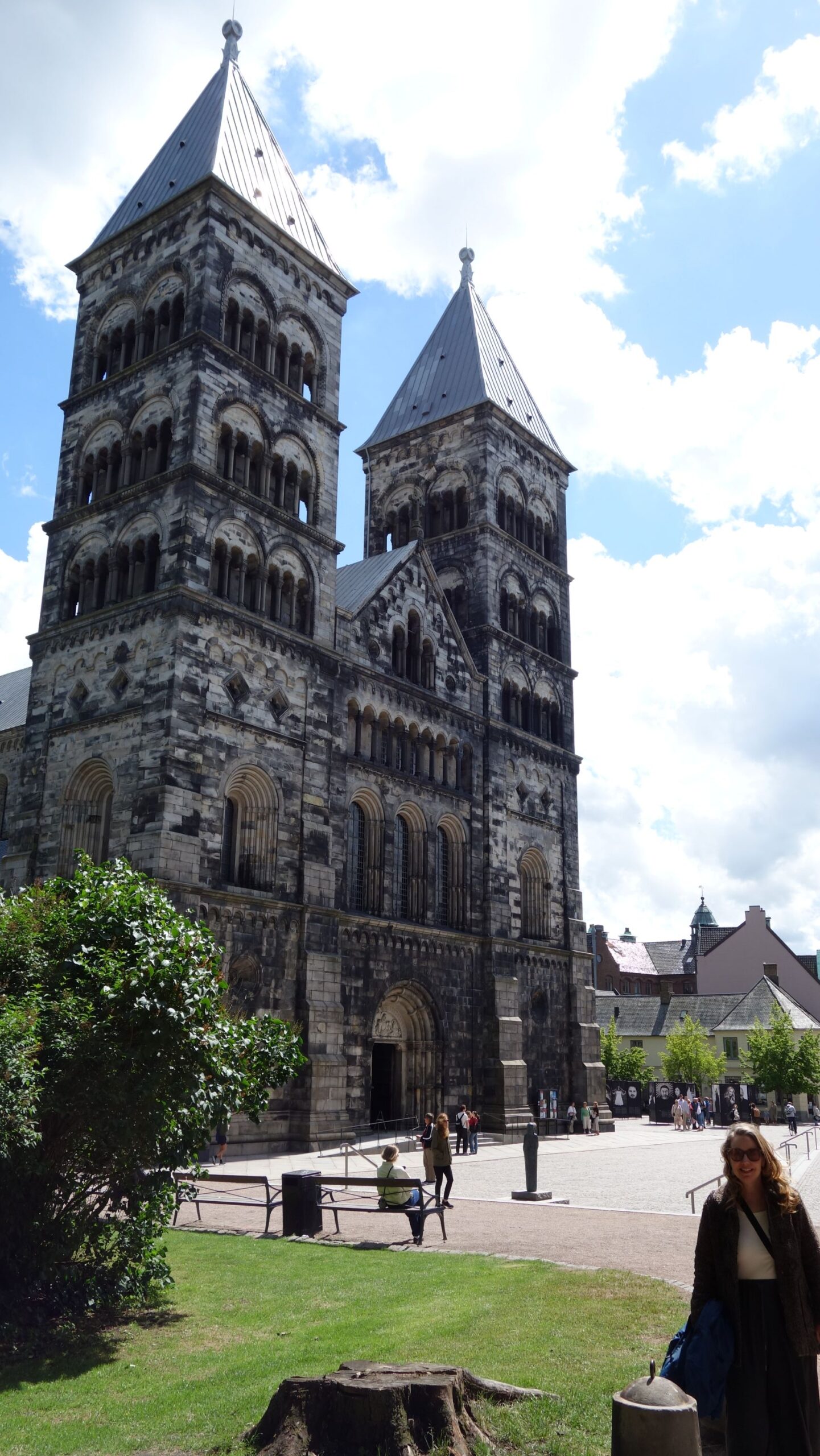 Lund Greeters is the local branch of Greeters International, a group of volunteer city guides all over the world who are local people who love their city and want to share it. They are a no-cost and no-tipping organization. We got to the cathedral and pulled out my travel phone and looked confused enough that Leif and KC (“kay-see”) came over and asked us if we were looking for them. KC is from Colorado, but married a Swede and has lived in Lund for thirty years, and Leif, from the northern part of Sweden, went to college in Lund, met a local girl, and married her and stayed. Both KC and Leif were retired (or at least of retirement age) and were vibrant and energetic people. They led us around the old town for three hours without slowing down, and again, all for free. Amazing people.
A few highlights from the tour:
– The cathedral dates back to the 1100s, but didn’t have enough money for upkeep after the Reformation, so buttresses started being put up to hold up the Romanesque walls. An architect in the 1800s fixed the roof and rebuilt the front towers (which impressively match the rest of the church) and ditched the external supports.
– The university here has 30,000 students and is the second oldest in Sweden, next to their rivals in Uppsala. For a town of about 100,000 people, that’s a large student population.
– Students have to find their own housing – the university doesn’t have any. That led to frat/sorority-like co-ed housing called “nations” where students from the same regions house together.
– The university students have a great sense of humor. After the town carried on forever trying to decide what statue to put in the square between the cathedral and a university building, the students had a large and official unveiling of nothing. They put a plaque on the ground with the title Nothing, and it stuck. The town liked it because it cost, well, nothing. At some point, the cathedral folks pulled it up to do some cobblestone renovations, and the student group put another plaque nearby proclaiming that Nothing had been stolen.
– The university also has a collection of casts of noses, started by a student casting his own nose back in 1986. Every year, a couple or a few people connected to Lund are chosen to have their noses added to the collection, including famous people like a woman professor who won the Nobel Prize in physics – the cast-makers walked into her class after the class was done and asked her to lie down to get her cast made. They’ve recently added audio of some of the people sneezing so you can hear the nose. Some casts are recreations, including one for Tycho Brahe, and they included a brass band across the plaster of his nose. I loved that (he is supposed to have had a fake brass nose).
– Near the cathedral is a gorgeous pharmacy, where everything inside is carved of wood, including the names of all the head pharmacists going back to the 1600s. When it was thought that the pharmacy might have to close because of costs a few years ago, the normally tranquil Swedes protested out front and saved the business. It’s a work of art to see the inside.
– A farmer who was digging for a new pigsty hit some iron objects on a site about three miles south of Lund. It turned out to be a lost town predating Lund, and the area of interest is huge. Less than one percent has been excavated.
– The town used to have twenty-two churches (for about six thousand people). All but two were torn down after the Reformation, and two were rediscovered, one wooden and one stone, when the town was trying to build a parking lot in the 1980s. Nothing now remains of the wooden one, but the outline is shown in the cobblestone. The stone church’s foundation was preserved in the publicly accessible basement of a new building.
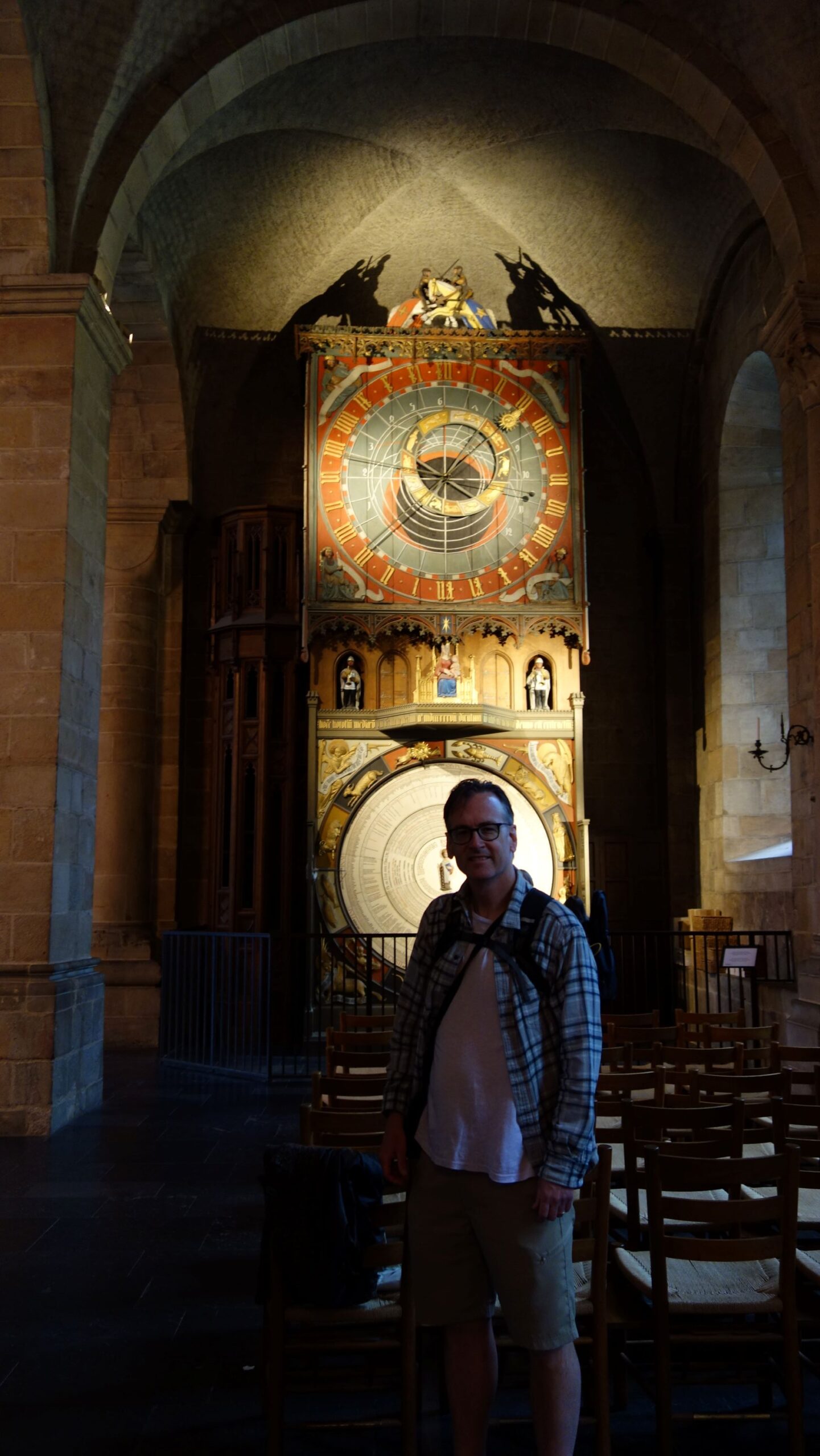
– KC and Leif made sure we were at the church to see the six-hundred-year-old astronomical clock perform. Two knights at the top strike at each other with their swords, once for each stroke of the hour. Then four servants and the three wise men process around Mary and Jesus while two trumpeters play the tune to “Good Christian Men, Rejoice.”
It was a fun tour, and we got to ask lots of questions, including asking how things went in 1967 when Sweden decided to change from driving on the left-hand side of the road to the right-hand side of the road on one day. Leif said it had been well planned, and the Swedes are rule-followers, so it went fine. As someone who doesn’t love driving on the left, I’m grateful.
 Leif and KC left us around 1:00, and Leif recommended we go eat at a local place about ten minutes up past the church. We value local information, so we walked there and were told we could order at the bar. The menu was in Swedish, and the bartender kept serving other people drinks over helping us, so we gave up there. The second place we tried was a cafe, but it was going to be twenty minutes for the bread to come out. Our third place was an Italian cafe, and we finally got a pleasant lunch, seated outside in an inner courtyard.
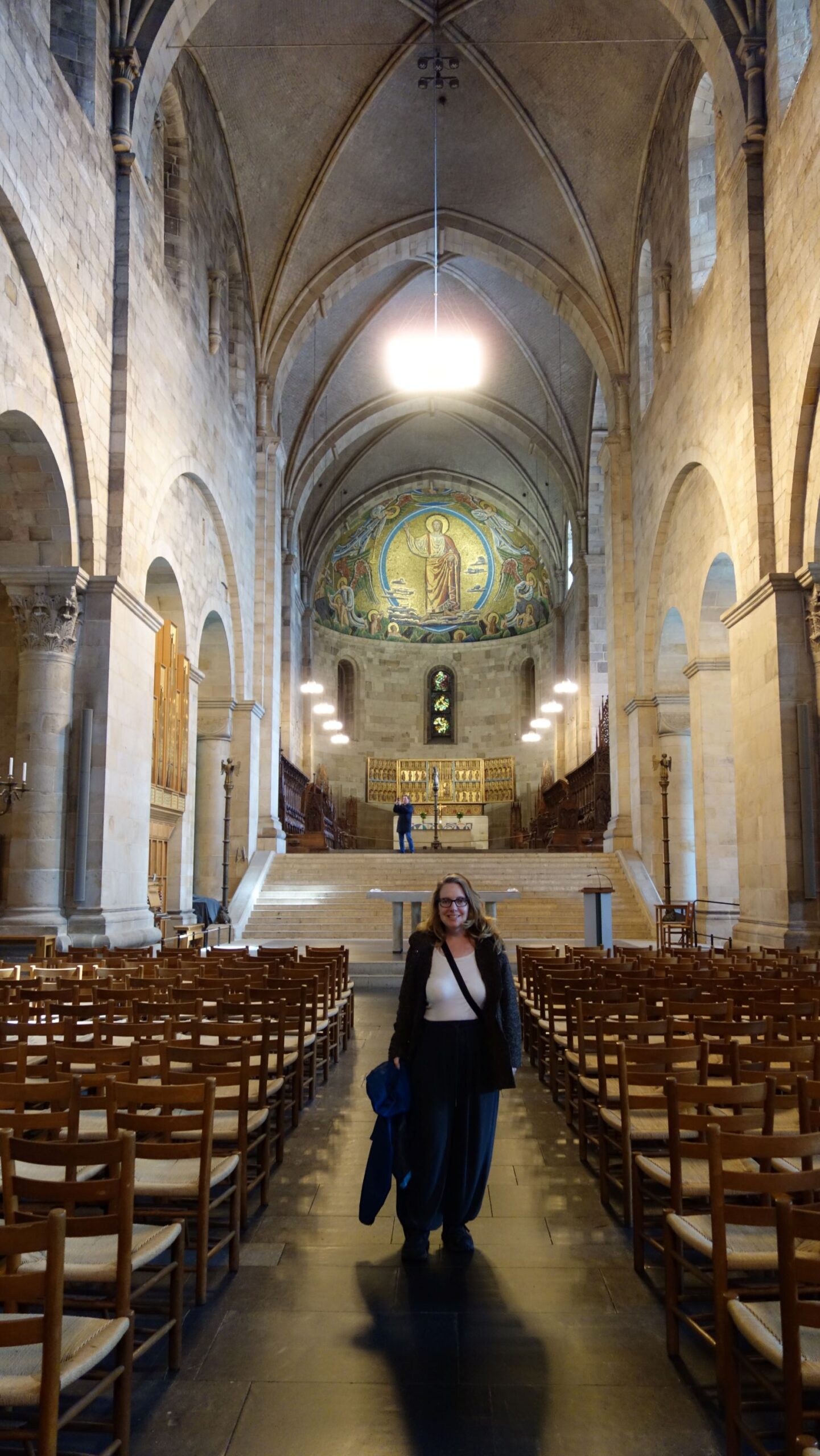
After lunch, we went to look in at the cathedral. It’s free, even to go into the crypt. In fact, we didn’t pay for any touring today anywhere – everything was free. While most of the church is plain, above the choir area, there is a huge and impressive mosaic of Jesus calling his saints out of their graves on the Last Day. After we toured the crypt, we sat and looked at that for some time (and we were hoping that a group in the choir area was going to sing, but it never did).
The crypt was interesting – some graves of important people were in the floor or on the walls, but what was new to me was that many of the supporting pillars holding up the roof of the crypt/floor of the church were carved with figures or patterns. I liked that touch.
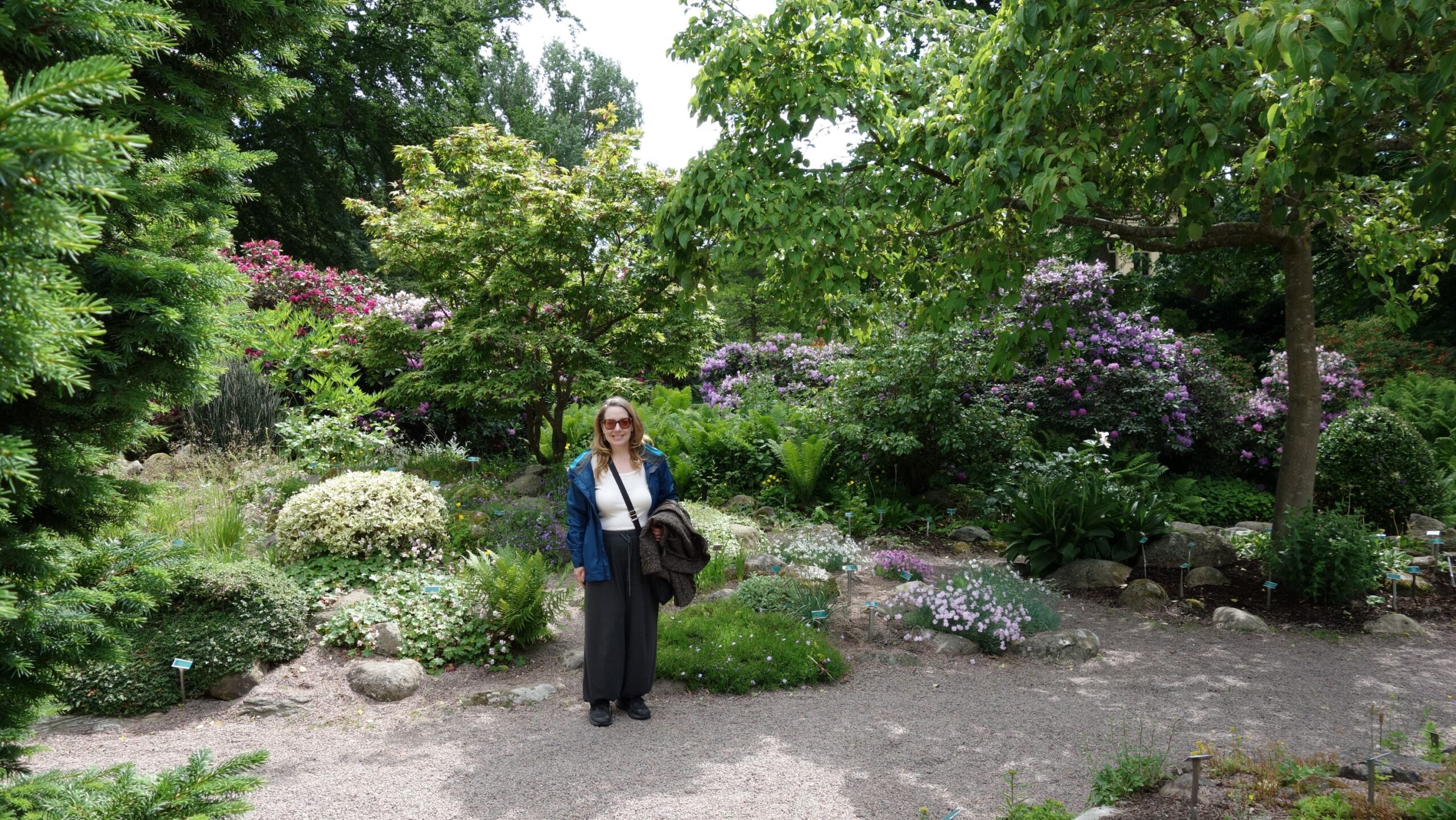 From the cathedral, we wandered east to the botanical garden. We both like gardens, and I had seen this recommended on a couple of websites. We got there, and it was free (sponsored by the town and university). The early results were a bit disappointing – the garden was basically a park – nice, but just grass and trees and shrubs. We got around to the other side of the (under construction) main central building, and things picked up. There were beds of flowers, and then the paths started winding thought flowering shrubs and around small undulations of rock and plants. That was more what I was expecting.
We came across some teens on a lawn throwing wooden rods at wooden blocks. It became clear they were playing a game, so we sat down to see if we could figure out the rules. We’re still not sure of all the rules, but it seems as if the goal is to knock down all of the other team’s blocks, and then knock down a central block, which it seems had to be done by throwing the rod while you were bent over and looking through your legs. We suspect that this last part may have been house rules.
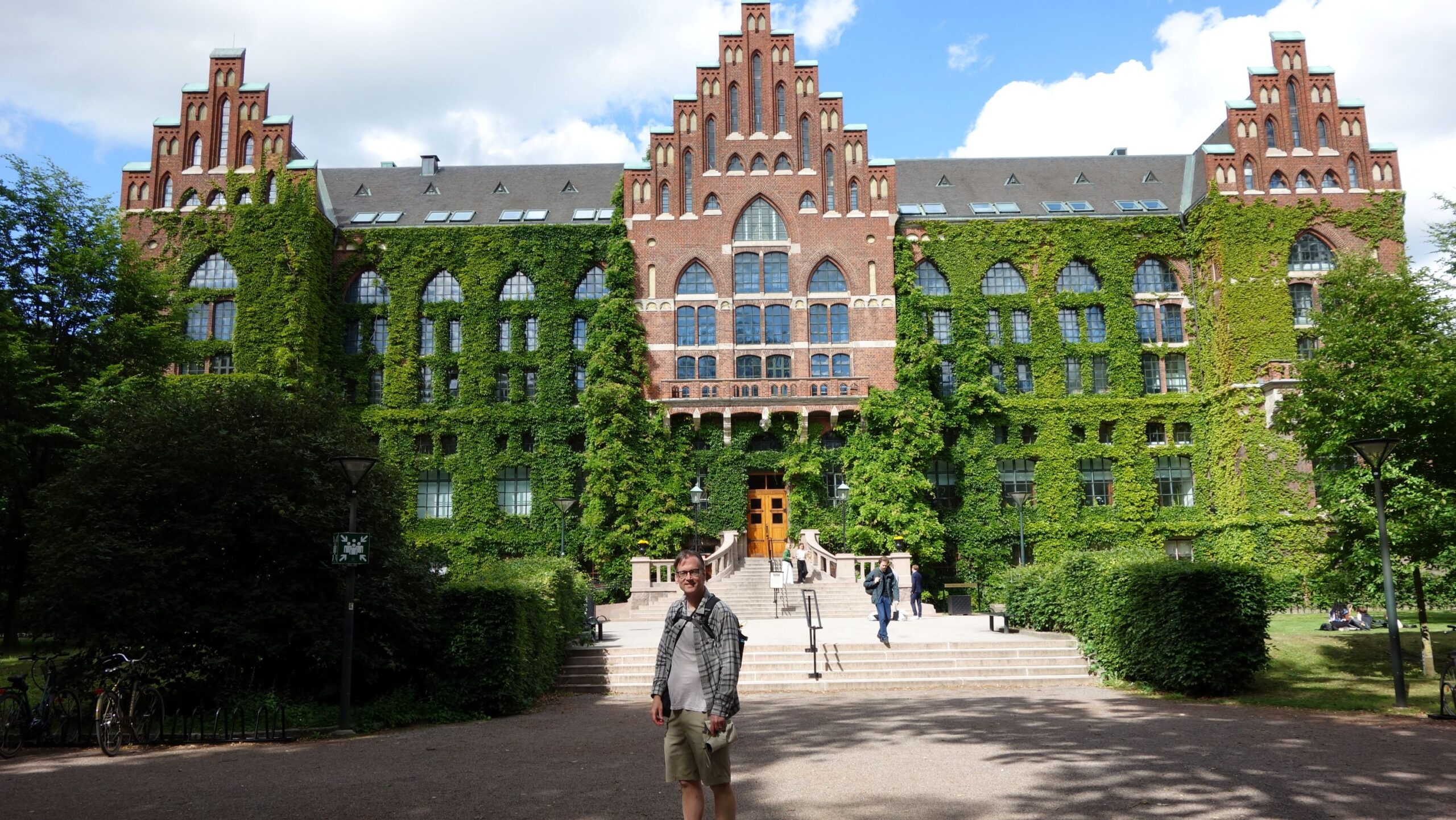 I then took us to the university library, which was an okay library with one really cool wooden silent-study room that was lined with old books. The outside of the building was very picturesque too, but I’m not sure why my research found sites saying it was a “must-see.” Still, lead an English teacher to books and she’s impressed.
My last touring adventure of the day was to go see the elaborate interior of All Saints Church. It took between ten and fifteen minutes to get there, and we discovered that the church was in use for a graduation ceremony. Ah well.
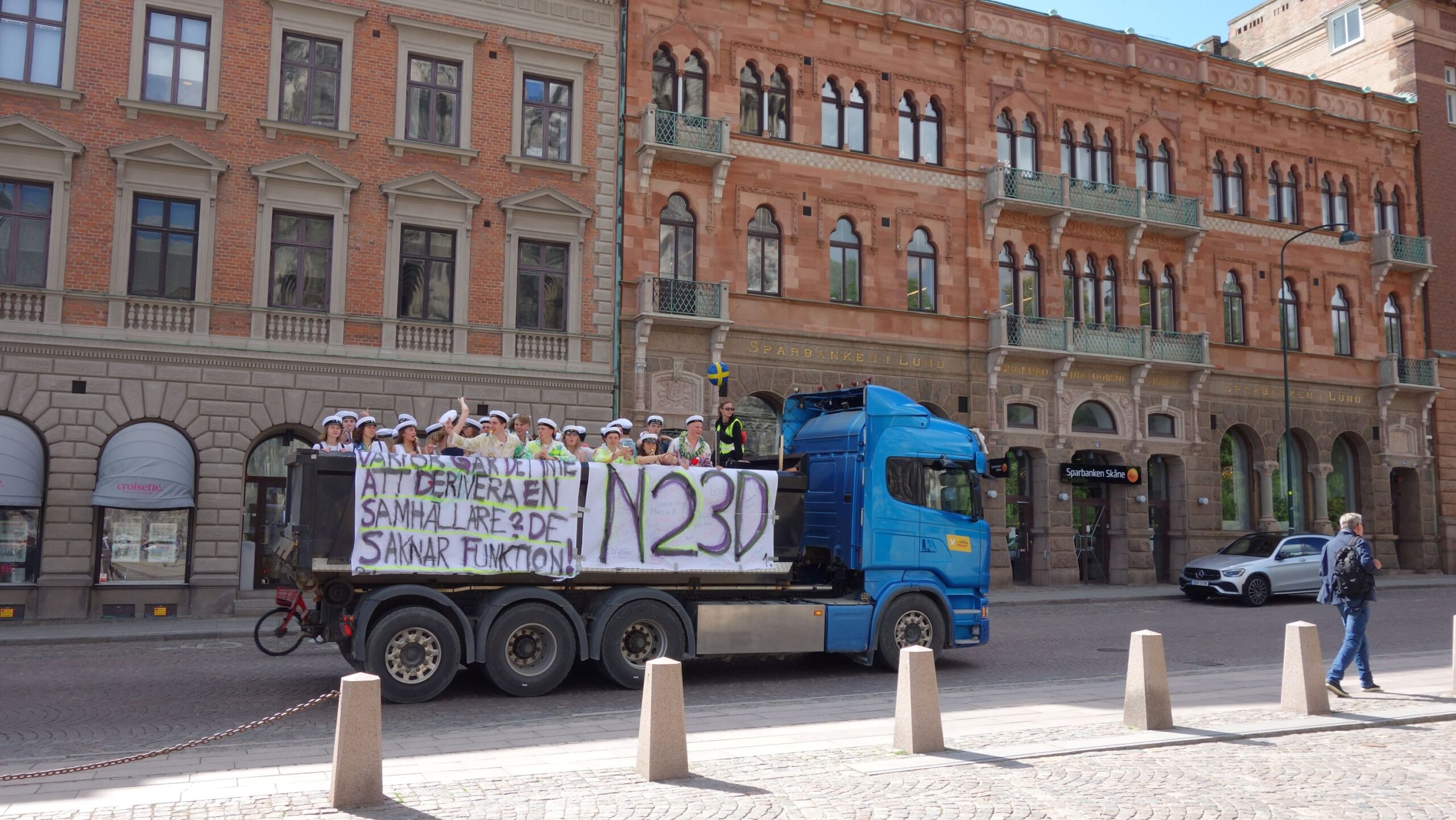 Speaking of graduation, today was high school graduation, at least in Lund. We kept running into hordes of students wearing white graduation caps, and then at some point, most of them piled into the backs of huge semis that drove them slowly though the streets for a couple of hours while they played loud music, yelled, blew whistles, waved, and generally seemed to be having a good time. Odd tradition to an American, but it was festive.
We ate supper at an Italian restaurant we had passed during the tour, selecting it from the smell alone. It was a bit pricey, but worth it.
 We found our car again by comparing landmark notes with each other, and drove out to our B and B, which is in an odd area. Much of it is farmland, but there are two large business headquarters-looking buildings of metal and curves. There are roundabouts where there’s only one street coming in and going out, so they seem to be ready to be expanded for future plans. There’s a new rail station, but the tracks don’t go anywhere yet. And our B and B is on a three-quarters-of-a-mile-long single-track dirt road. I’m guessing the area is in the early stages yet of transition.
Tomorrow we continue going back north, going to Sweden’s second-biggest city, Goteburg. Mer will be in charge tomorrow, so I get a break from planning.
And what amazing fellow tipped you off to Greeters?
I’m sure the amazing fellow did at some point, but I don’t remember. I stumbled across them online in my research. 🙂
Egad, I’ve been using them since 2019 and have mentioned them to you at least a couple of times!
I see you pay close attention to what I say…