Author Archives: mriordan

Iceland, July 2021, Day 4 (Wednesday), Snaefellsnes Peninsula

Matt decides to outsmart Iceland and puts on the spandex shirt he brought as an underlayer. THAT will keep Matt warm. Iceland turns down the heat….

The day ultimately ended up being good, weather-wise, but the morning was windy, cold, raw, and in some places rainy. The first two stops we made were really cold, seeps-inside-you cold. And I was wearing five layers. In July. After the second stop, the day started to warm up, and the winds dropped down to more normal, so we were fine, but I originally thought we were in for a long day.

Which was my day to be in charge. We took our time getting ready this morning and had a long breakfast because we were waiting for the local supermarket to open at 9:00 to see if they had a SIM card for a phone and a box of tissues. In an Icelandic town of 900 people, think less supermarket and more large convenience store. They didn’t have a SIM card; no surprise. They also didn’t have tissues. We thought maybe the attached pharmacy might have tissues, but they didn’t open until noon. We decided to make do with a roll of toilet paper we snagged from our room.

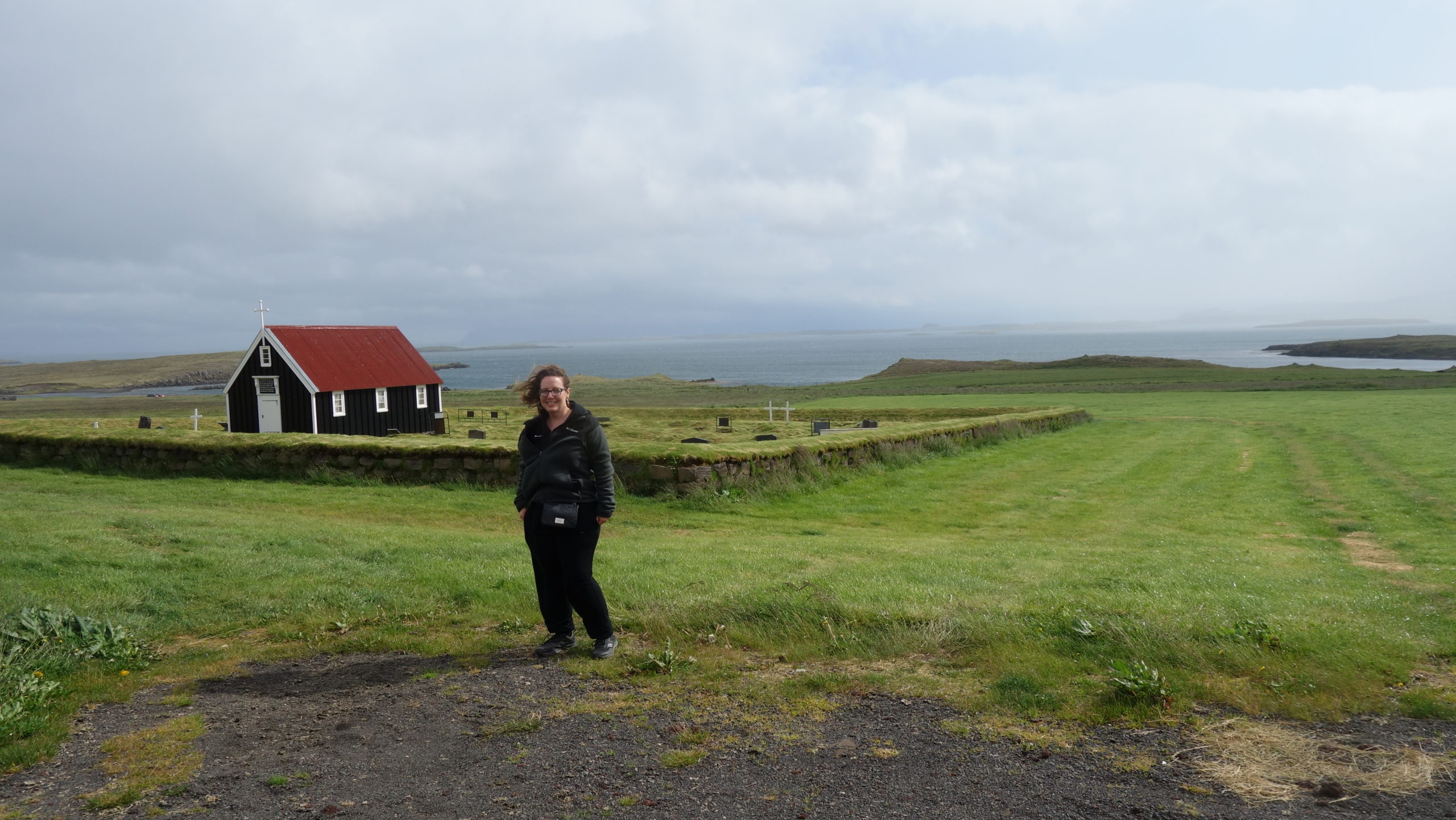
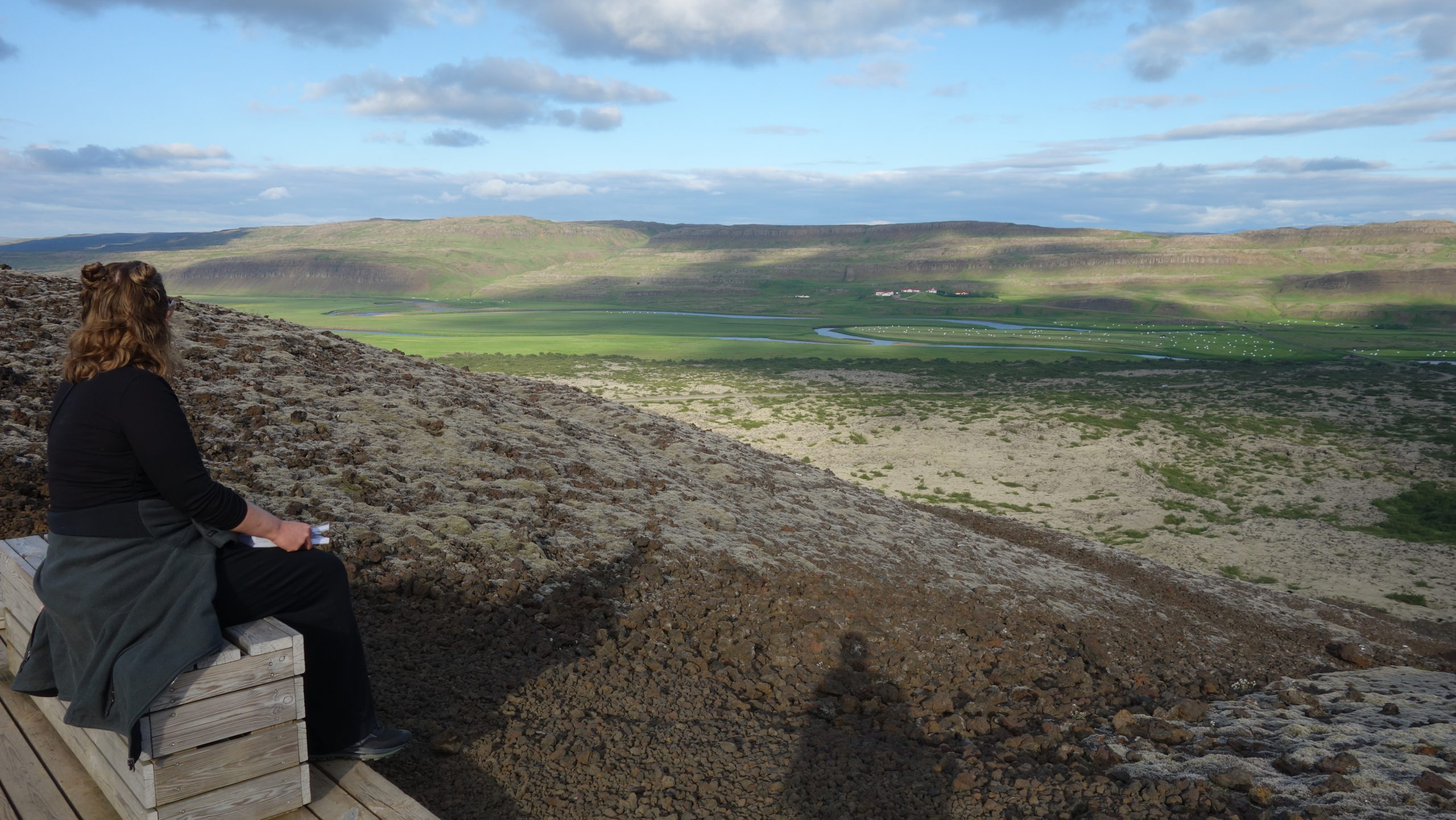
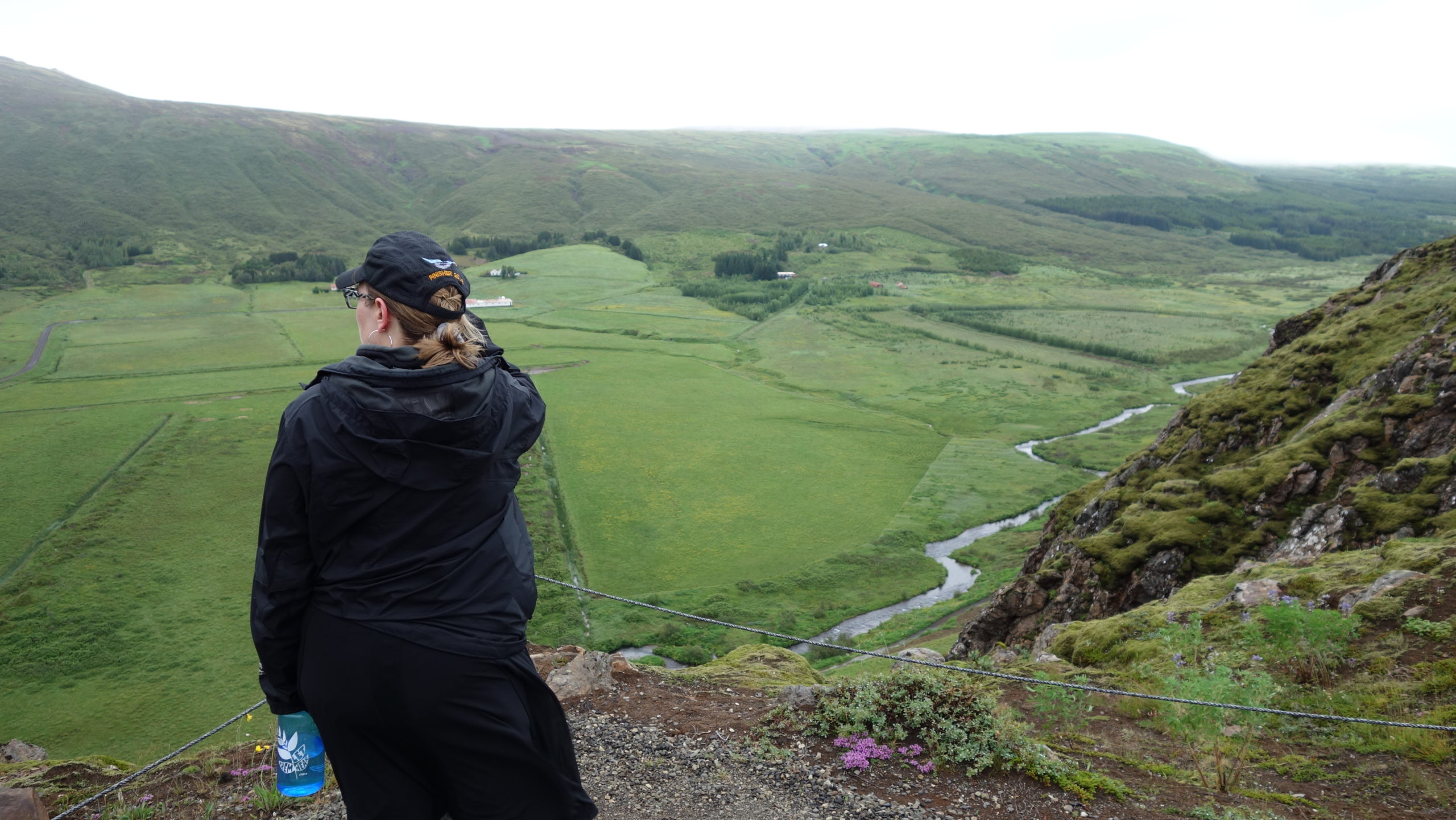
My days tend to be a mixture of planned sightseeing and “where does this road go?” whimsical moments. Our first stop was whimsical – a pull-off on a high point of the road going west. The views of the next town and surrounding countryside were great, but it was the first of our two really cold stops. The second was a somewhat-planned stop in that I had seen it online and filed it away. When I saw the pretty red church situated in a mountain-surrounded field, I knew I wanted to stop.

So I turned down the dirt road to go it. The car was immediately dive-bombed by an arctic tern; they get aggressive during mating season. I bumped along with the road getting rougher, and I decided this couldn’t be right. I stopped and asked a man who was taking pictures of wildflowers how to get to the church. He said it was the next road. The tern dive-bombed us again on the return drive.

The church was worth a stop. There were good views in all directions, even with the low-lying clouds covering the tops of mountains and, sadly for us, the nearby glacier. All day long, we would get small glimpses of the glacier, but never the whole thing. We started calling this phenomenon “The Dance of the Seven Clouds.” Anyway, we took our time and some pictures at the church, which was the last really cold stop of the day.

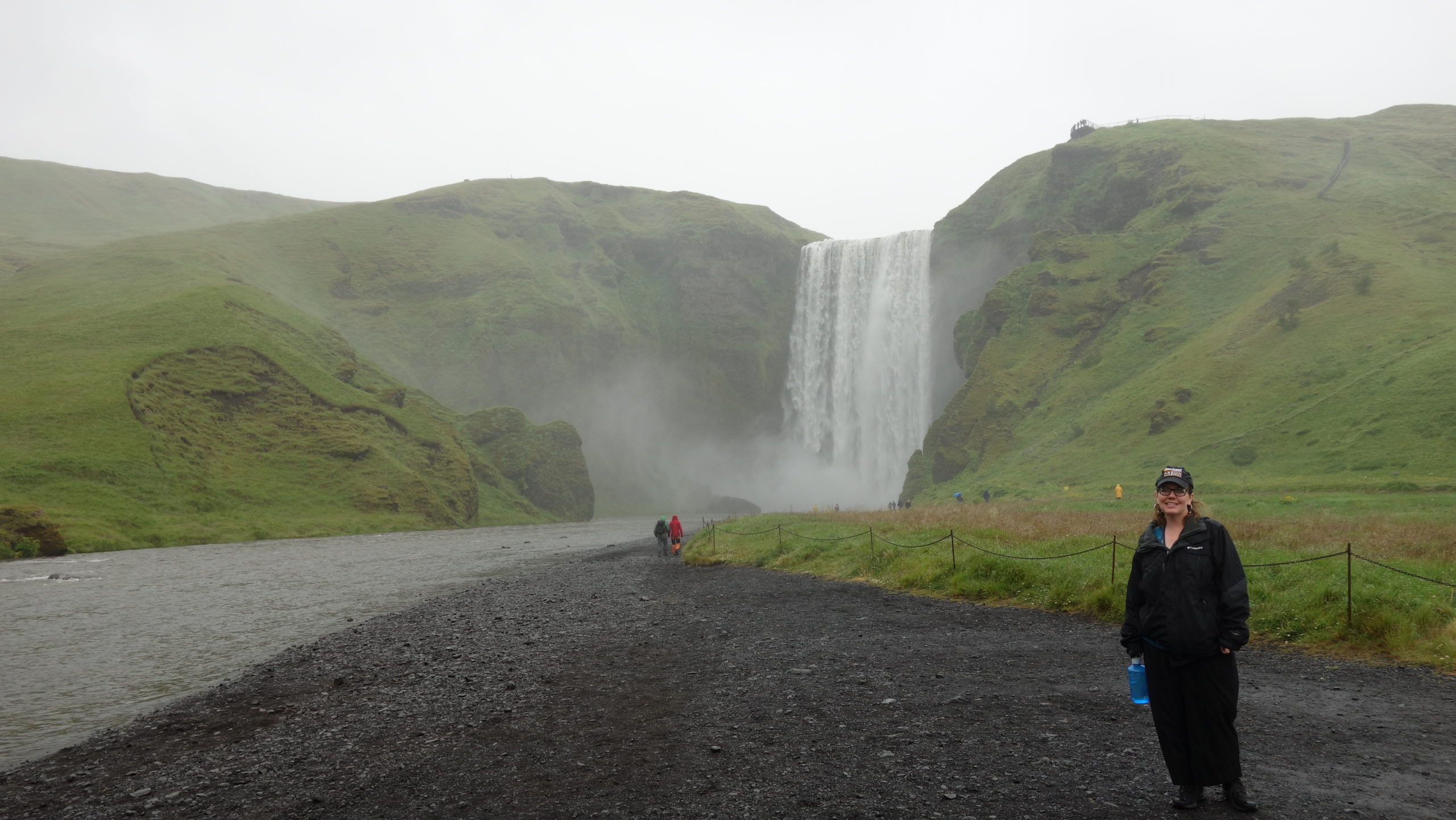
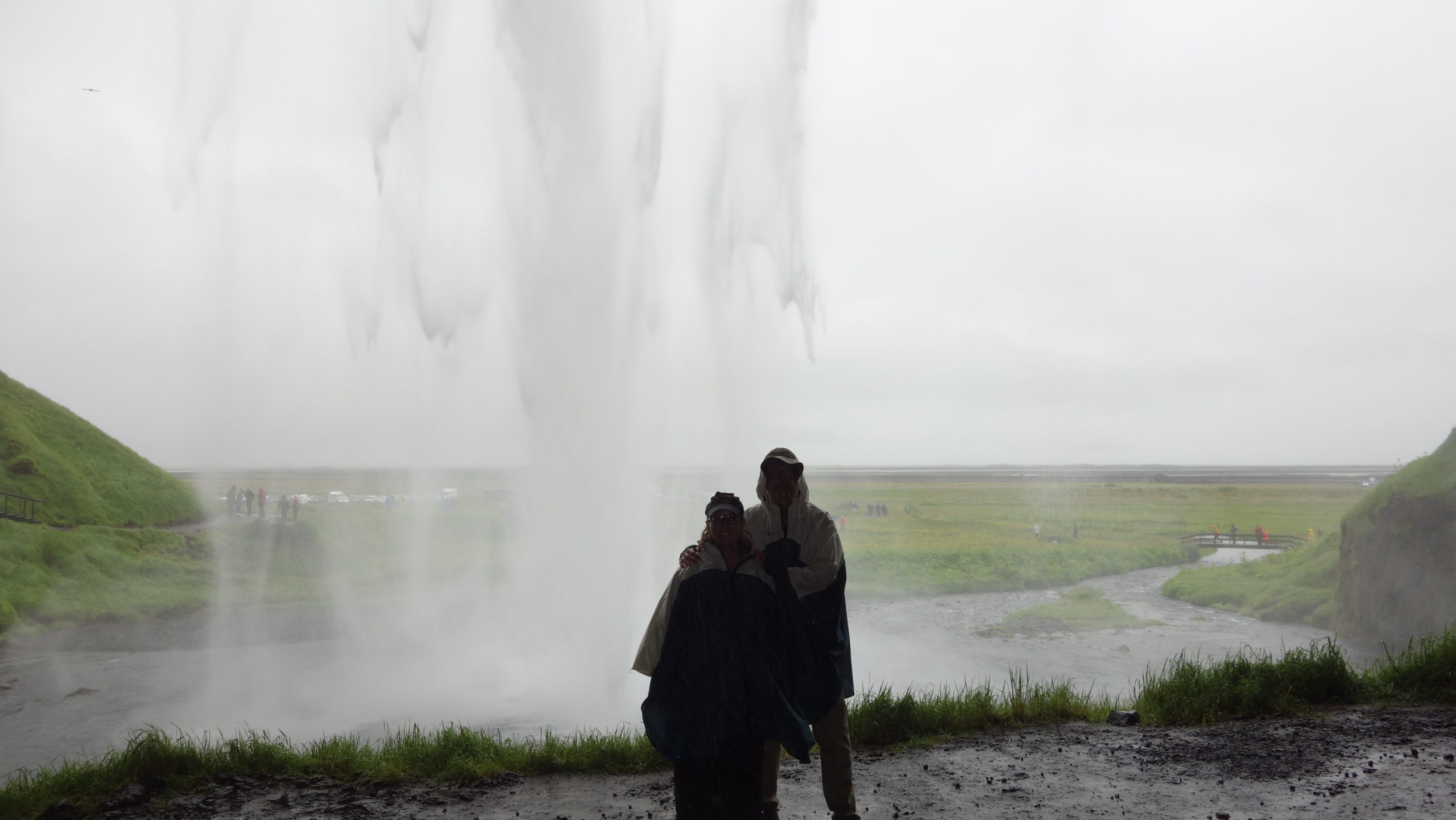
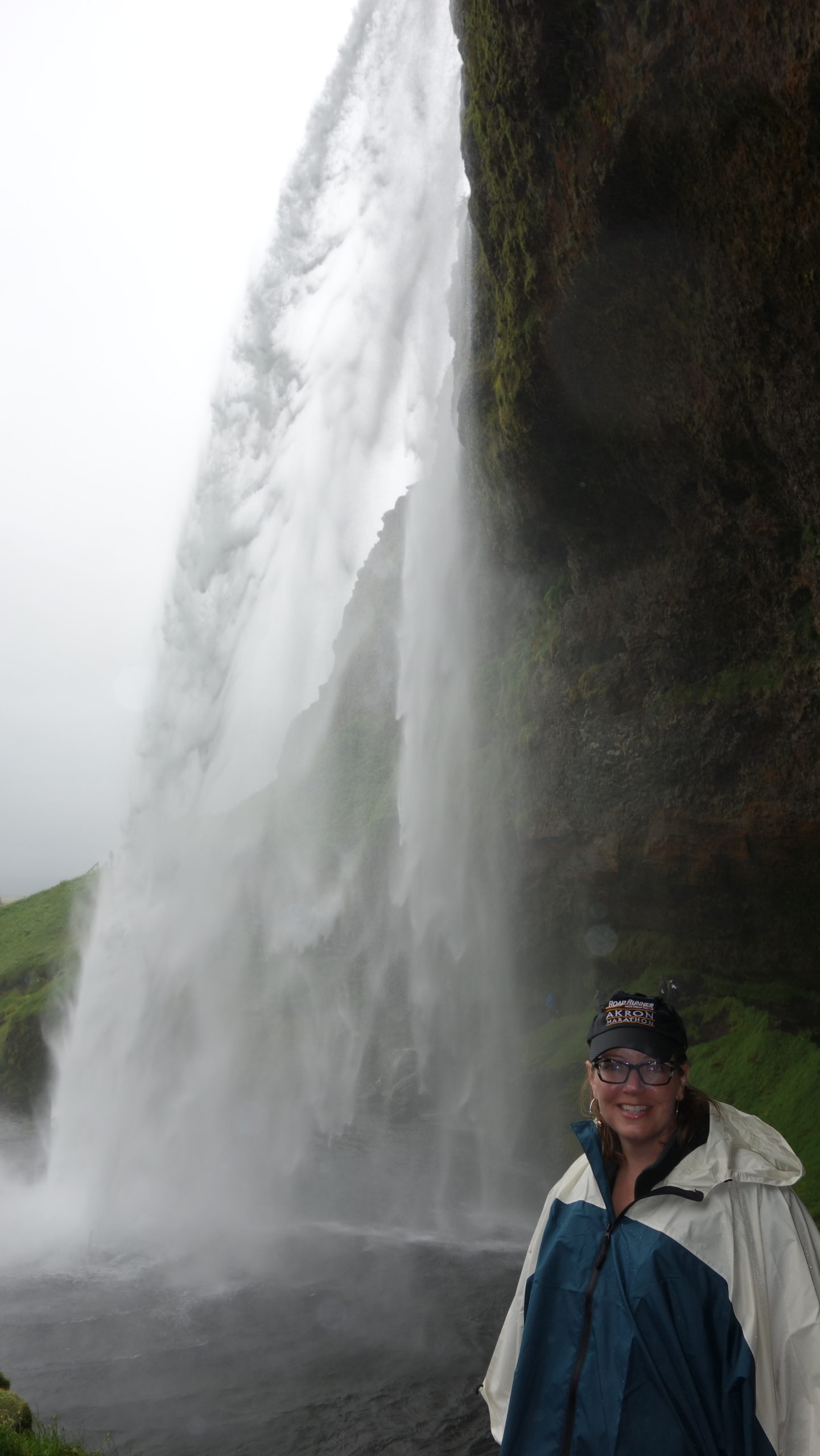
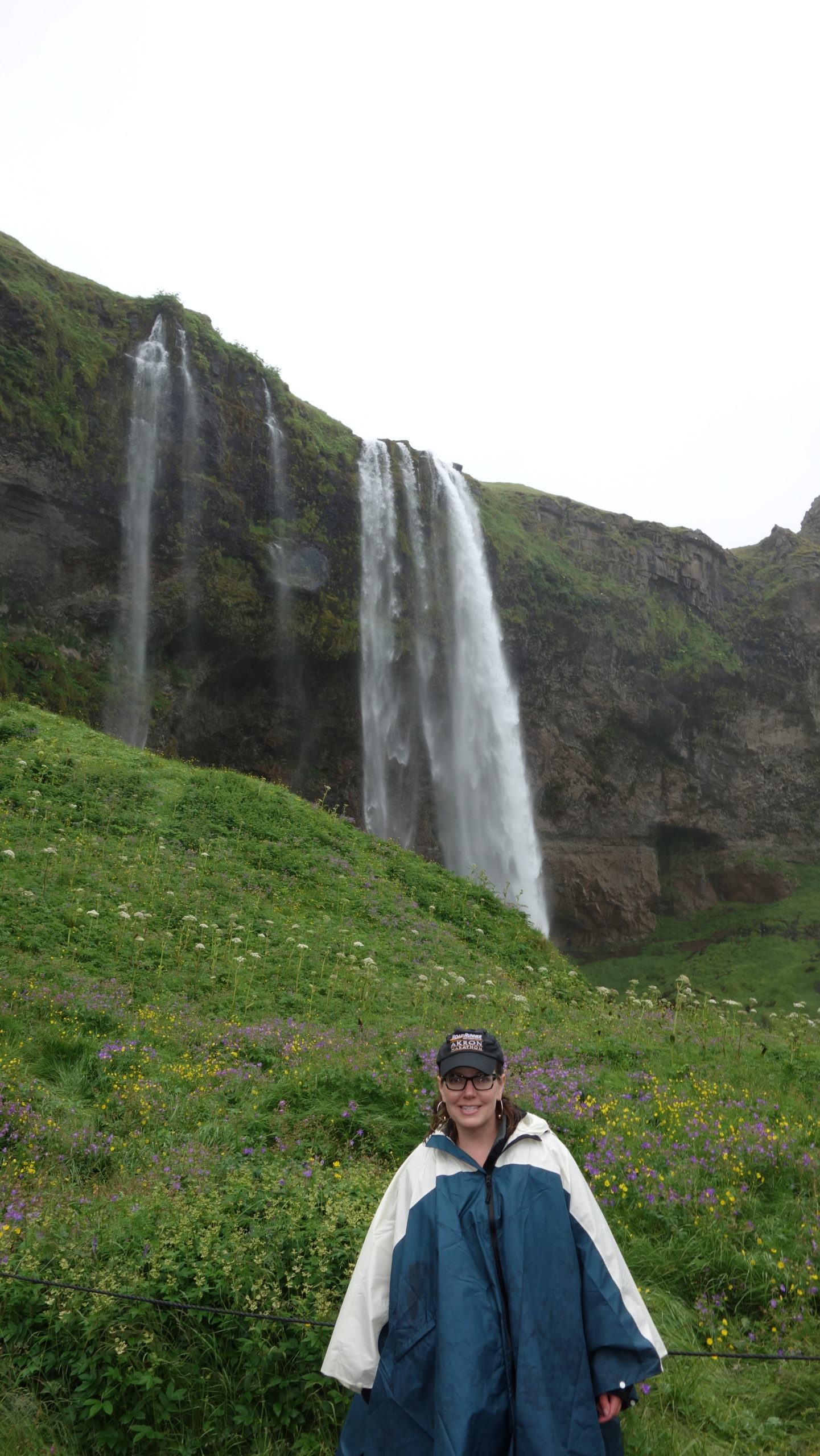
I had wanted to see a small (by Iceland standards) waterfall named Svodufoss. It is “only” 35 feet tall, but is situated well with the glacier above it and mountains around. Iceland seems to be stepping up both the environmental as well as the tourism game by installing plastic pavement grids filled with crushed stone to serve as paths for visitors. That makes hikes dry and easy, and protects the fragile plant life next to the paths. The locals had installed one of these at Svodufoss, as well as a stone wall/bench area with a stone patio that allowed us to sit and watch the falls, which we did for about ten minutes.

We made a snack/pit stop at the cute cafe we had eaten at yesterday, and then went back into the Snaefellsjokull National Park on the western part of the peninsula. We went down a one-track paved road that became an okay dirt road that became a rough dirt road. At the end of the road, separated by a mile or so, are two colorfully orange-painted lighthouses. Both are surrounded by lava fields, but the first one we went to is about thirty feet tall and has the mountains as a backdrop. I really liked that one. The second lighthouse is pint-sized, being maybe ten feet tall, and on the edge of a grassy area. In the middle of the grassy area is the area’s only freshwater well, which locals used to believe was a mixture of water, holy water, and ale. The well is still accessible for anyone who is interested, but bring a cell phone or flashlight – it’s dark in the mound built over it. The coast at this lighthouse lets you look back east over the rest of the peninsula, which was impressive today as the waves were crashing all along the coast as far as we could see.

A return bumpy trip got us back to the parking lot at the head of the one-lane road, where we parked to see Skardsvik Beach, a rare brown sand beach in Iceland. Most of the beaches are made of black pebbles or sand. I’m not sure where the brown sand came from, but we strolled around the small beach and loved how it was framed by black lava all around.

The day before, Meredith had been in charge and had taken us to the southern part of the peninsula, where we zoomed by two huge sea stacks without stopping. I clearly needed to fix that today, so we stopped by the Gestastofa Visitors Center, which is near the sea stacks and overlooks them (and you can hike to them as well). We used the free bathrooms (no joke in Iceland, where facilities are few and far between), and then walked over to the black lava cliff overlooking the sea (but not the stacks, which are in another direction). Again, we were impressed at the power of the waves crashing into the rocks. We then did walk most of the way out to the sea stacks, but stopped short of them, as we could see them better from a small distance.

We didn’t go far, however. About a mile down the road from the visitors’ center was a cliff overlook that was built (the overlook, not the cliffs) to see the stacks, but also had great views of the nesting seabirds on the cliffs below. It was a great stop; plus, as a bonus, the sun had come out some, so we could shed layers. The glacier was still stubbornly hiding under clouds, but we were warm (I think it was 52 degrees out, according to my car).

I was very proud of Meredith at my last stop for the day. We pulled into the parking lot for the Raudfeldsgja Gorge, and we started the climb up to the gorge entrance, which is a good little hike. The surrounding cliffs and mountains and ocean views were spectacular, so rest stops were never a bad thing. But, once we got to the mouth of the gorge, we found that it was only a few feet wide, all of which were taken up by a shallow stream. And Meredith actually waded it in her new Gore-Tex hiking shoes. I don’t take that for granted. We got into a roofless antechamber of sorts where there was some dry land, but that ended quickly. I scouted ahead to see how hard the hike was, and I turned around when I saw that it involved scrambling up small waterfalls. In the process of my turning around, the water came over the back of my right shoe. Ooops.

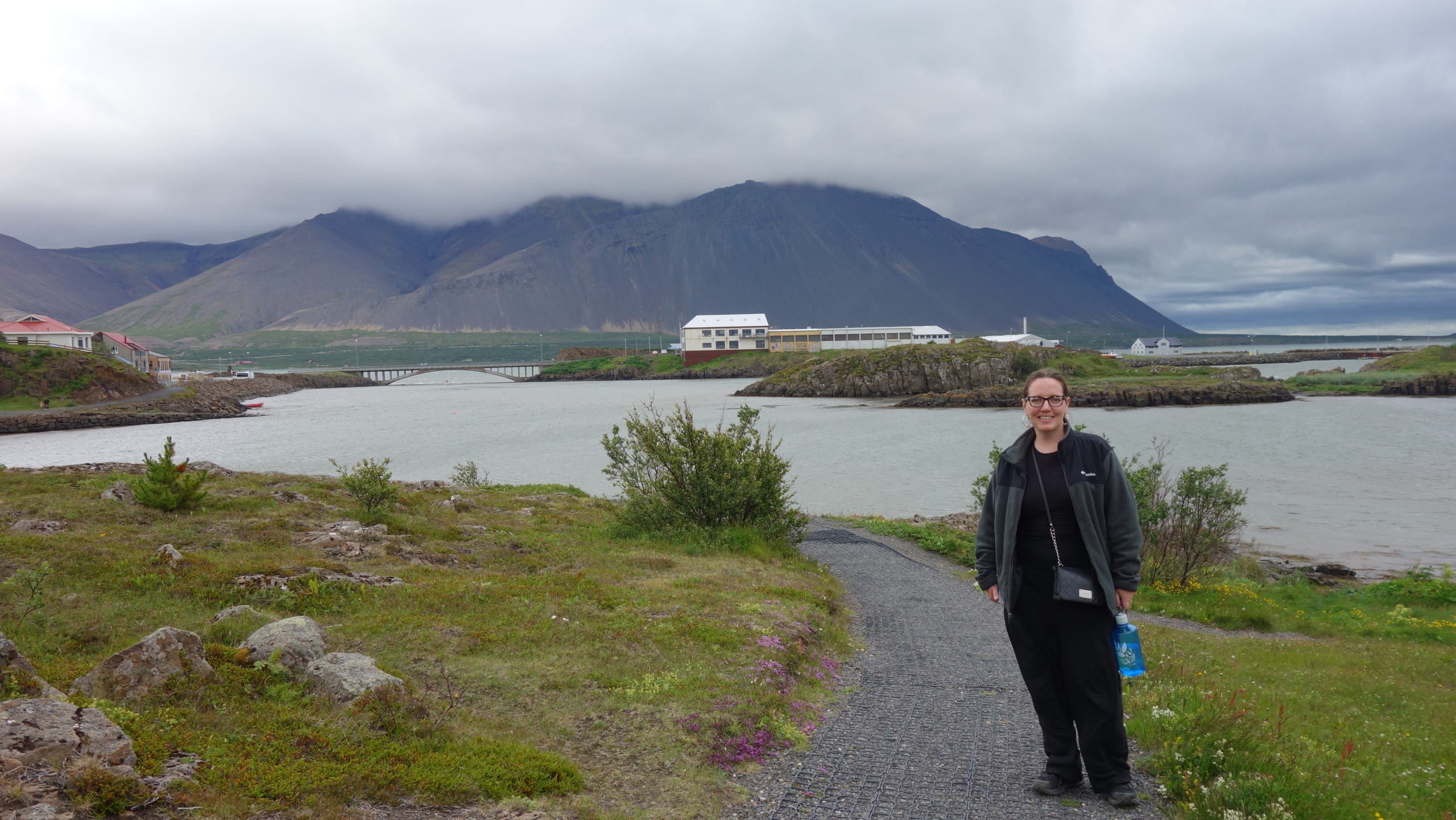
We hiked back down and then took the same mountain pass we took yesterday. The top was still covered in clouds, but the views going up were enjoyed by Meredith (who could look around) and by both of us on the way down (when the views were in front of us). We went back to the guesthouse, ate a quick supper, and then took advantage of the lack of rain to walk down to the small harbor of the town so I could see the mountains loom over the harbor and fishing boats.

There are several things to do and places to see here that I would love to have fit in, but they will have to wait. One of the great things about travel is how there is always more to do than time to fit it in, so you always have a reason to come back. That, and sometimes when you are really cold, the sun comes out and the touring goes on.

Iceland, July 2021, Day 3 (Tuesday), Grundarfjorthur and Snaefellsness Peninsula

“Ah, you silly Americans!” says Iceland in good English with a cute accent. “You think you got some wind yesterday? Ha! I’ll show you wind!” And so Iceland did. I have never felt sustained winds like those we encountered today. We know for sure (based on weather data) that one place we were had sustained winds of 38 mph. We’re pretty sure that on top of a volcanic crater in the middle of a lava plain facing the ocean, we must have had sustained winds of 50 mph. It totally messed with my windblown hair.

But I get ahead of myself. We got to the Snaefellsness Peninsula early, and headed to the northeast part of the area (the land overall juts into the ocean into the west, so this was the “upper right” part). We were again amazed at Iceland weather. Everyone not in California or Florida always says, “If you don’t like the weather, wait a minute.” These people have not been to Iceland. Coming from the south, in the space of about fifty miles, we had areas of misting rain, clearing, real rain, clearing, and misting rain again. We came over a mountain pass to get to the northeast, and we pulled over at a viewpoint to enjoy the view and to eat some brownies we had brought from the bakery in Borgarnes. When we got there, it was cloudy with patches of sun, but very windy. Then it clouded over. Then it started to mist and we got back in the car. Then it rained hard. I think we were stopped for less than ten minutes. When we drove away, we drove out of the rain within three or four miles. The end result of the constantly changing weather was that we decided just to tour and assume things would work out. Generally, they did, with any rain we encountered usually stopping after a few minutes of our arriving at a place we wanted to see.

Back to the northeast part of the peninsula. We pulled off on a side road at a sign proclaiming “The Shark Museum,” a museum showing how shark is caught and processed, and offering a taste of shark to tourists. But we were there about thirty minutes early, so I took the opportunity to drive a small dirt ring road along the ocean. It was sunny, but there was mist blowing in from the mountains, so we saw the brightest and closest (and full) rainbow either of us had ever seen. We saw multiple rainbows today, but this early one was spectacular.

We got to the museum a little after 10:00, and it was very much a family affair. The museum itself was one large room with family artifacts and a short video showing how they process shark. The same family has been catching Greenland sharks since about 1600. The sharks used to be caught for their liver oil (a Greenland shark liver weighs about 300 pounds), but the meat made people ill, until they buried it for six weeks and then dried it. I can imagine how that went:

“Gunnar! Every time I eat shark it makes me sick!”
“I know, Einar! It is too bad. We have so much meat.”
“Gunnar! If it makes me sick when it is fresh, maybe it will be okay to eat if I bury it in the ground for six weeks!”
“Einar! You are a genius! But, to be safe, after you dig it up from the ground, you should hang it in the air for three months, and then try eating it.”

Obviously, this is fictional. The original conversation would have been in Icelandic.


The motherly figure showing us around was very friendly, and when she got to the tasting, she acted as if of course we wanted some shark. Because she was so nice, and because it would shame Meredith into eating some, I actually tried a small piece. It was, technically speaking, not good. I saw a “tourist reaction” sheet at the door that showed the touristic stages of trying shark, and it ended with, “What in the name of all that is holy and good is that taste?” I agree with that sentiment.

Meredith thought it was okay.

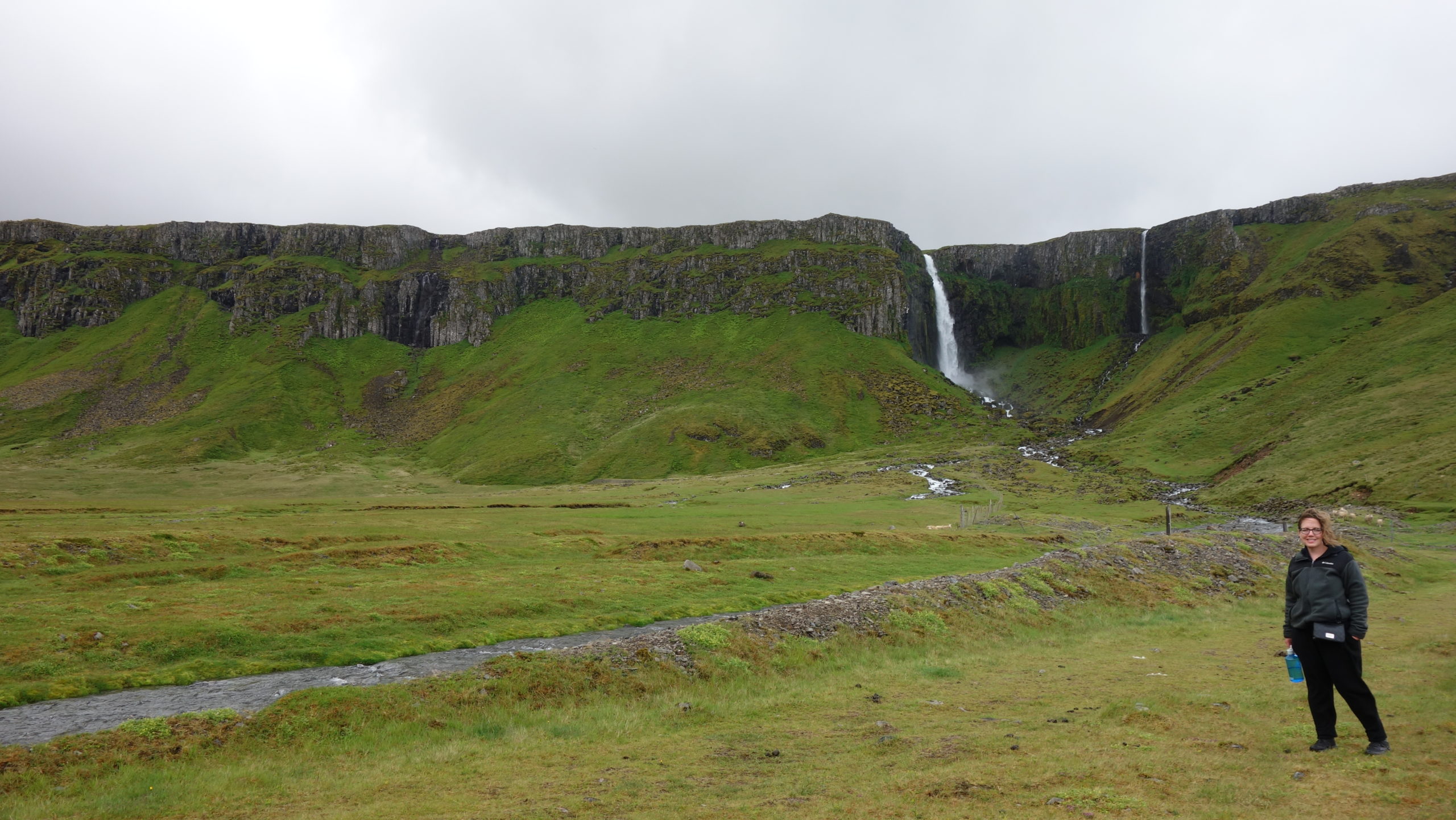
After a quick photo stop of the small church on the farm, we headed along the main road going west, until we got to our first major waterfall on the peninsula, Grundarfoss. Grundarfoss is a large waterfall cascading 200 feet off of a mountain, with a dramatic ridge framing one side. You can walk up fairly close to the falls through a sheep pasture, with a walk of about three quarters of a mile. That involved jumping a small creek. Happily, at that point, we were committed, so Meredith successfully tried the leap. The rain let up as we got to the falls, and the wind died down considerably, so we spent a good ten minutes there looking around. As Meredith likes to say, Iceland is a 360-degree country:  there are views in all directions. As we wandered out, the wind and rain came back, so we were happy to get back to the car and the heated seats. I’ve not before given thought to wind chill temperatures in July, but I have now. For those curious, 50 degrees with 35 mph winds feels like 41, which I think feels even colder when you get wet.

We drove the short distance to the town of Grundarfjorthur, where we would be staying the next two nights. No one was in at our hotel; we’ve been worried at the increase in numbers of places that have check-in via a “call us” number posted, especially since the cell phone we keep in our car is a U.S.-only plan – it doesn’t work in Iceland, so that may make things harder as we go along. For now, we moved on out of town to a highly visited falls/mountain combination – Kirkjufell (the mountain) and Kirkjufellfoss (the falls).

You can hike out to the falls from a parking lot, and get a picture of the falls and a dramatic stand-alone mountain in the same shot. It is on tons of post cards, and has been used (so Meredith tells me via Rick Steves) in the Game of Thrones TV series. It is easy to see why – even in the on-again, off-again mist we were in, it was a beautiful spot. There were mountains around, the falls, the lone mountain, the town spread out, and the ocean.

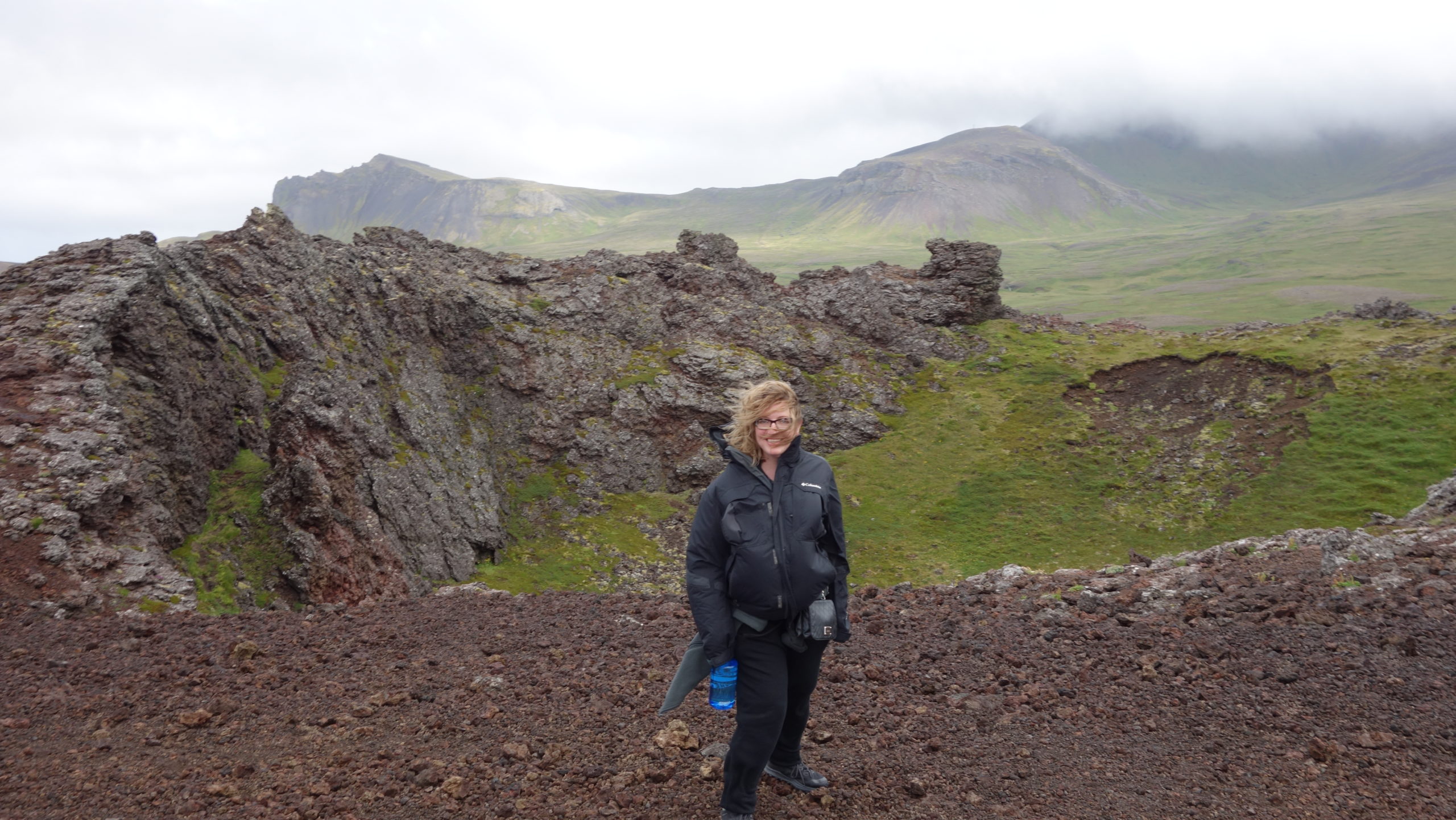
After lunch at a very cute café on down the road, we continued our whirl-windy tour by stopping at the Saxholl volcanic crater. Saxholl is a fairly small mountain at 300 feet, but it towers above the lava plains around it, and is open to the sea. There are also stairs that let you climb to the top. So up we went, even in the ever increasing wind. It was a fairly happening place, with a dozen or so cars in the lot. We met some people coming down, so when we got to the wind-tunnel top, there were about eight of us up there. We were all laughing at having to brace against strong wind gusts above the normal gale. It was indeed a bracing experience. The views were grand, but there was something about feeling the power of nature on top of a former power of nature that made us a little giddy.

On to another volcanic crater, but a less active one for us. The Holaholar Crater is one you can actually drive into. There are no views of the surrounding country, but the road takes you to a spot that creates a wonderful frame of the mountains as backdrop outside the crater.
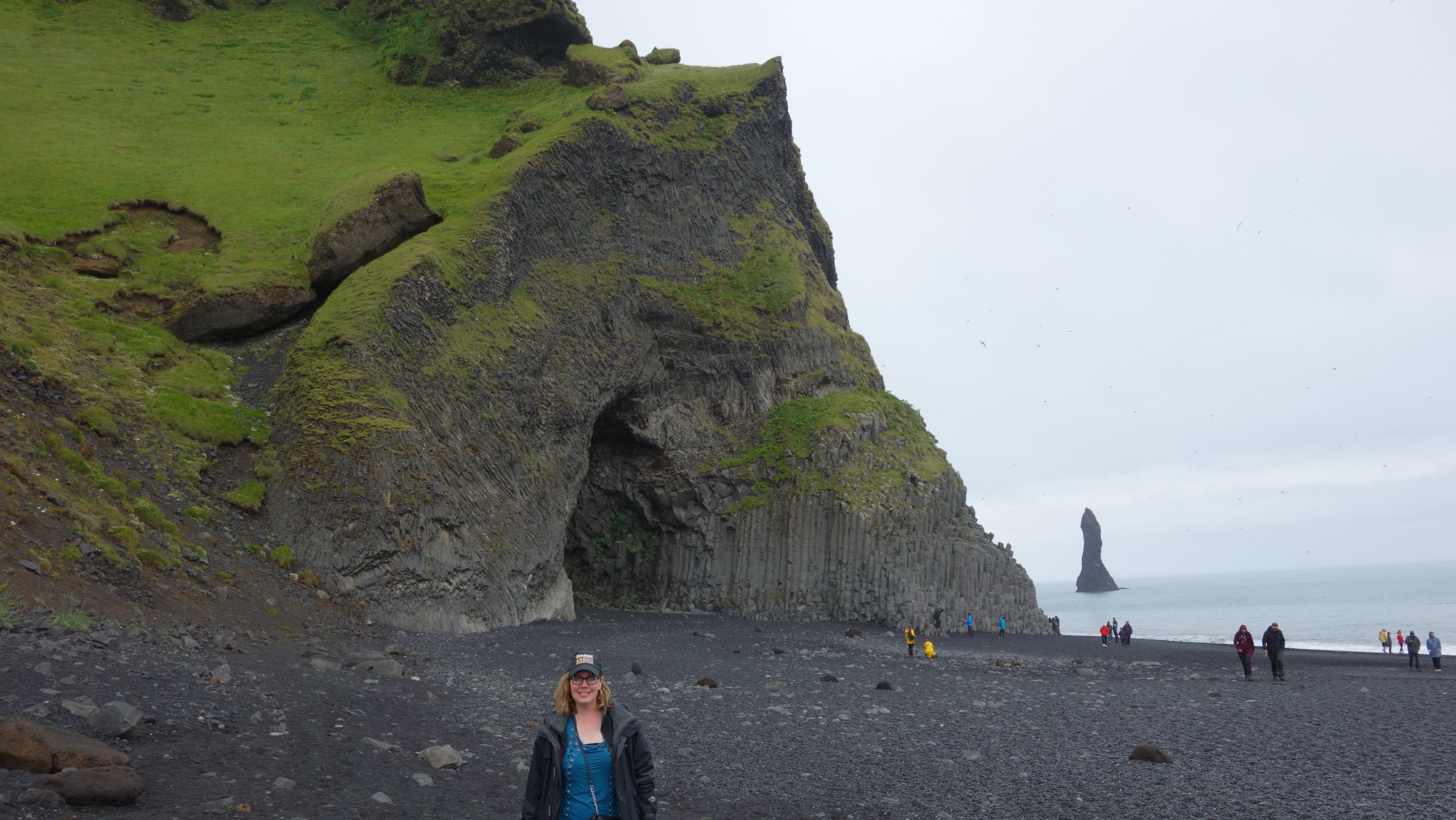
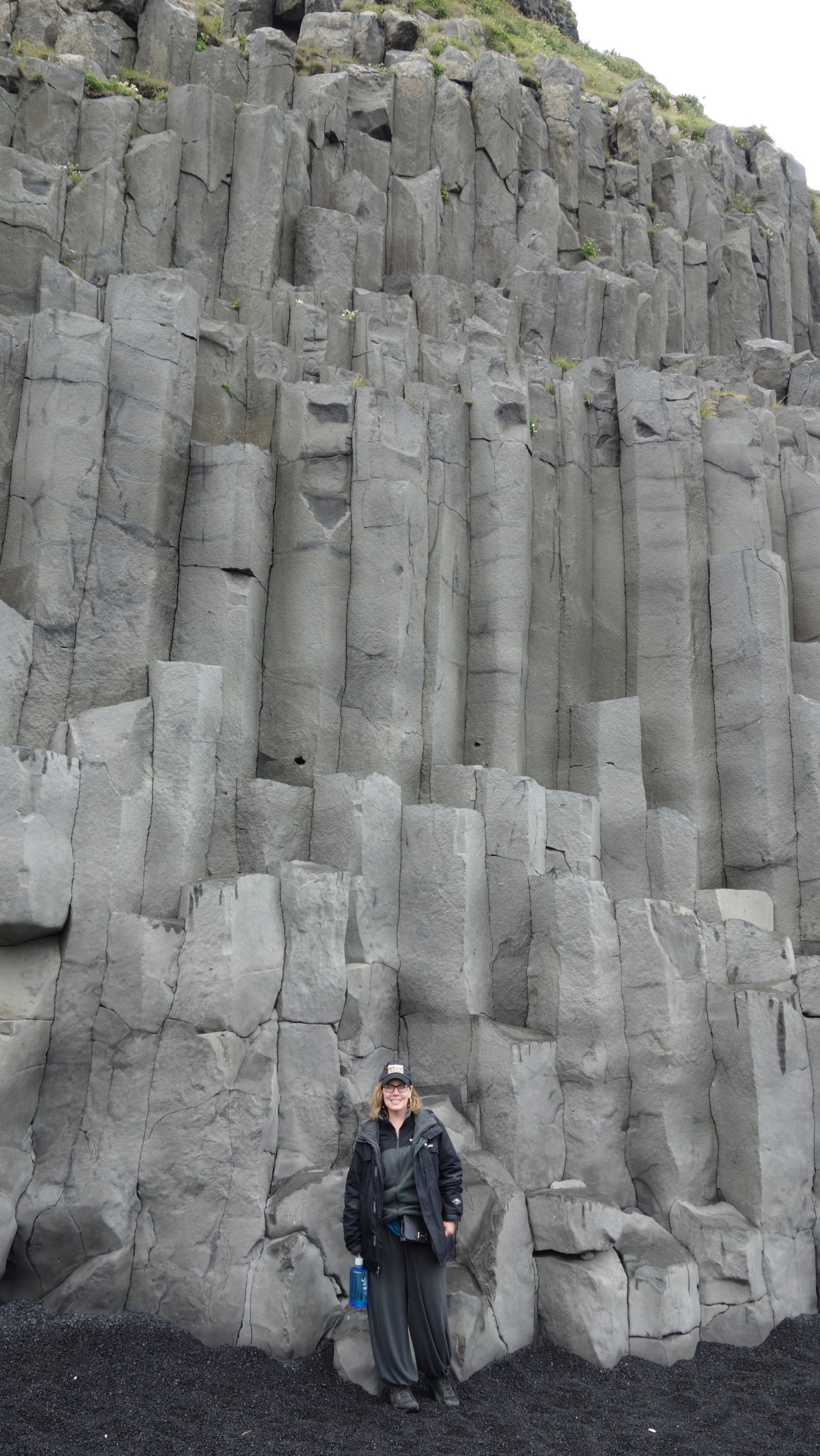
Djupalonssandur, a black sand beach, was next on the list. A surprisingly full parking lot was at the end of a mile-long single-track road. I knew from the crowds and the first collection of sight-attached free bathrooms that we were somewhere important to the local economy. A dramatic path led down through a lava field to a beach of black lava pebbles and sand. The crashing surf was wrapped on each side by huge rock formations and cliffs. It was raining steadily as we walked down to the beach, but let up after a couple of minutes down there. We lingered for ten minutes or so, and went back on another path. Before we went back to the car, we climbed a boardwalk to the top of an observation platform on a hill overlooking the beach for a grand view of where we had been.

You may think this sounds like a full day, and it was, but Meredith was in charge, so we had another stop. After a quick stop at a commemorative statue to a local woman whom the sagas say traveled as far as North America (where she gave birth to a child) and to Rome, we finished the day at Arnarstapi. Arnarstapi is a small collection of buildings near a very small harbor, but it boasts some great boardwalk walks along the edges of cliffs where arctic terns nest and where you get grand views of rock formations. We walked the boardwalks, and Meredith decided we could take the cliff walk to the small village of Hellnar. Rick Steves recommended it, and it started out on an easy path. That gave way at the lava field to a rough path of fist-sized stones. Add in some drizzle and rain and wind, and the walk was tough at times. It all cleared up at the far end, and the sun even came out a little for the return walk, which seemed much shorter. Happily, Iceland threw in some more drizzle right at the end so that we would appreciate our car’s heated seats.

We came back to town over another mountain pass, but this one was cloud/mist-bound, so we didn’t see to much. Our hotel was still locked and unstaffed, but a kind woman at a restaurant let us use her cell phone, so we got checked in okay. Some food at 8:00 pm helped shore up morale.

It was a long but good day. Touring around is wonderful and beautiful, but it ain’t no breeze.


Iceland, July 2021, Day 2 (Monday), Borgarnes area

Today we got introduced to three Icelandic things that we will almost certainly experience again on this trip – wind, water, and wings (in the form of midges). But don’t let the wild words worry you with waning willpower; we didn’t.

We started the day off with a lovely drive to the northeast to a rural area that features the most powerful hot spring in Europe, named Deildartunguhver. Easy for me to say. You can know in your head that hot spots in the Earth’s crust exist, and you can know the heat from those spots can heat water, but it is a mighty thing to stand in front of a hot spring where water is literally boiling and steaming out of the ground to form pools that would scald you. Deildartunguhver supplies the town of Borgarnes with all of its hot water, and happily for me and Meredith, someone built a beautiful spa on the grounds to take advantage of the spring.

We visited the hot springs (which is wisely fenced off and posted with warning signs) and stood in the clouds of steam issuing up from the spring. We would be cool one second (standing in the fifty-five degree air), and then in one step, we were standing in warm steam. Just a couple of feet made a drastic difference. We scouted out the spa area; the hot pools are outside and visible from the walkway, but we were there about forty minutes before they opened, so we took a chance to explore.

We went back to a roadside sign I had seen, and it turned out to explain about the area we were in, with a map as well. We walked across the street to a dirt road to look at a very involved road map, and I decided to take a picture of Meredith with the mountains in the background. I stepped back onto the dirt road to take the photo – no big deal. A dirt road off of a tar road that would see one car every five minutes. So, of course, as I took the picture, a car turned off the tar road onto the dirt road. We got back in the car to go look at a church marked on the map, seeing a John Deere tractor along the way being driven by a mom with her son in the cab with her. The church was very small, and in a beautiful location, but the gate was closed and tied off, so we headed back to the spa.

Krauma Spa is quite wonderful. It feels upscale and is small, capping visitors at 130 people at any one time. We got there at 11:00 am when they opened, and for most of our visit, there were only about a dozen people (and only six of us altogether for the first half hour). Icelandic custom is to shower before going into pools, even ones heated by water from the ground, so we did that before heading out to the pools. Krauma has five hot pools that range in temperature from 98 to 106 degrees, as well as two steam rooms, a cold pool, and a relaxation room.

We started in the coolest pool of the hot pools, where we spent a long time talking with a couple from Denver. It lightly rained some, but that was fine by us in a hot pool. We then tried the second pool, where I discovered that the pool was designed as an inverted cone, presumably so you could lie down on the incline, which we happily did. The third pool was quite large, and had the best view of the mountains. The overflow from the pool fed the small stream that ran next to the walkway up to the building, with the water going back to the hot spring. I joined Meredith briefly in the hottest pool which we went to out of order, by mistake. Meredith wanted to get the full experience, so she went to the last pool while I went to check out the relaxation room.

Which was wonderful. It was a room with ten lounge chairs in it, circling a stand-alone woodstove, while calming music was piped in. The room smelled just a little of the wood being used for the fire, and a wall of windows looked out over the mountains. I settled in, and almost fell asleep. Meredith came in to tell me she wanted to try the steam room and the cold pool. She was back very shortly after discovering it was difficult to breathe in a steam room (one of my complaints about them) and difficult to stay for more than a few seconds in a pool of 45-degree water. She joined me in the relaxation room, which got even better when I quietly ordered a hot chocolate from a staff member who came to check on the fire. It was a wonderful experience. We did hear the wind howling outside the windows, but that only made the room cozier.

So wonderful, in fact, that when we went to shower and change back into our clothes, we discovered we had been there two and a half hours soaking and relaxing. By the time we got ready to leave, it was 2:00. Not a bad start to a touring day.

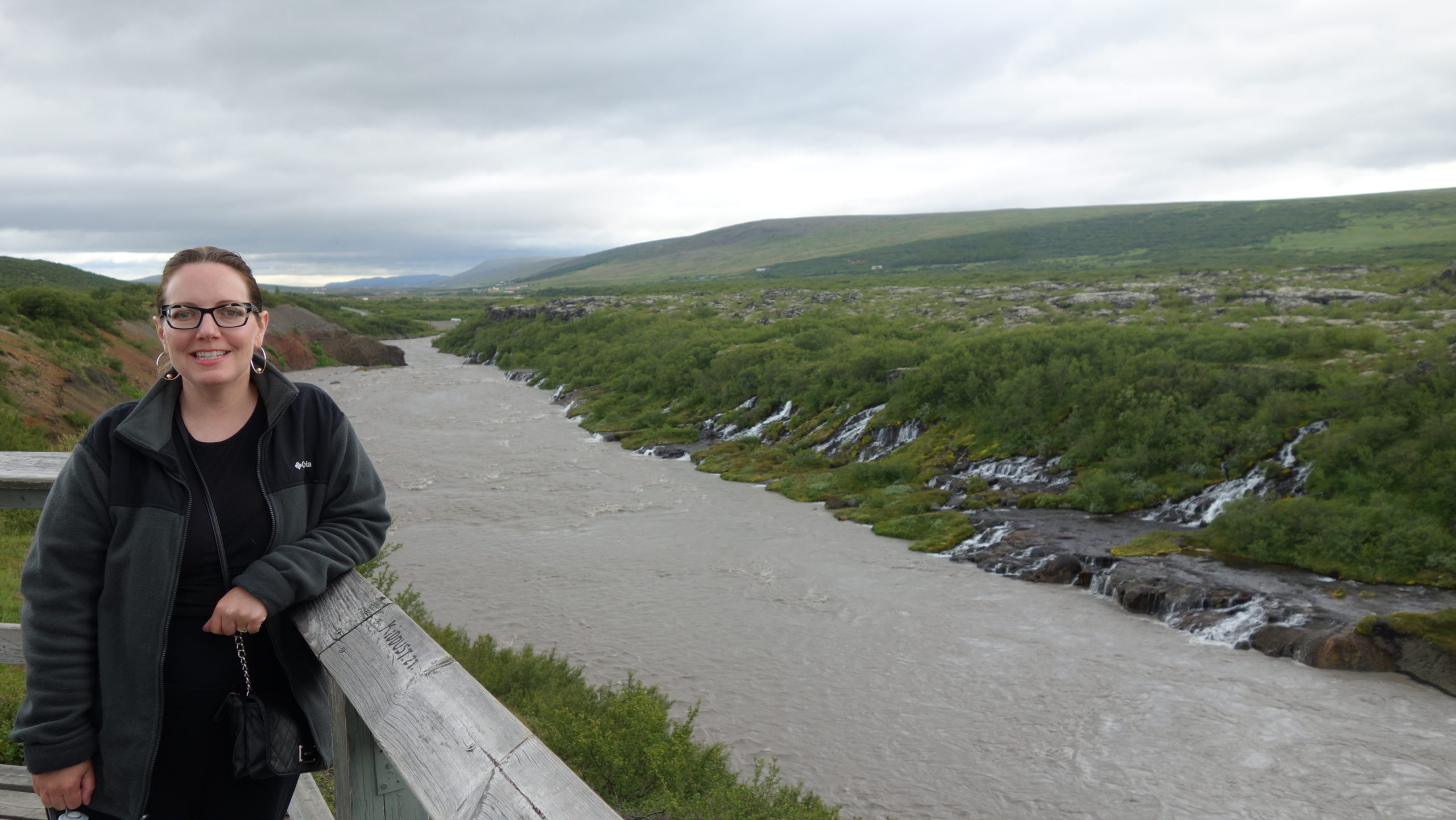
Back to the car and on to sight seeing. We headed a little more northeast, to the first two of the many waterfalls we hope to see in Iceland, and it was a good introduction to the amazing power of water in the country. A large parking lot and a useful cafe were at the head of a very short trail to Hraunfossar (“Lava Falls”), which was magical. It reminded me of Plitvice Lakes in Croatia – a long series of bridal veil falls emptying into a strong river below. The water comes from groundwater sinking through lava fields in the area, as well as water runoff from a nearby glacier. The water seems to come right out of the side of a steep bank, and goes on for about half a mile. The path takes you to several vantage points and over a bridge to the far side for more views.

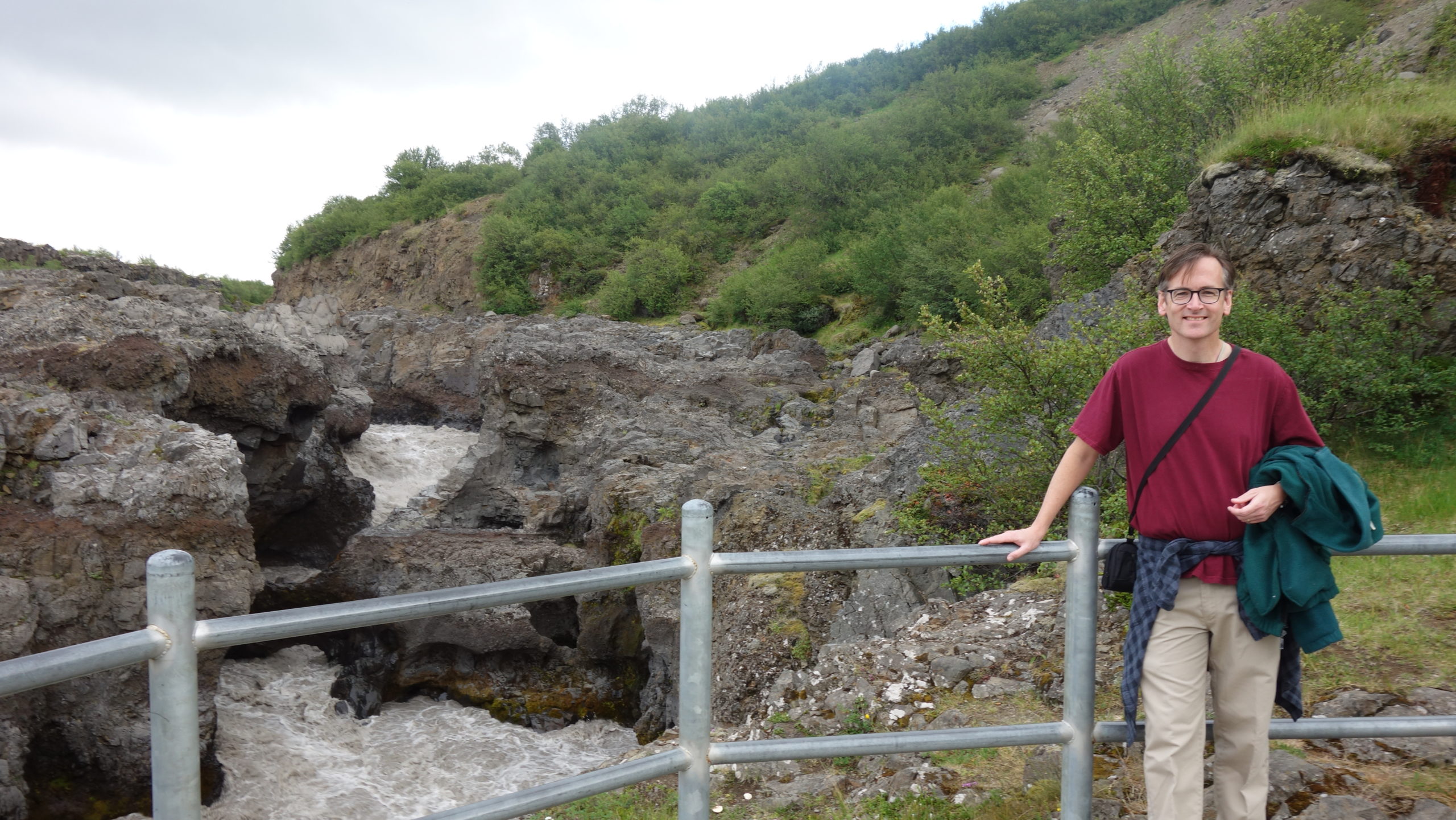
Just upstream from Hraunfossar is Barnafoss (“Children’s Fall” – named for the legendary story of two children falling in on Christmas day while mom was at Mass). Barnafoss is a typical waterfall, but a powerful one cutting a channel through the igneous rock of the area. It is also full of mud or gravel, so looks churned up. The waterfall is very loud, and has cut the rocks into interesting shapes.

The only slight downside was the midges in the area. Meredith had read about midges in Iceland, but only in relation to a lake in the north. The bugs don’t seem to want to bite, but they do love to crowd up around your face and ears in large numbers. In places where the wind was blowing, we were fine, but in sheltered areas, they could drive you crazy. We did bring mosquito netting along for our heads, so that will go into the backpack from now on.

We headed back to Borgarnes, but happily took a different way back after a wrong turn (on a circular loop). The views were incredible – the sun was peeking through the clouds in various places, sometimes showing off the snow on a few mountains, and sometimes shining on bare rock. It made those objects pop out against the grey clouds. We also found a very pretty river in a valley area when we stopped to check out the menu for a restaurant (“Rock and Troll”). The restaurant was closed, but the short visit was worth the delay.

Back in town, we parked the car and walked (and were blown by the wind) to the Settlement Center, which is small museum that tells the story of the first sixty years of settlement in Iceland (from about 900-950 AD). I had thought that all of the sagas being referred to around the area were just tales, but there are books of settlement from early on. I’m sure some legendary aspects had crept in (like the idea that huge animals and giants defended Iceland from a Danish magician spy who had taken the form of a whale), but the epics pass on a lot of information about who was in Iceland and where. By the time the Icelandic Commonwealth was formed (about 950), there were an estimated 34,000 people living here. The museum also explored how the Vikings were such great sailors (they were the first to make a boat with a continuous keel for strength), as well as admitting we don’t know exactly how they navigated the open oceans in pre-compass days. The museum only took about thirty minutes to get through, but it helped me to understand how important the epic sagas are to the island’s history.

We walked back along the long trail to the hostel, and grabbed a cheap supper from a nearby grocery store. We may not have much history in Iceland yet, but today was pretty epic.

Iceland July 2021, Day 1 (Sunday), Borgarnes

For the first time since November of 2019, we’re back on foreign soil! A deep gratitude to God and many thanks to the medical researchers, policy makers, and common people’s best efforts to get us to this point. Thank you, all!

It took a little time to clear customs and get our rental car at the airport, but by about 8:30, we were underway in our yellow Kia. It is almost brand new, and has a million features even my 2015 car doesn’t have – hybrid engine, push start, automatic lights, automatic washers, lane detectors, and many other things I don’t even know about. Renting a car is series of happy accidents with controls for some time.

We drove about an hour and forty-five minutes north to the small town of Borgarnes. We certainly got a taste of traveling in Iceland – we drove from mist to rain to mist to rain to cloudy (which was a happy progression for landing in a town we wanted to tour). We also traversed lava fields, green pastures, the outskirts of Reykjavik, drove under a fjord in a three-mile tunnel, and were dwarfed by roadside mountains. This is going to be fun (not to mention beautiful).

We got to Borgarnes about 10:00 in the morning, so our room wasn’t going to be ready. We ate a light meal in a bakery that overlooked the mountains and a fjord, and so that was a good use of time. Meredith always leans on Rick Steves for her touring wisdom, and Rick does cover Iceland. So we followed Rick’s introductory walk around town, seeing a small park, the heated town pool, the surprisingly excellent track and field area, a hill commemorating parts of an Icelandic saga (a son’s nurse was hit by a rock and drowned by a cranky father, which made his son retaliate by killing a servant of the dad – strange tales), and a small island, and finished by walking a path along the fjord back to the athletics fields. That got us to noon, and our room was ready, which allowed us to take a long nap until 4:00.

After showering and eating at a local restaurant (where I saw horse on the menu for the first time; I got beef), we jumped in the car and headed off through incredible countryside for about thirty minutes, until we got to Grabrok Crater, a very small extinct volcano. The area is still very rugged since the volcano erupted only about three thousand years ago, but the locals installed a boardwalk with steps all the way to the top. The views of the surrounding countryside kept changing as we climbed, and the views from the top were photogenic. Meredith is very patient with my “Wait! Stop!” moments of reaching for the camera. There is a path all around the lip of the crater, and we took our time strolling along it. The evening was pleasant, and the weather was very good.

Grabrok Crater was the only touristic goal of the day. We took the car back to Borgarnes and settled in for a fairly early evening. We indeed have many things to be thankful for.


Iceland, July 2021, Day 0 (Saturday) – Hershey, Pennsylvania and on to Newark Airport

We started this morning by driving back to Hershey from where we stayed in Harrisburg. We wanted to visit the Hershey Botanical Gardens. We drove back to Chocolate World, figuring we would see signs to the gardens, but we somehow missed them. We asked the teenage male worker at the gate where the botanical gardens were, and he looked confused. “Motanic gardens?” he asked. “I’ve never heard of those.

After we briefly checked out Chocolate World to see if it was still crazy at 9:45 am (it was), we plugged the word “garden” into the GPS. It was six tenths of a mile away, next to the luxury Hershey hotel. Away we went.

Meredith and I are members of Akron’s Stan Hywet Hall and Gardens, and as such, we get in free to many gardens around the country. Hershey’s is one of those, so we were allowed in. We started with the butterfly house, which has something like four hundred butterflies in it. I love butterfly houses – they are magical. We got to see butterflies eating up close, using their really long proboscis, which they store by rolling up into a small coil in front of their faces. There were all-black ones and violet ones and orange ones, as well as others. They had one called a Luna moth that was imprisoned in a mesh cage because it seems it lays its eggs all over. Oddly, in its moth stage, it has no mouth or way to eat, so I guess it must eat a ton as a caterpillar.

We roamed out to the garden proper. It started as a rose garden, and the roses are still spectacular. They have added a Japanese garden, a rock garden, and an arboretum, as well as other flower gardens. The entire space is about twenty-three acres, so it is a manageable size. We were able to tour the entire park in about two hours. We still had time, so we went and ogled the Hershey Hotel. It is lovely, with multiple balconies and an interior enclosed fake courtyard. My guess is the rooms cost more than the $125 we spent on our hotel in Harrisburg.

We got on the road around 1:00 after trying to find somewhere to eat that didn’t have a thirty-minute wait. We figured we could eat on the road at a less busy time (2:30, as it turned out). We got to Newark with no issues and little traffic, and had a few confusing moments along the way involving parking, and then checking bags/getting boarding passes (why they have international passengers use a kiosk is beyond me – the kiosk always asks us to get an agent). In the end, though, we got to out gate about three and a half hours before takeoff, which was pretty good for an airport we have never used.

Lord willing and everything goes smoothly, the next stop will be Iceland!

Iceland, July 2021, Day minus 1 (Friday) – Pennsylvania

After our last summer’s planned trip to Sweden was cancelled due to the Covid pandemic, we kept an eye on which, if any, European countries would open up first. That turned out to be Iceland, so that became our summer of 2021 trip. We booked the trip in July with the hope that more people would get vaccinated, and that would help open things up more, which actually happened – we don’t need to quarantine in Iceland at all now, which is a great thing.

But, out usual plan of flying out of Toronto wouldn’t work this time since the Canadian border has remained closed. So, we found cheap tickets out of Newark, which is seven hours away from Cuyahoga Falls. Since we have never flown out of Newark before, Meredith thought it wise that we should get part of the way there a day before, and so we settled on getting to the Harrisburg/Hershey Pennsylvania area today (Friday). We’ll fly out tomorrow, but we are only two-and-a-half hours away from the airport. We’ll still leave two hours of traffic time as well.

All of which to say, we got to tour Hershey today, going to Chocolate World. I’ve been on the factory tour of a local chocolate company in Ohio, so I thought this would be the same thing, but a little bigger and slicker. I was quite wrong. The Hershey complex is huge. It is home to a resort, an amusement park, a water park, a large stadium for converts (country singer Luke Bryan played there tonight), and of course there was Chocolate World itself. There have been no factory tours since the early 1970’s. Chocolate World is instead a collection of shows and venues, usually related to ways to get you to open a wallet.

We took the free tour, which shows how chocolate is made. But, being a tourist destination, the demonstration is a full-featured ride. You ride in a little car, and see animatronic cows and candy bars along the way while your virtual guide explains how chocolate is made (about a dozen different steps). Fun fact we learned – Hershey’s is one of the only chocolate makers in the world to use fresh milk (others use powered milk).

Chocolate World was fairly mobbed when we went on the tour, but was packed when we got out; a thunder storm had moved in, so the amusement park shut down for a time, and many people came in to Chocolate World. I expect Hershey loves it when a brief storm moves in – some serious money gets spent.

Since the weather was bad and the car was far away, we got tickets to “Hershey Unwrapped”, a show where we were supposed to be students learning how to make chocolate. It involved a box of samples. It was silly and fun with two different actors playing a new teacher and an established teacher, and we had a good time. When we got out, it had stopped raining, so we decided to go back to the car.

That was about all we could do. The influx of people coming in for the concert meant that the crosswalks were full of people, so the cars trying to get out couldn’t go much of anywhere. After about ten minutes of waiting in a parking lot and only moving one car length, we parked and went back to walk around a little. We couldn’t get in to the amusement park, but we could watch some of the roller coasters through the fence. We also looked at the baked goods and custom confectionaries in another store, and by then the traffic was moving.

We headed to our hotel in Harrisburg after one false start (the GPS found three “Front Streets” and I guessed wrong on the first try). We got to the hotel at 7:30 pm but were told out room was not ready yet because the hotel was full for a firefighter’s parade on Saturday. Not great, but we had to eat anyway, so we went and got a light supper at an Indian restaurant, returning at a little after 8:30. No one was at the desk, and there was a sign saying they would be back in five minutes. So, we took a stroll along the Susquehanna River, getting back to the hotel about 9:00. We caught the front desk person leaving again, but managed to get into our room. Where the toilet tank didn’t fill correctly without reaching into the tank to mess with things each time. But, we had to live with it since there are no other rooms. I would have hoped for better from a national chain where we were paying $125/night (as a discount!).

So, tomorrow we will see if we can get smoothly headed to Iceland. Today was a fun day, and it was nice to break up what could have been a nine hour drive. It also acted as a good scouting visit should we wish to come back to explore the local chocolatier another time.

Enigma (Emma)

In a small, friendly community like New Baltimore, unexpected visitors drop by one’s house from time to time … but I was still surprised that someone was at the door at nine o’clock.  Matthew had just gone upstairs to bed, so I was the one who answered the door and found Jennifer, a grade-school neighbor girl, holding a tiny ball of white fur in her cupped hands.  She explained, “I found this kitten in the woods, and I didn’t see any mama cat or any other kittens, so I brought it home, but my mom said we can’t keep it, because of our dogs — it might not be safe.”  I called for Matthew to come back downstairs.  Taking the kitten from Jennifer, he said we’d keep it for a day or two, until we had a chance to get it to a shelter.  Somehow, though, I had a suspicion that the proposed shelter trip would never come to fruition.

The kitten’s eyes were open, but they couldn’t have been for long.  It was a tiny thing that couldn’t yet feed itself or even go to the bathroom without assistance.  During those first few days, Matthew became the “mama-daddy,” feeding it formula with an eye dropper and “expressing” its bladder, a term and technique we learned from Matthew’s brother.  Apparently, mama cats lick their kittens’ lower abdomens to encourage them to urinate, so dampening a washcloth with warm water and rubbing a kitten’s belly with it effects a similar sensation.

To keep the kitten from exploring or hiding or getting hurt from some non-kitten-proof furniture or decor, we put it in a box, leaving the top open.  We did it for the kitten’s own good, but it hated the confinement, and would stand on its hind legs and latch its little claws into the side of the box while making a noise that was a cross between a whine and a high-pitched growl — a noise hard to explain but easy to interpret, as it was clearly indicative of frustration.  The kitten obviously shouldn’t have been separated from its mother at such a young age, but I couldn’t watch over it constantly:  after having only been back in Ohio for a few weeks, I’d just started a new teaching job, so every afternoon, I’d come home with trepidation and hope that the kitten had survived another day.  We decided that if the Grim Reaper had come for it, it had probably just made that whining growl and refused to be taken.

Over the years, the kitten experienced myriad changes, starting with a change of gender.  When cats are tiny, their gender isn’t always obvious to the layperson.  Initially, I’d thought the kitten was female, but others convinced us it was male, until a visit to the vet confirmed that she was female after all.

These shifting gender assumptions led to a change of names.  When we’d believed the kitten was male, my aunt suggested Moses as an appropriate name, since the kitten was (sort of) found in the bulrushes, with parentage unknown.  Upon confirmation that she was female, I went back to my original name pick:  Enigma, because her origins were a mystery — but I figured we’d call her Emma for short.  And we did, for a time; however, her name continued its metamorphosis.  In our New Baltimore house, we had lacy curtains at various windows, and when Emma would jump up onto the windowsill, there was something vaguely bridal in the effect of a white cat behind white lace, so we started calling her “Miss Emma-sham,” in reference to the wedding- dress-wearing Miss Havisham in Dickens’s Great Expectations.  This morphed into “Miss Shemma-shem” and then, ultimately, into “Shem-shem,” “Shemmy,” or “Shems.”  These were the names that stuck, although “Shemony” was an occasional musical variation (“Shemony is ivory,” to the tune of “Ebony and Ivory,” and “Shem-shemony, Shem-shemony, Shem-shem sheroo,” to the tune of “Chim Chim Cher-ee”).

Along with a change of names, Shemmy underwent a change of looks as she got older.  Cats are often at their cutest when they’re kittens, but that wasn’t the case with Shemmy.  At first, because she was so little, and she kept looking rather wet about the face and paws, we called her the drowned-rat cat.  She was mostly white, but had a dark gray splotch on her head that looked like an ill-fitting toupee.  With age, though, she put on enough weight that she no longer looked scrawny, and her toupee lightened considerably, and she became obsessive about grooming, often feeling the need to do so immediately after we’d pet her (“washing off the mama-filth/ daddy-filth,” we’d say).  Nonetheless, for a short-haired cat, she had oddly thick, coarse fur that sometimes defied her grooming attempts, especially when the weather turned colder.  One fall, she even had a spiky ridge of fur clumps running from head to tail, as if she were some kind of feline-stegosaurus hybrid.

As Shemmy grew up, not only her looks but also her personality (or should I say “kitty-ality”?) changed for the better.  Whether from nature or lack of feline nurture, she was a feral little thing.  When she was tiny, Matthew would lie on the floor and let her climb onto his chest, which took some effort on her part.  Then he would let her wrestle with his hand.  Both of these playtime activities were cute, but the latter proved unwise, since the hand-wrestling game turned a bit more painful for Matthew as she got bigger, and her teeth and claws got sharper.  Petting her semi-safely involved distracting her attention with one hand while petting her with the other (“Pet the snaky girl,” we’d say, remembering hearing that snakes can be most safely grabbed right behind the head).  Recalling the commercial of our youth in which an owl is asked how many licks it takes to get to the center of a Tootsie Roll Tootsie Pop, we’d ask how many pets it took to get to the center of the Shemmy-fierce (i.e., before she’d try to attack us).  As in the commercial, the answer generally seemed to be three.  Shemmy’s fierceness extended to other cats as well as to us, particularly if they were female.  After two failed attempts to take in other female cats, we promised each other, and Shems, that we wouldn’t try again as long as she was still with us.  Shemmy even had an aggressive-sounding purr.  The purring of most cats is a soothing, peaceful sound, but her purring was loud and fast, less “tender lullaby” and more “gentlemen, start your engines.”

With age, Shemmy got noticeably mellower.  After about a decade, she was a lot less likely to attack us when we’d pet her, and after a few more years, she was practically sweet.  She never was much of a lap cat, but whenever we were on the couch, she’d almost always come sit between us.  She had a talent for staring at us without moving and without blinking.  A colleague who regularly drove by our house once asked us if the white cat in the window was real.  Despite her seeming more standoffish than snuggly, she loved to have her nose rubbed, and if we leaned our faces down to hers, she’d touch noses in a “kitty kiss.”  She also had trouble resisting the lure of the finger:  if she was out of reach on the couch, one of us could just hold out our index finger, and she seemed to feel compelled to come close enough to sniff it.

Our house, too, changed because of having Shemmy in it.  For one thing, it got furrier:  she shed more than any cat we’ve ever known, and we’re not the most diligent housekeepers.  But to make sure that we didn’t go too long without washing our floors — or without washing patches of them, at least — Shemmy would throw up from time to time, with those times being particularly frequent during her kittenhood and in her golden years.  In itself, this isn’t so unusual:  lots of cats have somewhat temperamental digestive systems.  However, what set Shemmy’s barfing apart was the artistry she put into it.  While throwing up, she’d turn in a wide arc, creating room-spanning splatter patterns.  Kind of a Pollock of puke, she was.

The throwing up never left a permanent mark, but Shemmy did do permanent damage to one of our beds in her younger years.  Sometimes, cats are masterful at disappearing for hours at a time, unfindable to their seeking owners until the cats decide (often around dinnertime) that they’re ready to materialize.  One day, though, when looking for Shems under the bed in the guest room, I noticed a bulge in the fabric lining the bottom of the box-spring part of the mattress.  Reaching under the bed to touch the bulge, I found it solid, warm … and purring.  Shemmy had slowly and steadily been pulling out some of the stuffing to make herself a little nest.

I can’t say I always shared Shemmy’s taste in home decor.  For years, most of our cats have used the litter boxes in the basement, but if we didn’t keep a litter box in the kitchen for Shemmy, she’d poop on the floor.  And when she got arthritic as a senior cat, we wanted to make sure she could still get up on the couch to join us, so we put out a step stool to help her.  The one we had on hand was a cheap white plastic one stained with green paint, and it was only intended to be a temporary measure — yet when I ordered a cute wooden step stool, it was apparently not sufficiently stable, and Shems wouldn’t use it.  I tried again with a sturdier wooden one, but nothing doing:  the ugly plastic one became part of our living room furniture, and I just tried to remember to hide it in a bedroom whenever we had company.

In addition to the changes in our house, and in Shemmy, since she first came into our lives, our lives themselves changed.  She became part of our home in August of 2001, within weeks of our moving back to Ohio.  Matthew had just started working as the IT guy at CVCA, and I’d just started teaching eighth grade English at Jackson Middle School.  Since that time, some of the changes have been positive ones.  For example, I got my master’s degree and a job at CVCA, and we bought a house within walking distance of the school.  But we’ve also experienced a lot of loss in recent years.  It’s startling to think that when Shemmy was a kitten, my parents were still alive, as was Matthew’s father, as were Grammy and Grampy Wooster, Grandpa Johnson, Uncle Frank and Aunt Jean, Uncle Bob and Aunt Zovie … in Shemmy’s kittenhood, I don’t think any of them were even sick, let alone gone.

And now we’ve lost another member of our family.  To be honest, we were pleasantly surprised that Shemmy survived 2020 — most cats don’t make it to nineteen years old.  However, though she was obviously slowing down, and though she was troubled with frequent ear problems, she didn’t have any life-threatening physical ailments, to our knowledge.  So when spring break rolled around and we finally had the chance to travel, at least domestically, we took it.  Unfortunately, it turned out that in saying goodbye to Shemmy before our trip, we were saying goodbye for the last time.  When we got home on the Saturday of Easter weekend, Matthew went inside first.  I was still in the garage when he came back out and told me that Shemmy had died.  To our great relief, she had still been alive — and in the kitchen for food — when our friend Liz had come to take care of the cats the day before.  We’re also grateful that our friend Dubbs, who’d been our cat-sitter earlier in the week, had spent some quality time with her in her final days.

So the Grim Reaper finally came back for our little Shems.  I knew that even she couldn’t hold him off indefinitely … but I’m glad she succeeded for almost twenty years.

“Husbaaaaaannnnnndddddd!”

The cry came from downstairs. It was early August of 2001, and we had just moved back to Ohio, and into our first house in New Baltimore, a two-story affair. I was upstairs in the office, working on the computer, when Meredith called up to me. Her voice was urgent and slightly pleading, but not in an emergency kind of way. I dropped what I was doing and headed downstairs.

There, at the foot of the stairs, at our rarely used front door, was our neighbor’s daughter, Jennifer. She had found a tiny, tiny kitten in the woods, and she knew we had cats, so she brought the kitten to us. Meredith was holding the little thing, and the kitten was crying. That noise breaks my heart. I scooped the cat up, and for some reason she quieted down. So started a nearly twenty-year love affair with Enigma, our cranky, grumpy, angry, but always companionable cat.

I installed the not-yet-named kitten in the guest room, in a cardboard box. She was so small I had to feed her with an eye dropper for a few days, and had to express her bladder (make her pee) using a wet finger rubbed on her tummy. For the first week or two, Meredith made me go up and make sure she was still alive. She easily fit in my hand, and when I let her out of her box (which she hated), and I stretched out on the floor, she actually had to climb my side to get up on my stomach. That was adorable, so I started playing with her with my hand as the toy, which she attacked with her little teeth and small claws.

Of course, the teeth and claws quickly got bigger, and it took her many, many years to grow out of the “Daddy is a chew toy” phase of life. She had a bit of temper and tended to swipe at you or try to bite you if you petted her more than once or twice, yet she was always in the same room as we were. We laughed that we had to distract her with one hand by having it in front of her, while we used the other hand to pet her back. She would put up with that for about thirty seconds.

Enigma was named as such because her origin was a mystery. We don’t know why she was left alone, especially as one so small. Our best guess is that her momma kitty was moving her litter, and Enigma was the last one waiting to be moved when Jennifer found her.

Enigma is a bit of a mouthful to say often, so Enigma became “Emma” in daily life. But her name did not stay there. Emma became Emmy and Shemmy and Shemma and finally Shem-shem.

Emma moved with us to our new (and current) house in 2007. She stayed companionable and cranky, and she put up with her brother cats. But only her brothers. She hated other girl kitties, and the two times we tried to adopt another girl cat both ended badly, and with our finding new homes for the other new cats.

Shemmy had a major thaw once our long-time couch kitty Macska died in 2014. She decided that now that the couch was available, it should belong to her. She spent most of her time on the couch or on a large cat scratcher we dubbed her “throne.” Emma even let us pet her a little some, but mostly she liked to sit between us on the couch and stare. And stare. And stare. She was an unnerving good staring kitty. My brother said he imagined she was trying to siphon souls away.

The couch development was fun, but it made for messy clothes. Shemmy was an epic shedder; her fur grew in short tufts which would pull out in the entire clump when she groomed (or when I would tug on one just to see it come out whole). Our couch, clothes, and living room floor were often covered in white fur. She usually shed as much as the rest of the other cats combined, which sometimes was as many as five other cats.

As Emma got older, she started getting a little lame in her back legs, and she had to haul herself up onto the couch, much as she did as a kitten climbing on me. Out of consideration to her advancing years, as well as the condition of our couch, we put out a plastic step for her to use, which she did all the way up to her end. And here too, she was determined. Meredith was not thrilled for a plastic paint-stained step to be in our living room, so we tried to buy two different wooden steps that were cuter. Shemmy would have none of it. She wanted her plastic stool, and after a few hours of our trying to have her use the other ones, she won out. The ugly stool was in our living room until Monday of this past week, two days after she died.

In the last year, Emma showed more signs of arthritis: she walked more slowly, and usually only got off the couch to eat or use the litter box, or to go to the top of the stairs to escape visitors or to stare at us from above. Her grey fur on her head, which we lovingly called her toupee, faded greatly. She started having some trouble grooming, so Meredith helped her (once we found a comb she would put up with). She got a yeast infection in her ear we couldn’t quite beat. She was always a violent ear-scratcher, and with the infection, she often dug so hard as to draw blood. We tried our best to keep her fur clean and used medication to try to give her some relief. She still stared at us when we were on the couch, and she had one of the loudest and most aggressive purrs I have ever heard, even up to her death (one of our friends who was caring for the kitties while we were on vacation got Emma to purr during her last week).


We took a vacation last week to Virginia, to get away for spring break. We knew Emma was old, but she had been unusually old for the last few years (cats usually only live to about fifteen), and so we thought she would be fine while we were gone. We were sadly wrong. When we got home on Saturday (the 3rd), I found her on the kitchen floor. She had probably been dead for a few hours. We know from our sitter that she ate around noon on Friday, and so we hope that meant she felt pretty good even as late as Friday.

Emma graced our lives with a quirky personality for nineteen years and nine-ish months. We really had hoped she would get to twenty years old, but she still had a long life. We used to joke that she was so fierce that the Grim Reaper would be afraid to come and get her. I guess he had to wait a long time for age to make her a little more accessible. It is very strange to see the couch without her on it, and very strange not to have Shem-shems staring at us as we eat on the couch. We did admit she was “not for all markets,” but she was an entertaining kitty whom we loved, and she will be missed.

Virginia, April 2021 – Day 6 (Friday) – Norfolk

Our touring schedule sometimes requires perseverance. Today, in order to be in a lovely place, we pushed through:
– Temperatures in the mid-thirties with twenty-something-mph winds (two days after temperatures were in the seventies)
– Counting on the on-site café to be open for breakfast and being disappointed
– Walking a half-marathon (13.1 miles) worth of distance over the course of the day
I know these “hardships” are not much in a pandemic age, but they sure wore me out today. The wind and cold almost made us give up in the first hour, but we stuck it out, and the temperatures, while never warm, did get up to comfortable by noon.

Anyway, we made our way to Norfolk, which is a navy town of 240,000, to go to the Norfolk Botanical Garden. Yes, we had already been to Richmond’s earlier in the week, but our visit was free (for our being members of Stan Hywet Hall and Gardens), we like walking in botanical gardens, and there are some special features of Norfolk’s gardens. They are surrounded by water on three sides (the water of a lake, not the ocean); at 175 acres, it is the largest botanical garden in Virginia; and it abuts an airport. Really, really abuts it – the garden started out as a WPA project at the same time the airport was built in the 1930s. You can walk to and from the airport easily from the gardens, and there is a viewpoint looking right at the airport, with the airport fence only ten or twenty yards away. One of my favorite spots on the grounds is a bench overlooking a quiet inlet of the lake, over which jets were taking off right overhead (just a few per hour, so not too disturbing, but very cool). Anyway, you can actually drive in, fly in, or boat in to the gardens, which is pretty great. There are actually two interconnected canals for boats to float up to the visitor’s center.

So, yes, another botanical garden, but one with a cold start that almost made us change plans. I’m glad we didn’t. There are twenty-six display gardens and two large “exploration gardens” that are essentially woods with good paths and lots of azaleas planted around. I enjoyed all of the spaces, but several stood out to me:

– The Perennial Garden, where hundreds of daffodils and tulips were planted around a fountain, in a symmetrical way, in a place that was adjacent to one of the canals.

– The Renaissance Court, which is a series of terraced lawns facing a huge fountain, which in turn looks onto another great space, which is…

– The Moses Ezekiel Statuary Vista, where the garden has displayed eleven sculptures of famous artists through the ages, with all the statues being created by Moses Ezekiel, who was born in Virginia during the 1800s.

– The Flowering Arboretum, a huge space full of flowering trees, which are planted such that some of the trees are always in bloom. Today it seemed as if every third tree was in full flower. This was probably my favorite place in the botanical gardens.

We saw all the individual spaces, and then caught the last tram going around the park. It was good to sit for awhile, and the tram gave us a good overview of what we had seen during the day, with the driver providing some light commentary along the way. Satisfied that we had done everything to do at the gardens, we quit a little early – at 4:45. Hey, we aren’t young anymore.

Virginia, April 2021 – Day 5 (Thursday) – Charlottesville

This blog entry is brought to you by Kelly Horwitz, my sister, who recommended most of today’s itinerary!

From our cabin, Charlottesville is about a two-hour drive away, so I was a little hesitant to go all that way. So, I e-mailed my sister, who lived there for three years while getting her law degree. I was pretty sure she was going to volunteer to come and guide us around, her praise of the place was so high. I also came to the conclusion that I have driven almost two hours to go to parts of Amish country back in Ohio, so that settled it – westward we went.

It had rained all night long, but had stopped by the time we got to our destination. But it had gotten cold – 40s with wind, which was a far cry from the sunny and 70s we had been enjoying. So we had a rare day on which my often-commented-on Spider-Man jacket was on display next to Meredith’s “whoa!” fuzzy winter jacket. One lady at lunch said she loved both our jackets. We were pleased with that.

Our first stop of the day was a little country shack called Monticello, the home of Thomas Jefferson. We got to see a ten-minute film on Jefferson that focused largely on the contradictions of a man who fought hard for liberty, but kept slaves. I would have liked more of Jefferson’s own words in the film, but it was okay. We actually got to see it twice, because we waited for Jefferson himself to show up in the form of (wait for it) Williamsburg’s actor. When you don’t go to Williamsburg, Williamsburg comes to you. I thought George Wythe was a more powerful speaker, but Jefferson presented his ideas in a conversational tone that was pleasing. He spoke about the delicate nature of a democracy, and how we needed to be vigilant in preserving our liberties by remembering the words of the Declaration of Independence. He spoke for twenty or twenty-five minutes, and then we were ready to head up to the house.

We walked up to enjoy the unfolding views. Monticello is on a small mountain, and so the scenery changes all the time. The walk also led us past the large, still-used family cemetery where Jefferson is buried, with a grave marked by a ten-foot obelisk.

We approached the house from an angle, and lower down, along the gardens on the north side of the hill. So I decided to explore all around the house and save the front for last. We couldn’t go in the house because those tickets had sold out online, but we were fine wandering the grounds. The keepers of Monticello are trying to recreate the gardens as Jefferson had them, and I’m not sure where they are in the process. There were full beds of plants growing, and it was a very pretty spot, so much so that Jefferson had a small writing space constructed there. He would work in the garden some, and then write in his little office overlooking the valley and mountains.

The estate originally had a line of buildings along “Mulberry Row,” which housed free workers and slaves, and housed small shops where things the estate needed were made, or were sold. Most of those buildings are gone, but some have been reconstructed, and Jefferson’s stable still exists. All of the buildings that had information available talked about the enslaved people who lived and worked there, and a few mentioned the free workers who helped to build the house itself.

We wandered up to the back of the house, which is not unusually impressive compared to the more famous front, but has the advantage of far better views. We made our way into a tunnel that went through the basement and storerooms, learning how the household ran.

We finally came around to the front of the house, which is beautiful. To our surprise, it is not huge. It is large, of course, but with much of the space out of sight in the basements and under the two wings of the house, it looked to be a magnificent large home, and not the palace-sized building I had always supposed it would be.

We stopped by a few places we had missed, including the rest of Mulberry Row, and headed back down the path to the parking area. We had a short drive to our lunch place, the Michie Tavern, which dates from about 1793. Kelly had recommended it. In her words – “On the way to TJ’s is Michie Tavern which dates to the 1700s. (Although I think they moved the tavern to its current location from elsewhere, so I don’t think TJ and Monroe were pounding brews there.)” Even if Jefferson never tipped back a brewski there, we got to have our first buffet in a year – really excellent southern food. The concession for the pandemic was we had to wear our masks and put on plastic gloves before we could get to the serving area. We may have had two plates, and the ambiance was great – bare wood everywhere, and tin plates and cups. I loved it.

Stop three on the Tour de Charlottesville was Highland, the estate of James Monroe. The setting of Highland was also quite pretty, but may have been better in that it was lower than the surrounding hills on a couple of sides, so the hills were close up, instead of across a valley. The down side is that the actual house Monroe built and lived in for a time burned to the ground (probably between 1730 and 1750, after he had sold the plantation), and then was completely lost to memory. It was found again in 2014 after some small archeological work was done on site, and they hope to do more this summer.

It turns out what had always been presented as Monroe’s house was actually a guest house (from 1818) and a later addition from 1870. Ooops. They confirmed the dates by dating the tree rings in the timbers used in the existing house. A few outbuildings still survive as well.

Kelly had mentioned she liked the peacocks wandering about, but sadly, they are no more. There are sheep and a donkey and a kitty on the property, but we didn’t get a chance to see the kitty. We did have a long talk with a docent, and she filled us in on all the complexities of working out what had happened to the estate, and how that knowledge keeps changing. We also talked some about Monroe’s slaves, and how he sold many of them off to take care of his debts, but that he refused to break up family groups, even if it meant less money for him.

The final destination of the day was the University of Virginia, but I took a whimsical detour up to Carter Mountain Orchard. The views from on top of the mountain were breathtaking, but some of that may have been the thirty-mph winds whipping around up there. I hope to go back some day when we can sit and enjoy it.

UVA was where Meredith’s dad got his ABD (all but dissertation) degree in English, and my sister got her law degree. Also, it was where Edgar Allan Poe went to school for one semester before having to withdraw because of lack of money. That doesn’t stop UVA from having a marker on Poe’s room and having it viewable from outside, as well as having a medallion in the street leading up to his dorm. We were actually glad they honored him that way, and Meredith was able to get pictures of the Poe-related things.

We stopped by The Lawn, which is the heart of the original campus that Jefferson designed during his retirement. It is harmonious and symmetrical, and I found it to be very pleasing. Not bad for a self-trained amateur architect.