London 2019 – Day 3 – Tuesday

Sometimes on these city trips, we stretch the city out. In this case, we stretched it by a ninety-plus-minute bus ride to go see some rocks. It’s amazing what people will pay to see.

All of us got up early and were on a bus, heading west at 8:30 am, going to see Stonehenge. A not-insignificant part of the trip was in just getting out of London to the highway. London is huge. The countryside out to the stones is very pretty in a non-dramatic way, with lots of fields and pastures. The bus drove right by the monument, so my first sight of the place was through a bus window. I had not realized how big the stones were. We zoomed on by, to the visitor center, getting off the bus about 10:30 with strict orders to be back by 12:30. The stone circle is a little over a mile from the parking lot, and there is a shuttlebus, but Mer and Brianna and I decided to walk on such a beautiful morning. In the interest of time, we did take the bus back, but the walk out was soothing. Shelby and Neuf took the bus out, so they were there for some time before we showed up.

I had not realized that the area around Stonehenge is full of burial mounds – hundreds of them within just a few miles of the stones. The stones were added roughly five thousand years ago to an area that seems to have been important from before that time (there are some mile-long dug trenches still visible that predate the stones being erected). Stonehenge is also the only existing stone circle that has stones on top, called lintels. Many of the stones are over ten tons, and they were all hauled from at least several miles away, with some seeming to have come all the way from Wales. A lot of people put a lot of effort into the construction, and no one really knows why. The stones do line up with the sun on the winter and summer solstices, but we do not know if that was the main function, as a sort of calendar.

Anyway, it is very impressive and worth seeing, even with a nearly four-hour drive round trip. You can’t get into the stone circle, but you do get to walk all the way around it, and you can get quite close on one side. There were a ton of people around, but the site is so large that you can get alone pretty easily. In fact, if we had been there with a car, I could have easily spent another three hours wandering around the burial mounds and checking out all of the visitor center. As it was, two hours pretty much covered the walk out to the monument, the actual visit, and the shuttle back to the tour bus. We got there with about five minutes to spare.

When we got back to London, Mer wanted to get a quick bite to eat an an Italian restaurant and then head over to the Docklands area of London to do a walking tour out of her guide book. Brianna, Neuf, and Shelby decided to go see a small museum and poke around some shops in that area instead. That worked for us – the Docklands is not high on the list of what to see in London for most people, but we stayed out there back in 2009 when we first visited London as a couple, and we wanted to go check it out again, and more thoroughly.

The Docklands used to be the world’s busiest port, but it got bombed out in World War Two, and then never recovered as the shipping industry went to container ships which could not come this far up the Thames. The area became one of the poorest in all of London, and was largely abandoned until the 1980s, when developers figured out it was cheap land. Now it is all gleaming glass and steel and parks and fountains, and is home to most of the high-tech office workers and banks in London. It has a very “city of the future” feel to it, which we had remembered from our 2009 stay.

What was new to us on this trip was getting into the small but well-planned parks. The designers put the shopping areas underground, and then put parks on top of them with fountains, flowers, and green spaces. They are great parks – small, but inviting. It must be working – we saw real estate advertised, and a 517-square-foot one-bedroom apartment was listed for the equivalent of about $600,000. I have no idea who lives in these places. Not teachers.

We enjoyed our walk around, and then took a fast boat back up the Thames to the Embankment dock. As such, we got to sail past all of the Docklands and see the new apartments on the river, and then go under Tower Bridge and past the Tower of London. We zipped past St. Paul’s, and all the way back to near our home for the week, where we stopped in and got reorganized before heading to Chinatown for supper and then ice cream for dessert.

I don’t usually try to eavesdrop, but the Chinese place had communal tables, and the man and woman next to me were talking though the whole meal. The man got to telling the woman many of the major stories of the Jewish Scriptures (Old Testament), and he did an excellent job. I have no idea why he was so familiar with them, and I did not know how to ask, since we had not spoken to each other during supper. Then, in the ice cream store, two men came in, and one was talking in a British accent about the New England Patriots and one of their players. It was a little surreal.

It was a fine evening, so Mer and I walked back home, getting slightly lost several times, which resulted in wandering into different parts of Chinatown three different times. All part of the fun. We made it back home eventually. The others are not home yet, so I do not know how their afternoon and evening went. More eventfully than ours, it seems. I’ll update when I know more.

….

The others rolled in about 10:00 pm last night, and had a great time exploring most of London, it seems, although they had a few slight frustrations. They started their time together by visiting the Sir John Soane Museum, which is the home and collection of a major architect from the late 1700’s and and early 1800’s.  It turns out it is closed on Tuesdays. They visited a Victorian custom umbrella shop nearby, and they rode London’s double-decker buses several times.They got in a visit to Herod’s, which they said was high-end and a really quirky building. They went to Hyde Park to see the Peter Pan statue (under restoration and fenced off) and the Princess Di memorial fountain (empty of water).  After the sunset, somehow they got on the back side of Kensington Palace and had great views through the lit windows into the rooms and ended up in an area where people were swiping cards to get out of the grounds; they were allowed out. They finally looked for two different London restaurants, which were closed (one was new and not open at all yet), and so finally out of fatigue and hunger ate at the nearby Pizza Hut and then came home. They had a busy afternoon – we left each other only at 2:30. We clearly need another week here so they can see all of London, because I think they would.


London 2019 – Day 2 – Monday

It is mostly a great thing to be in a country where you speak the local language. It makes touring much easier. Since it makes touring much easier, it means people can strike off on their own, which Mer and I encourage. But it does mean that people have different experiences. Such it was today. Neuf and Shelby were already gone by the time Mer and I went upstairs to go around 9:00. Brianna decided to hang with us today.

Not only did Neuf and Shelby head off on their own, but they also did not stick together for long, each going to see different things. They started together at Buckingham Palace, but then Neuf had a ticket to tour Westminster Abbey. So their days looked like:

Neuf: Neuf went from Buckingham Palace to Westminster Abbey, then back to the palace. She caught Platform 9 3/4 (of Harry Potter fame) at King’s Cross Station before heading over to the British Library. She then texted and joined Shelby at the British Museum.

Shelby: Shelby started at the palace with Neuf, then toured the Queen’s Collection – an art exhibit focusing on royal portraits of Russian and British families. She then spent the rest of the day in the British Museum, where she managed to get to every single room in the entire museum, which is really impressive. Neuf joined her toward the end of the day.

That left me and Meredith and Brianna. We headed back to Covent Garden to get breakfast. We took a detour into St. Paul’s church (not cathedral). We had intended to walk through it to get to the market area, but the gates to the main square were closed. So we were stuck in the church and churchyard, which was not a bad thing at all. The churchyard had a striking statue of the conversion of St. Paul done around 2010, with Paul looking very young and very Roman. It worked, with the sculptor catching the instant by having the horse rear and Paul fling his arm up over his eyes – it was all quite dynamic. On the far side of the church was a small brick maze that led to a portrait of the queen, so I did the maze path for fun.

St. Paul’s is known as “the actor’s church,” and the inside is filled with dedications and memorials to actors. To drive home the point, the first sign we saw inside the lobby of the church was a directional sign to Hamlet auditions. We had not prepared a monologue, so we just went into the church, which is simple and elegant inside.

After a picture stop outside the church and one of Meredith posing with a flower cart (since she is teaching Pygmalion right now at school, which takes place here), we made it to the market. Our first-choice place was closed, but we had a good breakfast in a cute restaurant across the way.

After breakfast, we jumped on the Tube, the London subway, and took it to the Victoria and Albert Museum. I knew nothing about the museum, other than that Mer had said it was eclectic. I thought it would be a small museum filled with some decorative art. Um. No. It was a ginormous huge big museum, filled with pretty much anything that had any tie-in to a decoration. They have sculptures and silver and gold and paintings and fabrics and glass and architectural models and costumes and tapestries. They have Roman things, and early Christian objects, and Islamic and Buddhist art. They have some Donatello works, and Turner and Michelangelo and Rodin. It is an incredible museum. We ended up being there until 5:00 pm.

We walked in from the Tube – the museum has its own Tube tunnel access, and we walked into one of the sculpture galleries, where I was greeted by over a dozen Rodin statues. Welcome to the Victoria and Albert Museum! We caught a free guided tour that walked us through several of the most important Medieval and Renaissance works, which mostly focused on religious objects. We got to see a sculpture of Samson killing a Philistine; it was special for only having a few contact points on the ground. We saw a few works of Mary and Jesus and saw how the style changed over the years. The tour included a couple of ornate saint bone boxes (reliquaries), including one that had been associated with St. Thomas Becket (an English bishop murdered by four knights who thought they were doing the king a favor).

After the tour, we ran into a docent who recommended a half dozen rooms to go see, including architecture, glass, sacred silver and stained glass, household and decorative silver, and the theater and performance rooms. We also saw some other rooms, like paintings, along the way.

Of what we saw, I liked the sculpture, of course, but I also loved the theater rooms. They had costumes from The Lion King musical, and a First Folio of Shakespeare. They had the original horse puppet from The War Horse, which is a show I love. There was a Fred Astaire tux and stage designs for some famous productions and more. I don’t think I had ever seen anything like it before.

Even where we had lunch was spectacular – the cafe is decorated by heavy floral wallpaper designed by a famous designer, William Morris. We had dessert sitting in a sunny enclosed square, looking at a shallow splashing pool (although no one was in it today, since it was only about fifty-five degrees out).

One of the reasons we do this colleagues-included trips is so we can get to know our fellow teachers better. Mer and I both knew that Brianna was a fun person to be around, but we had not gotten to spend a ton of time with her. Today at the museum, the tour guide was introducing a glass cup and asked if anyone in the group of about twenty people believed in fairies. Brianna’s hand shot up as she said, “I do!” That was delightful. We knew she was a cool chick. Oh – the cup was supposed to have been left behind by a king of the fairies and had been passed along in one family for hundreds of years until the museum bought it.

We left the museum about 5:00 and went back to near Covent Gardens, to do a Rick Steves guidebook walk of the Gardens area that led over to Soho and Piccadilly Circus. When we got near the market area, I saw a souvenir shop and asked if I could go in it. Shelby had been looking for a specific souvenir, so I thought I would scout it out for her. Great minds think alike, because she and Neuf were already in the shop. And so we were reunited. They and we had also noted the same pub – The White Lion – earlier in the day and considered it a potential candidate for our dinner location, so we decided to eat there. After dinner, Shelby and Neuf went home, and the three of us finished up the walk. Soho does feel very bohemian, with lots of music shops and small streets, and Piccadilly Circus feels like Times Square had a love child with a quiet Paris neighborhood – garish lit-up signs reflected in the glass and stone fronts of elegant buildings. It is the heart of the theater district, so we saw lots of shows advertised.

Tomorrow is an early day, as we’re all heading out together to go tour Stonehenge. After that, who knows where our London fancies will take all of us?

London 2019 – Day 1 – Sunday

We met a British man on the street tonight who is retired and walks around downtown with the purpose of being useful. He freely helped us find a gelato place, including walking with us and chatting the whole way. He really did just want to be friendly and welcome us to his city. When he found out we were American, he said he hoped we realized how lucky we are. True words.

I am lucky. Meredith and I have the means and the freedom to travel, and we both enjoy it. Most relevantly, we both have the health to travel. One of our good friends who was supposed to join us on this trip could not make it because of health reasons, and I almost was in the same metaphorical sickbed.

On Thursday, I started having an occasional dry cough and my eyes were stinging, which I wrote off to being tired. That continued on Friday, and I did not think about it much. I began to get worried on the walk home – I got so cold my teeth started chattering; it was cold, but not teeth-chattering cold (it was about thirty degrees). I could not get warm at home unless I was in bed under a ton of blankets. That kept getting worse, and I went to bed around 8:00 in hopes of getting well overnight. We were supposed to leave for the airport and then to London at 10:00 am, so I was not optimistic. Everything pointed to the flu, and that usually lasts at least a full day. By the time I got into bed, even the act of rolling over caused pain in my sore muscles, and I was cold if anything other than my head stuck out of the blankets. I warned Meredith that I would have to play London by ear, and maybe I could pay the change-ticket fee and join her later in the week.

My hopes were not raised when I woke up at 1:00 am and struggled to get out of bed and got to the refrigerator to get a Gatorade in an attempt to stay hydrated. By 3:00, I got up and took an Advil, hoping it would lower the fever I now had and the sore back that was keeping me from sleeping. London was dimming in a haze of flu symptoms.

When the alarm went off at 7:30 am, I was surprised at how much better I felt. I was clearly not one hundred percent, but I could move without pain and did not feel feverish. I proceeded to get ready for our trip, and I kept feeling better a little at a time. So, in the end, I made it to Toronto and on to London with Meredith and three other friends – Meredith N., Shelby, and Brianna. I do not know if I was healed by God having mercy on me or not – I know several people were praying for me, but many of us have been praying for other people who are seriously sick at school, and it is hard to see why a flu would be healed when other illnesses linger for people. I do know one thing, reinforced by our new British friend – I am lucky, and I need to be thankful. I am thankful to be with Meredith and we are both healthy enough to rack up eleven miles of walking on our first (partial) day of touring in London. Thank you, Lord.

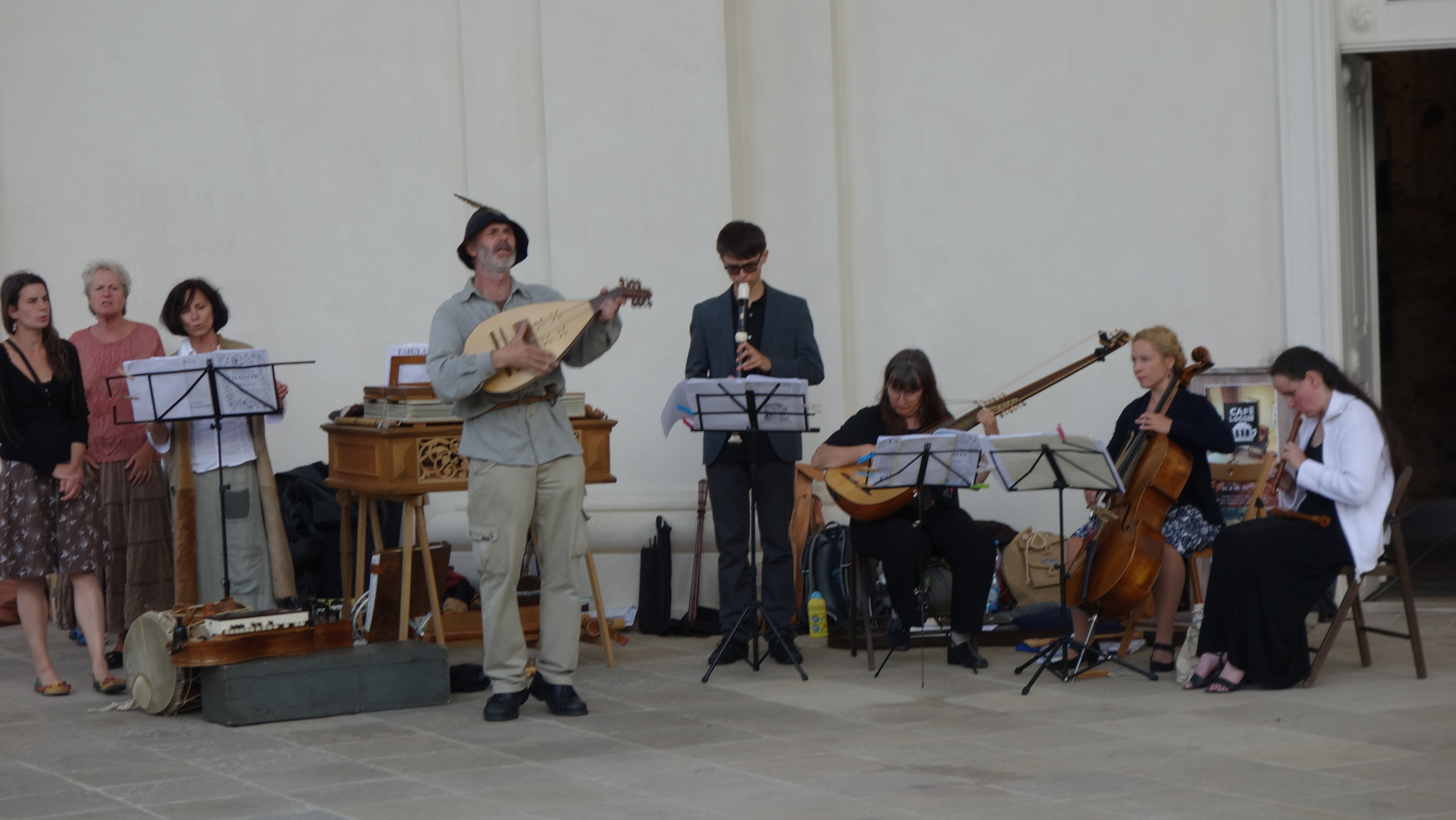
The trip here was uneventful, and I was actually tired enough to get about three hours of fitful on-and-off sleep on the plane. Meredith, of course, just graded the whole flight. We got to our Air BnB in the middle-of-everything London (just a few blocks from Parliament and Trafalgar Square) around noon, but we could not check in before 3:00. We were able to drop our bags, and we headed back out, walking up to Covent Garden to the enclosed market there. While we were scoping out eating options, we were offered a free tasting of hot chocolate (which made my day) and got to listen to a lively string sextet (including a cellist who held her cello neck between her shoulder and neck). That was delightful. We then split up, as Meredith and I wanted to go get a picture of Meredith in front of St. Paul’s church (not cathedral), where My Fair Lady/Pygmalion is set, and then we planned on going on to Chinatown for lunch. The others wanted to stay in the area and do some shopping and sightseeing.

When we got to the church (a walk of about three hundred feet), there was a street entertainer there balancing on a round can and leading up to juggling knives. We stayed to watch, especially since he was right in front of the church. He was fun to watch and had good crowd engagement. We then got the picture of Meredith and walked up to Chinatown, which brought us through really lively and busy streets. It was a nice day, and Londoners seemed to be enjoying it. Unfortunately, the restaurant for which we were aiming was small, with only about a dozen tables, and all of them were full. We ended up going to the French bakery chain Paul, which was fine for our jet-lagged bodies.

Mer then walked us over to the bridge in front of Parliament, and we walked the area following a recommended walk from Mer’s Rick Steves guide book. We only got about halfway through it before seeing it was time to check in at the apartment, so we headed back. We bumped into the other three coming from the apartment, and they said the cleaners needed thirty more minutes. That was unfortunate, but we went to a park and ate some cookies that Meredith N. (“Neuf”) offered us. The others walked to the Thames while we ate, and then I wanted to see the pedestrian bridge across the river that followed the train line into Charing Cross train station. We ran into the others there. By then, we were able to head back and get into the apartment for a nap.

Or so I thought. Neuf and Shelby went back out for an English tea back at Covent Garden. They said it was wonderful. Meredith and I and Brianna all enjoyed a two-hour nap, and then I felt better after a shower.

The evening was mellow – we finished the Parliament-area walk and had supper in a pub along the way. The walk ended in Trafalgar Square, and while we were looking in our guidebook, our very nice British man introduced himself, ending our evening with kindness and gelato.

I’m looking forward to a good night’s sleep to see if I can continue to feel better, but even if I feel a little worse, I would be sick in London, and that would still be something for which to be grateful.


2018 – Amsterdam (and Giethoorn, Zaanse Schans, and Volendam) – Day 7 – Friday

Meredith relies heavily on the Rick Steves brand of travel books to plan these vacations. I like using the internet, which allows me to occasionally go “OR,” or Off-Rick. One of the places I found in my searches that looked lovely was Giethoorn, a small village carved out of a peat swamp where the traditional center of the town remains largely unchanged – no motor traffic (other than five-mph boats on the many canals), and the center is now a protected World Heritage site. I really wanted to see it.

This created a problem; to get there by public transportation takes at least two hours each way, which is a long time for a day trip. It is around ninety minutes by car, which is about as far as I am willing to go for a single site in a day. So the obvious thing to do was to hire a local guide. I could have rented a car more cheaply, or even gotten an Uber for less money, but Mer and I have always enjoyed the guides we have hired on past trips. They are guides for a reason – they know things about the sites that are otherwise hard to pick up, or they know places not on the beaten paths, and they take care of the driving.

Enter Cherry, of Cherry’s Travel. Cherry is originally from Hong Kong, but has lived in the Netherlands for twelve years. She has lived all over the world, and loves travel. She put together a private tour for us, with her and a driver, on only about sixteen hours’ notice. I did not book things until Thursday, as I was keeping an eye on the weather, which was cool but sunny today. Cherry agreed to take us to Giethoorn, then to the all-in-one-all-things-Dutch village/site of Zaanse Schans, and finish off at the sort-of seaside town of Volendam. She said it would be a long day, but it would get us a Dutch highlights tour all in one day.

We got to Giethoorn around 10:30, and booked a canal boat tour for 11:30. We used the time in between to wander the village. The town has a public walking path because most of the houses are on small islands, and the paths and bridges to them are private. The path takes you past boat companies and restaurants, and to the church, where you can walk north or south. We went south, admiring the thatched-roof houses and the many many many bridges across the many many many canals – the town has over 150 bridges for just 2,600 residents. The canals, and the large lake next to the town, were all created by farming peat for fuel. As the peat was shallow, all the waterways (including the lake) are only about three feet deep.

Traveling off-season has challenges – not everything is open, and it can be cold (it was a high of forty-four today), but it has advantages too. We had the town largely to ourselves. While we saw five or six tourists on small boats in the canals, I do not remember seeing any obvious tourists on our walk, which was very peaceful and beautiful. When we got back for our boat tour, it ended up being a private tour – four of us and the pilot in a boat that can hold fifty people. It probably was not good for the boat company, but it was good for us. Other boats we saw while we were there had more people in them, but we had our own.

After the boat tour, which also went out on the lake, we grabbed a quick lunch, and then walked the northern part of the town. Again, we had it largely to ourselves, although we did run into a group of eight or so twenty-ish-year-old guys going into a restaurant, but I could not tell if they were tourists or locals. Giethoorn was a hit with us, and I would happily go back when it was warmer so I could spend more time wandering the town or renting an electric boat to take out on the lake.

Going to and coming from Giethoorn took us through a huge area of reclaimed land – the Dutch are really good at building dikes, and turned their Zuiderzee (South Sea) into a large freshwater lake by building a twenty-two-mile dike across the mouth to the Atlantic. Then they built more dikes to reclaim dry land from some of the lake. The land now sits below the lake level, as does much of the country – two thirds of the Netherlands is below sea level. Driving along and seeing the water within just a couple of feet of the top of the dike with towns below that level on the other side is eye-opening. Mer put it well when she said that the Netherlands looked to be one good rain away from flooding.

We drove back around Amsterdam and went north of the city, to the tourist-focused site/town of Zaanse Schans. It is a tourist trap, with five relocated and working windmills, a clog-making shop, a cheese-making shop, and a cute village where no one lives (they are shops), but the tourist area is surrounded by cute homes where people really do live, so the whole area is open to people to wander around in, and most stores give demonstrations for free so that they get potential customers into the store.

We got to see the five windmills, although not so closely as I would normally like, as we were a little pressed for time. We got to see an excellent clog-making demonstration by a man with flawless English, who then did the entire demonstration in Chinese for the group after us. It used to take two or three hours to carve a wooden shoe, whereas the “new” (eighty-year-old) machines he demonstrated could make a shoe in five minutes. Why wooden shoes? They last a long time and are waterproof, which is important in a country where water is everywhere.

We went on to a just-us cheese-making demonstration given by a cheerful young woman. She explained that their young cheese was about a month old, and old cheese was aged one or even two years. We wandered the shop and then out into the old village area, before getting in the car to go to Volendam.

I keep wanting to call Volendam a seaside town, but it technically is not one anymore. It was on the sea until the early twentieth century, when the sea dike was built. Now, Volendam is on a huge lake, but still looks like a seaside town. In fact, it reminded both Mer and me of Rockland, Maine, where Mer’s grandfather lived. In Voldendam, we walked along the cute street facing the lake and got a private demonstration of how to make stroopwafels, with Meredith assisting in the process. Stroopwafels are a Dutch dessert for which very thin waffles are cut in half and filled with caramel, and then put back together. They are delicious. It turns out the fresh, warm versions are drool-worthy. Mer and I picked up chocolate-covered stroopwafels and ate them looking out at the lake.

We finished walking the main street and then hustled back to the car to get out of the gusting wind, which was now very cold with the sun’s going down. We rode back into town, getting home about 5:30.

I thought that was to be the end of the touring day. Since we had eaten late, we headed out around 7:00 to get light fare from a local supermarket. However, when we were halfway to the market, my eye was caught by a woman playing a piano in a restaurant, so we crossed the street to look at the menu. It turned out to be an Argentinian eatery, so it was mostly grilled meats. We decided were were all okay with that, and we went in for what turned out to be our favorite meal of the week. If you are ever in Amsterdam, check out La Casona near the Prinsengracht canal. Our meal was a fitting celebratory end to an excellent week in Amsterdam and environs.

I loved this trip. The city is beautiful, with the old buildings and all the canals. The museums are top-notch. Getting lost is easy, but you don’t really mind in a city like this. The people with whom we interacted were all friendly, and many were outright charming. We squeezed in a visit to a castle and a canal-rich village. We saw heroic World War II sites and got to The Hague, remarkable for at least having an article in its name.

Lord willing, we’ll be back. When it is warmer. These Thanksgiving trips, if they continue, need to look south.

2018 – Amsterdam (and Vleuten) – Day 6 – Thursday

Dubbs was in charge today, and decided to let all of us sleep in, even if she woke up at her usual 3:00 am. Mer and I were allowed to lounge in until 9:00. Dubbs had one touring goal – to get to the Christmas fair being held at the De Haar Castle in Vleuten, near Utrecht.

That sounds like a modest goal, but it involved some planning. We walked to a nearby Metro stop, took it to the Amstel station (our third major Amsterdam train station this trip!), took a train to the Utrecht station, took a train to the Vleuten train station, and then finally got on a shuttle bus to take us to the castle. What could go wrong? Well, you could get on an express from Utrecht to Gouda, zipping right by Vleuten, which would probably require a return trip back to Utrecht before catching the right train. And you probably could get stuck on the station side of a Metro exit barrier because your card time had expired, with no way to buy another ticket, which might make you dash through the gates after someone else had gone through. That possibly could go wrong.

But we did make it to the De Haar Castle around 1:00 in the afternoon, where we bought our admission into the two-hundred-plus-booth Christmas fair on the grounds of the beautiful castle that the De Haar family refurbished in the late 1800s as a summer home and entertaining center. They rubbed elbows with the rich and famous of the twentieth century, including Gregory Peck and Brigitte Bardot. The castle is beautiful, surrounded by moats and canals and gardens and walls. The structure is made of red brick, and was designed by the same architect who did the Rijksmuseum and Amsterdam’s central train station. The woodwork of the main hall ceiling is stunning, and the walls are filled with stained glass. It is an elegant home, even if it was only used for about a month per year.

We paid to tour the castle, and paid the slight extra to tour the servants’ hallways and quarters, so we have now done the “nooks and crannies” tour of the De Haar Castle, but still have not managed it at Stan Hywet in Akron. It was interesting to see how there were hidden corridors for the staff to use so as to stay out of sight of the guests. We also read that it was not unusual for staff to work seventeen-hour days, but that the De Haar family treated their help well, providing clean and modern rooms for them to live in, and the information we read said the staff often remained loyal to the family their whole lives.

The tour was fun, with the only downside being that it was given in Dutch. We had English cards telling us what we were seeing, but it sounded as if our guide, an older man, was quite funny. It was the first time this whole week that we were surrounded by Dutch who spoke little or no English.

The fair itself was good – the number of booths was dizzying. I’m not sure we actually saw them all. We stopped in at the “Moulin Rouge” tent to hear some live music (two Dutch women singing Carpenters songs in English), before finding a good food tent. Dubbs shopped for a few gifts, including a new scarf for herself, and that was the afternoon. We left the fair around 5:30, when it was mostly dark, so we got to see all the Christmas lights come on around the tents of the fair.

We got back home around 6:15 and headed out to supper a little after 7:00. It was in a very cute pedestrian-(and bike, of course)-only area. After having Italian food in Lisbon last Thanksgiving, we decided on Mexican in Amsterdam this year. After supper and dessert, we walked a mile or so back home, admiring the canals and looking into the upper windows of lovely Amsterdam homes. So starts our Christmas season. Here is hoping Santa brings us some unexpired Metro cards.

2018 Amsterdam (and The Hague) – Day 5 – Wednesday

Sadly for blogging purposes, there were no thong-wearing or shirtless men seen on the breakfast run today, but as I was waiting for my bagels, a super-handsome man came in, with dark, curly hair, a dark long coat, and a dark scarf. Dubbs said she will be getting the bagels from now on.

Dubbs was in charge of things today, so that meant three things – museums, museums, and museums. She loves art. So off we went back to the Rijksmuseum, since we had only seen a very small part of it. We got there just after the museum opened at 9:00, and we had each room almost to ourselves (even the one containing The Night Watch). It only started filling up, largely with school children, at 9:45 or 10:00. Dubbs wanted to see the nineteenth-century paintings and then see all the Rembrandts in the museum. Sadly, a painting she really wanted to see, The Milkmaid, is on loan to a museum in  Tokyo currently. It took me much longer than it should have to realize that the Dutch national art museum would be almost all Dutch artists. Ooops. I tended to like the unusually lit paintings (sunsets, cloudy days, moonlit scenes), especially if they had water in them. Mer liked the ones with bare trees.

We spent about two hours in the Rijksmuseum and then took the Metro to Amsterdam’s southern train station, where we caught a train to The Hague, about fifty minutes away. When we did get there, we discovered that the train station was surrounded by “buildings of the future”-feeling buildings, with curved surfaces and shining metal, and some really seemed to be made of plastic. They all made getting out of the train station confusing, but we finally found our way out.

We grabbed lunch in a small shopping street, and then made our way to the main square near the parliament building, which was next to the beautiful Mauritshuis Museum. The museum was in a former mansion, so it was a living space. What that means was that the art hung in large, but human-sized, rooms, which made it much more intimate. There were only about fifteen paintings or even fewer hanging in each room, and there were only sixteen rooms on two floors. Seeing this museum was really easy, and the views out many of the windows were across a pond into a park ringed with cute buildings. This was definitely one of my favorite museum buildings.

Since the Dutch Golden Age (the seventeenth century) produced lots of wealthy people, Dutch painting has a lot of portraits – the rich liked getting their own picture painted. As such, there were a lot of portraits in the museum, but the most famous one, The Girl with the Pearl Earring, is a tronie – a made-up portrait. She never really existed, but she is plastered on everything in gift shops around Amsterdam (and certainly in the museum in The Hague).

One of the things that caught my eye was the flexibility Rembrandt displayed – he could create paintings of great detail, and then he could paint ones where the backgrounds were just suggested shapes, or the subject was painted with broad stokes and blurry lines. Some of his paintings seemed to me to anticipate the Impressionist movement about two hundred years before it actually happened.

We saw the entire museum, including a special exhibit on Dutch paintings found in great English houses (the English really liked Dutch paintings), in under two hours. We walked back to the train station and got back home around 6:30. I was not feeling totally well, probably as the result of caffeine from drinking too many Cokes over the last few days, so Mer and Dubbs went off to dinner without me, and took advantage of my picky absence by going to a Thai restaurant. When I was feeling a little better, I went to a supermarket and got salted nuts and fruit juices.


So it was not the best end of the day, but the day itself was quite fun. I wonder what Bagel Boy will turn up tomorrow morning?


2018 Amsterdam (and Haarlem) – Day 4 – Tuesday

I made a bagel run again this morning, and although I was not passed by any thong-wearing rollerbladers, I did get to see a really buff shirtless man standing in front of his huge window on the third floor. Dubbs has volunteered to get breakfast from now on.

This was another day when Mer was in charge, and we started off fairly early so we could get to the museum campus and the Van Gogh Museum at 9:00, for when our reservations were. There was a thirty-minute window, so our getting there at 9:30 was no issue. We decided to pick up an audioguide that walked us through the highlights of the collection, which took about an hour and a half, which was a perfect amount of time for us today.

The Van Gogh Museum was roughly organized chronologically, although they sometimes had grouped items (like self-portraits) for easier comparison. They’d also dedicated parts of each of the three floors to works by other artists who inspired Van Gogh. It was very useful to see, especially with the help of the audioguide, how Van Gogh’s style developed over time. Van Gogh tried to capture the emotion of a person or scene, and he did this by experimenting more and more with brush textures and using more and more bright colors. He also started using basic colors next to each other, instead of mixing the colors on his paint palette, which forces the viewer to mix the colors with the eye, creating color that is not really there.

Since the museum has hundreds of letters that Van Gogh wrote, it interwove his history with the history of his paintings, from working in his hometown, to moving to Paris and then to the south of France, to admitting himself into a mental hospital, to finally moving back north to be near his brother, before Van Gogh shot himself in the chest and died two days later. His brother, then his brother’s wife, and finally his nephew worked very hard to make sure that Van Gogh’s work became known, with the nephew’s being instrumental in getting the current museum to be founded and opened.

We all found it interesting and moving. The only downside was, even in off-season on a random Tuesday, the museum was fairly crowded, making viewing some of the paintings difficult.

We left the museum and actually took the fairly new Metro line to the train station, where we caught the train to the town of Haarlem, about twenty minutes away. Mer wanted to visit the house of Corrie Ten Boom, who, with her family, hid Jews during World War II, and later preached forgiveness and love through Jesus around the world. The museum really was her home, so the museum can only take twenty people at at time, in a first-come, first-served line outside the home. We got there two hours before the next English tour, and Mer was debating about if we should wait in line. Happily, since we were hungry and very, very cold in the wind and high-30s weather, she chose to risk the off-season line, and we went and ate.

When we got back from lunch, we still had forty minutes to wait, and there was no one in line. We queued up, and by the time we got admitted, it was still just the three of us (although a Canadian couple joined us thirty minutes into the one-hour tour). Our guide was a volunteer who had recently moved with her husband from South Africa. He was hired as a hockey coach, and she was asked at her new church to help out with the tours, and as she had been on the tour once before, she was eager to help out. She was very kind, and it was nice to have such a small group so we could interact with her.

I knew nothing of Corrie when I went in. She and her sister, both in their fifties, along with her father (in his eighties), were deeply devout Christians who had a long history of praying for the people of Israel. So when the Nazis started rounding up Jews, they wanted to help Jews escape the Netherlands. They would open their door to anyone who asked, and helped over eight hundred Jews escape. They had a false closet built at the back of Corrie’s room, accessed by a small sliding door. The entire structure was built of brick so that it would not sound hollow, and could hold up to eight people standing back-to-front, crammed in together.

One day, a man stopped by to ask for money to help his wife get out of jail; he said she had been helping Jews. Corrie told him to come back in the evening, and when her sister went to answer the door in the evening, she heard a car, which tipped her off that the Gestapo was coming (no one else had cars). She hit a hidden buzzer, and four Jews and two resistance fighters fled into the closet. The Germans raided the home, but could not find the hiding place, and so decided to wait out the Jews, waiting about two days while the people in hiding suffered with no light, food, water, or heat in February. The Germans got bored and turned the guarding over to the local police, and as there was one policeman who was sympathetic to the smuggling group, he got the Jews and two other men out and away.

Meanwhile, Corrie and her sister and father were arrested on charges of having too many ration cards. The Nazis offered to let the father go, since he was old, on the condition that he would stop helping Jews, but he refused. He was sent off to a prison camp, where he died ten days later.

The sisters were moved from a jail to a concentration camp north of Berlin once the Allies started closing in. Corrie’s sister remained positive and kept reminding Corrie to forgive. The sister died in the camp, but had two very specific visions of houses where centers of healing would be set up, and one was at the camp in which she died. Both visions were realized after the war, to the point where the owner of the one home was shocked as Corrie described it in minute detail, even though she had never seen it. Corrie went on to tour the world, preaching forgiveness, even to the point of writing to forgive the man who turned her family in. She kept touring most of her life, into her early eighties.

I was amazed at the story. Corrie and her family were giants of the Christian faith, and I had known nothing of them. I was grateful to tour the home.

Afterwards, we went to the town square to tour the cathedral of St. Bavo. It houses a five-thousand-pipe organ, and we were lucky enough to be in the church when someone was practicing for a concert. The acoustics were amazing, even to one of Mer’s little “meeps” sounding during a quiet spell. The cathedral is simple, but impressive, with an intricate wooden ceiling and a very modern stained glass window that was installed in 2015. The floor of the church is all tomb covers, and they are all worn away from foot traffic so that no names are visible anymore.

From church, we swung by a chocolate cafe to get warm (it really was bitterly cold) and then took the train back to Amsterdam. We grabbed a canal tour boat for a one-hour tour of the canals, captained by a funny man who was a skillful sailor, getting the boat into canals not designed for a boat so large. It was pretty to see Amsterdam lit up from the viewpoint of the canals – the houseboats and the canal-facing homes were all very pretty.

We started walking home, but got very cold and jumped into a restaurant to eat and get warm. Then Dubbs, who thinks of these phone-related things, summoned an Uber driver to get us within a few blocks of home, saving us from a cold walk.

It was a long day, and the weather was not always kind, but we saw a lot of worthwhile places today.

2018 Amsterdam – Day 3 – Monday

Amsterdam’s city symbol is three side-ways crossed, which look like the letter “X”. I was amusing myself with laughing about Amsterdam being “XXX,” or triple-X. Then it occurred to me that this might actually be where the term “triple-X” comes from – that Amsterdam has long been known for, shall we say, looser morals, and that this may have worked its way into English. This theory pleases me so much that I have not bothered to do the seventeen seconds of web research I would need to verify it. I like my idea even if it is not true.

Today was “my” day, and I wanted to take a bit of a touristic risk. We all like seeing cities, and we all like games, so I thought we were a perfect match for City Challenge – Amsterdam, an iPad-based game in which you run around the city solving puzzles and racking up points in an attempt to get the highest score for the month. It is not a timed game (for the most part), so it lets you have time for picture stops and lunch and such. It has a four-hour option of the game that takes you through most of the old center of the city, so if we finished it, we would have a good overview of the city (which is not the same thing as being able to navigate a city based on circular canals).

So we picked up our iPad around 11:00 after a pleasant thirty-minute walk from our house to the main shopping area near the train station, on the northern end of the city center. We started the mission just south of the station, which meant we would end the day back at the station.

The iPad games broke into a few categories. There were many stops where we had to answer multiple choice questions about Amsterdam; generally, we were taking wild guesses at these (we did not allow ourselves to use an iPhone for the answers). There were several stops where you had to look at a picture of the famous building in front of you and spot the differences between the real building and the edited picture. And then there were multiple major challenges, which were the most involved, but worth the most points.

These were generally fun. We had one for which we had to help friends find their lost friend before their flight left, based on the photos he had posted online. We had to run through the shopping district collecting letters from signs to spell a word out (the only game we failed at because the instructions were not clear to us how the counting of the signs was to be done). My favorite game had us solving which one of the men in the statue version of Rembrandt’s The Night Watch had killed the captain; we had to run around the area and collect four hints from virtual eyewitnesses while being chased by virtual henchmen. We had to match photos of parts of houses along three blocks to help the police find drug houses. We had to collect clues on how to defuse a bomb near the museums (I had to keep telling Dubbs not to say “bomb” so much around crowds and police). We had to help two lovers find each other in the Vondelpark. We had to help reboot the computer system at the train station based on timetables for trains. It was a blast.

And we actually learned some things about the city. We did not know that fifteen thousand bikes are dredged from the canals each year. We missed that the main shopping street was also the most expensive, with rents of three thousand euros per square meter.  (We thought it was a different shopping area with Armani and such that we had seen on Sunday). There are a little over a hundred kilometers (sixty miles) of canals in the city. The “Old Church” is the oldest building in the city, and the “New Church” burned down three times.

We saw most of the city, skipping the northwestern and the southeastern areas. While I had no desire to see the famous Red Light District, I knew there was a chance the game might take us into it, but I figured the “working girls” would not be working at 11:00 am on a Monday. I was wrong. I was looking at my iPad map when I caught, out of the corner of my eye, a curvaceous mannequin displaying lingerie. As I turned to make a snide comment to Meredith about her needing new clothing, the mannequin suddenly moved. I became very interested in my iPad, and our two-block tour of the District was quickly over.

The rest of the areas were quite lovely – the shopping district, in all of its holiday decor; lots of canals and lovely houses; the museum campuses; and the pleasant Vondelpark, where two nice ladies offered to help us when we were looking confusedly at the iPad. We explained we were playing a game and thanked them. I love the people here – they are incredibly nice.

We finished the “four hour” game in about six-and-a-half hours. We racked up over 45,000 points, but we will not get our official score and ranking via e-mail for about a day. The rankings hold the best scores for the last thirty days, and it looks as if we will fall into second place. Drat that letter-gathering game!

We had supper pretty much to ourselves in a restaurant next to the gaming place. It was great – two funny men running the restaurant, good food, and eighties pop music playing on the radio. We grabbed some dessert nearby and walked home. And walked. And walked. We ended up finding some new and pretty spots, but had to keep consulting the map and iPhone to get home.

So, between the game and the scenic stroll home, we set a new (for us) vacation walking record – 16 miles, or 31,000 steps. None of us was sad to get home, even if it was only 7:30. I think we will all sleep well tonight.


2018 Amsterdam – Day 2 – Sunday

One of the reasons to travel is to see things you either can’t see or would rarely see at home. To wit, I ventured out to get us all breakfast this morning while Mer and Dubbs got ready. Normally, even in the metropolis of Cuyahoga Falls, I do not walk out the front door and get greeted by a canal. Add in mostly deserted streets (on a Sunday morning) and charming buildings and a beautiful day, and you have the makings of an astonishingly great walk. I saw some very cute children in life jackets getting bundled onto canal boats. All very European Normal Rockwell.

That is when I was passed by the rollerblading man. Since he came at me from behind (ha!), I did not get to see him from the front, but the backside was certainly in view. The man was wearing a hat, a coat, and a blue thong, and rollerblading. In thirty-six-degree weather. Even in relaxed Amsterdam, he was catching odd looks from the few people out and about.

Since many places are closed on a Sunday, I took a circuitous route to a bagel place we had seen on Saturday, to see if there was anywhere else open.  Along the way, I passed the Bag and Purse Museum, which I had not known existed. Then, I passed the Waldorf Astoria Hotel, which was tastefully guarded by a large man in an impeccable suit, who I am sure would have politely refused me entrance.

I finally got to the bagel store, where I learned several things: food is expensive in Amsterdam, with bagels running over four dollars each; Europeans spread butter and jams using spoons instead of knives; nude men on magazine covers is considered good possible breakfast reading material. A man at a table was talking about how smells are all frequencies, and went on to expound how all of life is frequencies.

The walk home was uneventful. This was just getting breakfast, mind you.

Mer was in charge today, and she wanted to go to church, so we went to church. We may have had one or two or a dozen photo stops along the way. We still made it on time, to an English-speaking service of a Vineyard Church, housed in an old church that had been updated with sound and other A/V equipment, as well as an extensive coffee bar. The people seemed very kind, and it was a good service. We opened with the hymn “Great Is Thy Faithfulness” sung in Dutch, but projected with English lyrics, and then the rest of the songs were all in English with Dutch lyrics projected. The sermon was all in Dutch, but we were provided with headsets to listen to a live English translation, which is always an impressive trick to me. The sermon was on the importance of giving – being willing to give up time and money to serve God, and how God is faithful even when you give. He used a few examples, but one that stuck out was of a friend who was a doctor who gave up what could have been a lucrative practice in the Netherlands to go practice medicine in rural China instead. The doctor is retired and has little money now, but is full of life and joy; he gave away himself and does not regret it at all.

After church, we strolled over to the Rijksmuseum, which is the national museum of the Netherlands. It is enormous. We got a museum pass card that we can use five times in any number of museums around the city, and we signed up for a “highlights tour” for 3:00. That gave us time to eat lunch in the cafe before joining the tour, which was only five of us joining a charming guide who took us on an hour tour of some of her favorite works, which included talking about the building.

The Rijksmuseum was built in the late 1800s as part of a nationalist movement in the newly-created Netherlands, so the building was designed to be a museum. The architect had experience in building cathedrals, and so many aspects of the museum resemble large church buildings, from stained glass to large entrance halls, to Rembrandt’s The Night Watch being in a place where an altar normally would be. In fact, the place was so much like a Catholic church that the Protestant king refused to dedicate the building and never set foot in it.

Our guide, Anne, showed us several paintings. One was a beach scene that seemed happy, but she asked us to look more closely and explained more about it, and it was of fisherman’s children who were “Children of the Sea” (the name of the piece), so it was not so cheerful as it may have looked at first. She showed us a painting of a street scene influenced by photography, with the rooflines of the buildings cut off. The central figure was of a woman who originally was a maid, but the painting did not sell, and the artist heeded the advice of some friends and repainted her as a fur-wearing rich woman. The painting then sold.

We went upstairs to the seventeenth-century room, where we saw a painting of a family party that was out of hand, with even the children smoking and drinking; it had a moral of (more or less) “as the parents do, so will the children.” It seems paintings like that sold very well. We saw an extraordinary still life, and while I am not fond of still life paintings, this one was almost photorealistic. The artist really was showing off, and for good reason.

We finished out tour with Rembrandt – his The Jewish Bride painting from late in his career, with a husband and wife holding hands, but I thought they looked slightly sad. Of course, we finished with the huge and magnificent The Night Watch, which was revolutionary for the time, with Rembrandt’s capturing motion and action instead of stiff poses. We were told the painting was cut back at one point because it did not fit where people wanted to hang it. No one knows where the lost portions went, but the museum has a painted miniature copy of the full canvas, so at least we know what it was supposed to look like.

That was a grand way to spend an hour, and I like art much better when someone helps me understand the history or symbolism of a painting. We will almost certainly be going back to the Rijksmuseum later in the week, but today we had a 5:00 reservation to see the Anne Frank Museum, which was about a thirty-minute walk away.

You need to have a reservation for the museum, which Meredith booked two months ago, because it is so small. The museum is mostly made up of the building where the Franks and four other people hid for two years before being discovered by the Nazis. That was the most striking thing for me – to see how small the rooms were where the people all had to live together for such a long time. Anne Frank wrote a diary during her time in hiding, and after the war it was published by her father, who was the only person of the eight to survive the concentration camps to which they were all sent.

The presentation of the museum was excellent. We had audio guides that were room-activated, and so would tell us the history of the Frank family and the people who helped them hide. The actual rooms where the Franks and the others lived had no audio guide descriptions, probably to keep people moving through the small spaces. They still had the marks in the wall that recorded Anne’s and her sister’s heights, and still had Anne’s decorations pasted to the walls of her room. It was a moving experience, and very worthwhile.

We had supper at a nearby pancake place, with the Dutch pancake somewhere between the American version and a French crepe. We took a slow and casual walk back home, enjoying the amazing interiors of the houses that we could see through the large windows, and we loved the various lights playing off the water of the canals.

So, whether it is looking for bagels or getting pancakes, travel always gives you food for thought.

Amsterdam 2018 – Day 1 – Saturday

Little delays can add up; our plane was delayed in loading cargo, and so we sat on the plane for thirty minutes or more before finally taking off an hour late. Then, at the Amsterdam airport, it was a bit of a hike to passport control, where there was a huge crowd of people being held out of the entrance area for reasons we could not tell. Happily, Dubbs saw a sign for another entrance to passport control, which was another fair hike. It was open, which was great. What was less great was that they only had one person working the desk for non-EU passports, and so it took a little over an hour to clear the passport counter. The good news from that wait was that our luggage was waiting for us, so that was efficient.

The delays made us all decide that getting a ride from an Uber driver was worth it, so after a ten-minute wait for the driver, we were shuttled to our AirBnB residence, which worked well. Our host, Andy, was super friendly and gave us lots of information about Amsterdam. I think the information will be useful, but it did take thirty minutes to communicate when all we could think about was bed. So, after a very, very long twenty-eight-hour day, we finally got to go to sleep for a couple of hours. If given a choice, I will avoid ever doing that long a day again when traveling – it is too hard to function in a new environment on so little sleep.

The world was both literally and figuratively sunny when we woke up mid-afternoon. It is a northern city in November, and so will still be cold (in the low 40s), but the sun helps a lot. After a couple of quick showers, we spilled out into the old city center of Amsterdam.

Not surprisingly, it is stunningly cute. There are canals everywhere, and all of the streets are lined with three- or four-story houses with colorful facades and fancy roof lines. The Dutch seem very fond of large windows, so we could see inside many houses and apartments, and it seems the Dutch love books; despite limitations on space, many houses had a room for a library.

Mer was in charge of the afternoon, and so she led us south to the museum district. It was a beautiful walk. The canals make the neighborhoods scenic and slow down motor traffic, although the Dutch seem to have the low-country love affair with the bicycle, so we learned very quickly to check to make sure we were not accidentally in the bike lane. We have an informal bet about who is going to get knocked down by a biker first.

A close-second bet is who is going to fall down the stairs first. Because so many of the buildings are so narrow, but still fairly tall, we’re guessing the old buildings in Amsterdam must have at one time been taxed on square footage of the ground floor. Our apartment is no different – we are on the third floor, and both sets of stairs are the steepest stairs I have ever seen, and for good measure wrap around at the top of the flight, just to make the steep stairs harder.

The museum area of Amsterdam is beautiful – multiple open spaces with dramatic buildings scattered throughout. The park was in use and was lit with tons of lights, and skaters were already skating on a rink. At the same time, a trio of people were tossing a Frisbee around, which is not something you usually see with ice skaters nearby.

We went into a museum to buy a Museumkaart, which gives you unlimited access to Amsterdam’s museums. Or, more accurately, it did. Now, you get five visits on the card, and have the option to register it to get the full version, which gets mailed to you. This is not the best option for tourists here for just one week. So Mer scrapped her plan of visiting the modern art museum for an hour, and we went to find supper.

Here too, we hit a bit of a snag. The first place we went was a small pub, and was packed out. Europeans eat later than Americans do, and it was only around 5:30, but that did not stop people from being social over a coffee or beer. We moved on to another restaurant, where we had more success.

Mer had no firm plans for after supper except to see the city, so we wandered south a couple of blocks to a park, which was very pretty in the dark, except for the few places that were not well lit. Otherwise, the lights reflected off small canals, and it was lovely, except for the cold that descended after the sun went down.

We all brought warm winter clothing, but I still got cold on the hour or so walk back to the apartment. I must be out of practice. We walked in the general direction of our home, but felt free to be distracted by lights or anything that looked interesting (including a friendly tom cat). While the Christmas lights are not anywhere near so extensive as Lisbon’s promised to be last year at this time, Amsterdam has the distinct advantage of having the lights already turned on. It’s a bit of a coup, really.

We got back to the rooms fairly early for us, around 7:30. That is wise given the little sleep we have had, and Amsterdam promises to be fun to explore tomorrow.