Ireland 2022, Day 2, Monday – Bru na Boinne and Trim

Sometimes coming up short on time is a huge help. Today, we got launched from Navan around 8:45, which was fine. We had 10:15 admission tickets to Bru na Boinne, the home of the Newgrange and Knowth chamber tombs (as well as many other smaller tombs). I had calculated we had time to go see another ruined abbey, one that has two of the finest high crosses in all of Ireland. What I hadn’t remembered was that I had made all of my time calculations from the village of Slane and not Navan, which is an added difference of twenty minutes. When we actually got to Slane, I decided we had to skip going to the former monastery, and I reset our GPS to Newgrange.

Computers are funny things. When you tell a GPS to get you to Newgrange, it will do that. What it won’t tell you is that you can’t get in to see the tomb without a ticket from the visitors’ center, which is across the Boyne River. Happily, we can read signs, and made the discovery after only a couple of miles (and before we got all the way to the monument). I corrected the GPS by asking it to take us to the visitors’ center.

Computers are funny things. When you tell a GPS to take you to the visitors’ center, it will do that. What it won’t tell you is that the cow path of a road it wants to take you down will indeed be a slight shortcut to the center. We chose to follow the signs on the main road instead.

The Bru na Boinne (Newgrange) Center is a pretty great little museum. It has displays and videos explaining about the tombs and (a little) about the people who built them. You can go through the entire exhibit in about forty-five minutes, which is good, because that is all the time we had before our small bus left to take us to the sites. The quick lowdown on the tombs – there are three major passage tombs, but one is mostly unexcavated. The tombs are all about five thousand years old. The tour includes the two open ones, Knowth and Newgrange. We know little of how or why the people built the tombs, but some of the rock came from thirty miles away or more, and some of the stones weighed more than five tons. Knowth is a larger site, with the main tomb and several smaller tombs. You are allowed on the top of Knowth; since there has been a fort on top and a farm, I guess they figure it’s okay to let tourists on the boardwalks up top. Newgrange has the attraction of your actually being able to go inside the chamber.

We left the center and walked across a very pretty pedestrian bridge across the Boyne River. A short walk led us to the parking lot, and there we met our bus. It took us out to Knowth first, where we spent about forty-five minutes exploring the grounds, which included going to the top. The tomb is surrounded by heavy skirt stones, some of which are decorated with geometric designs. From the top of the mound, you can see in all directions, and signs at the top told you what you were looking at. I found a distant-looking Hill of Tara and a very close Hill of Slane. I was much more excited about seeing the Hill of Slane from the mound that I had any right to be. I never actually recognize things from signs posted on hills or tall buildings, so I kept pointing it out to Meredith. She is a patient wife.

The bus then took us to Newgrange, where we spent another forty-five minutes on site. Meredith and I got to go in the tomb with the first group (of two), a tour of twelve people. You have to stoop in places to continue, and a couple of places are quite narrow, but we ended up in a small chamber shaped like a cross. The three small rooms used to hold human remains of important people. There were many designs etched into the stone in this section. Newgrange is famous for being built such that the interior of the tomb chamber is lit by the sun for a few minutes on the winter solstice. Our guide demonstrated it using a light bulb, and even that was impressive. You can go on the solstice to see it actually happen, if the weather is good and if you win a lottery of ten or so tickets out of thirty thousand entries.

The outside of Newgrange is highly decorated with white and grey stones. The decoration is an interpretation from an archeologist who worked Newgrange in the 1970s. He found all the stones on the ground, decided they’d fallen from the outside of the tomb, and took an educated guess on how they might originally have been arranged. It created some controversy, but I like the effect myself. It looks more imposing and regal than just a mound of grass.

We headed back to the visitors’ center, where we ate a quick lunch (at 1:00). We were then off to the town of Trim. Trim got on my touring radar from having a fairly intact castle in it from around 1200, as well as having an interesting river walk. When my brother mentioned how much he liked Trim’s castle, it firmed up my determination to go see it.

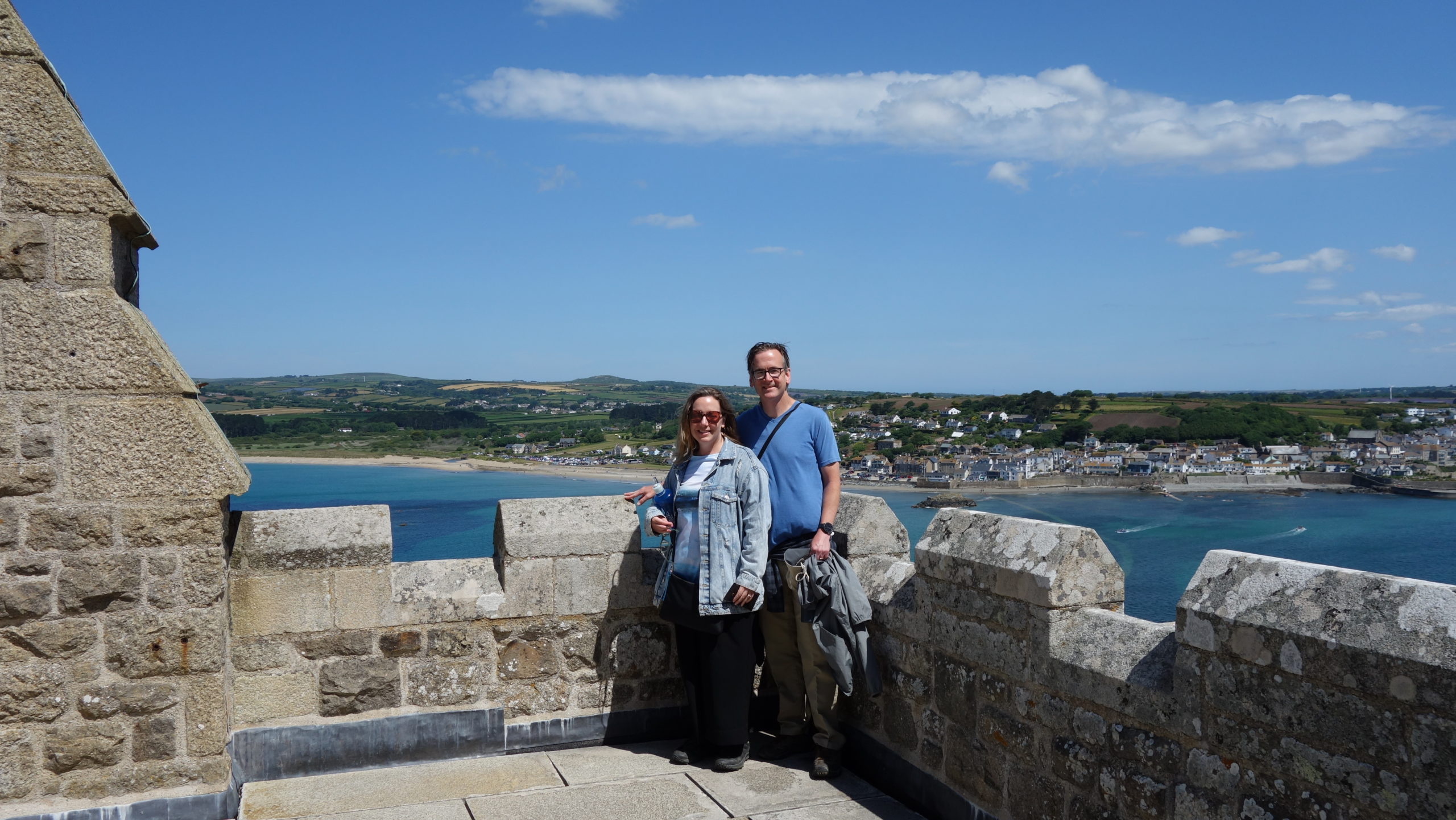
Trim’s castle was built by the Anglo-Normans as a power move, to firm up their rule of eastern Ireland. They started with a central keep/tower space, and eventually added outer walls and a moat. The grounds are free to tour, and a minimal fee gets you a forty-five minute tour of the interior, which included the roof. We did that, of course. The tour was interesting, and the views from the top were great on a sunny day like today. We both loved the tour.

We then followed a walking tour from Mer’s favorite guidebook writer, Rick Steves. We followed the Boyne River for a ways, until we got to the ruins of a large Gothic church (all after having met two older gentlemen who talked to us about considering becoming Catholic – it is Ireland, after all). The ruins of the church were impressive, but so was the old (and still in use) cemetery surrounding it – it had huge trees growing all over, and many Celtic crosses for tombstones. It was a pretty spot, for ruins and a graveyard. We weren’t done being ruined yet, though – we continued on a little bit to a ruined church/hospital complex from the thirteenth century. We returned the way we came, and fit in one more quick ruin – the tower of an abbey destroyed by Cromwell; the tower used to be seven stories tall. It is still impressive even standing in ruins.
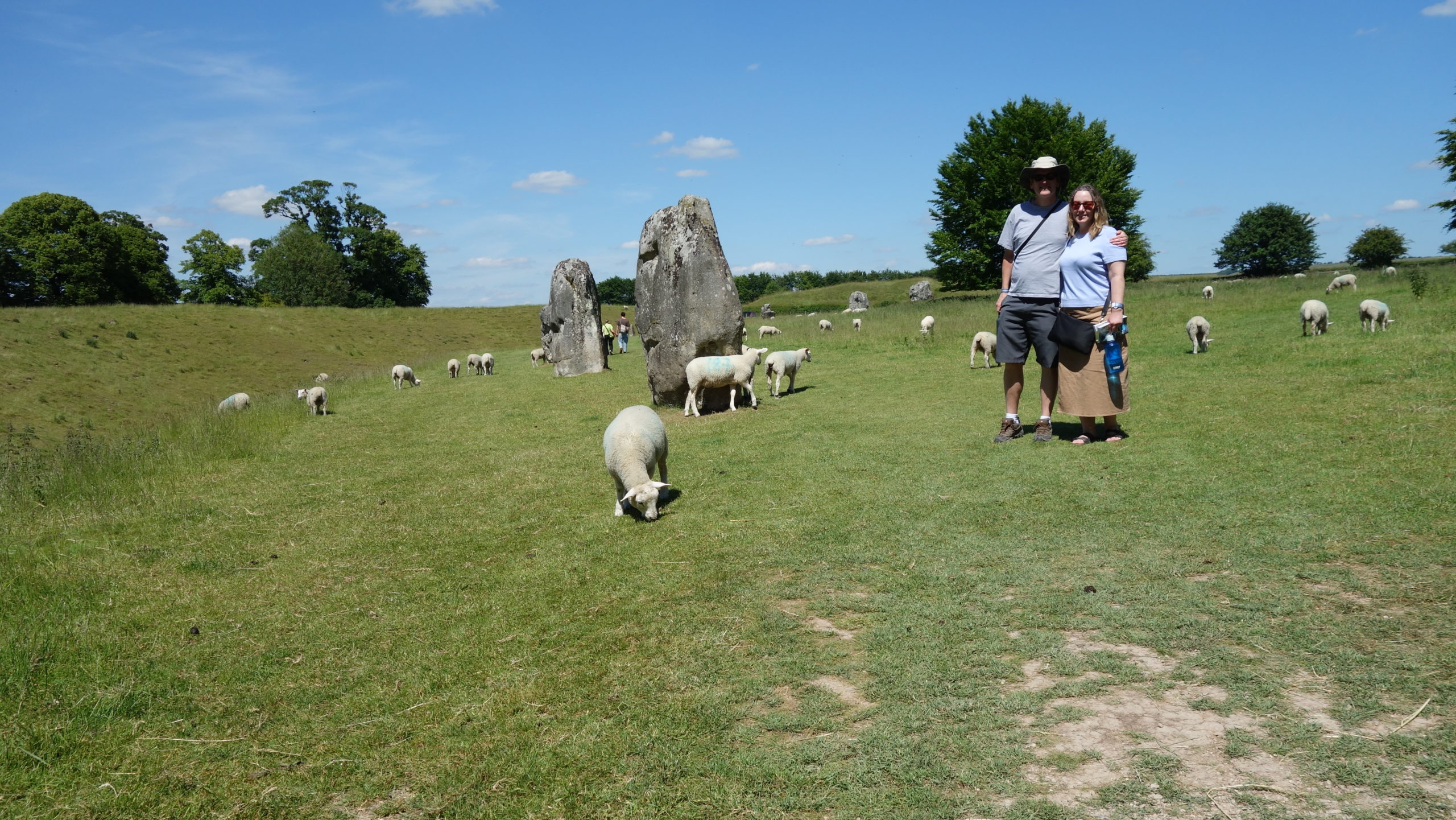
So, if you are keeping ruins count, we’re up to six ruined abbeys and one castle, in two days. We would have seen even more in this area, but sometimes time is short.

Ireland 2022, Day 1, Sunday – Navan Area

For weeks I had been trying to figure out what I wanted to do with Meredith over our spring break vacation. I kept looking at places to go in Europe, since Mer loves traveling. But I kept running into ever-changing and sometimes hard-to-understand Covid-related restrictions and requirements. Finally, about three weeks ago, Ireland announced it was dropping all Covid entry forms and tests. I booked our tickets the same day.

We flew out of Dulles (Washington) for the first time; driving six hours saved us about eight hundred dollars on airfare. It was a bit tense leaving Ohio when we hit a heavy snow squall that lasted about thirty minutes; I was afraid we were going to be driving at thirty miles per hour for a long time and so we would miss our flight. Happily, the snow stopped, and after an easy and uncrowded airport experience, we ended up at our gate almost three hours early. I’ve agreed that next time we can try leaving thirty or forty-five minutes later.

We arrived in Dublin this morning (Sunday), and we had our car and were off on our first day of touring by 7:00 am. That meant we had about five hours of touring to do before we could get into our B and B and get the three-hour nap that we do to try to break jetlag issues. We were fairly tired, but excited to be in Ireland.

Our first two stops were the Hill of Tara, a series of five-thousand-year-old mounds that were used for burials and other unknown uses. Later, Tara became the place where Irish kings were crowned. We stopped there twice because the visitors’ center didn’t open until 10:00, and we needed a restroom break. Off we went in search of a gas station, and then we returned.

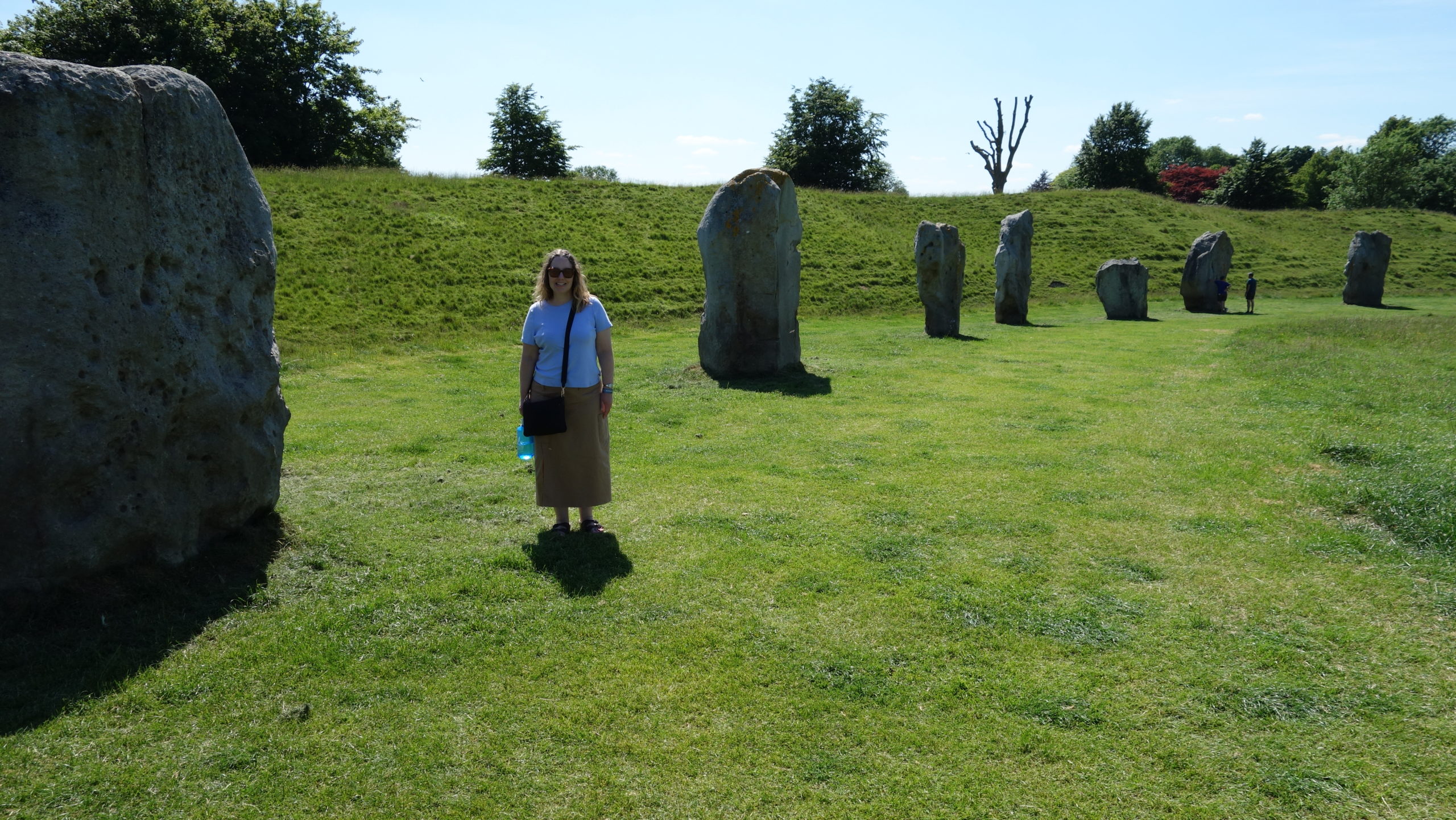
The Hill of Tara is a very broad hill. Meredith and I both had pictured some small but dramatic mound towering over the rest of the landscape. Not so much – it is a very large site. You can walk around and even on the mounds, but they are hard to appreciate fully from the ground since the scale of them is so large. Arial photos help (on info placards at the entrance), but what our guidebook said really helps is the visitors’ center and tours offered from there. Which was closed for two more hours. Still, we were glad to be able to picture the hill for when it comes up in literature or history.
We then drove on to the larger-than-expected town of Navan, where our B and B is located. I thought Navan would be a village, but it is a town of thirty thousand people. I drove out to north of the town down a very narrow road to go see Dunmoe, a ruined castle. What none of the websites at which I looked told me was that the castle is in the middle of a field, surrounded by barbed wire for livestock. I didn’t see an obvious way in, and there was nowhere to park, so I turned around. One minor tourism failure.

I drove back through town to whence we had come, to go down a wider back road full of Sunday bikers out riding. We pulled up to an actual parking lot for the Bective Abbey, which is a ruin of an abbey that was destroyed by Henry VIII. It overlooks the Boyne River and so is a very pretty place to wander about. After we were there for about thirty minutes, we walked down to the Boyne and the pleasing stone bridge that was built over it. A nice man gave us permission to walk right down to the river, and he told us that a Ben Affleck film had used the bridge in a movie a year or two ago.

Back in town, we pulled up to a street that seemed to be a little in disrepair (closed businesses and shuttered homes). I wanted to check out the Lighthouse Church, and the address was for this street. We found it, only to discover that it was the offices, and the church itself met elsewhere. But it wasn’t posted in the window of the office.

Enter new-to-me technology. For years we have traveled with friends who have smart phones and use them to aid in solving various things that pop up when traveling. I hate phones myself, but I caved enough for travel to get a Google Fi phone that I can deactivate when we aren’t on vacation. I used it in this case, and found that the church worshipped in a hotel a couple of miles away, and we had just enough time to get there.

It is a lively and active church. The announcements were full of listings of ministries and Bible studies (including one in Portuguese). The music was contemporary (and loud), but was well done and enthusiastic. The pastor preached on witnessing and how we all have unique (and therefore important) stories to tell. He used three women from the book of Acts as examples of ordinary  women whose stories are still being told – one woman provided (was generous), one prioritized God by risking meeting with believers, and one woman persevered even when things were hard. It was a satisfying service full of cute accents, and the people were very welcoming.
I then got to use my phone again. After my GPS seemed to show that our B and B was on the next road over from the church (but with no street address), I used my phone to verify that this was the case. And it was. What a blessing to two people who had been up for twenty-six hours! We drove over and were able to get into our room, where we slept for three hours and showered.

Feeling much more human, we drove to the village of Slane to eat at a restaurant attached to a hotel. The food was very good and quite welcome to our time-screwed-up bodies. But we could have gotten food in Navan – I took us to Slane because I wanted Mer to see the Hill of Slane, which has a small (ruined, of course) abbey at the top.

Tradition holds that Patrick of saint fame lit an Easter fire on the hill, thereby making a local king mad. However, they made up, and the king became a Christian. The abbey was added much later and was finally abandoned in the 1700s. But it makes a wonderful place now to see a sunset on a gloriously sunny day. The cemetery located there is still in use, and many of the graves had fresh flowers on them; one grave even had a note to “Mum” because today was Mothers’ Day in Ireland.

I thought that was it for the day, but on the way back to the B and B, I swung in to one more cemetery since it was right off the road. It had a very intact round tower there, so we got to see that. Since the towers were places to hide during raids, the “ground” floor door is twelve feet off the ground, and was accessed by a ladder that could be pulled up after everyone was inside.

And then we really did come back to our home for the night. We should get a good sleep tonight and hit the ground touring tomorrow. At least we won’t be ruins after some food and sleep.

Christmas Break 2021, Day 8, Wednesday – Biltmore House, Asheville, NC

Sorry for the lack of a post yesterday, but, as hard as it is to believe, I stayed out until 12:30 am. Oddly, I didn’t feel like blogging when I got back to the hotel.

We left Charleston yesterday morning and had an uneventful four-hour drive back to Asheville. We had all wanted to see the Biltmore estate, which is the largest private home in the United States, built by the Vanderbilts back in 1890. Meredith and I had been in the summer several years ago, but a friend had told us the house was an amazing thing to see at Christmas. Plus, Dubbs had never seen it before, and we NEVER get to introduce the well-traveled Dubbs to anything new.

We hadn’t seen the Biltmore on the first leg of the vacation because while I was e-mailing back and forth with the guest services about what kind of ticket we needed, they sold out for our days. At that point, Dubbs leapt into action, finding there were a few tickets left for a 10:45 pm admission to the house, but only on Wednesday the 29th. So we extended the vacation by one day to fit the tour in, with the added bonus of turning a twelve-hour driving day (from Charleston) into a nine-and-a-half-hour day (from Asheville, which took us a little farther west than we needed to go).

We arrived to see the estate grounds during the day, getting to the house, after driving the two-and-a-half-mile driveway, around 1:00. The driveway was deliberately designed to be long and winding, in order to have guests to the house enjoy the surrounding nature. It used to take forty-five minutes to get to the house. Our hotel is a seven-minute drive from the entrance, but it took us twenty-five minutes to get home from the house. It’s a large estate.

In a fit of madness, Dubbs asked me what we should see, and I told her the pond was pretty. So we took off for the pond and boathouse, heading downhill for the water I had seen from the house. Although Mer and I had been here a few years back, the path did not look familiar to me, but I chalked that up to the assumption that we had taken a different way. Or not. When we got to the “pond,” it turned out to be the “lagoon.” And not so pretty as the pond. Ooops. So much for asking me what we should see. Still, it got me and Meredith to a place we hadn’t seen.

After hiking the long and uphill hike back to the house, we toured two of the gardens. They are a little underwhelming in late December, but a few things were still in bloom. We chatted with a gardener who said that the Biltmore could employ as many as forty-five gardeners, but they never had that many since the Asheville area cost of living was so high; people couldn’t afford to live locally and work as a gardener.

We did get to see a lot of blooming plants in the greenhouses, and some were very pretty. Meredith likes plants with leaves that have two or more colors, and there were several varieties of that, along with cacti, ferns, flowering trees, and more. The greenhouses are huge, and so we spent a fair amount of time there.

We took a quick detour to the gift shop; Dubbs had promised to pick something up for a mutual friend. By now, it was about 4:00, so we went to check into the hotel via the circuitous route of getting off the estate. Since we knew we had a late night coming up, Dubbs and I took naps while Meredith graded.

We got back to the house about 10:15, and got into the house right on time at 10:45. We grabbed an audio tour recording, and spent a happy touring time in the house, going through about thirty of the 260 rooms of the house. We got to see the main dining room, with the seven-story roof above, where multi-course meals were served to guests, with the entire dining experience lasting two hours, while the guests were dressed in evening attire (not sweats, as we might prefer by today’s standards!).

We saw the more intimate breakfast/lunch room, the main atrium, which houses an indoor garden, the grand staircase, Mr. and Mrs. Vanderbilt’s bedrooms, some of the thirty guest bedrooms, the billiard room, the smoking room, the guest lounge area, the bowling alley in the basement, the indoor swimming pool (now dry since it leaks), the kitchen areas, and some of the plain (but comfortable-looking) servants’ quarters. All of the main upstairs rooms were decorated with Christmas trees, including a huge one in the dining room. All the fireplaces had (gas) fires burning, and despite the expanse of the house, most of the rooms felt intimate. It is a grand place indeed.

That ended the official touring of the trip, and we walked back to the car in the first real rain we’ve had on the trip. That was an excellent way to be reminded of how blessed we were to have sunny days and, with the exception of the first day, warm temperatures. Both Asheville and Charleston acquitted themselves very well. But I am ready to get back to my own castle now, and see my kitties, friends, and relations.

Christmas Break 2021, Day 7, Tuesday – Charleston, SC

After breakfast in a cute nearby cafe, we headed downtown to the wharf, to catch a sightseeing boat for a ninety-minute tour of the Charleston harbor. It was a bit foggy, but we could still see Fort Sumter from the dock, and we could see the huge bridge across the river, so I figured it would be okay. The fog lifted during the tour, but it stayed overcast, which was fine with us since we were sitting on the top deck. Too much sun could have been hot, and certainly could have burned one or more of us pasty people.

The tour was mellow, but informative and often funny. The captain of the boat narrated as we went around the harbor, and we learned a bunch of things:

  • The cruise ship dock is either going to get a facelift or a new one will be built soon. The current one is quite ugly.
  • No building in downtown can be higher than the highest church steeple (about 240 feet).
  • The first shot of the Civil War was fired from Fort Johnson (which is near Fort Sumter), which fired a warning shot that signaled other Confederate cannons to fire on Fort Sumter.
  • Fort Sumter surrendered when its men ran out of supplies and after they had been hit by an estimated 45,000 cannonballs. No one was killed in the battle, although one Union army solder died after a gunpowder accident during the military honors that the Confederate army gave to the surrendering soldiers.
  • For Sumter used to be quite a bit taller, but was knocked down by all the cannon fire.
  • During the Revolutionary War, the British fired on a wooden fort in Charleston harbor, but the cannonballs just bounced off the local palmetto wood. The Americans went out and collected the balls and shot them back.
  • The far side of the harbor is one of the most expensive places to buy a home in the US.
  • Charleston shrimp are never frozen – they are sent directly to local markets.
  • The huge bridge was built after one of the two old bridges received a safety rating of four (out of one hundred).
  • The new bridge came in under budget and ahead of schedule.
  • And we saw two dolphins playing in the wake of the prow of the boat. That was fun.

After the tour, we headed across said huge bridge to Mt. Pleasant, where we grabbed a quick lunch, and then drove to Patriots Point, the home of the retired aircraft carrier the USS Yorktown. It is also home to a destroyer and other military exhibits, but we only had time for the Yorktown.

What a ship. It is ginormous, and the Yorktown is small by today’s standards. We spent almost five hours on board her, and we still didn’t see everything (although we came very close). We talked to some Navy vets at the information center so we could ask them general questions about carriers, and then we set off touring the hanger deck, where aircraft used to be stored. It is now home to many displays, and the World War 2 aircraft that would have been on board. The top deck is home to the jets and other planes that were used on the Yorktown until she was retired in 1970.

We saw a good film that interviewed several (now older) members of the crew, which was informative and touching, especially when they were talking about the friends they lost. The movie also spliced in original footage from World War 2.

We took self-guided tours of the guts of the boat. The ship was home to three thousand men, and so became a small city. It had three dentists on board, a police staff, a brig, a snack shop, regular doctor office hours (twice a day), a laundry, a machine shop, electronics repair, a kitchen capable of serving three thousand men four meals a day (counting “midrat” – a meal a midnight for men on duty). The kitchen had ingredients set out to make ten thousand chocolate chip cookies.

I loved going all the way down to one of the engine rooms. It is full of huge machines and is very cramped, and when running, it could get up to 130 degrees. The ship ran off of steam generated by oil-fired boilers. There were four engine rooms each driving a fifteen-ton propeller. I think the fastest speed I saw listed was thirty knots (thirty-four mph) if all four were running full-out.

On the other end, we got up to the flight deck, and then were able to climb up into the bridge. The views of the area were grand, and the sun had come fully out.

The Yorktown was involved in the first carrier versus carrier battle in which the fight was all carried out by planes – the ships never saw each other. She was also involved in the battle for Midway (after having been patched together in seventy-two hours for repairs that should have taken weeks).  The Yorktown survived the war and was in service long enough to be the recovery ship for Apollo 8, which was the first Apollo mission to orbit the moon.

It was a fascinating afternoon. Dubbs waited patiently while Meredith and I finished up by getting into a flight simulator (which was fun, but really just an amusement ride), and then lying flat on our backs in a mock-up of Apollo 8 to see film of that mission. And so, we closed the museum out.

After Patriots Point, we headed what I thought would be a short distance to an amusement place with mini-golf and go-karts and games. It turned out the map I was using didn’t have an obvious scale, and it took about twenty minutes to get there. We waited about thirty minutes total to ride the go-karts (they only had seven). I had thought it would be fun to take advantage of the warm evening, and it was, but I hadn’t anticipated such a long wait.

We ended the evening by trying to find a restaurant that was not where the GPS said it would be, followed by one that was out of business, followed by one that was short-staffed and took about an hour to get us our food. There, the waitresses were nice and comped us almost all of our bill, so although it was a bit of a wait for the food, at least we got in an inexpensive meal.

And so ends our tour of Charleston. We will head back to Asheville tomorrow to go see the Biltmore Estate, and then head home on Thursday. Charleston was highly recommended to us, and it turned out to live up to expectations. Fun city.

Christmas Break 2021, Day 6, Monday – Charleston, SC

Dubbs was in charge today, and after a quick breakfast (the place was open, but Meredith’s first choice was sold out, so her eatery streak continues), we headed over to Boone Hall Plantation, which is just outside of Charleston.

Boone Hall Plantation has a dramatic entrance, with a three-quarter-mile long dirt drive lined with huge live oaks. The oaks frame a classic-looking brick building with tall white columns holding the roof of the porch, but as classic as the house is, it was only built in the 1930s, replacing a rather ordinary-looking farm house. Still, the drive and the house are sufficiently picturesque that they were used in the 1980s mini-series North and South and also for the movie The Notebook. Both shows used the exterior only – the inside is very nice, but smaller than most people would expect from a “mansion,” as it only goes back a little ways (one large room wide on the main floor).

We got there about 9:30, so we hung around the house for the 10:00 tour. We passed much of the time wandering the flower gardens flanking each side of the front of the house. The gardens had brick paths that wound through many flower beds and trees, and while one side was being prepared to be planted with winter flowers, the other side was already done and so was largely in bloom.

The house tour took about thirty minutes, and only covered three main rooms on the ground floor. The house is still privately owned, and the family lives on the second and third floors. We saw a large library (with two grand pianos), the dining room, and a very pretty enclosed porch connected to the men’s smoking room. The entire downstairs was decked out for Christmas, and all smelled of pine from the multiple trees in the house. It was very pretty.

After the house, we made our way over to the the eight houses remaining from the slave quarters. They are now all small museums, showing how slave life was on the plantation, moving though the Civil War and emancipation into the Jim Crow laws of the late 1800s and 1900s, and then moving though the Civil Rights movement. It was very thoughtfully done.

We finished our time at Boone by taking a “trolley” ride (carts pulled by a tractor). It took us on a tour of much of the rest of the seven hundred acres of land the plantation still owns. The property is the oldest continuously worked farm in North America, having been settled in 1681. The land didn’t have enough fresh water to raise rice, which was very profitable, so they raised cotton instead until the late 1800s, when bigger and more modern plantations drove the price of cotton too low. The farm then switched over to pecan trees, and became the biggest pecan orchard east of the Mississippi. Pecan trees, it seems, have a shallow root system, so the grove was mostly wiped out by two hurricanes (one in the early 1900s and one in the 1980s). The farm now grows a variety of crops, employing ten farmers, and hosting multiple “U-pick” crops each season.

We drove back into downtown Charleston to go to the Gibbes Museum of Art. It is a small but well-laid-out museum of three floors. The top floor was given over to a featured artist who experimented with abstract paintings and collages. The second floor was largely given over to landscape artists who worked in and around the city, and the first floor was largely made up of portraits. There were a couple of rooms of French Impressionists as well. We spent a little over an hour at the museum.

We walked down the road a bit to try the dessert place Meredith had wanted to go to last night, and this time it was open. All three of us got fancy ice cream sandwiches, which we ate outside on a bench in the warm sunshine. We took advantage of the nice day to walk over to the main semi-open-air market, which is four blocks long, in roofed-in buildings. Inside, people were selling jewelry, food, clothing, toys, hats, art, and more. We may have taken advantage of fresh mini donuts (about the size of a quarter).

We headed back to the car, but got distracted by the Circular Congregational Church, a large circular church built in 1890, but with congregational roots back to the 1690s. I saw a still legible tombstone from the 1790s, so there has been a church here for some time. We spent a lot of time wandering around the churchyard trying to read inscriptions on tombstones.

That was about it. We went back home to rest, and then went out for pizza, where the guy warned us the wait time was about forty minutes because he was so busy. There only seemed to be two people working, and last night we were turned away from a half-empty restaurant due to staffing shortages. It made me wonder if this is going to be the way things will be for a time with the latest Covid surge. Still, we got fed, and the pizza was good.

That wrapped up Dubbs’ day today. I’m in charge tomorrow, which always makes me a little anxious to fill the day productively, but not exhaust us in the touring of things. It’s a fine balance to strike, but Charleston has been a fun and lively place to tour so far, so I think things will turn out okay.

Christmas Break 2021, Day 5, Sunday – Charleston, SC

Poor Meredith was in charge today, and she did her research. Despite that, the places she wanted to go for breakfast, supper, and dessert were all unexpectedly closed (despite what their websites said). But I still managed to have a very southern day, with biscuits, chicken, and pralines on my menu for the day.

The major sight we went to see today was an unqualified success, though. We drove out to Middleton Place, a rice plantation that had been with the Middletons for four generations, which included a signer of the Declaration of Independence. Even after the fourth Middleton passed away, the estate still stayed in the family, with the last private owner creating a non-profit foundation to care for the place in the 1970s.

The original plantation was huge – over ten square miles, and after trying several crops that didn’t pan out, the owner finally settled on rice, which grew very well and made the already wealthy Middletons even richer. Rice is a labor-intensive crop, so the plantation had at least one hundred slaves on the property. The historical placards around the grounds tried to give as much information on the enslaved population as historians have been able to uncover, as well as trying to cover the Middletons themselves and how rice was grown in the area.

The estate is gorgeous. The first Middleton decided to make the grounds his showpiece, and adapted French formal gardens to work for his terrain. The gardens are laid out such that the paths reveal the sights a little at a time because of limited sightlines. The rest of the garden always seems to be around the corner or behind a hedgerow.

The showstopper sight is the line where the main house used to stand (it was burned down at the end of the Civil War). The house looked over a long lawn that went down terraced grounds to two reflecting ponds that led the eye through the trees to the river that flowed in a line away from the house. And even in late December, there were still blooming shrubs and flowers about.

We did tour the remaining house structure – the main house used to be flanked by two smaller houses, and one of these was only damaged in the war, not destroyed. The Middeltons rebuilt that structure to live in as a home, and that was where someone lived until the 1970s. The house is pretty as it goes, made of red brick and two stories high, but is not especially grand. The house does have many Middleton furnishings and other possessions, including a pass that let a relative pass through the Union lines in the Civil War. It was signed by Abraham Lincoln, and is still preserved.

In addition to the self-guided tour of the grounds, we caught three guided tours – one on slaves on the plantation, one on the animals of the estate, and one on the history of the gardens themselves. Mer and I do love guided tours for the personal storytelling style they have.

And we did also get to pet one of the two kitties on the grounds. He was a very large tiger kitty who was very friendly. We also later saw an alligator. We did not determine if he was friendly.

We had lunch at the restaurant, which was not only open, but had the benefit of supporting the foundation to keep the estate up. We are always good at eating for a cause.

It was a perfect day, weather-wise, with lots of sun and temperatures in the seventies. The grounds had lots of shade, including many live oaks, which have huge canopies of leaves. So we were never hot, but enjoyed the warmth very much this late in the year.

We opened the place, getting there right at 9:00, and we almost closed it out, leaving around 4:30. I had seen some pictures online of Middleton Place, and I’m very glad we got to spend the day there. Spending a pretty day in beautiful surroundings is a very good thing indeed.


Christmas Break 2021, Day 4, Saturday– to Charleston, SC

Merry Christmas! This was one of the more unusual ones I’ve ever had, in that we spent the morning packing up, left Asheville, and then drove the four or so hours to Charleston. It was an uneventful drive, during which we listened to an audio book of A Christmas Carol, which is quite witty in the narration.

We got situated in our Airbnb, which is in a newly constructed apartment/condo building that is quite swanky, with marble countertops, an open floor plan, and a beautiful outdoor pool that we will probably have to content ourselves with looking at (because of overnight temperatures in the fifties making the water quite cold). It’s a nice place, and while not within walking distance of downtown, it is within ten minutes or so of driving on neighborhood roads.

The one outing we took on this transition day was to go downtown, right down to an oceanfront park. It has an iconic fountain in the park in the shape of a pineapple, and wading in the fountain is encouraged. No one was today.

There were many women and girls out in fancy dresses, having their pictures taken. As far as I could tell, they were all Hispanic, so I’m not sure if this is a Hispanic culture custom or a southern thing. Either way, it was festive. Why not wear a pretty dress when Christmas day is seventy degrees and sunny?

While we were strolling the edge of the bay, we saw a disturbance out in the water that turned out to be two dolphins. We pretty much only saw the fins, but it was still exciting for those of us in landlocked cold lands. Later on, we saw another (or one of the same) dolphins much closer up, and sometimes it would arch its back out of the water. It was a nice welcome to Charleston.


Even the drive out of the downtown area was great. For whatever reason, Dubbs’ phone’s GPS sent us on a zigzag through about ten blocks of beautiful streets with picturesque homes. This looks like a good town in which to wander around, and we seem to have some good weather coming up in which to do so.

Merry Christmas to all, and to all a good (and warm!) night.


Christmas Break 2021, Day 3, Friday– Asheville, NC

Today was my day to be in charge, so I fussed over a bunch of options. This area is pretty, so I wanted to do something  outside. I finally stumbled across a hike up a small mountain at the Carl Sandburg Home National Park that looked good. A hike up a mountain at the home of an important literary figure in the US? I get to hike, AND Meredith gets to see a book-related sight. Sign me up.

The park is about forty minutes away, so after breakfast at a local diner, we headed south. The walk from the parking lot is impressive – it looks across a pretty pond and up a hill at a white farmhouse, which is in a field surrounded by trees. We read some of the information about Carl (who was viewed as “the poet of the common people”) and his wife, Lilian, who was famous as an award-winning goat breeder, as well as having a master’s degree in literature.

We walked up the hill to the house, which is sadly closed right now because of Covid. We were able to walk around it, and then over to the goat barn, where not only did we get to see some of the descendants of goats that Lilian raised, but we also got to see two kitties, one of whom was friendly enough to come over and let us pet him. Good kitty.

Then, it was up the hill trail that would take us to the top of Glassy Mountain, a little over a mile away. It was a pleasant walk though a pine forest that had rhododendrons scattered about as well. The trail itself was not difficult, although it did climb steadily up, and the weather was quite warm (in the fifties). The trail leveled out at what looked to be the top, which was surrounded on all sides by trees. Dubbs and Mer had joked that if Mer was making the effort to climb all this way and didn’t get to see a view, I might not make it back down the trail. Happily for me, the trail continued on the ridge until it came to a bald area of rock where we had solid views of several layers of hills and mountains. Meredith, in honor of such a literary great as Sandburg, composed a haiku for the occasion:

Uphill’s a challenge,
but mountain layers are lovely.
Matt’s allowed to live.

The living Matt and crew made our way back down the mountain after a thirty-minute stay at the top.

We drove back into downtown Asheville after that, getting there a little after 3:00, to go to the (closed) Thomas Wolfe House, which is the museum and house where the American author Thomas Wolfe was raised. The museum very thoughtfully put out a QR code, which, when scanned, led us to seven different places around the grounds where it talked about Wolfe, the house, and his literature, all for free. We would have loved to see inside the house, but the audio guide was well done.

That wrapped up touring for the day. We walked a couple of blocks over to the art museum area, where we found an open Italian restaurant. After an excellent early (4:00) meal there, we headed home so we could have a mellow and restful Christmas Eve evening, maybe with streaming some services.

That will wrap up this tour of Asheville. The town did very well for itself, being a lively and walkable space with much to do. Tomorrow, we’ll close the book on the Asheville chapter and start in on the Charleston one.  Nicely done, Asheville!


Christmas Break 2021, Day 2, Thursday – Asheville, NC

Dubbs let us sleep in this morning before we headed out around 9:45 for breakfast at a diner. After that, we headed back into downtown Asheville, to go to the Asheville Art Museum, which is a small but pretty museum. It has four floors and a rooftop cafe area that has decent views of the mountains.

The museum mostly focused on the twentieth century, and featured regional artists. One section was dedicated to self-taught artists of varying quality, which I found interesting. Usually museums I have been to feature top-notch work from unusually talented self-taught artists, but some of the work here was what ordinary people who were dedicated could produce. The museum still treated that art seriously, which was refreshing to see.

I enjoyed the museum very much, but can’t describe too many of the works – being modern, many were abstract. One that I do remember was one for which an artist fed flies sugar water with dye in it and let the flies poop on a canvas. It was actually an interesting piece, but I’m not sure how much credit the artist gets in that work (except as maybe “found” art?). Ewwwwww.

The museum also had a painting by Zelda Fitzgerald, who was married to the novelist F. Scott Fitzgerald. It was quite good – it looks to me that she had talent and some training.

After our high-brow encounter with art, we swung by a chocolate store and then Ben and Jerry’s for “lunch,” and proceeded back to the Pinball Museum, where we successfully got into the building today. It was a fun couple of hours, although I did verify my long-held feeling that I am much better at video games than I am at pinball. I stank it up at pinball today. Mer had some good rounds of pinball and played some video games, including Burger Time, which she loved as a preteen on an Intellivision gaming system that her grandparents had for the grandchildren. I was most successful at playing the original Star Wars game. That was a good time. Dubbs floated around both pinball and video games, seeming to do well at both.

We were about a block away from the Basilica of St. Lawrence, which we wanted to tour. Unfortunately for us, the basilica was closed today, except for the mass schedule, because of Christmas week. So we’ll have to check that out next time.

We headed back to the car after a detour through a small art “mall,” where many styles of art were for sale. I loved the stained glass, but there were interesting pieces in decorative metal, photography, paint, and more. Once back at the car, we went home so Dubbs could grab a nap before supper.

Supper was at a barbeque place in Biltmore Village, around 7:00. Biltmore Village is the small village next to the Biltmore estate, and is now mostly a shopping area. We strolled around the streets looking at the Christmas lights, and even detoured into a Christmas shop that was open. Afterwards, we headed home for the evening.

So we covered modern high art, modern video game art, and consumer art. I guess we artfully dodged about today. Asheville continues to be a fun place to be, and the weather was beautiful again. Here is to tomorrow and the plans I have to make tonight!


Christmas Break 2021, Day 1, Wednesday – Asheville, NC

While Ye Olde Blog is usually saved for international travel, Covid has changed the vacation landscape enough that even domestic trips are exciting now. Plus, Aunt Mary asked to “travel along with us” this time, so away we go.

Mer and I didn’t go anywhere at Thanksgiving this year because of Covid concerns – we weren’t sure what Europe was going to do, and so we didn’t want to buy tickets too far ahead, which then turned into not buying tickets at all. So we decided to get away with our usual Thanksgiving travel companion, Dubbs, but at Christmastime instead.

We wanted somewhere new (to us) and warm, so we picked Asheville, North Carolina, and Charleston, South Carolina. After an uneventful travel day yesterday, we had a full day of touring today, with Meredith being in charge.

We had breakfast at a Waffle House near our morning destination, the North Carolina Arboretum. An arboretum in winter may seem a bit of an odd choice since nothing would be in bloom, but we find winter hiking a good change of pace – with the leaves down from the trees, you can see more in the woods. In this case, that meant often getting to see some of the Blue Ridge Mountains.

We spent a couple of happy hours there, and it wasn’t too cold unless you got caught in the active wind. Since most of our time was in the woods, in a valley, or both, the cold was manageable. We wandered around the garden area, which was decorated for Christmas. That helped make up for the lack of flowers. Mer even decided to get tickets to come back at night to see the gardens all decorated with lights.

We followed various trails around to get a flavor of the area. My favorite was the rhododendron garden. The plants were still green and in leaf, the trail sometimes went though rhododendron tunnels, the paths were freshly mulched, and it was all next to a very clear stream. Lovely.

After the arboretum, we drove over to downtown Asheville, where we got a late lunch at a Mexican place. Dubbs wanted to make sure we could still get tickets for the local art museum, so we walked over there. After being assured we could get into the museum tomorrow, we went back to an ice cream shop after Dubbs may have dropped a hint or two.

We then walked five or six blocks, passing several hardy buskers along the way. Asheville has about ninety thousand people, putting it between Canton and Akron in size, but it was much more happening than either of those downtowns, even with this being a work day in December. We ended up at the Asheville Pinball Museum, which is a lofty name for a place where you can pay to play seventy pinball and arcade games from our youth. Sadly (and wisely), the folks who run the museum limit numbers, and so had a two-and-a-half-hour wait time. But they also ran the next-door Movie Poster Museum (free, with the hope that you would buy a poster or two), or you could pay a dollar to see the Lunchbox Museum. We did both, which were fun strolls down memory lane.

We went back home to rest a bit before heading out around 7:15 to go back to the arboretum to see the lights. The wait and the drive were worth it. The garden area is small, but was filled to the brim with lights, including a huge “tree” made of a cone of lights that could change colors and make shapes up and down the tree in the lights. We, of course, saw the entire thing. They had an extensive miniature train set with two running trains, which included a “river” of blue lights and white “rapids.” There was a quilt made of lights that were synched to music. There were multiple arches of lights, illuminated trees, wrapped trees, and even a lit-up unicorn. I accidently happened to get a shot of the unicorn barfing up a rainbow. I was delighted by the mistake.

It took us a bit over an hour to see all of the lights, and then we headed back home for the night. Tomorrow is Dubbs’ day to be in charge, so we shall see what shall come of that. So far, Asheville has lived up to the hype.