Author Archives: mriordan

Linus 2006(?) – 2018

Linus

Back in May of 2017, I opened an e-mail. It announced that a woman had to get rid of her two sweet tiger kitties because her young son was allergic. I knew then that our household had gone from four to six cats.

Mer has always loved tiger cats, and our tiger cat, Jackson, had died two years before. She kept saying she had a tiger-shaped hole in her heart, so I knew as soon as a she saw the two tiger faces in the picture that she would want to adopt them. She did wait a week or so to see if anyone else would take them, but when no one did, we welcomed Linus and Skittles into our home.

They were a very unusual pair in my forty-plus years of being around cats. Linus was Skittles’ father, and they adored each other. Usually, male cats take off after mating, and if they do stick around, they can be a danger to litters of kittens if they feel threatened by the new ones. Skittles was extremely shy (and still is), and spent a lot of time under the bed. Linus, who was very outgoing, still often took time to snuggle with his son under the bed.

As seems to be normal with cats, Linus had his favorite places. He liked Meredith more than me, and so one of his spots was the arm of the couch on her side. He would often be found there, sometimes asleep in the most strange and contorted positions; he seemed to like sleeping on his face, with his nose buried straight down. I still don’t know how he was breathing like that, but he seemed fine. He also loved the arm of the couch because then he was right there if Mer sat down. When that happened, he often left his haunches on the arm, and put his two front paws into her lap, standing and kneading on his front legs. It was very cute, but dangerous – Linus had the sharpest claws I have ever seen on a cat, and they grew back so fast it was hard to keep them trimmed. If he grew tired of that, he would return to the arm of the couch or head to the footrest, where he would settle down. I often returned home from work to see the couch in reclined position, which meant that Meredith had wiggled her way off the couch to let Linus keep sleeping on the footrest.
Linus also loved the window seat, where he could watch the world go by or sleep in the sun. His last regular place around the house was a bit odd; he loved being by the water dish upstairs outside our bedroom, even though it was on a wooden floor, which could not have been as comfortable as the beds or couches. He was such a great “melder”, where it looked as if he was fused to the floor, that it looked like he had passed out from drinking too much water. It was funny and cute.
Linus was generally a quiet cat, but he did once or twice a day let out a foundation-rattling “Mrwap!”. I have never heard a meow that loud. He would do it if you scratched his head – just once, and then he would sit there happily getting love. Or, he sometimes just did it. On rough nights (for us), he would let off several in a row over a few minutes in the middle of the night, but these were thankfully rare. His loud cries usually had us laughing, because you always knew who it was.
Out of six cats, we had four who fled anytime anyone came over, and two who were social with visitors – Linus and our outgoing black-and-white cat, Catness. Since we love our kitties, we do like visitors to get to see them, and since Linus and Catness were both long-haired cats, they were very striking. We think it likely that Linus was at least party a Maine coon cat.

Maine coons are usually huge, but Linus was always skinny to the point of being bony. He never weighed more than about eight pounds, and we felt like he was getting even skinnier over the last couple of months. We took him in to the vet in June, and he weighed seven pounds, but his blood work all came back normal. I started feeding him high-calorie kitten food, which he loved, in the hope he would put on weight. It did not seem to help much.

About a week ago, Linus stopped eating his canned cat food, which he usually ate. I took him to the vet again, and he now weighed five-and-a-half pounds. The vet thought he might have intestinal cancer, which is difficult to detect, but interferes with food absorption. He gave Linus an anti-nausea shot, and sent me home with steroids to give him. The vet said some cats responded well to them.

Sadly, Linus was not one of those. He rallied nicely for two days, eating again and gaining some strength back. We gave him his steroids and hoped. Then, on Thursday night, he ate only to bites of canned food, and would not eat anything Friday morning. I got some anti-nausea pills from the vet, but Linus still would not eat Friday night. One more pill for one more try on Saturday morning, and he still would not eat, and his eyes looked glazed over. It was time. We took our sweet, loud, long-haired, tiger of love to the vet, and we stood there and pet him as he passed away.

Fifteen months is not a long time in a human life. Turns out it is plenty of time to have you heart changed. We loved Linus, and we miss him. If kitties can go to heaven, I expect to hear a loud single “Mrwap!” when I get to the pearly gates.

Belgium 2018 – Day 13 – Thursday – Paris

And so, all good things must come to an end. We fly out tomorrow, Paris to Toronto, and, God willing, will be sleeping in our own beds by 10:00 or 11:00 tomorrow night. We did not want to risk train breakdown, train strikes, etc., so we came into Paris today after a leisurely morning in our Brussels hotel. We got into our Paris B and B a little before 4:00, and so that left us with a little time for sightseeing and exploring.

When in doubt, I like to walk in cities. If I do not have a specific destination, or if I am not in a hurry, I like to walk so that we can see the city on foot. In so doing, we stumbled across a pedestrian street full of restaurants about four blocks from our B and B. We ate a late lunch there, outside, and got in some good people-watching.

Sadly, my illness flared up and caused me some distress, so we had to go back to the B and B until a little after 5:30. By then, I was feeling better, so we went back down the same street to the pedestrian area, and we kept heading south toward the river. My plan was to get to the Seine, then turn west to go to a large formal park near the Louvre. Along the way, we stumbled across multiple pedestrian areas, including a small square where tons of people were just hanging out (or, in one area, having a dance-off among friends).

Once we got a block from the river, we went west, which brought us along the back side of the Louvre. We had never seen the museum from that angle before, and it is quite elaborate, with carved columns and decorations along the entire wall. And it just goes on. And on. And on. I finally felt we had to duck into the main courtyard to see the famous entrance of the museum, and discovered that the courtyard bordered the park I was aiming for, the Jardin des Tuileries.

Imagine our delight when we saw not only dozens of classical-style statues, and miles of well-kept hedges, and multiple large fountains, and myriads of people everywhere, but also, along one side of the gardens, a with-rides fair set up. We obviously detoured into that area; it was a great chance to get to see Paris at play. It was also odd to see these large fairground rides throwing people about with one side of the Louvre as a backdrop. We laughed with people laughing at their friends screaming on rides, and navigated fried-food lane and many win-a-prize stalls. It was much fun.

The fair dumped us out on the far end of the park, which overlooks the Paris obelisk and, further away, the Arc de Triomphe. It was a great place to sit and watch, so we did just that. The city has provided many movable chairs around the park, including some that recline, so we reclined and watched Paris go by. By the time we got up, it was after 7:00, and so we took a very very crowded Metro train back to our B and B. From there, we wandered around looking for supper, and then wrapped the evening up a little after 9:00.

It has been a great little trip. I look forward to these times away with Meredith – it breaks up the routine of bills, chores, and grading. Two weeks together is wonderful, though I am looking forward to some routine now, especially one involving petting kitties at home. We saw several Belgian cats, but they were too wary to come close enough for to us to pet them, so we are both going through withdrawal. It will be great to see the people back home, once the jet lag wears off (I’m usually fine by day three, which will be Monday). It is amazing to live in an age where you can go from Paris to Cuyahoga Falls in about twenty-one hours, and I am grateful that Mer pushes for our going on these trips. Every time, they keep us wanting to come back for more.


Belgium 2018 – Day 12 – Wednesday – Brussels

I have now been on over fifteen trips to Europe with Meredith over the last twenty-two years or so. In all that time, I do not remember getting sick on the trip; I have gotten sick several times after the trip, but not during it. That streak ended on this trip, but happily, the touring could continue, just at a more subdued pace. I have been feeling off since Monday morning, but today was tougher. I could tour, but got tired very quickly, and so we came back to the hotel twice during the day for me to rest. It was difficult to get up the energy to go out for our evening jaunt, but I managed, and it was a good day of touring.

We stumbled onto a Brussels tradition – Ommegang (Flemish for “walking around”). The Ommegang festival used to be a religious procession, but fell out of favor around the time of the French Revolution, which frowned on such things. It was brought back as a historical celebration in 1930, and now commemorated Charles V and his son visiting the city in 1549. The “king” leads a parade of fourteen hundred in-costume people through the city, ending in the Grand Place (the main square), where they have a two-hour-long show which includes medieval lights and fog machines. It only happens two days a year, and this year that was today and Friday. It seemed as if we should make the effort to catch some of the festivities.

Part of the celebration is a small Renaissance faire in one of the city parks. They have a small “village” with people selling wares, and some people explaining life from the 1500s. They also have combat demonstrations and a jousting tournament. And it was all free (although donations were accepted by individual re-enactors).

Since the village did not open until noon, it left us with some free time, so we headed over to the area to go to the remains of the Coudenberg Palace, which was an enormous palace built over five hundred years, that burned down in 1731. The ruins were torn down to build a new grand square in 1774, and it was mostly forgotten about until the 1980s, when the ruins were excavated. Once the foundations, cellars, and even part of a road were unearthed, the city covered the site with a concrete roof and opened the site up to the public.

In addition to the appeal of ruins underground, there was an advertised exhibition on giants, which sounded intriguing. The website said giants have a special place in the lowland countries, especially Belgium. I was up for that.

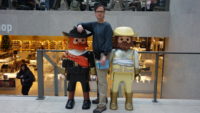
The ruins of the castle were impressive, and the cobblestone road that was uncovered shows the original slope of the steep hill that existed before it was leveled to make the new square. That was all interesting to me. What surprised us both were the giants – it is a term used to describe the large mannequin puppet people you see in Mardi Gras parades in New Orelans. It seems they have been really popular in Belgium for a very long time. So we got to see a bunch of oversized people scattered about the ruins of the old palace. It was a bit surreal. It helped explain some of what we had seen around the country; we had seen some giants in the psychiatric hospital art museum in Ghent, and we had seen three of them when we exited the cave near Dinant. We’d thought they were fairly random, but it seems they have an important place in the festivals of Belgian cultures. We even got to see one of the giants being prepared for the parade later in the evening. The Coudenberg Palace experience ended with a small museum, and we were through the whole place in a little over an hour, and so we went back to the park to see how the village was coming along.

Not very promptly, as it turns out. It seems “noon” is a rough time for these sorts of things, so we went back to the hotel for the first rest of the day. We returned to the park around 3:00, and things were more lively. It was a small village, and, different from Renaissance faires in the US, the normal civilians were not in costume – only the actors were. You would think a faire like this in a city that was actually around in 1500 would be bigger, but maybe people are too close to the history Americans don’t have. It was small. We did get into a long conversation with a “monk” who told us how a barber would have repaired a badly healed broken bone (in an unpleasant two-hour operation that involved cutting into the leg, scraping out any fat, moving the muscle, and then manhandling the bone back into place). It would have been for only the rich, and people only survived the surgery half the time. He was fun to talk to, and his English was pretty good.

It was 4:00, and we had found out earlier that the Magritte Museum, which was very close by, was free today after 1:00, so we went there. I had liked what I’d seen of Magritte at the Atomium yesterday and wanted to see more. After blitzing though all three floors of the museum in forty-five minutes, I still liked much of what I saw. Magritte seems to me to be playing with minds a lot – he does things that can’t be seen in the real world, like a painting being half in the day and half in the night, or the background of a painting being full of trees growing upside down. A few paintings were just odd or did not click with me, but on the whole, I liked Magritte’s work.

I looked on the map and realized that to take the Metro required us to walk away from our hotel about fifty percent of the actual distance to the hotel, so we took it as an opportunity to walk the city. We stumbled across a small park that was perfectly manicured, across from the church where the procession would meet up with the “king” later in the day. That ended part two of the day. I got back to the hotel and lay down, and after another hour, it was hard to go back out, but we both really wanted to see the Ommegang procession. Off we went, at a bit of a weary pace.

We swung by the huge and fantastically-named Palace of Justice to look out over the city. We could see the Atomium from there, and the city had even put out lawn chairs for people to hang out on the square. It seemed to be a popular place with the under-thirty crowd. We walked up toward the upper town until we got to the church, where we just caught the various guilds marching into the church. I did not know it was open to the public, so we found a spot on the road to wait for the pageant.

It was fun. The king and his guard led the way, followed by a modern street-sweeper to clean up after the horses. That was followed by a drum and fife group, and color guard throwing flags in the air, and crossbow men and musket bearers and small bands of instrumentalists and lords and ladies and commoners, and, wait for it, four or five giants. That was satisfying. Everyone seemed to be having a good time, and we were glad we had made the effort.

We grabbed a quick to-go supper and ate in our room while watching an obscure American film; we were enjoying the Flemish subtitles.  I’m hoping today will be the toughest day of being sick, so that I can have more energy as we leave Belgium for Paris tomorrow, and then home via Toronto on Friday. Belgium has been very good to us, and I am not sick of it at all.

Belgium 2018 – Day 11 – Tuesday – Brussels

I have seen the future, and the future is 1958, which helps explain my lack of flying car. Since I was stuck on the ground, I allowed three hours for us to get our car to the Brussels train station to return it to Hertz, so that we would not get charged for an extra day. Since the car was due at 11:00, we left at 8:00. Normally, the trip from Dinant to Brussels is about an hour and twenty minutes, so I thought we were playing it pretty safe. Queue up the construction traffic jam, and my meandering attempt to get around it, and throw in circling the train station a few times trying to find where the car rental place was, and stop to ask a cab driver to help, which he very kindly does, pointing out the postage-stamp-sized sign of where to return the car, and find that the car return agent for Hertz is nowhere to be found for several minutes, and you return the car at 11:03. Happily, they did not charge us for the extra day. And so, we bid goodbye to the rental car, which is always a relief. I love the flexibility of a car, but am always anxious driving it in other countries where I can’t read the signs and I don’t know the conventions.

Since we were relying on the kindness of strangers to find the car rental station, we were blessed to have another kind man stop on the street when he saw us struggling with our map. He saw where we were trying to get to and told us where the metro was and which stop to get off at. He then wished us well and went on his way. What a great guy.

So, we checked into our four-star swanky hotel. I had some credit on the travel site Orbitz, so I used it to get us into a 390-euro-a-night hotel. Sweet. So, of course, they did not have my booking. It turned out my name was spelled incorrectly, and it was fine. I’d expected they were running a credit check on us and seeing that we didn’t really belong in such a hotel. It is a nice room, but it is funny how at the end of the day, it is just a bed and a bathroom, although the room does have a weak air conditioner. I’m used to American freeze-you-out air conditioning, and this one has been running for about ten hours now and has just kept the room at the same temperature (about 79 degrees).

Since I had slept little last night because of Belgian national exuberance over World Cup play, and because I was feeling a little sick, I took an hour-long nap, which also helped us get into the later afternoon, which is when things could start to cool down. We headed to the northwest part of the city on the Metro, to go see the rather amazing Atomium.

The Atomium is a sixty-year-old structure left over from Brussels’s 1958 World’s Fair. It is a giant atomic model mirroring the structure of an iron crystal. It was the central showpiece of the fair, and it is still pretty cool. It is 330 feet tall, and not only can you take an elevator to the top to the observation level, but you can also climb around inside five of the atoms as well. Most of the atoms tell the story of the 1958 World’s Fair. Some fun facts – forty million people came thought the fair; more than forty nations participated; and eight out of every ten Belgians went through the exhibition. It’s a pretty great exhibit.

Two levels were showing some of the work of Magritte, a Belgian artist best know for a painting of a man wearing a bowler hat, but with an apple hiding his face. It was really interesting, and the exhibit brought out how Magritte was fascinated with the hidden – hidden faces, hidden scenery, and so on. Just knowing that little bit of information really helped me understand his work on display, and I really enjoyed it. Mer and I were even able to pose for Magritte-esque photos.

Most of the atoms were connected by escalators, and you could generally look out a porthole to see the connecting structures and the spheres. One of the escalators was wildly lit with pulsating colored lights, and even the normal staircases felt like you were moving around a space station. There was even one sphere set up with sphere-shaped beds to accommodate school sleepovers.

After a brief stop back at the hotel, we went to the area around the main old square, where we found a crepe restaurant and had supper. Afterwards, we took advantage of the evening air to do a book-guided walk around the square area, looking at the main hall and its tower, the gilded decorations of the old trade guilds, the first glass-roofed shopping arcade built in Europe, a recently cleaned church that I would have sworn looked as if it had been built in the last hundred years, and the main shopping streets all around – all pedestrian-only zones. There were people everywhere, and in the main square the town was setting up seating and lights for a concert series over the next few days. It was a lively scene. And yes, we did see a very small statue of a small boy peeing in a fountain.

That took us back home, where we watched the end of the England-Columbia World Cup game – it was on in all the bars, so we decided to check it out. England won on penalty kicks.

So, if I saw a little bit of the 1958 future, it was worth the trip out to the site. Our immediate future should hold some more good touring of Brussels tomorrow.


Belgium 2018 – Day 10 – Monday – Dinant

When Mer announced five years ago that she wanted to go to each of the European countries covered by tour guide Rick Steves, she left the yearly picking of each country up to me. So I picked Belgium this year, and I don’t remember the specifics as to why. I think I wanted a small country for less driving. Check. I wanted a flat country, since we have spent the last five summers in hilly or mountainous country. Flat – check. I wanted somewhere cool, because I do not feel well when it is really hot (above eighty, and especially above eighty-five). The normal temperatures of Belgium this time of year are in the mid-to-high sixties, so that is perfect. Except we have had unusually hot temperatures on this vacation, several times reaching eighty-three or eighty-four degrees. The hot weather has also brought tons of sun, so we have had no rain in a region where it usually rains half the days. So that has been a solid trade-off, but it has meant managing our touring to keep me from getting sick from the heat.

So we started this morning off driving to the nearby Jardins d’Annevoie (the gardens of Annevoie). It was still cool at 10:00 when we got there, and Mer was not sure what we were doing when I pulled into the parking lot. It was a gravel lot looking up at a small farmhouse. She was wondering why we would drive to see a farmhouse; however, the gardens were across the street, and she was okay once she got a glimpse of them.

In the interest of getting going in the morning, I had us skip breakfast, knowing we were going to a tourist attraction that should have a cafe. They did, and I was thrilled we had waited. We had breakfast on our private balcony (no one else was there yet), looking out over one corner of the gardens. It was delightful.

When I say “gardens,” you need to picture manicured grounds and not just flowers. The gardens date from about 1760, and shrubs and fountains and paths were valued. There were some flowers, but what brought me to these gardens were the descriptions of the water features. The gardens have water everywhere, and it is all gravity-fed, so the fountains and brooks have been flowing continuously for 250 years.

The results are spectacular. I love water, and so this is hands-down my favorite garden anywhere, and that includes Versailles. Fountains fed pools which fed other fountains which fed streams, all in a park-like setting with trees (some 250 years old) and hedges and arbors and nooks and statues. It was largely shaded, so the sun was not an issue. They had multiple swans, including a black one, and we kept hearing a peacock, although we never saw it. We walked around the grounds for two hours, and we were pretty much by ourselves. We saw six other people, but four of them were as we were leaving, and the other two were so far ahead of us we only saw them twice, at a distance. It was right out of a Jane Austen novel, from which I quoted freely in order to impress my beloved (it is important to stress to ladies of certain breeding the importance of learning and discourse). I enjoyed Ghent and Bruges, but this was very different, and the peace of the gardens was quite welcome.

We headed back to the hotel room for a cheap take-out lunch in our little kitchen overlooking the Meuse. That made me sleepy, so we hid from the afternoon sun for forty-five minutes while resting in our room. It was still hot out when we left around 3:00, so there was only one thing for it to escape the heat – go underground.

Two summers ago, when we were in Austria, we were having unusually hot weather then as well. Mer took me on a tour of a salt mine, and it was one of the most wonderfully cool (both senses of the word) moments I had in Austria. It made quite an impression. So, when researching things to do in this area, when I saw we could go to a cave, I remembered Austria. It is a great way to get out of the heat. When I considered that I was, for the time being, castled and museumed out, and saw it was a hot day, we were going caving.

The Grottes de Han (the Caves of Han) are in the town of Han, about thirty minutes from Dinant. I expected to pull up to a parking lot in front of a cave. Instead, we came to the center of Han, which is not big, but is not just a crossroads. It seems the cave had been a tourist attraction for over two hundred years. After finding parking a couple of blocks away, we walked back to the center, where we could buy tickets for the cave, the safari park, or both. We then waited twenty minutes for our train to take us to the cave entrance, about a mile-and-a-half away. It is possible that the train may have been in use for two hundred years as well; it was rickety and loud, and it was a ton of fun. It ran us along the local river (the Lesse), past a small campground, and through some forested hills.

We had a fairly small group of about dozen people, and we circled around the guide. Who spoke French. And then moved on. Seemed as if I was going to be a bit clueless on the information of the cave. Mer translated what she could for me, but the cave acoustics were prone to echoes, and the guide spoke quickly, so Mer did not always catch much. But that was all right:  we were headed underground, where we would need light jackets, and it was going to be full of rock formations, and an unexpected-to-me underground river, happily called the Styx.

The cave is unusual in that it is a fairly horizontal cave, with little vertical change. There is a hill on top of the cave, so the cave gets deeper while staying fairly level. Part of the river had run through the cave at one point, and parts of it still flood from time to time. It is made of of several huge chambers connected by small passageways. There were limestone columns that were twenty or thirty feet high, and gentle and delicate lace-like formations of deposited limestone, twisting back and around on itself like fabric.

We crossed the river several times, and it was fascinating to see the water flowing with vapor coming off the surface. The entire cave was well lit with LED lights, and the guide would turn them on and off to highlight certain parts of the chambers we were in. The lights off the water were lovely.

In one large chamber we entered, they had small cave-drawings of animals projected on the walls, with projected fires burning in front of them. I saw the projectors, and they were large and high-end, so I was curious about that, since a smaller and much cheaper projector could have done the same thing. Then the guide had us sit down on chairs, and she turned down the lights, and the entire front half of the cave became a huge screen, with laser light show included. It was a stylized computer-generated film of the cave, from the Big Bang to the present day, somehow all tied to a stag running around. It was really impressive, and explained the need for the projectors. I don’t think it had much of anything to do with the cave, but it was really entertaining.

In the largest cavern, the guide took us about halfway up to a landing, and then sang two notes. Way at the top of the cavern, a torch appeared, and it was run by a teenager down to us. Because I do not speak French, it was not clear to me if that is where early explorers came in, or what was the origin of the torchbearer; it seemed it was a tradition that until 1989 was still done with a real torch. They stopped that because of the smoke pollution in the cave. It is now done by a fairly-effective LED torch instead.

The tour finished with a long stretch of elevated walkway along one of the underground streams, and took us out into daylight. We were a five-minute walk from town and our car, so we headed home for supper in our kitchen.

Since today was the Belgium-Japan World Cup game, and it was an elimination game, we walked down after dinner to a small town square where the town had a large screen set up for the game. The square was jammed with people, and included a for-locals Belgian waffle stand. We watched about twenty minutes of the game, and Belgium was clearly dominating, but could not score. We went back to the room and could tell by noise levels what was going on. Japan scored two quick goals in the second half to go up 2-0, and Belgium finally tied things up in the last fifteen minutes. Then, four minutes into bonus/injury time, Belgium scored and the place went nuts. Then, two minutes later, the game ended, and the place went really crazy. It is kind of fun to be in a World Cup country, assuming I can get any sleep tonight.

So, here it is, about 10:30 pm, and the evening is cool again. Based on the honking horns and cheering people, they are pretty happy that the heat of the day is over too. Tomorrow, on to Brussels. I’ve loved Dinant – I could have spent another day here easily, and maybe even two more. It is a lovely part of Belgium. Our guide in Ghent had found out we were going to Dinant, and she asked me what we were going to do after the first hour and a half. And here I never even managed to get up to the citadel in town. Next time.


PS – I forgot to mention – when we left the hotel this morning, we saw a guy walking along with a backpack. That was not unusual, but what was amazing was the black cat sitting on top of his backpack, just riding along. It was really cute.

Belgium 2018 – Day 9 – Sunday – Dinant

Sometimes, I do judge a book by its cover. When I was researching places to go during my time of being in charge in Belgium, I had decided on going to the southeast of the country to the area around Spa (the town responsible for the English word “spa”). Somehow, when I was looking something up, I saw a picture of Dinant, with colorful houses, a large stone church, and a towering cliff with a fort on top. As soon as I saw that, I changed all of my plans. That is how we ended up in Dinant today after a two(ish)-hour drive from Bruges.

Our hotel is great – a small four-room place with a common kitchen that has large windows that overlook the River Meuse. We might be seventy-five feet from the water – just a street and cafe seating away. The only downside is that because our room faces the river, it also got the full afternoon sun, so it felt as if our room was at least eighty degrees. It is not surprising that a country that is usually in the upper sixties in July does not have air conditioning, but it was hot. Happily, the owner got us a fan, which will work with Belgium’s cool nights.

After a quick lunch in our convenient hotel, we took a two-hour river cruise on the Meuse. We headed upstream, and the countryside ranged from pleasant (gentle hills and cute houses) to amazing (sculptured gardens and sheer cliffs with people climbing on them). We got to go through a modern-day lock that brought us up about six feet to the higher stretch of the river, and I loved that. We stayed in the shade on board, which was a good thing on an intensely sunny day like today, and we were entertained by the ramblings of several little girls running around chattering in French. The cruise was a good use of time, and helped rest our legs that had been walking about eight or nine miles a day this vacation.

By the time the cruise had ended, it was too late to climb up to the citadel. It was 5:00, and the fort closed at 6:00. We do not generally like to rush through touring things. So, instead, since I had a car, we drove about five miles to the nearby town of Yvoir, up into the hills along one-lane roads, to get to the ruined fortress of Poilvache, which had been destroyed by an army around 1430. It had commanding views of the Meuse and countryside, had ruined towers and parts of a defensive moat, and it closed at 6:00. We got there at 6:05. Happily, a very polite man told us to feel free to take pictures from the lookout next to the cafe, but we did not get to see the castle itself. Maybe tomorrow.

Back in Dinant, we walked to and over the Saxophone-speckled Pont Charles de Gaulle bridge, where you get amazing views of the town and citadel. Why saxophones? Albert Sax, the inventor, was born in Dinant, so there are large saxophone sculptures everywhere.

We followed signs to the 23 August 1914 memorial. Dinant was on the front line early in WW I, and Germany’s advance was checked in this area by French troops. In retaliation, the Germans accused the town of being French supporters, and promptly executed more than six hundred men, women, and children, before sending the remaining men off to a concentration camp. The memorial is a diamond-shaped tunnel of iron with the names of all the victims cut into it backwards, so they can be read correctly as you walk through the memorial. On the outside, in normal text, are multiple quotes in French about peace. It was very moving.

We walked back into town and got take-out food for supper. Why pay for the restaurant view that we already have? We have all day tomorrow to explore the region before I close the cover of the Dinant book that has opened so well (assuming we find things open, that is).

Belgium 2018 – Day 8 – Saturday – Bruges

Not all who wander are lost, but sometimes they really are. You may think you are walking toward the main town square, but no towers appear, and more and more cars are going in your direction, and then there is an actual directional sign for cars, something you never noticed in the pedestrian-intensive city center. Mer had said you could not navigate by towers in a city (because the houses get in the way). But, if you turn around and look, far away on the horizon, looking especially small, would be those towers you can’t navigate by. You would then sigh, and trudge back along the same road you had been walking along for the last fifteen minutes while your helpmate chuckles for a ways.

Today was my first day to “be in charge”; Mer had decided what we were doing for the first week, and I got the second week. I decided to stay in Bruges and to try to see some things we had not done yet.

We started the day off taking a short boat tour of some of the canals. I liked our captain – he was warm, but for the most part, the tour is less about the captain’s commentary than about seeing Bruges from another angle. I did learn that the oldest bridge in the city (still in use) is from the 1200’s.

We then walked to the main square to the Historium. The Historium is a cross between a Disney display and a history museum. There is a film that you follow through seven different rooms that recreate Bruges on a day in 1435. It uses the film, which uses computers to create the town in the background, and real actors to tell the story of an errand boy of seventeen running around the town trying to find an escaped bird and a painting model. Some of the rooms pipe in smells and use lighting to recreate lightning. They even have it snow in one room. Mer and I had our tour all to ourselves, which was great. We really liked it. The ticket also included access to the view-terrace over the town square, and some short history write-ups on the development of Bruges. We ended the tour with an eight-minute-long VR film showing us on a boat taking cargo into Bruges. I may have knocked my body into my booth wall once when the narrator told me to look left. I did not see a wall there….

After lunch, we went to the “Battle for the North Sea” exhibit next to the Historium. I thought it was going to be about the sea battles of WW II, but it was about the German Bruges-based U-boat fleet, which I had not even known existed. It presented the German side of things on one side of the hall, and the British response down the other side. In the middle was an astonishingly small outline of an actual U-boat model 1. It was maybe only twelve feet wide at the widest.

The German program was fairly successful, in that the English never found a good answer for the U-boat problem. The 90-some U-boats launched from Bruges sank over 2,500 ships, but only 2 out of 5 U-boat sailors survived the war.

The British tried a late-war assault on the canal where the submarines came from, and they were able to deliberately sink three ships in or near the canal, but the subs were still able to get out at high tide. Of the eight hundred men who were in the attack for the British, about six hundred were wounded or killed. The navy still somehow published that the attack was a complete success. It did manage to boost British morale.

There was a display of the eleven Victoria Cross medals (the highest British military honor) handed out after the battle, with a short write-up of each recipient. Many of the men had died in the attack, and at least two more would die within two years from diseases (after the war). It was a very costly battle for the English.

The exhibit was excellent, and was small enough to be seen entirely in a little over an hour. I had no idea that there was a widespread submarine program in WW I, so the information in the exhibit was all new to me.

We then headed back to the room for a small rest – it really does seem to help out on these eighty-degree days. I then took Meredith to the north section of the old town, to find a church that had a small museum with religious art in it. We found it, but I was surprised that the church itself was full of modern sculpture. It was not bad, but it was not what I’d expected. We wandered around for a few minutes, then left, and I expressed my confusion on the art inside. Mer asked me for the address of the church, so I looked at it – it was at 79, and we were at 72. Somehow, there were two churches with art exhibits more or less on the same block. So, of course, when we got to the church I was looking for, it was 4:30 and they had just closed.

We headed back south, and stumbled across a huge, squat, fortress-like church – St. Giles. The door was open, so we headed in, and found an exhibit on lace (a Belgian specialty) used for the clergy. The church itself, with parts dating from around 1300, was interesting to look at, and there was actually a small printed guide in English to help explain what I was looking at. It was quite thoughtful, and helped in some way make up for the other closed church.

Then we got lost. In my mind, I had crossed a canal, but we had actually only come up to it. Since I had not crossed it, when I headed away from the canal, I was also heading away from the center of town. Mer had mentioned something at the outset about being turned around, but happily, I knew exactly where we were….

Once we actually found the main squares again, we grabbed supper. On the way back to the B and B, we found an open chocolate shop, so we stopped in and bought some filled chocolates, which we ate in the room.  Oh – and the fish market square where there was a concert last night was hosting salsa dancing tonight. I really like this town.

The chocolates were good, but not the amazing I had hoped they would be. For ease, I had bought a pre-packaged set of chocolates. I think we would have had more flavorful success if we had picked them out ourselves. Maybe we’ll find this success when we visit Brussels in a few days.

My first day had a few frustrations, but nothing too bad. We got back to the room a tad early (about 7:00), but it will be good to get a longer sleep tonight before I have to drive two hours to Dinant tomorrow.

Belgium 2018 – Day 7 – Friday – Bruges

Bruges is a delightful city. We had breakfast and then headed out into one of the cutest old towns I have ever seen in Europe. The town has multiple canals, several huge church or civic towers, lively squares, and rows of neat Flemish homes stretching to a still-surviving moat around the whole center, complete with old-style windmills. Coochy-coo.

In cities and towns like these, half the fun is seeing the town. You can pick almost any street and find something worth seeing, even if it’s a residential area. We did actually go see some sights, but there was no real rushing of the journey.

The first stop was the Church of Our Lady, complete with a huge tower next to it – the largest brick tower in the low countries, in fact, at 379 feet tall. Sadly, it is not open to the public. But the church is, and is also undergoing restoration, so we got to see two people actually working on fine detail restoration on one wall. There were signs not to disturb them, so we could not ask any questions, but I had never seen this kind of repair work going on. It seemed slow and detailed.

The church is quite beautiful itself, including statues of all the apostles and Jesus. Most of the art of the church is kept in the back half, behind the altar, where you pay a small fee to see it. It includes some decorated brick graves from the fourteenth century, some recently revealed frescoes on the ceiling, a couple of bronze royal tombs, a huge altarpiece, and more. The most important piece of art is a Michelangelo sculpture of Mary with Jesus on her lap. They both look slightly sad, and it is highly detailed, as is all the Michelangelo work I have seen. As with all Christian art, I loved being able to tell what was going on in the paintings or sculptures.

From the church, we went to Bruges’ Begijnhof (the houses where single women could serve). The complex was smaller than Ghent’s, but this one is still somewhat active as a religious space – there are several Benedictine nuns who live here and still worship in the church. We got there in time to hear them sing noontime prayers. After the prayers, we went and toured a model of a typical house, and it seemed very comfortable, with a kitchen, dining room, sitting room, private courtyard, and bedroom. Our guide in Ghent had indicated that the women joining these communities tended to have some money, and I guess they were used to some space.

Near the Beginhof is a large park next to a canal, and we strolled through that. At multiple areas around Bruges, the city is putting finishing touches on huge sculptures around town, many of which you can walk on or in. We toured one floating on the canal – it was a three-story wooden structure with grand views of the park area.

After seeing much of the park, we walked for about an hour through several squares to get to a row of restaurants on a slower-paced street, where we ate lunch. Several of the squares have impressive buildings on all fours sides, with towers or decorations or statues or monuments. These tended to be fairly crowded, but as we found out later in the day, most people are day-trippers. By 8:00, most of these same squares are much quieter (except for the fish market square, where a German or Flemish band was covering “Born to Be Wild” to an enthusiastic crowd of all ages),

After lunch, we took an hour rest back at the B and B – useful for beating out the unusually hot weather we had today (mid-eighties). Happily, with a breeze and lots of tree or building shade, the heat has not been an issue.

After our siesta, we went back to the main square, but missed the bell tower climb, which closed at 5:00. So we took a Rick Steves guided walk from the main square, through a neighborhood, out to the canal/moat at the edge of the old town. It had trees and benches and a biking path (of course – it is Belgium), and several windmills. We took a break there to enjoy the place before walking south on the path to enter the old town again from a different place.

We finished the day with dinner and ice cream, in two different locations, seeing more of the town along the way. Bruges had some tourist-hype around it online and in our tour book, and it did not disappoint.


Belgium 2018 – Day 6 – Thursday – Ghent to Ypres region and Bruges

We bid farewell to our wonderful hotel in Ghent and splurged on a twenty-euro taxi to take us across town to pick up our rental car. We are usually adventurous enough to use public transportation, but we had luggage to deal with, and about a mile of walking to do even with using the tram. Sometimes money buys you time and ease, so we used a cab. After a few minutes with a very pleasant car rental agent, we were on our way north to Ypres and the Flanders Fields area, in the heart of a major World War 1 front line.

While Ghent negotiated a peaceful occupation with the Germans and, as such, the town survived intact, the town of Ypres (“Ieper” in Flemish) was right on the stalled front line of the war for four years and was completely destroyed. Amazingly, the people of Ypres rebuilt the town according to the original plan, including rebuilding the massive town hall, Cloth Hall, and the enormous nearby cathedral. Cloth Hall now houses the tourist information office, and a large museum dedicated to WWI, focusing on the Flanders Fields area. We were helped in our efforts to see the museum by a kind man who informed us that where we had parked was a no-parking zone in half an hour. The town was setting up a community viewing area for the Belgium-England World Cup game that evening, and we were parked there. We were very grateful for his letting us know and ended up finding street parking before going to the museum.

The museum was one of the best museums I have ever been in. It was well laid out, with artifacts from the war, video recreations of actors telling individual stories, maps, well-presented written information, and special bracelet-activated kiosks that tried to find people like you from the war to tell their stories. That proved a little tricky to do for a forty-seven-year-old man from the US, but I still liked the idea of personalizing the experience for each visitor.

The museum presented things mostly in chronological order, with some groupings of topics (like trench warfare, weapons and uniforms, medical care, and so on). It started with the pre-war issues of the countries involved, which mainly seemed to boil down to intense nationalism (we saw children’s games where you were to shoot the Hun in the butt), international stress of expanding colonies world-wide, and an arms race as armies got bigger and better equipped.

Except the poor Belgian army. They were supposed to be neutral in Europe, and had an army of mostly volunteers equipped with outdated gear. The saw what was going on around them, and just deployed their army to defensive positions only four days before Germany invaded. They were quickly overwhelmed, although they did have some success with newer weapons against older strategies – a small bicycle machine-gun unit held off an elite cavalry unit from Germany. France’s war plan had not anticipated Germany invading Belgium (a mistake they would make again in twenty years for WW II), and so it took them two weeks to deploy, along with the English. As such, Germany advanced quickly across much of Belgium, although not so quickly as they had planned. Once the Belgians deliberately flooded parts of northern Belgium as a defensive measure, and once the French and English got deployed, the war settled into trench warfare for four more years, centered in this area around Ypres.

The museum did a great job of capturing the horror of the war, showing pictures of the devastation. Many trench areas were barren wastelands of mud with a few stumps scattered in amongst craters from shells. Men had to lay down wooden planks to walk on because the mud was everywhere. The Germans tended to build shallow concrete bunkers in which to sleep and hide during shelling attacks, while the British dug tunnels twenty-five feet or more underground. In either case, the men slept packed together. The trenches were rat-infested and usually had some water in the bottom, so that it was hard to stay dry. Boredom for the men at the front was an issue, and officers would order occasional raids just to keep morale up, despite heavy casualties incurred during these raids. It was a miserable existence.

All in all, the museum was fantastic, and I was sad we only had time (three hours) to do the main museum. We left off the archaeology museum and climbing the Cloth Hall bell tower, largely because our parking meter was up. This is one time when the town would have been wise to have free parking, since we would have stayed longer and spent money on supper.

Leaving Ypres did give us time to visit a few other places nearby. We went to the town of Zonnebeke, which is home to the Passchendaele Museum and Memorial Gardens. Passchendaele is the name of a nearby town, but the whole region was the site of a massive British offensive that failed in its objectives. It was supposed to be a breakthrough battle to capture the coastal German submarine ports, but instead got mired down and took three months. The British and German casualty numbers are disputed, but seem to be about 250,000 dead and wounded on each side (500,000 total).

The museum there is supposed to give an idea of trench life, but we did not get to see it. We got to Zonnebeke close to 4:00 without having eaten, so we grabbed a picnic lunch and then ate near the museum, which was in a lovely park. By the time we were finished, it was almost 5:00, and the museum closed at 6:00. So, we decided instead to visit the memorial gardens. In the gardens, seven nations – Australia, the United States, the United Kingdom, New Zealand, Canada, Germany, and Belgium – designed gardens from 2014-2018 to commemorate the one hundredth anniversary of the war. Each garden was filled with items of symbolic meaning – the US showed pictures of Belgians on planks of food crates (we sent food to Belgium), Germany had a stone with a hole in it to represent the unknown number of casualties they had, Australia had plants from all over the country, and so on. It was peaceful, and we had the gardens to ourselves, so it was a good compromise on having to skip the museum.

From there. we moved on to the United Kingdom cemetery of Tyne Cot, which is the largest UK war cemetery anywhere in the world, with about twelve thousand soldiers buried there. Over eight thousand of those buried there were identified only as “A soldier of the Great War, known to God,” which is sobering. I’m guessing they did not yet use dog tags for identification, but I do not know. The cemetery was immaculate, with roses planted by the headstones, and a long wall across the back listed by regiment the names of the men who never came home but whose bodies were never found.  The list was only of those who went missing during the last year of the war (those who did so earlier are listed elsewhere), and there were still over 34,000 names. As you approach the visitor center, there is a quiet recording of a woman saying the names of each of the dead men. All of this in the middle of quiet farm land. It was very moving.

The British attach great emotional investment to WW I sites like these. We ran into multiple school groups of British children, both at the Flanders Fields museum and at Tyne Cot. There were multiple little crosses put at various headstones which had messages from children written on them, thanking these soldiers who have been dead for over one hundred years for the sacrifice they made. It was good to see that.

We ended our tour of the Ypres area by driving a few miles to Langemark, to the German cemetery. Meredith teaches All Quiet on the Western Front, a WW I novel told from the German point of view, and the protagonist, Paul, says he was stationed near Langemark, so Mer wanted to see it. The German cemetery is subdued, with low, dark headstones. The cemetery holds over 44,000 German dead. Over 25,000 of those are in a mass grave in the center, and all of the “individual” graves hold at least four men. Some hold as many as forty.

We ended a long day by driving the hour or so to Bruges. It took several tries to get into the city – we kept taking wrong turns, even with a GPS, and we had trouble finding the parking garage for our B and B. It was a bit frustrating, especially when I was as tired as I was, but in light of what we had seen that day, I tried to keep it in perspective. We ate a very late supper (10:00), and went to bed directly after.

In our travels, we have seen WW I sites now in Belgium, France, and Slovenia. It was a terrible war, but I am grateful that the regions most affected by the violence remember and work to make sure it does not happen again. As WW II showed, sometimes they fail, but they keep trying.

Belgium 2018 – Day 5 – Tuesday – Ghent

Yesterday was not a day of near-misses and wrong directions. It was a scouting day! We fit in a long and successful day of touring today, from about 9:00 am to about 10:30 pm. We have seen Ghent. Phew.

We started by catching the correct bus heading east out of the city center, and then walking a mile or so to our destination – the Groot Begijnhof. Insert your “I am Groot” joke here. Begijnhofs were Belgian and near-Belgium institutions where widowed and single women could go to live in community, but without taking full convent orders. They vowed obedience and chastity, but then were allowed to work and live by themselves in the community.  Ghent had three of these places in the city, and the Groot Begijnhof was the largest and newest of them, being completed in the 1870s.

I had no idea a place like this existed, and it was all very peaceful with harmonious brick buildings. We wandered around the walled-in compound, which is based around a huge church (which was sadly closed to the public). The current-day community is made up of anyone who buys a ninety-nine-year lease on a home, but it is still really quiet. Owners are not allowed to change much of anything, since it is a World Heritage Site. It is made up of about eighty homes, the church, and a few other buildings, all enclosed in a brick wall. They even had three cows grazing in a field behind the church, and this on the edge of a city of 250,000 people.

Back in town, we took our one-day-delayed boat ride, which was free on our Ghent City Card. We have really made out on those cards, spending seventy euros to get into over one hundred euros’ worth of attractions, not including multiple trips on the trams and buses. The boat trip was about forty minutes long, and took us along the main strip of the old river harbor, turning at the main bridge (St. Michael’s Bridge), before heading all the way up an old canal to where it now terminates at a road. We had commentary provided by the boat’s captain, who spoke in English, French, and German. He was a little hard to understand over the PA system, but that is often the case with PA systems. He told us about some of the buildings in town and a little history, but the real enjoyment was in seeing the town from the perspective of the river and canal.

Having crossed off yesterday’s events by noon today, we hopped on a tram heading northwest out of the city, getting off at the Dr. Guislain Museum, a museum in a former psychiatric institution, dedicated to the history of the treatment of the mentally ill, with a focus on Dr. Guislain, who revolutionized the treatment of the mentally ill in the 1800s, and right here in Ghent. The museum also house three art collections – one by trained artists who spent time in mental institutions talking to patients, one by self-trained artists, and one by patients themselves.

The history part of the museum was both fascinating and sad. It covered the treatment of the mad from medieval times when they would bore holes in the head to release the bad spirits, up to today with medication and MRI machines. In between, the treatment of the ill took various steps, but really took a leap with Dr. Guislain’s reforms in the 1850s, when he treated the mentally ill as ill and treatable. He built open and safe spaces for the patients, required good food to be served, and required staff to treat the patients with respect, including requiring them not to gossip about patients outside the institution. He helped write laws on mental health that were in effect until 1991. Dr, Guislain teamed with the religious orders of the Catholic Church because he thought the religious men helped calm the patients, and they were a much cheaper way to staff the hospital, when compared to secular nurses and caregivers.

The art exhibits from the patients were interesting, and several were excellent. There was a painter of still life works that focused on everyday objects like irons and phones that Mer and I both liked very much. The works from the trained artists were usually thought-provoking, although some were obscure or pretentious. The works of the untrained artists were across the board, with some being childlike to some being very advanced. It was not clear to me how many artists were ill and how many were not, and I think that was the point – that the art stands apart from the mental health state of the artist; the ill can and do produce good art.

That got us back into town around 4:00, looking for supper in a culture that usually starts to think about supper around 8:00. We eventually found a restaurant that was open and serving on the large square where we ate French fries a couple of days ago. We passed a very pleasant hour eating and people=watching.

Mer had a plan for us to do something right at 7:00, so we went back to the room to rest up for about thirty minutes. We walked over to the tourist information office across from the castle, but it was closed. We hung out outside the door until Mieke (“mee-ka”) walked up and introduced herself. She is the mother of four and grandmother of six, lives on a houseboat on the town’s bigger river (the Scheldt), is from Ghent, spent a year abroad in California, and happens to be a tour guide. She was there to take us on a private three-hour tour of Ghent.

Mieke took us all around old Ghent, starting at the castle. We walked down old medieval lanes that we had not yet seen, and which now make up a trendy neighborhood near the castle. She showed us what used to be a monastery where the monks healed people, and then round again to the River Leie harbor area, where she told us about how the shipping guilds used to fleece money from traders by requiring them to transfer the cargo to Ghent ships for a half-mile section of river, pay a toll, sell twenty-five percent of the cargo at Ghent rates, and then pay to transfer the cargo back to the original ships. It made Ghent really wealthy, along with the money that came pouring in from the cloth trade, first from wool and then later from cotton.

We crossed St, Michael’s Bridge and heard about the two major churches in the old town and the bell tower, which was deliberately built to be taller than the church steeples. She told us that the people of Ghent hated the new covered square space in front of city hall because they thought it looked like a sheep barn, but they have come around to liking it. We hiked out to the Scheldt River, and Mieke took us to an old ruined abbey. She is a volunteer at the abbey once a week to tell people about it, so she had a key, so we got to wander the abbey grounds by ourselves. It is much in ruin because most of the stone was carried away by the Spanish in the 1500s to build a fort nearby, but the old church still stands and is very impressive. It is still used for concerts, and has the tombstone of the older of the Van Eyck brothers (the painters of Ghent’s famous altarpiece) housed there.

Mieke took us back into town, showing us a trendy food court that is housed in what used to be a large church, and dropped us off in the same square where we had eaten supper. Mer and I love local guides, and the evening had been informative and gotten us to several new-to-us places.

Long day, but worth it. We feel as if we have a pretty good sense of Ghent, and since the festival season starts this coming weekend, we feel pretty good about getting out of town. We head out for Bruges via Flanders Fields tomorrow.