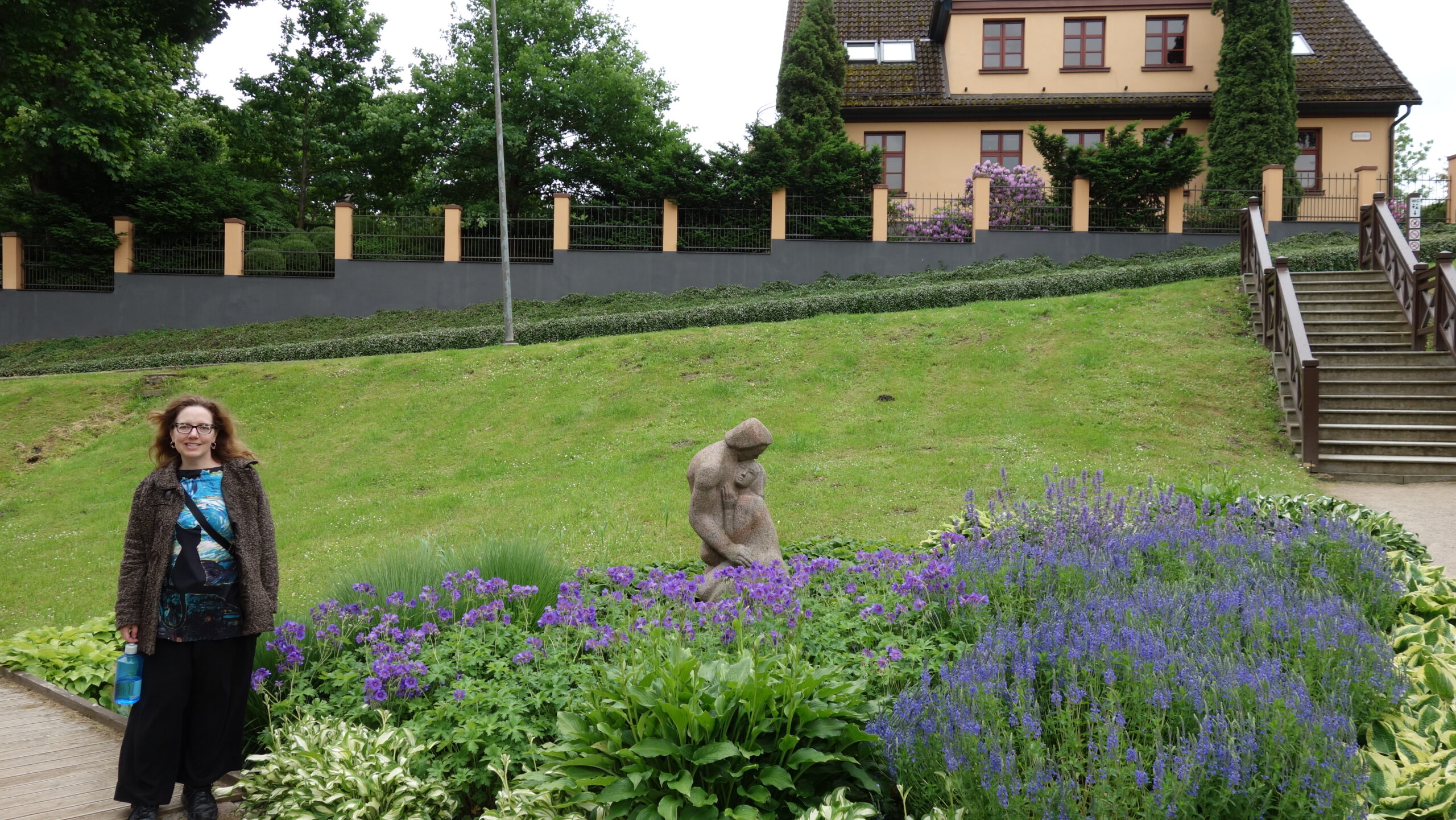
 Sometimes you step up to the touristic plate swinging for a homerun. And then you realize you’re facing the Latvian national team and their fearsome pitcher. First, he throws a mean curveball of weather at you. Then his screwball of “no factory tours” is unhittable. Finally he rams a fastball of renovation right down the plate. It makes for a long game.
We always check the weather when we travel to see what we need to wear and if we need umbrellas and that sort of thing. This morning, Kuldiga was supposed to have strong thunderstorms with frequent lightning and heavy downpours from about 10:00 to about 1:00, with some rain after that until 4:00. Not great, but we could do some inside things. It was mostly sunny when we set off, so I decided to do my far-flung option first.
Not too far away from the old town is the Kalku Street Quarter. It’s an old industrial area that now houses a brewery, a gym, and some shops. We walked there, but with a bit of difficulty resulting from my inability to read any sign in Latvian. Meredith finds this fascinating. She points out that the sign says, “Blahblah,” and that we are looking for “Blahblah.” What I see is the immediately forgettable “Blqxzwyh” and so never bother with signs.
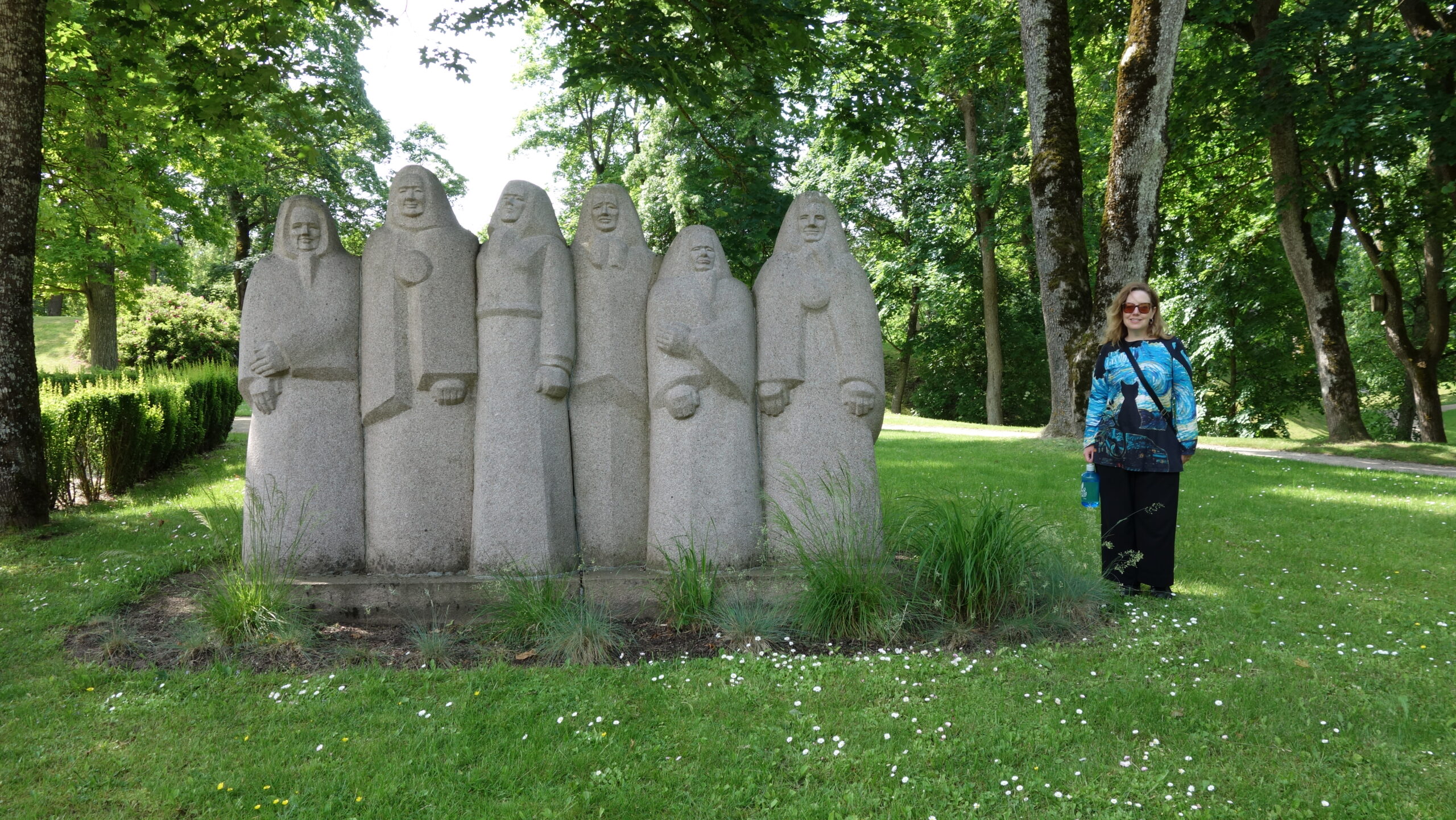 At any rate, we were there to see the very cool-sounding Klavins Piano Workshop. Davids Klavins founded the company to design new acoustic pianos, and he came up with what I describe as two-story vertical grand pianos. The player sits on a platform near the top of the piano and the soundboard extends some ten feet or more below the player. I found a clip online, and the piano sounded very sweet and responsive. And the factory had signs on the door saying, “This is a working factory! No guests!” So much for my tourist map telling me to go “listen to fantastic stories of experiences from piano master Davids….” You should still look up Klavins Piano clips – they are something to see.
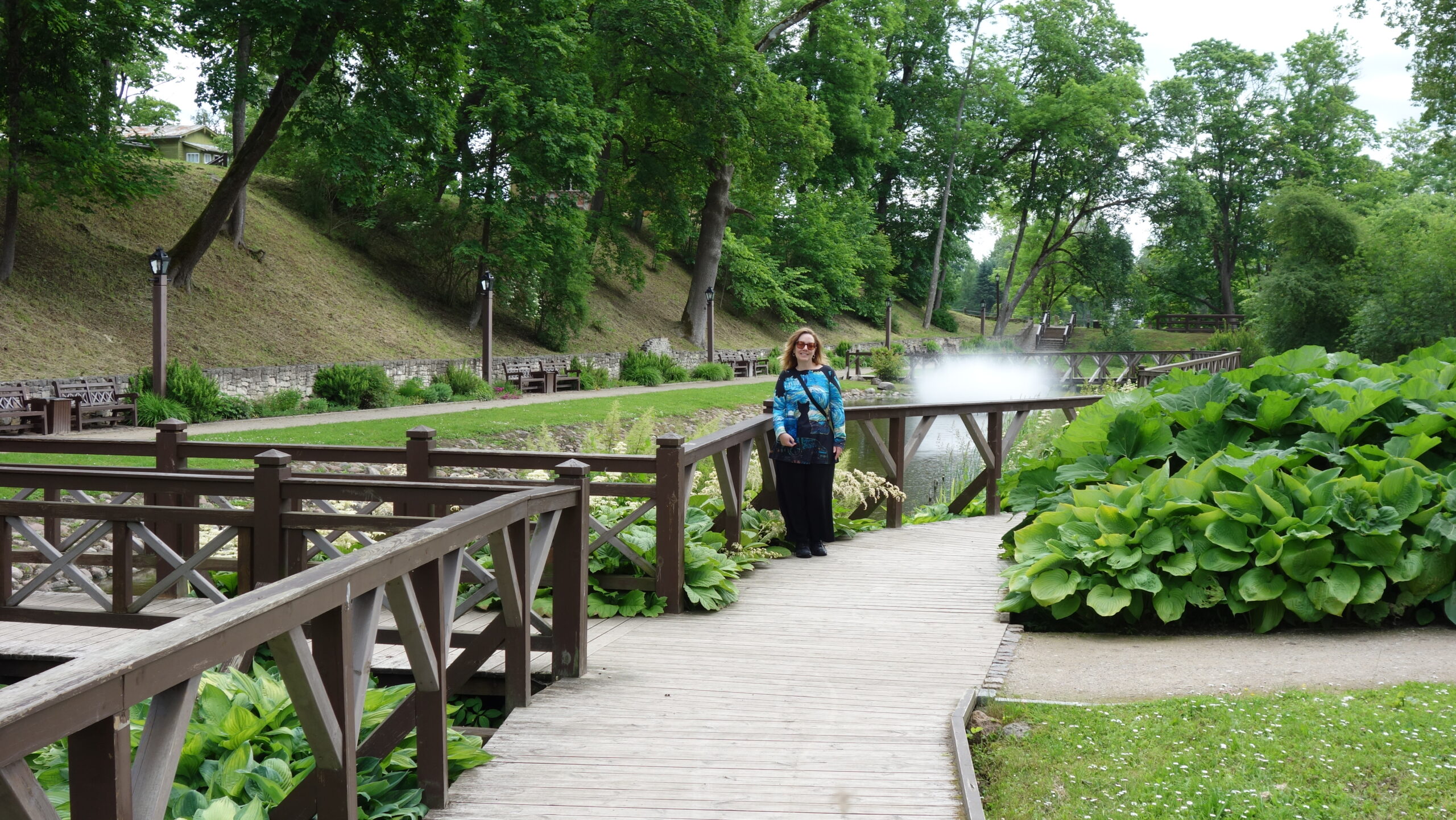 We walked back into the old town to the Town Garden park, where we had seen sculptures yesterday. We toured the whole park today. There are twenty-two sculptures of people in the park, all done by the same woman artist. She worked from roughly 1950 to 1990, so mostly under the Soviets, and yet her work is more human and tender than art I usually associate with heroic-style art produced under Communism. Some of her art showing women in national dress singing together (a national tradition) struck us as dangerous to create during Soviet rule. We’re not sure when the works went on display, so maybe they were after Latvia gained its independence. At any rate, we really liked the sculptures. And the park had pretty flowers, a boardwalk, and a fountain in it, so it checked a lot of our park boxes. We really liked it. Since we were close, we went to a viewing area for the river’s falls and sat there for a few minutes.
From the park, we went to the Living Museum (or the Live Museum, depending on which source you ask). It’s a small history-of-Kuldiga museum with animatronic and video displays. It was also locked at 11:50 when it supposedly opened at 11:00. Mer helpfully interpreted a sign as saying it would open at noon. It had just started raining lightly but steadily, so I thought we would wait for the museum. The rain lightened (starting a pattern of no rain/light rain/steady rain/no rain), and I thought we could be more entertained over next to the TI (tourist information office) by watching the dancing fountain there. The TI was just around the corner, so we went and watched the fountain until 12:05.
We went back to the museum. The door was locked.
We went back to the TI and went in. The woman at the desk confirmed that the museum should be open.
We went back to the museum. The door was locked. I called the number on the sign. After “Hello?” we got cut off.
We went back to the TI. I asked the woman to call, which she did. It was a fairly long conversation. At the end of it, she told us the museum was open and she didn’t know why we couldn’t get in.
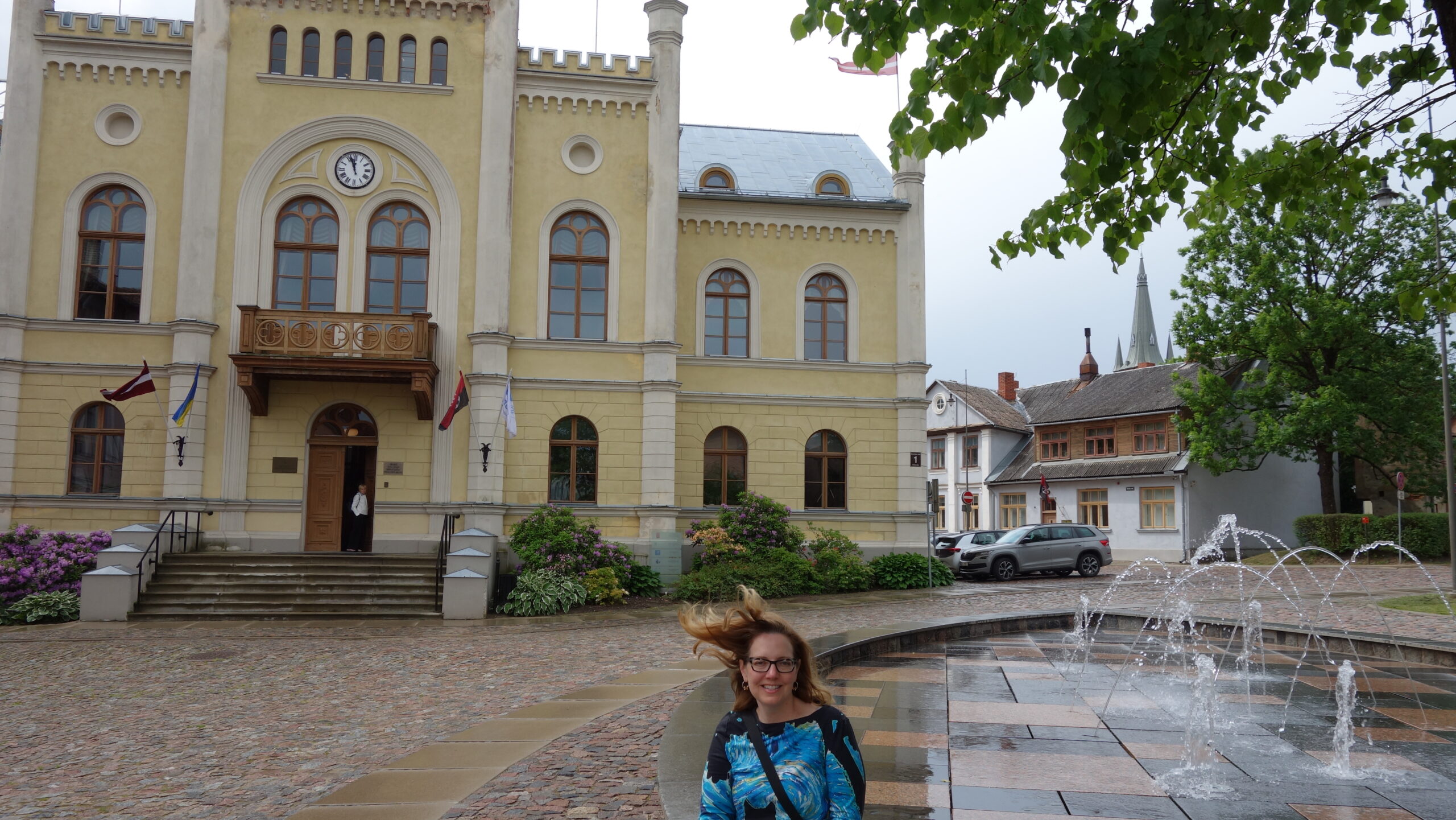 We went back to the museum. There was a young woman in street clothes standing in the door. She offered some kind of apology that I didn’t quite catch and she got us our tickets. It seems as if the “live” part of the Live Museum is the live guide, who was the young woman. She asked us to take as seat in a dimly lit room and told us to wait a minute so our eyes would adjust. She came back a couple of minutes later wearing a medieval-style robe and not her street clothes, so it seems likely that our eyes adjusting took the same amount of time for her to change.
Still, she was lively and funny. She took us through several rooms that sort-of kind-of told some of the history of the town using props, animatronics, and film projections. Imagine a small-scale Disney doing light history. We started in the punishment room, where we saw how people were punished in town back in the day. There was a pillory, of course, but there was also a metal-bar box for anyone deemed lazy. The box was too small to stand up in, and would have been tight to sit in. The authorities would put the lazy person in the box for forty-eight hours with no food, water, or shelter. Lastly, they had a dummy display of hanging, which could be quick (immediate death) or slow (four-plus hours) depending on how it was done.
We then moved into a room of the Baron Jacob Kettler, who helped make the Grand Duchy of Courland (this part of Latvia) rich and powerful by building lots of high-quality ships. The English and French ordered Courland ships, and the Baron used his own ships for trade. He made settlements in Gambia and Tobago, and he used the settlements to trade amber and grains with Africa, slaves to Tobago, and tobacco and coffee and cacao to Courland. It brought in a bunch of money to the town and area. The Baron is celebrated still in several displays around town, but the locals tend to gloss over the slave-trade part.
From the Baron’s room, we boarded a ship (it really rocked on the waves) to Tobago as settlers, with fifty percent of us dying along the way. None of us ever came back to Courland.
Next was a room with a skeletal figure who jumped at us. He represented famine. After the Baron’s death, the ruling family moved their government to another town and built another castle there. Kuldiga lost most of its income, and famine resulted.
The next room had a wrapped-up dead body in it. The woman had died of the plague. The plague came late to Latvia in 1710, but it ended up killing ninety percent of the town. The adjacent room had plague victims locked in the church with their hands out toward us (this part is solidly a legend with no documentation). The last room was Kuldiga of today, with a picture of the Baron and a picture of a hundred-year-old local sculptor who also was an actor and translated French films into Latvian. That was the statue of the man Meredith sat next to yesterday, and local legend says that since she sat and had tea with him, she will now live to be a hundred too.
And that was the museum. It took maybe thirty minutes, and was a good amount of touristy fun.
 We headed up the road to go to another sight, but since we were passing an old house that had the largest mantel chimney in Latvia in it, we stepped inside (it was free). We poked around the place and couldn’t find a mantel or chimney. Then I found a closed door that opened into a dim room with a large step down, so I went in. I still couldn’t see a mantel or chimney, and then I looked up. I was standing in the enormous chimney. There was no mantel – I don’t know why it was called that, but it seems as if the idea was to heat the stones in the huge chimney, and the stones heated the rest of the building. It’s not efficient, which is why most are gone, but this one was impressively large.
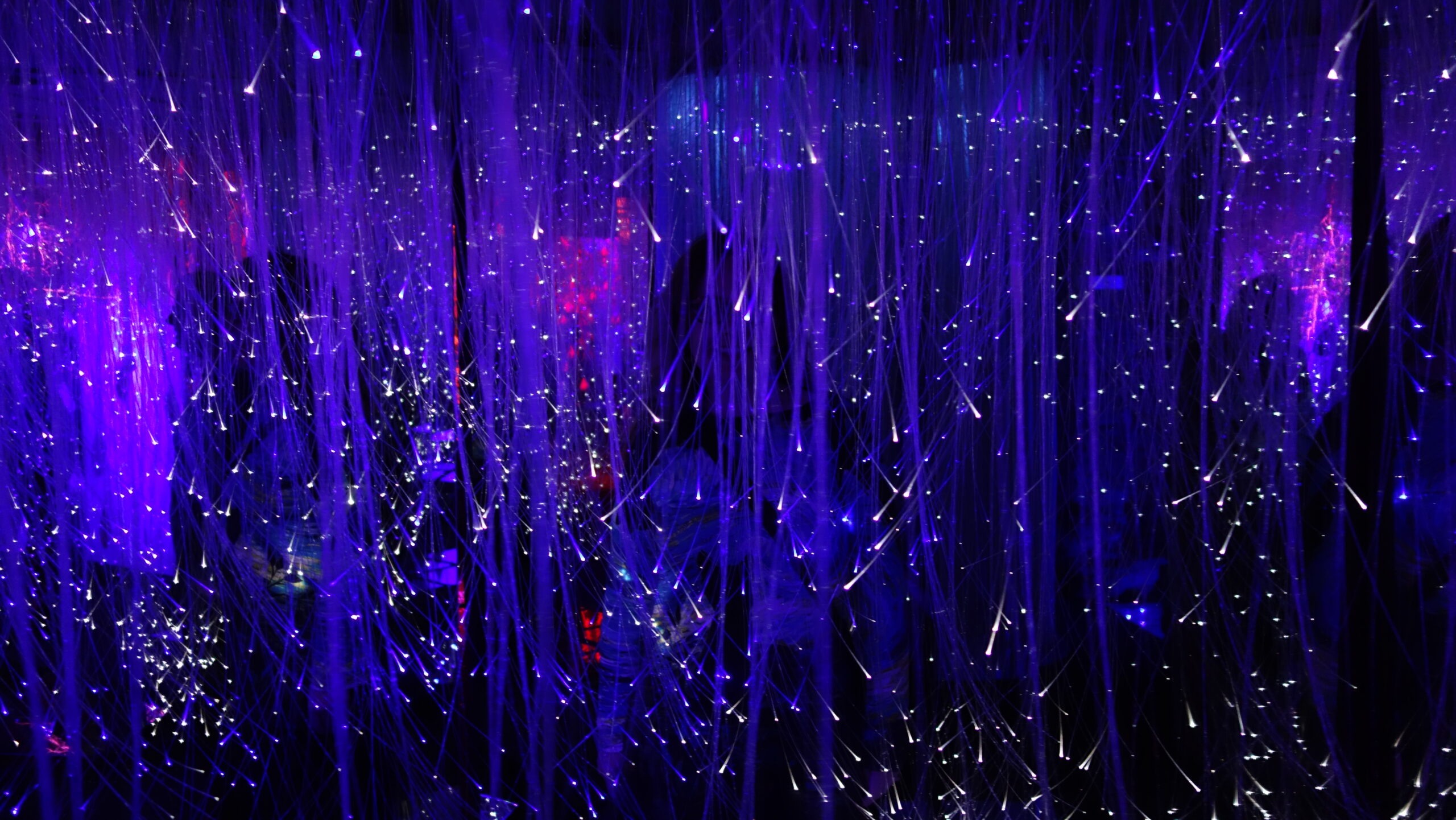
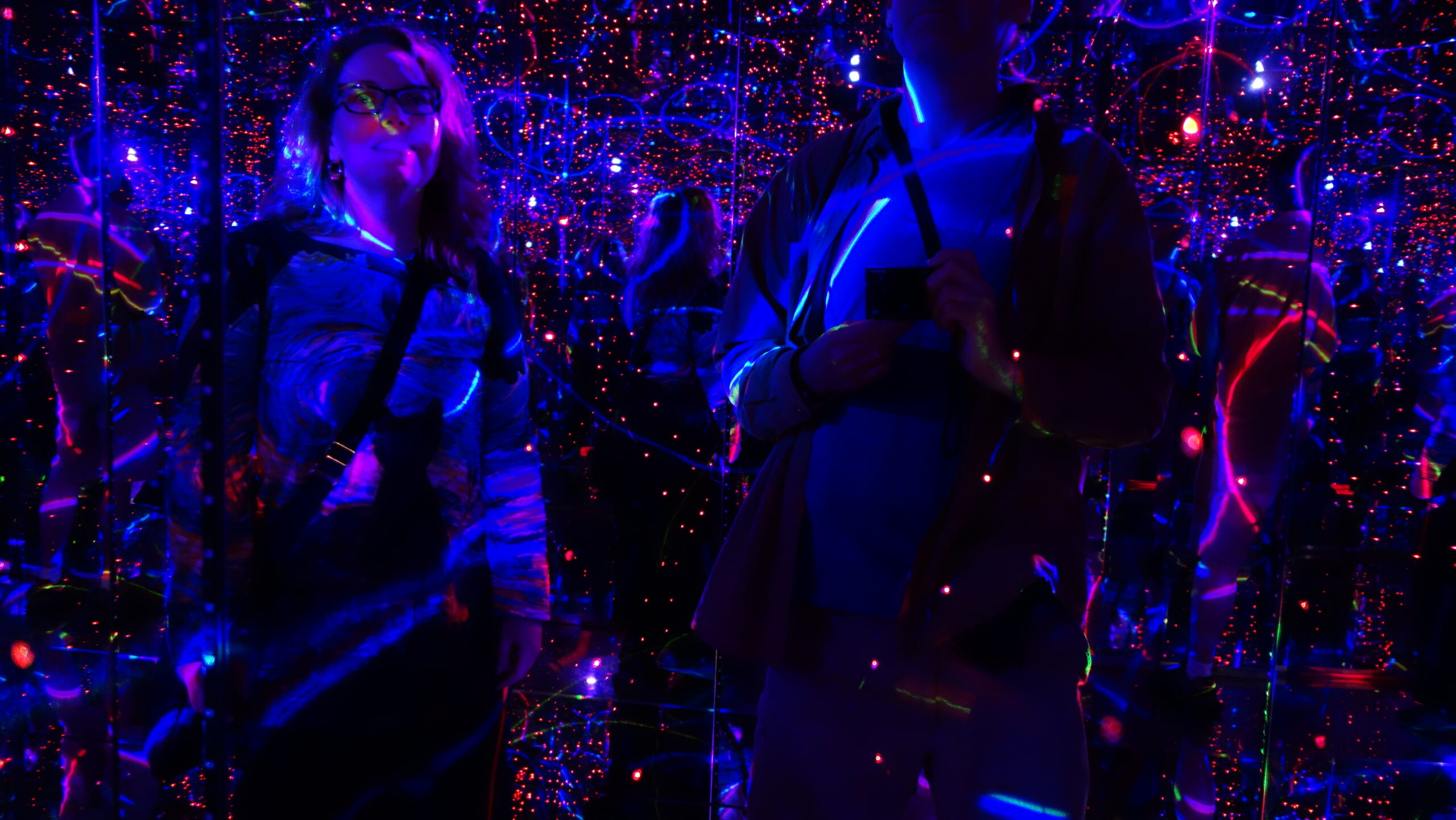
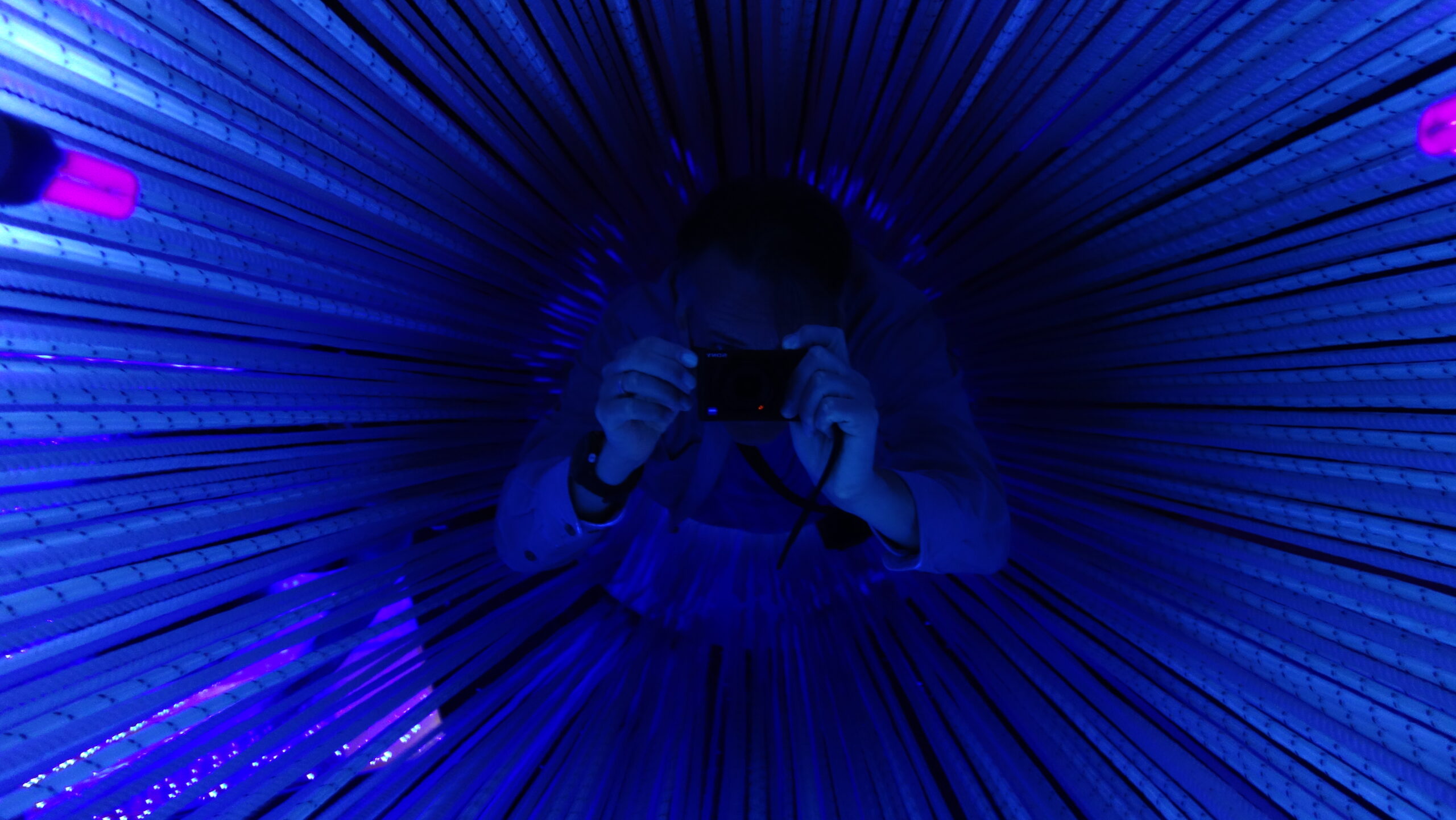 On to our next sight! We went to Visumnica (“Universe”). I wasn’t sure what it was, but the tourist map made it sound like optical illusions or mirror tricks or the like. It was mirror fun. Mer and I got to go through by ourselves. We started with a small mirrored room that had a light and sound show for three minutes with infinite-seeming lights in every direction. We got to do that one twice (maybe the day was slow?). There was a room with a lit-up plant sculpture reflected in slowly moving mirrors that made it hard to figure out where to go. I may have walked into a mirror. That was followed by dangling fiber optic strands between mirrors, and a vertical rope tunnel you stood in and had mirrors top and bottom. It gave the feel of a sci-fi time-travel tunnel. There was another small infinite-distance mirror trick, and a room where wall-sized mirrors slowly moved to make it feel as if the whole room were moving. As we have seen in illusion museums before, Meredith finds these fun and stands there enjoying them. I find them interesting but spend the whole time fighting my body as it leans against the tilt of the room even though there is no movement.
 It was now 1:30, and we hadn’t really been rained on. We were in the clear! We stopped at a bakery and got lunch, and then headed back to the room to check the weather and top up water so we could go on a hike next to the river. The forecast said the rain was done, although the radar showed some clouds over the Baltic Sea that worried me some. Still, we were good. We dropped the umbrellas and went to go to the hike.
We got about four blocks when it started to sprinkle.
No worries! I wanted to see the inside of the Catholic church in town, which is supposed to be lavishly decorated inside. We could wait out the obviously passing storm in there. It was a bit tricky finding the church since it was surrounded on three sides by other buildings, but we made it!
It was closed for renovation.
 No worries! I wanted to see the inside of the old Lutheran church. We got close to there as it started to rain harder, but the church was open, so we were in luck. The church had almost no decorations, but that may be because it was used as a warehouse and horse stable under the Soviets. We were able to get right up by the elaborate elevated pulpit and got up to the colorful altar. The man working there let us go upstairs to see the organ and choir area. There was a Bible exhibit of Bibles from many countries and times (the oldest one I could make out was from 1750 or so). We took our time and headed back outside. It had stopped raining, so we headed toward the hike along the river.
It started raining.
I decided to duck into a nearby riverside restaurant. It was a little after 4:00, so we would have a ridiculously early supper. It turns out the restaurant was high-end, and supper cost about fifty dollars (which is a lot considering our lunch at the bakery was five dollars), but the food was excellent. And we ate while the rain stopped.
Except it hadn’t.
We headed back to the room to get our raingear and to check on the weather. It stopped raining as we were walking back. The forecast said rain was done, so we added layers on since it was getting into the mid-fifties, and we headed out to the hike.
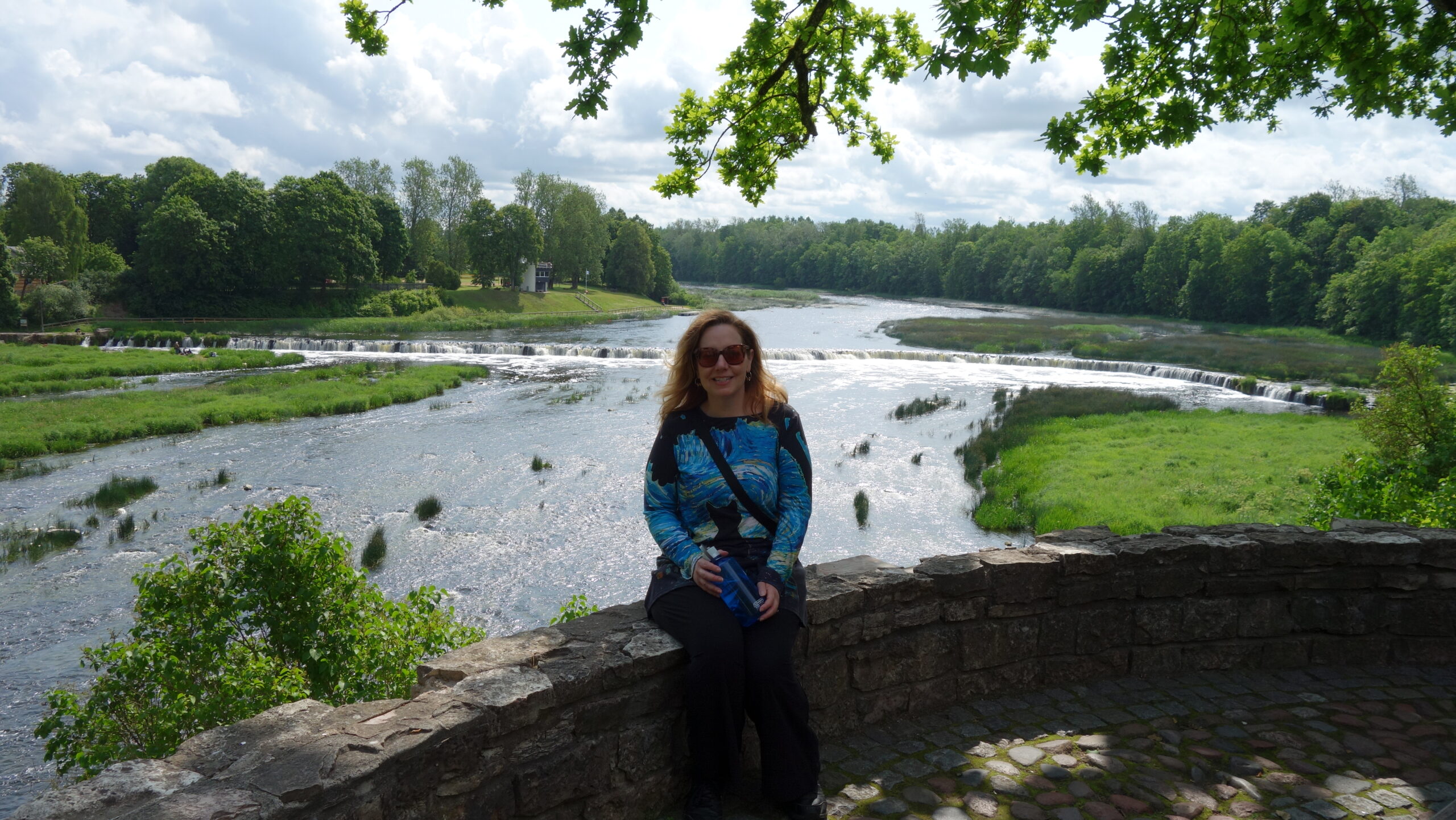
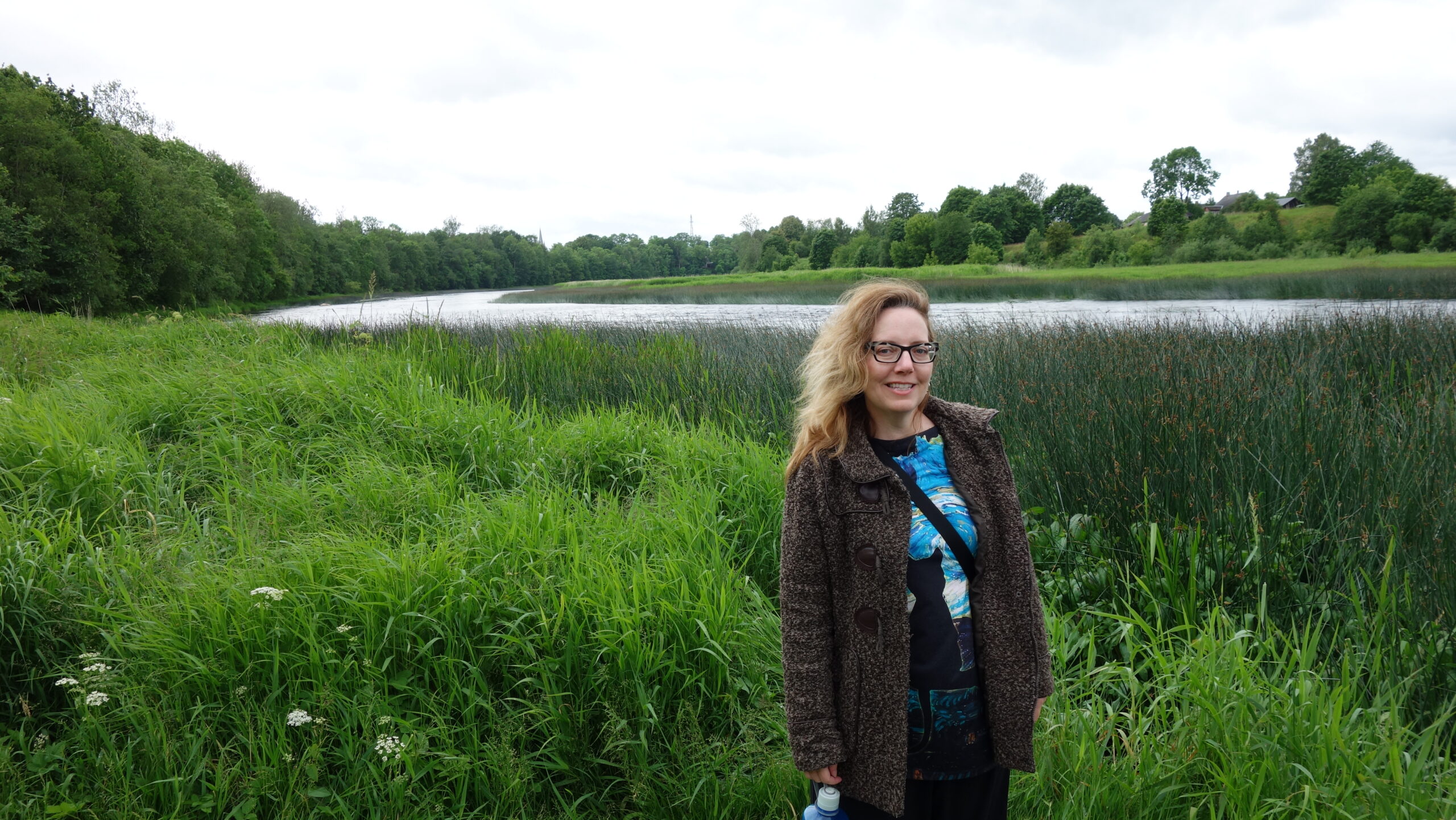 We got to the river before the rain came back. But this time, it was one cloud, and the rain stopped for the day after just a couple of minutes. The long-awaited hike along the river, which promised, according to my tourist map, “uncharacteristic views of the Old Bridge and the Venta Waterfall,” was underway.
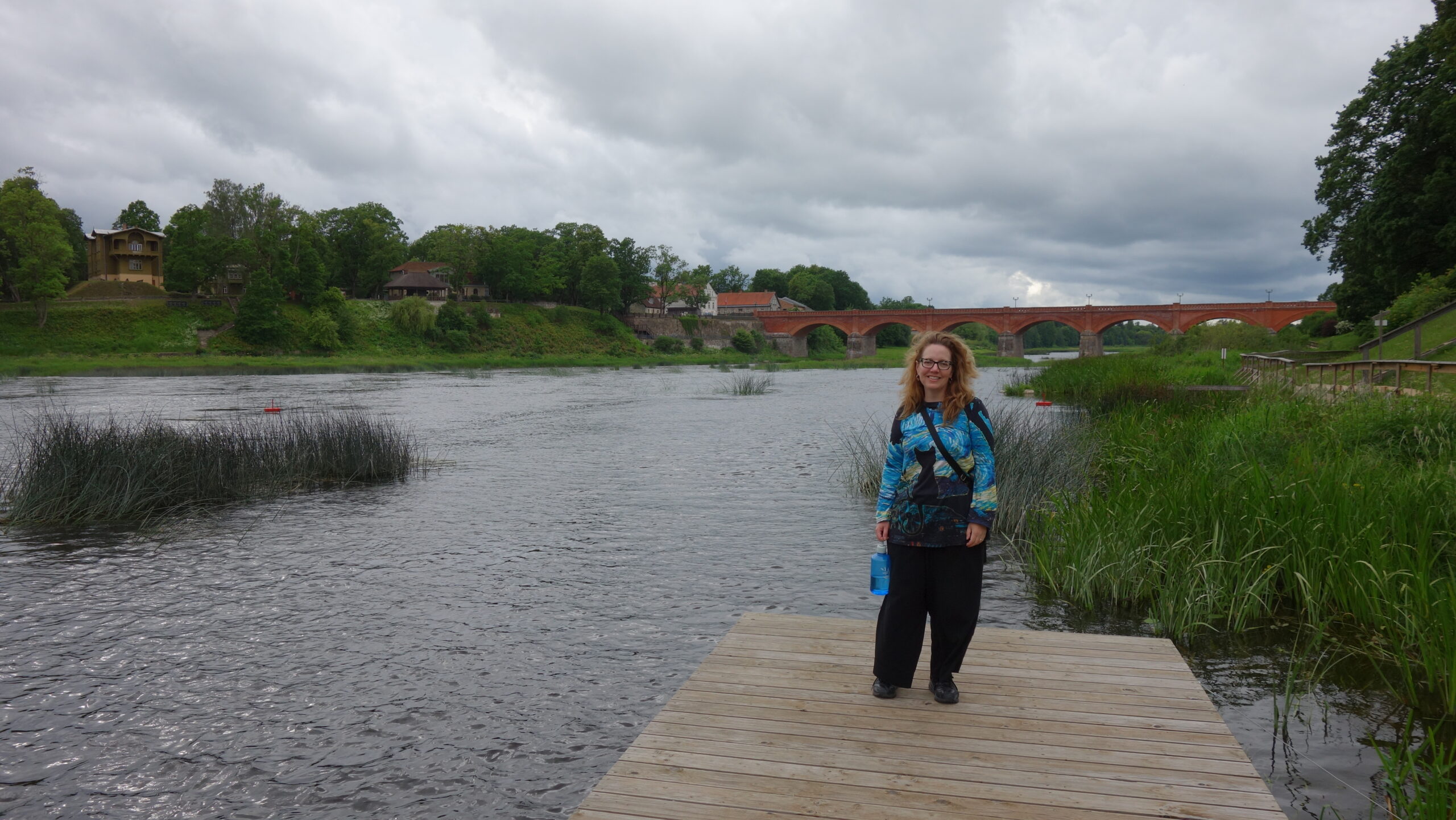
It was a pleasant hike, and we did get to see the bridge and waterfall once or twice, but mostly it was a nice path in the woods next to the river. You could catch glimpses of the river through the trees. After a mile or so, we got to a side path that went down to the river. We went down there and watched the water go by for a couple of minutes and then came back to the old town. I wanted to cross the brick bridge again and walk the other bank past the falls to a swimming area upstream. That gave good views of the falls and bridge, and we were pleased with the hiking portion of the evening. We headed home.
 Tomorrow is another day for Team Tourist versus the Latvian national team. We came out okay today, and I expect we’ll be fine tomorrow.