 The northwest of Latvia juts out into the Baltic Sea, and the tip of that jut is home to the Livs, the smallest ethnic group of Europe. Ventspils is the largest town of the region, and we used that as a launch pad (ha! See more below…) to explore the tip of the region in a counter-clockwise direction.
After breakfast, we headed north to… nowhere. There was no address we could find, which was consistent with a place that started life as a Soviet spying center. I used the internet to look up the longitude and latitude of VIRAC, home of Latvia’s space telescope center. The GPS found it just fine, turning us off the main road about thirty minutes north of Ventspils, and onto a concrete road. Within a few minutes, we were driving by some creepy abandoned Soviet apartment buildings that had housed the staff and families of the spy facility. We then got to the welcome center, where we paid for our English tour with Markus, a surprisingly mature and fluent sixteen-year-old who works for VIRAC to give tours. We were joined by a young Swiss man named Philip. He was enthusiastic and very funny.
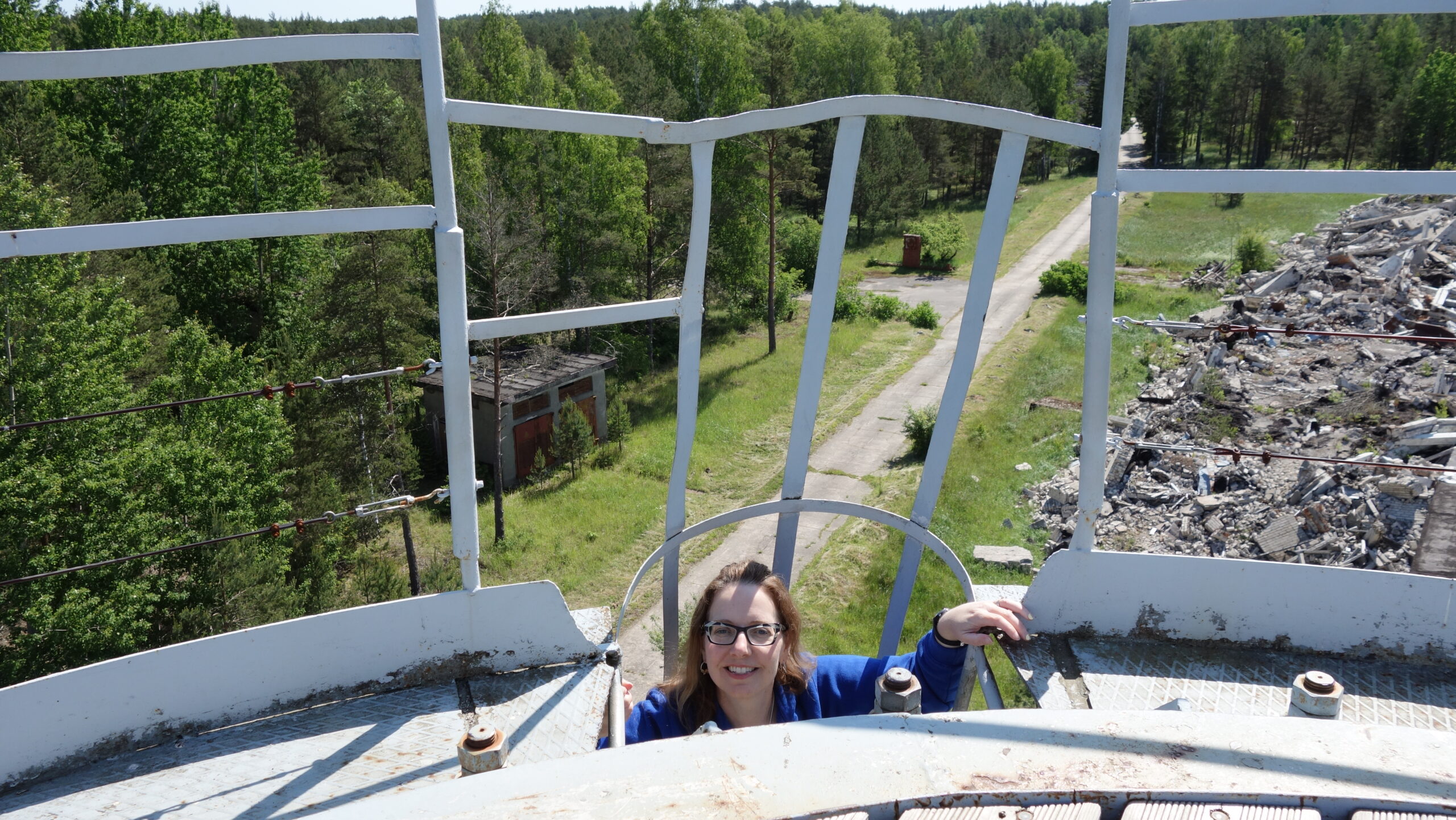 We started our tour heading over to the old control center, which had also been the base of an eight-meter radio dish. The facility also had (and still has) a sixteen-meter dish and a thirty-two-meter dish on top of remote buildings. The thirty-two-meter dish is one of the ten biggest in the world.
The large building next to the control center tower had been used for all the spies listening and going over things, but it is now a huge pile of rubble. It had become unsafe, so the Latvians demolished it in place. Markus explained that it’s easier to know when a building is going to collapse if you just do it yourself.
 And that was cool to see, but then came nerd heaven. He let us into the control tower, and it still had the original control equipment in the room, including a massive wire harness that the Russians had wrecked when they left in 1994. But the Latvians were able to get it working again after two years, and it was used for about a decade until newer electronics were installed. That was fun. And then Markus told us we could use the really steep and sketchy-looking ladder/stairs to climb into the basement, where they had shoved all the electronics they couldn’t find anywhere else to put. They had large motors and large junction boxes and switches and wires everywhere. It was great. We climbed back up, and I expected to go outside again when we were told to climb equally suspicious metal ladders to go up to an area decked out with Soviet-era stuff. That included a Russian map that had all western military bases marked on it, and a Latvian/Soviet flag, and a bust of Lenin. In a heartwarming moment that should be a warning to all leaders who think they’re important – the Swiss man asked who the bust was of, and Markus said he didn’t know, but thought it might be Stalin. Young people have forgotten what both Stalin and Lenin looked like, which is great.
 We got to head down the hallway that used to lead to the blown-up working center, and it was full of 1970s and 1980s electronic equipment (including oscilloscopes labeled in Cyrillic). There were (illegal) photos that the soldiers had taken of each other, and some wonderfully fun drawings modern-day school children had drawn of the telescope center, including one in which the telescope was staffed by aliens.
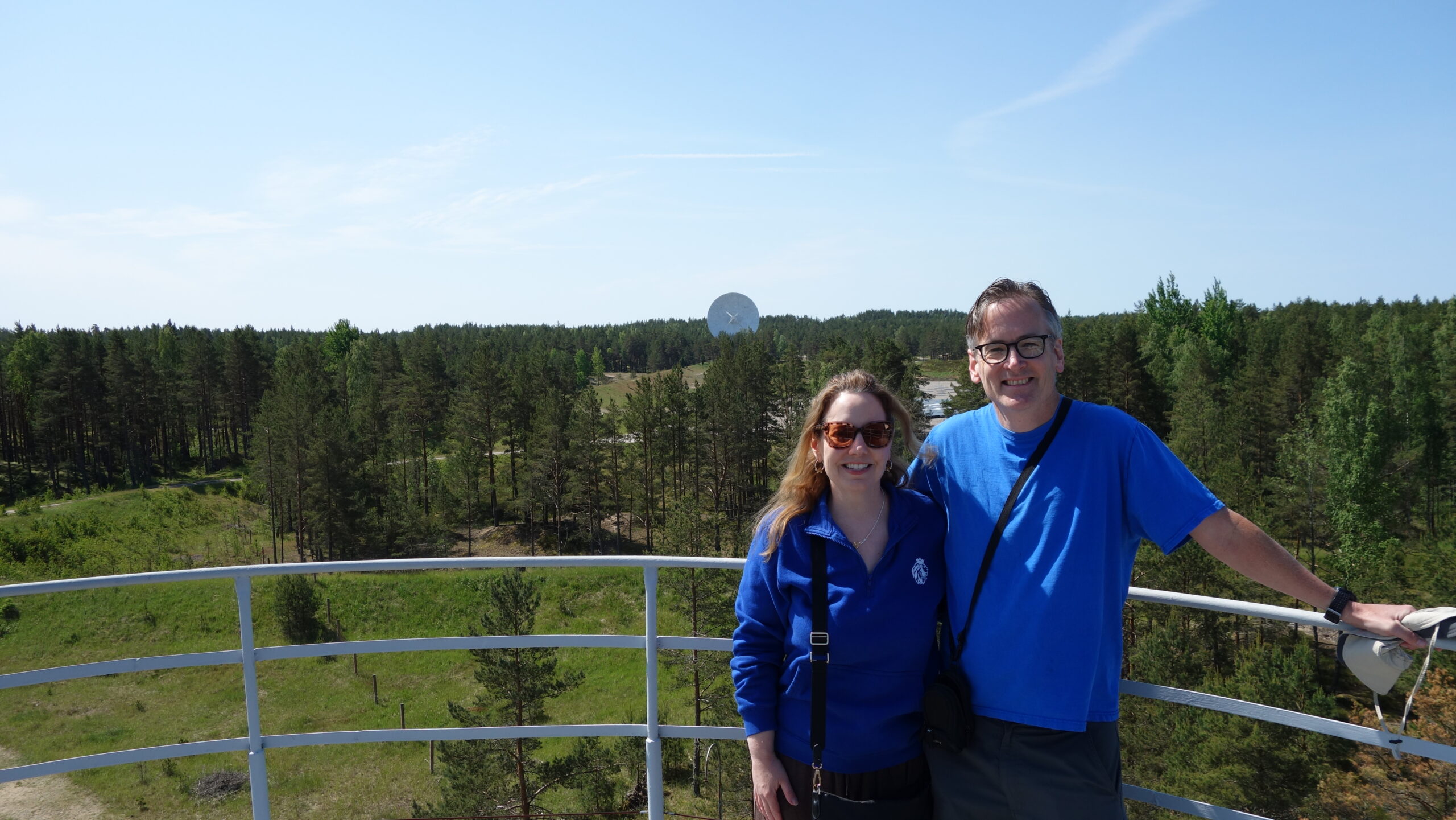
Back in the main tower, we got to go up another ladder-stair, and we headed outside to climb more sketchy ladders to get all the way up to where the old dish had been mounted. It was quite the vantage point. We could see the thirty-two-meter dish and trees as far as we could see. It’s not surprising a spying center ended up in the middle of nowhere.
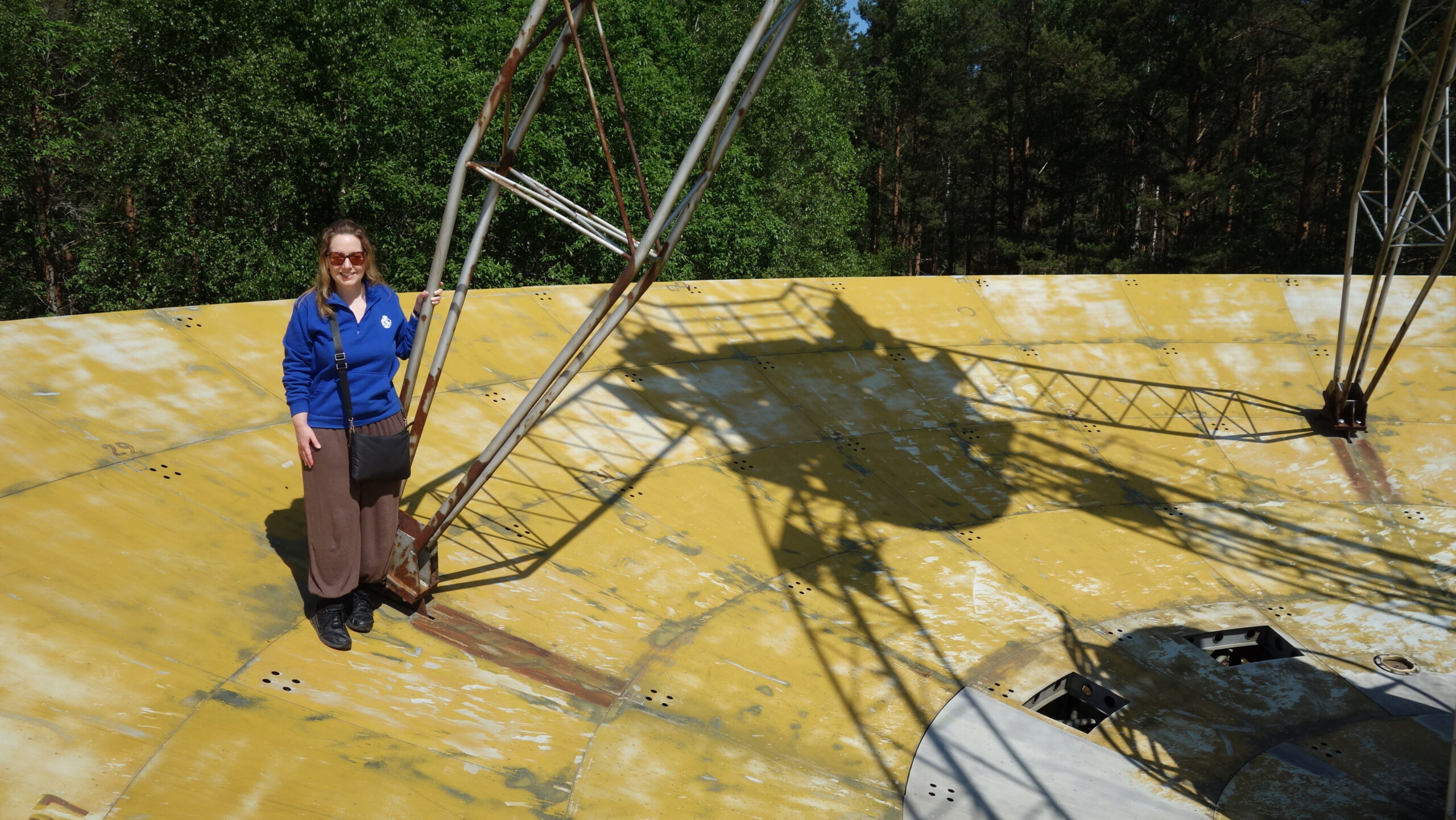
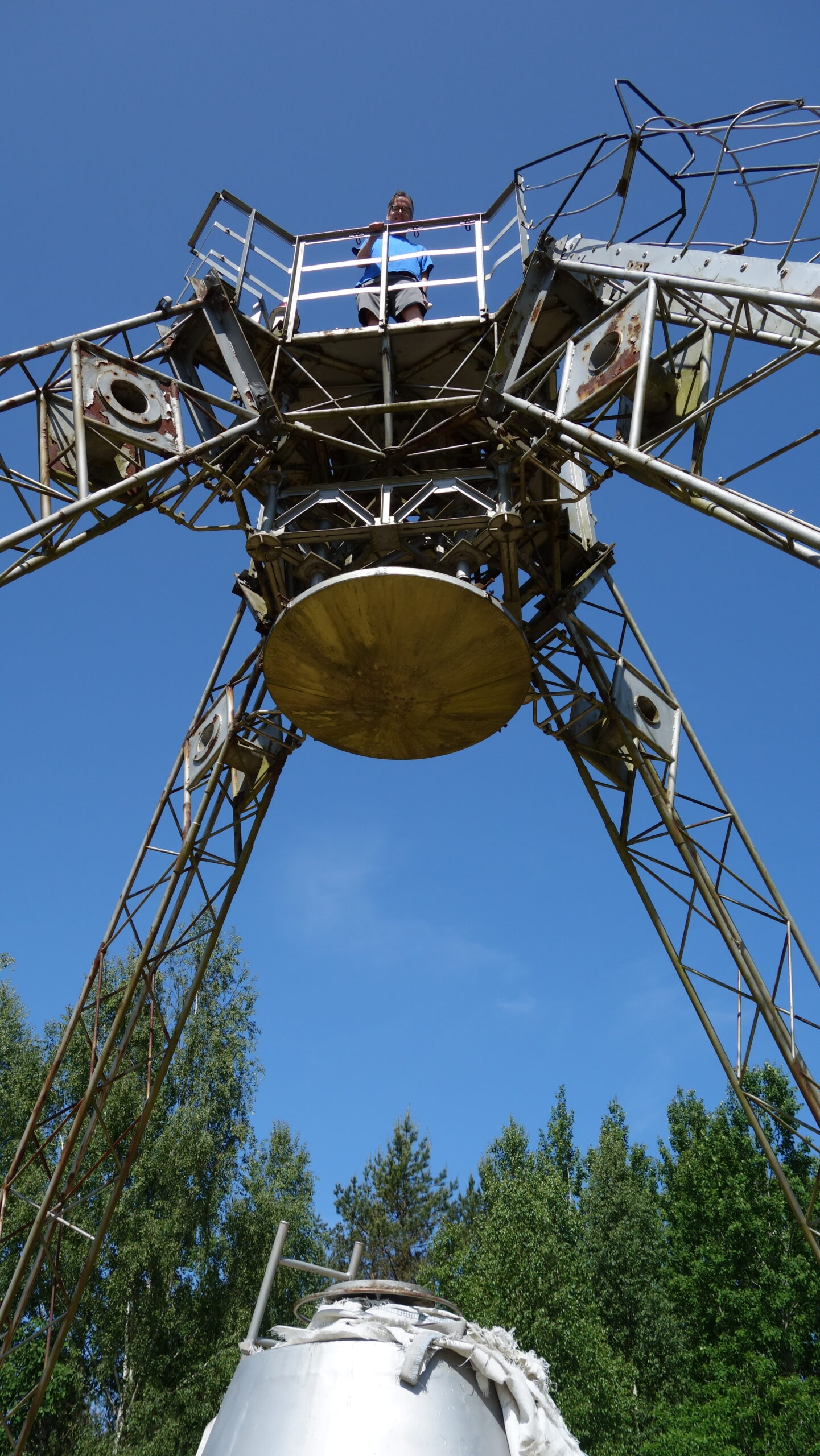
We went back down and outside and walked past a sculpture of Yuri Gagarin (the first man in space) over to the the old original sixteen-meter dish, which was on the ground. Markus told us we could climb up on it. We all clambered up in to the middle of the dish, even with its missing a few small panels. He then said we could climb even higher up to the reflecting mount above the dish, which was not an easy climb. I managed it, and the acoustics up there were incredible. Anything said down into the dish came echoing back to you immediately. I’m pretty sure that liability-conscious American facilities wouldn’t have let us climb all over everything. It was great.
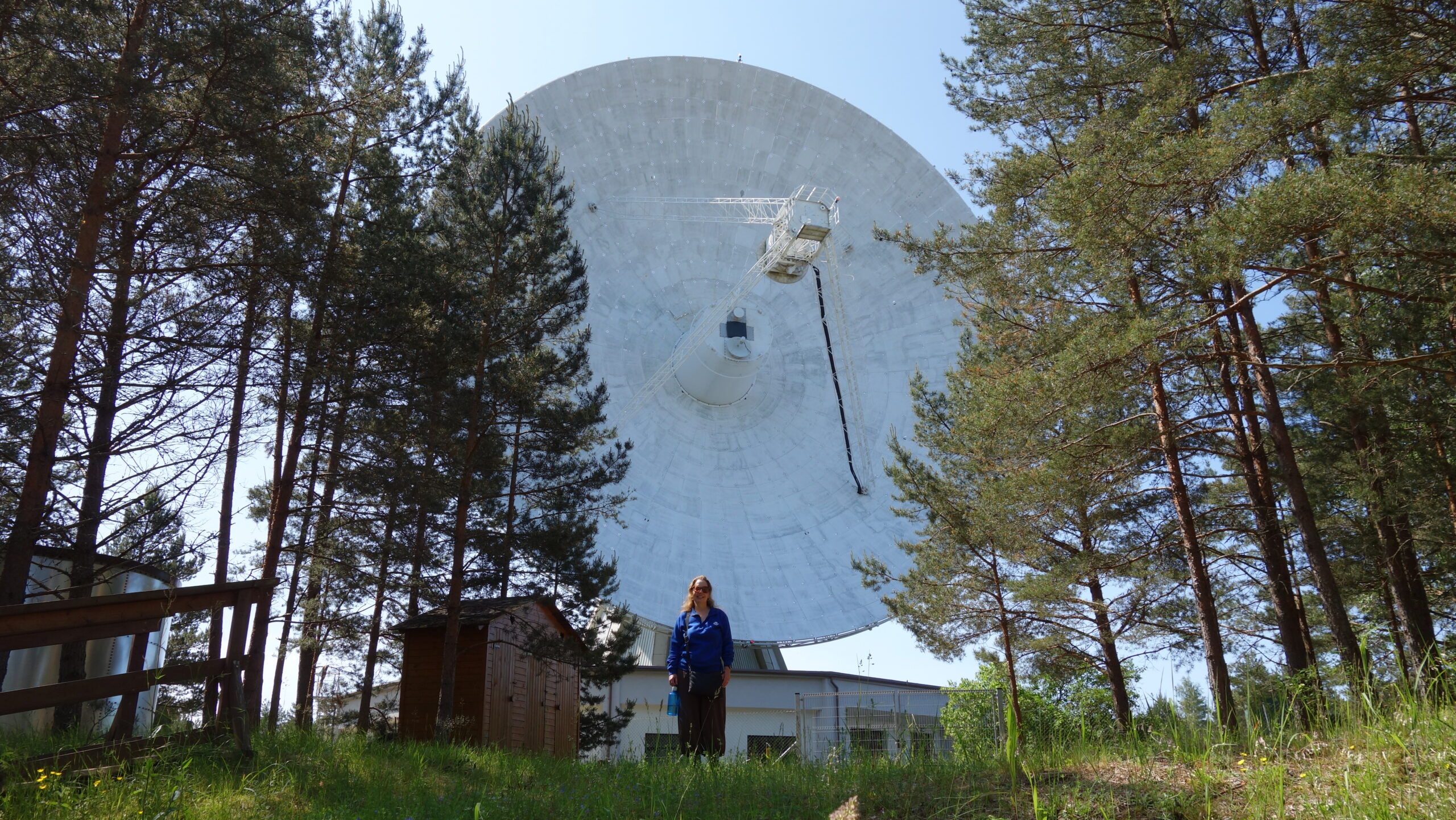 Back on the ground, Markus told us that they had renovated the thirty-two-meter dish about ten years ago, but before the renovation, tours could take people out onto that dish too. What a facility! While we couldn’t go up on the big dish, we could go see it, so Markus led us to an old maintenance tunnel and told us he would meet us on the far end. So I led the way with my cell phone flashlight, followed by Meredith, and then Philip with his cell phone. We walked and walked and walked in the cool, slightly damp tunnel. Someone at some point had made little monster faces on electrical boxes every hundred feet or so, and Philip amused us by telling us the sounds the monsters would make. We also tried turning off our flashlights for a few seconds, and the dark was pretty complete. It turns out the tunnel is 500 meters long (.31 miles). We were walking for quite awhile.
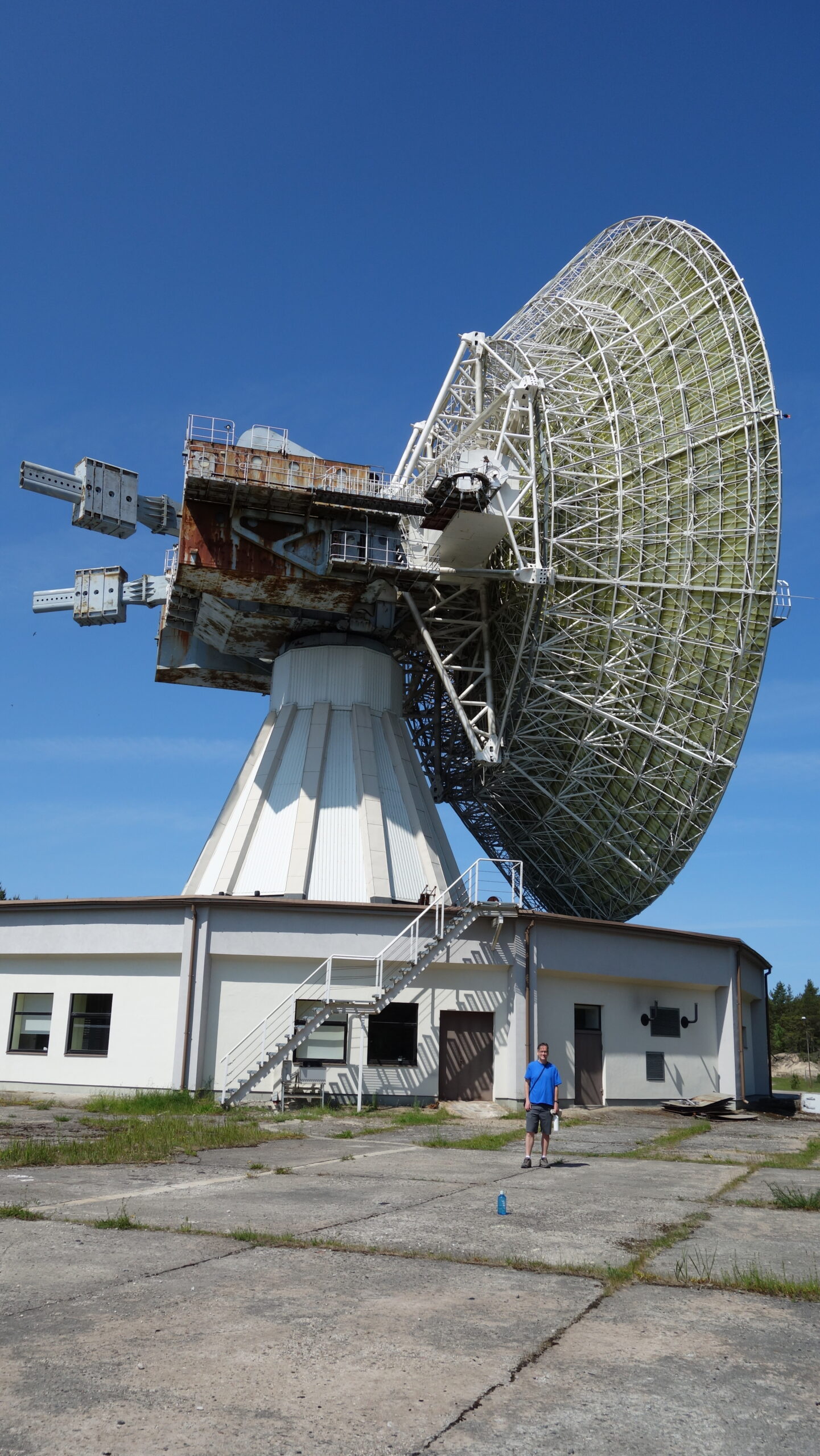 But the tunnel took us to Markus and to the foot of the big dish. We were let in onto the grounds, but were told we had to hang back since people were working. It was a delight to see the dish from the front and from one side, from which we could see the structure that holds the dish up and points it wherever the scientists need it to point.
Understandably, that ended the tour. We went back to the welcome center, where we thanked Markus and said goodbye to Philip. We asked if we could go see the creepy abandoned apartment buildings, and to my surprise, we were told to “go ahead.” So, on the way out, we stopped there.
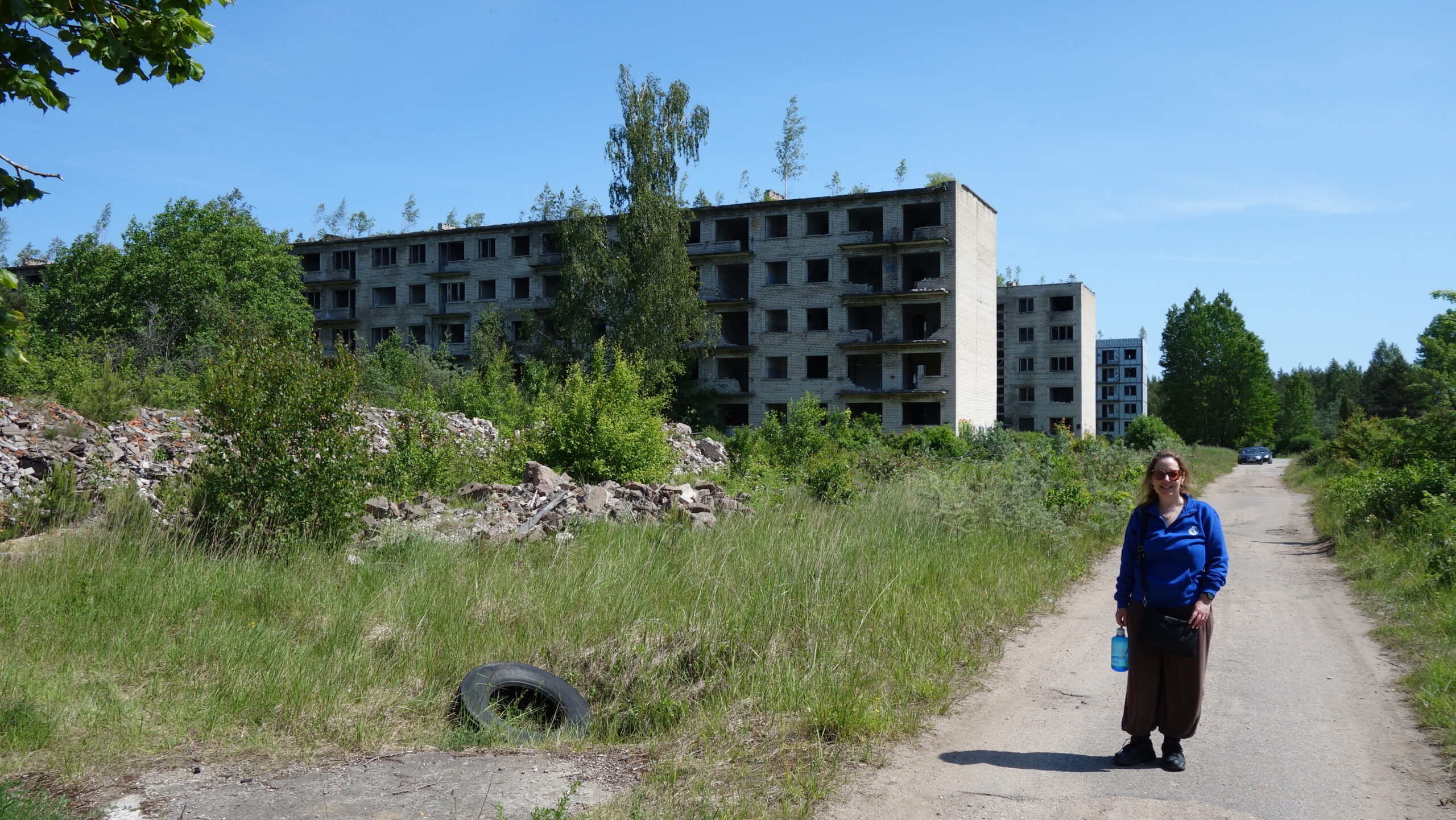 These were buildings that were lived in until 1994, just thirty(ish) years ago, but they are all in ruins. Mer has a strange fascination with abandoned places, so she was delighted. We walked down the old main street, and decided to go into the last building. The last building looked like a shell from the outside, but it was a real wreck on the inside – the main stairway was falling in, there were holes in the floor and in the ceiling up to the second level, and one wing of the building seemed to have had the internal structures all collapse in on themselves. We were very careful and didn’t stay long since I wasn’t sure where the floor might be weak. Mer loved it.
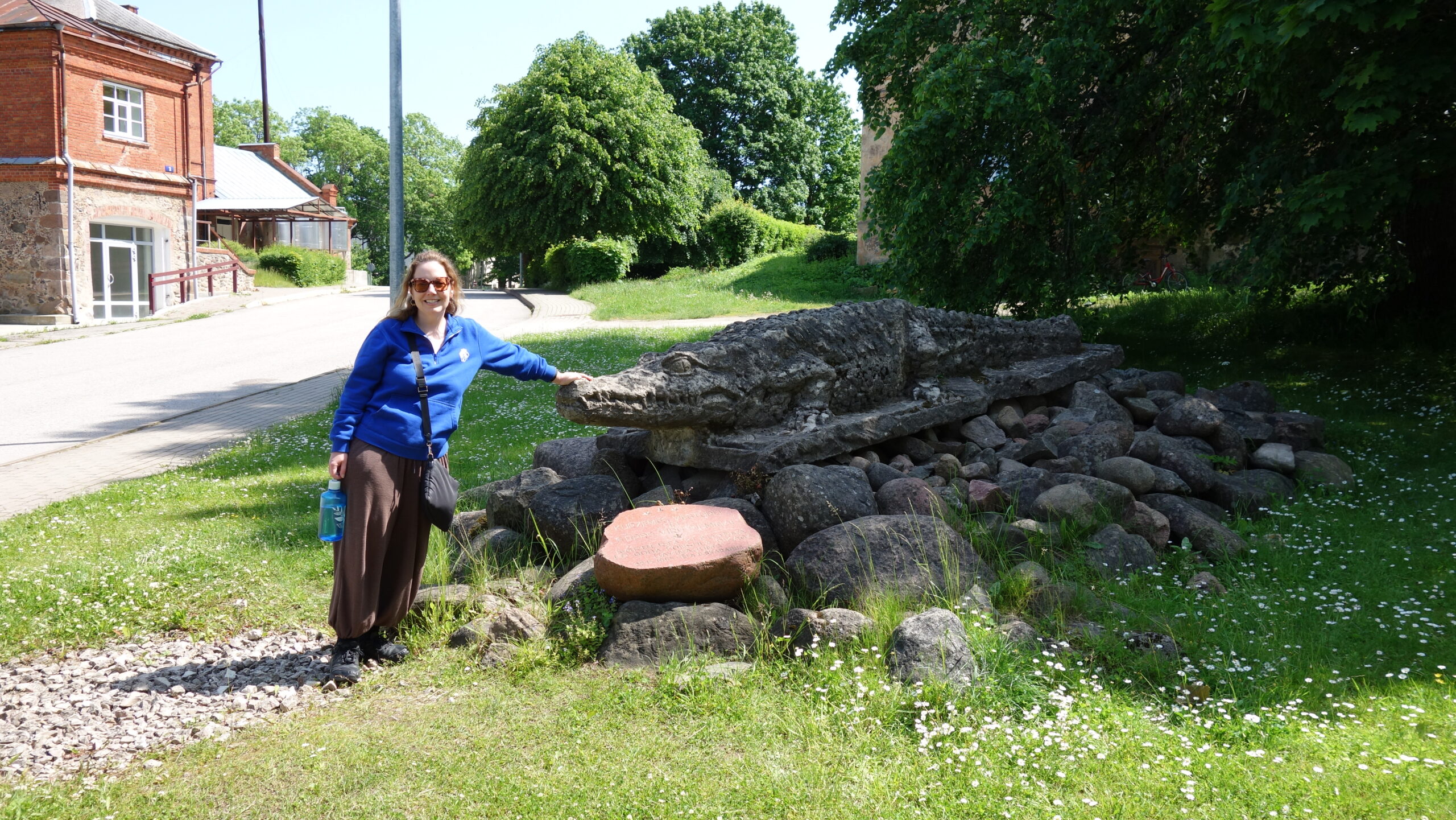
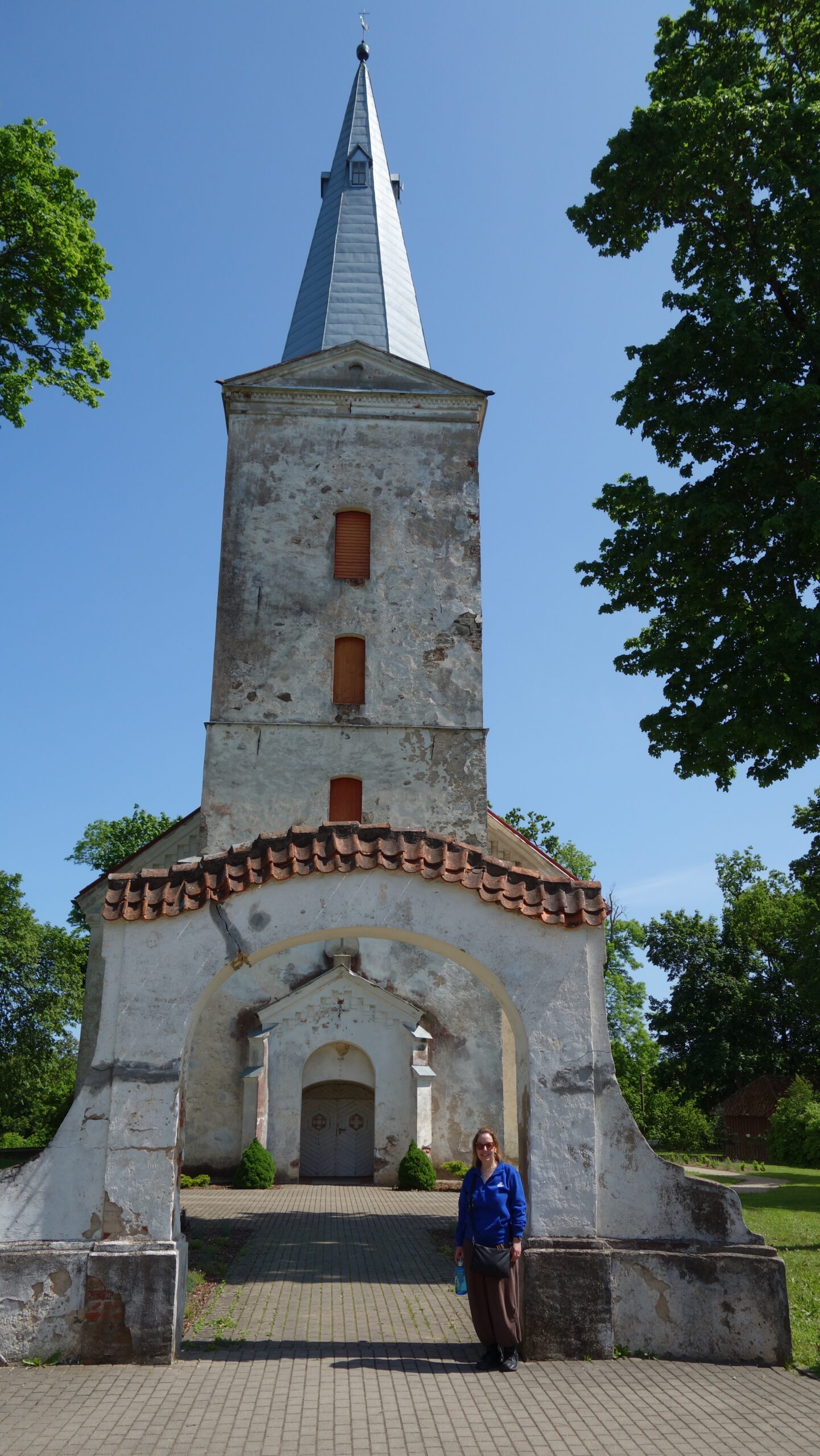 That wrapped up a hugely successful first outing. We then drove east to the town of Dundaga. It looked to be a pretty town with a large park and a lake/lagoon area. Mer was hoping to see inside the town church, which has an elaborately carved altar, but the church was closed by the time we got there (about 1:00 p.m.). We headed down a side road to find a large sculpture of a crocodile. In the middle of a small town in Latvia. It turns out that a man from the town fought in World War II, but ended up on the American side of Germany at the end of the war. If he went home, he risked being arrested by the Soviets, so he moved to Australia instead, where he lived in a cave where he mined opals for his art. As one does. To make a living, he killed about ten thousand crocodiles and sold the skins. This is supposed to be the inspiration for “Crocodile Dundee” and why there is now a sculpture in town (in addition to a modern one near the castle/great house of the town).
After a cafeteria lunch, we toured said castle. The town castle is more of a great house than intimidating fortress, although the original thirteenth=century building did have walls for defense. We got a tour from a young man (late teens?) whose English was very good, but he did say the castle had to be rebuilt after the “first firework and the second firework.” He meant fire, of course, but I didn’t have the heart to correct him.
 The castle now houses the tourist information office, and a small museum, and an after-school program for music and art for the local students. One room of interest was based on the fact that somehow people started sending commemorative medals to the castle at some point, and they now have about a hundred of them. There are medals to Hans Christian Andersen and Goethe and many others from around the world. The contribution from the USA? A medal featuring Richard Nixon. We clearly need to do better.
We got to see all three floors of the house, including some art exhibits of the very talented students, as well as two terraces and the courtyard. It was an interesting tour and good to see a small town try to save its local grand building.
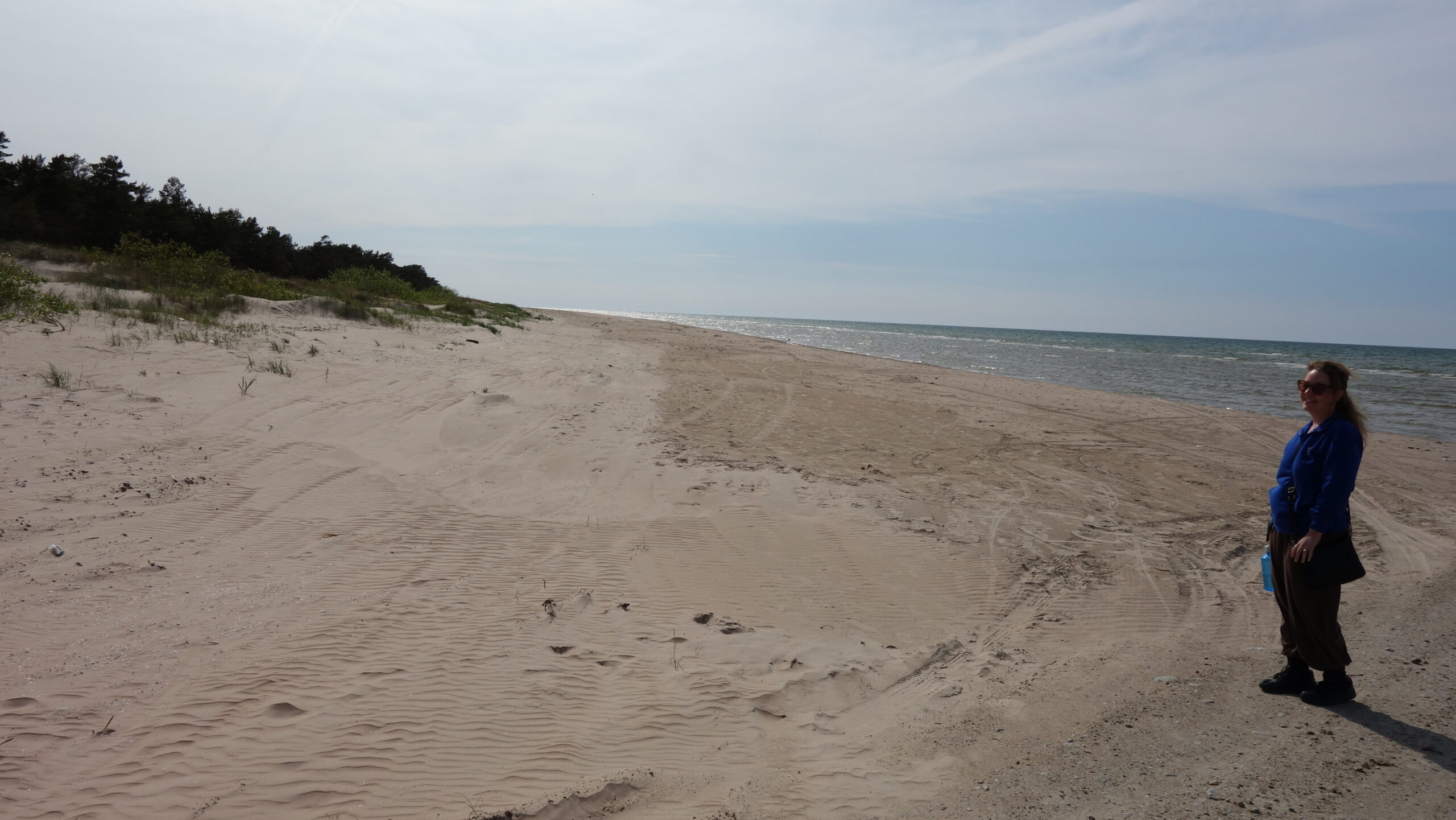 We then drove about twelve miles down a dirt road to go west to get back to the coast on the far side of the peninsula. We tried to find a large dunes area with a boardwalk, but the guidebook was vague, and we never found it. We kept on driving north to Cape Kolka, which is a point where the Gulf of Riga meets the Baltic Sea. We walked along the mostly secluded beach a fair amount, and climbed an observation platform. We tried to hike a pine-tree path, but there were tons of ants everywhere, and one bit my shin, and it actually hurt, so we retreated back to the waterside.
After the Cape, we tried to find the ocean again at a small “village” that was more of a collection of houses that were all posted as private property, so we gave up on that sight.
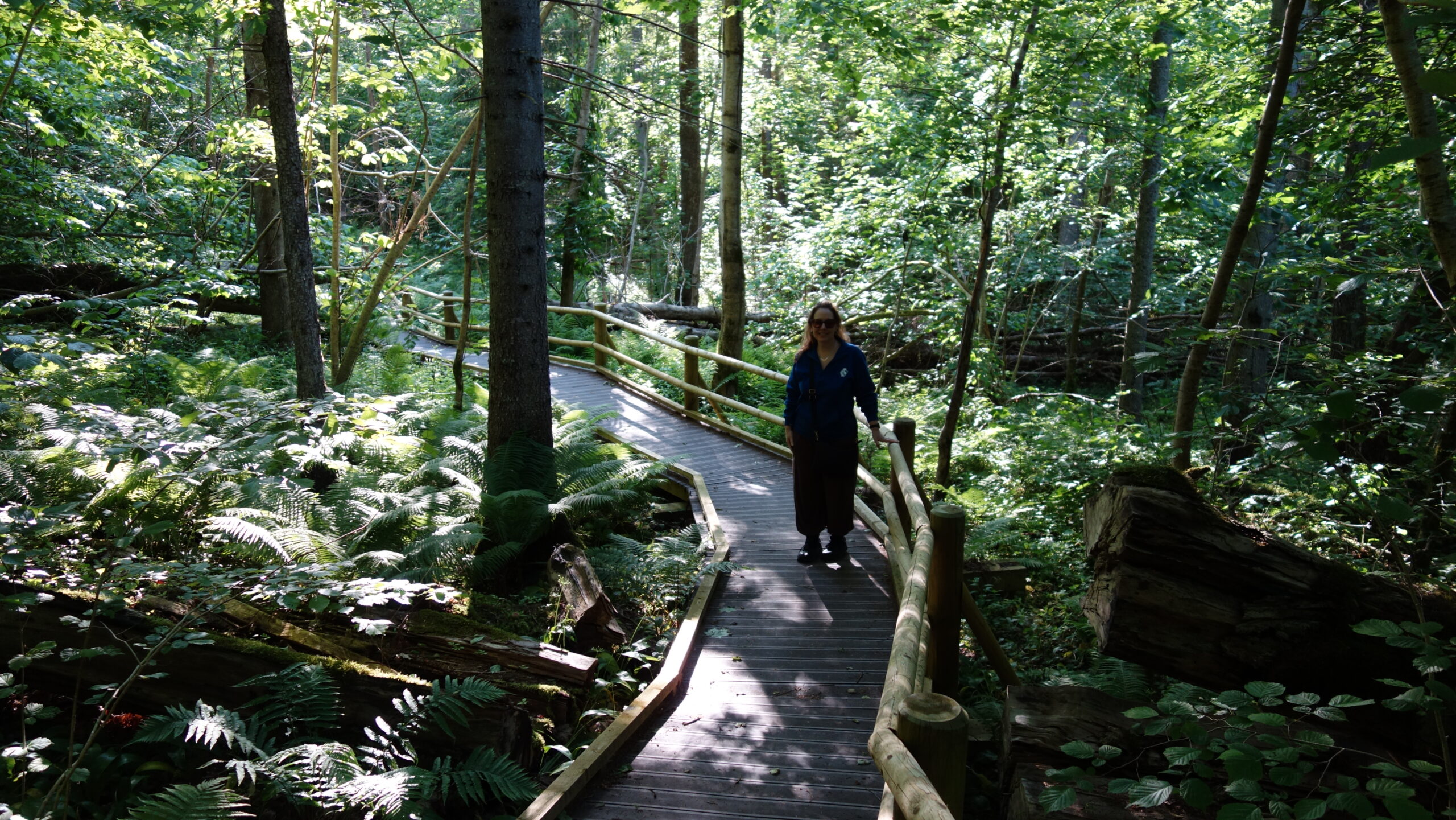 We finished the touring day by going to the area lighthouse. Mer figured that lighthouses are usually in dramatic places, like the ones in Maine. It turns out the Latvians built this lighthouse on the highest ground around, which is a couple of miles inland, in a farmer’s field. That was amusing. There was a hike down the hill on wooden stairs that led to a boardwalk through the forest, and we walked some of that trail. It was completely quiet except for the birdsong all around us. It was very peaceful.
And so we drove back home, where we got a late supper at 9:00. There are some hits and misses when you travel on your own, and while we had two misses today, the three hits more than made up for them.